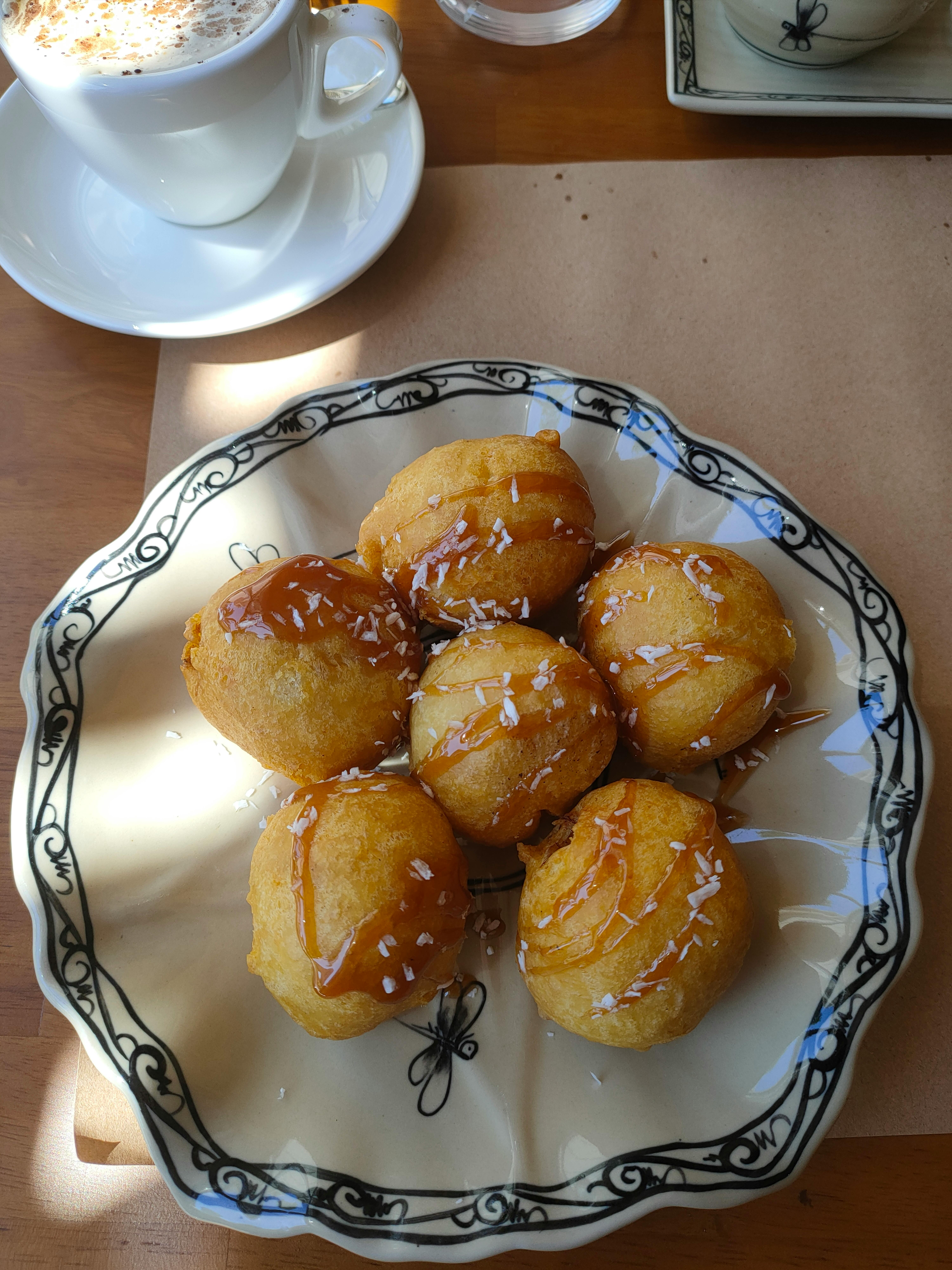
Photo: Valeria Drozdova / Pexels
The diets react (see scores below)
Common Ingredients
- cheese
- cornstarch
- eggs
- sugar
- baking powder
- milk
- oil
Specific recipes may vary.
Incompatible with 8 of 11 diets
Diet Ratings
Colombian buñuelos are fundamentally incompatible with ketogenic eating. The primary structural ingredient is cornstarch, a pure starch with virtually no fiber, delivering extremely high net carbs per serving. Added sugar compounds the issue further. Together, cornstarch and sugar make up the bulk of the carbohydrate load, easily exceeding the entire daily keto carb budget in just a few pieces. While cheese and eggs are keto-friendly, they are minor components that cannot offset the dominant high-carb ingredients. This dish would spike blood glucose and break ketosis.
Colombian buñuelos contain multiple animal-derived ingredients that are categorically excluded from a vegan diet. Cheese (dairy), eggs, and milk are all direct animal products. There is no ambiguity here — this dish is fundamentally incompatible with veganism in its traditional form.
Colombian Buñuelos are fundamentally incompatible with the Paleo diet. The ingredient list contains multiple non-paleo items: cornstarch is a refined grain derivative, cheese and milk are dairy products excluded from strict paleo, sugar is a refined sweetener, baking powder is a processed additive, and the unspecified oil is likely a seed oil. While eggs are paleo-approved, they are the only compliant ingredient in this dish. The combination of dairy, refined starch, refined sugar, and processed additives makes this a clear avoid with no ambiguity in the paleo community.
Colombian buñuelos are deep-fried cheese fritters made primarily from cornstarch (a refined starch with minimal nutritional value), cheese, eggs, sugar, and oil used for deep-frying. This combination runs counter to Mediterranean diet principles on multiple fronts: cornstarch is a refined grain with no fiber or whole grain benefit, deep-frying in unspecified oil (not extra virgin olive oil) adds unhealthy oxidized fats, sugar is an added simple sugar, and the dish is a processed snack with no vegetable, legume, or whole grain component. While cheese and eggs are acceptable in moderation, they are not the issue — the overall profile of a deep-fried, starch-and-sugar-heavy snack firmly places this in the 'avoid' category.
Buñuelos are fundamentally incompatible with the carnivore diet. While cheese, eggs, and milk are animal-derived ingredients, the dish is dominated by plant-based components: cornstarch (a grain-derived starch), sugar (processed plant carbohydrate), and baking powder (plant-derived leavening agent), plus oil (likely plant-based). The cornstarch alone is a disqualifying grain product, and sugar is explicitly excluded from all carnivore tiers. This is a fried dough-style snack — essentially a carbohydrate-based food with cheese mixed in, not an animal product with minor additives. No carnivore practitioner, including the most lenient 'animal-based' advocates, would sanction this dish.
Colombian Buñuelos contain multiple Whole30-excluded ingredients. Cornstarch is explicitly excluded under Whole30 rules. Sugar (added sugar) is excluded. Milk/dairy (other than ghee/clarified butter) is excluded. Cheese is a dairy product and therefore excluded. Additionally, even if all ingredients were compliant, Buñuelos are a fried dough/fritter — a baked good or junk food analog that falls squarely into the category of foods Whole30 prohibits recreating (rule 4). This dish fails on multiple counts.
Colombian buñuelos are primarily made with fresh white cheese (queso blanco or quesillo), cornstarch, eggs, sugar, baking powder, milk, and oil. The main FODMAP concerns are: (1) Cheese — the type matters critically. Fresh Colombian cheeses like queso blanco are typically high in lactose, unlike aged hard cheeses which are low-FODMAP. This is the primary concern. (2) Milk — adds lactose load. Even small amounts of milk combined with high-lactose fresh cheese can push the total lactose content into high-FODMAP territory. (3) Cornstarch — low-FODMAP and safe. (4) Eggs — low-FODMAP and safe. (5) Sugar — low-FODMAP in typical amounts. (6) Baking powder — generally low-FODMAP. (7) Oil — low-FODMAP. The dish could theoretically be made low-FODMAP by substituting lactose-free milk and a low-FODMAP cheese, but as traditionally prepared with fresh Colombian white cheese and milk, the combined lactose burden is a meaningful concern during the elimination phase. Portion size matters significantly — one small buñuelo may be tolerable for some, but multiple pieces would increase lactose intake substantially.
Monash University has not specifically tested Colombian buñuelos, and the FODMAP status hinges heavily on the specific cheese used. Clinical FODMAP practitioners would likely advise avoiding traditional preparations during elimination due to the high-lactose fresh cheese and milk combination, even if individual ingredients in very small amounts might fall below threshold.
Colombian buñuelos are deep-fried cheese fritters that conflict with multiple core DASH diet principles simultaneously. The dish is deep-fried in oil, significantly increasing total fat and potentially saturated/trans fat content depending on the frying oil used. The cheese base contributes substantial sodium and saturated fat. Added sugar, while modest, adds empty calories. The cornstarch base provides refined starch with minimal fiber, potassium, magnesium, or calcium relative to the caloric load. As a deep-fried, cheese-heavy, refined-starch snack with negligible vegetables, whole grains, or DASH-friendly nutrients, this food sits firmly outside DASH dietary guidelines. It fails on sodium (from cheese), saturated fat (from cheese and frying), refined carbohydrates (cornstarch), and caloric density.
Colombian buñuelos are deep-fried cheese fritters made primarily from cornstarch, cheese, eggs, sugar, milk, and oil. From a Zone perspective, this dish presents multiple challenges. The primary carbohydrate source is cornstarch — a high-glycemic, refined starch with minimal fiber, making it an 'unfavorable' Zone carb that spikes insulin rapidly. The addition of sugar compounds the glycemic load further. The fat profile is problematic: frying in oil (likely a refined seed/vegetable oil high in omega-6s) directly conflicts with Zone's anti-inflammatory fat priorities. Cheese provides some protein and fat but is a source of saturated fat rather than the lean protein Zone favors. The macronutrient ratio is heavily skewed toward carbohydrates and fat, with insufficient lean protein to achieve anything near the 40/30/30 target. As a snack, buñuelos offer no meaningful vegetable content, no omega-3s, and no polyphenols. While small portions could theoretically be incorporated as an 'unfavorable' carb block alongside lean protein and monounsaturated fat in a broader meal context, the food itself — as a standalone snack — is nearly impossible to Zone-balance without radical reformulation. It scores low-caution rather than 'avoid' only because it contains eggs and cheese (real food proteins/fats) rather than being pure sugar or candy.
Colombian buñuelos are deep-fried cheese fritters made primarily from cornstarch, cheese, eggs, sugar, milk, and baking powder. From an anti-inflammatory perspective, this dish has several concerning properties. Cornstarch is a refined carbohydrate with a very high glycemic index, and deep-frying in oil (likely refined vegetable or seed oil) introduces oxidized fats and excess omega-6 fatty acids. The added sugar, while modest in amount, contributes to glycemic load. Full-fat cheese contributes saturated fat, which is flagged as a 'limit' category in anti-inflammatory guidelines. The frying process itself can generate advanced glycation end-products (AGEs), which are associated with increased inflammatory markers. On the positive side, eggs contribute some anti-inflammatory nutrients (choline, selenium), and cheese provides protein and calcium. However, the overall profile — refined starch base, deep-fried, added sugar, saturated fat from cheese — tilts this firmly toward the pro-inflammatory end of the 'caution' range. This is an occasional indulgence at best within an anti-inflammatory dietary pattern.
Colombian buñuelos are deep-fried cheese fritters made primarily from cornstarch, cheese, eggs, sugar, and milk. The combination of deep frying, refined starch as the base, and added sugar makes this a poor fit for GLP-1 patients on multiple dimensions. Cornstarch dominates the carbohydrate profile with negligible fiber, offering almost no nutritional value per calorie. The frying process saturates the food in oil, dramatically increasing fat content and making it difficult to digest given GLP-1-slowed gastric emptying — a near-guaranteed trigger for nausea, bloating, and reflux. While cheese and eggs contribute some protein, the total protein yield per serving is low relative to the calorie load, and the fat-to-protein ratio is unfavorable. The added sugar, though modest, further reduces nutrient density. This is exactly the type of fried, starchy, high-fat, low-fiber snack that GLP-1 clinical guidance consistently flags as problematic.
*See how scores were generated at our methodology page.
Nutritional profile
Six traits that cut across every diet.
Fiber & Plants
How much whole-plant food and fiber it delivers.
Healthy Fats
The quality of its fats (unsaturated, omega-3).
Whole / Unprocessed
How close it is to its natural, unprocessed form.
Gut Gentle
How easy it is on digestion (low FODMAP, few irritants).
Low Glycemic
How little it spikes your blood sugar.
Protein Density
How much protein it packs per calorie.
Controversy Index
Higher controversy = more disagreement between diets.
Diet-Specific Tips
 Low-FODMAP — 5/10
View tips
- Fresh Colombian white cheese (queso blanco/quesillo) is high in lactose — a significant FODMAP concern
- Milk adds additional lactose, compounding the total FODMAP load
- Cornstarch is the base starch and is low-FODMAP — a positive factor
- Eggs, sugar, oil, and baking powder are all low-FODMAP
- No wheat/gluten ingredients — no fructan concern
- Lactose burden from combined cheese + milk is the primary disqualifier during strict elimination
- Could be modified with lactose-free milk and lactose-free or aged hard cheese to become low-FODMAP
 Zone — 5/10
View tips
- Cornstarch is a high-glycemic refined carbohydrate — classified 'unfavorable' in Zone terminology
- Added sugar increases glycemic load further, worsening insulin response
- Deep-frying in seed/vegetable oil introduces pro-inflammatory omega-6 fats, contrary to Zone anti-inflammatory principles
- Saturated fat from cheese is not the preferred monounsaturated fat source Zone recommends
- Macronutrient ratio is skewed heavily toward carbs and fat with insufficient lean protein
- No vegetables, fiber, omega-3s, or polyphenols — nutritionally empty from a Zone standpoint
- Cheese and eggs provide some real food protein/fat, preventing a full 'avoid' classification
 Anti-Inflammatory — 5/10
View tips
- Cornstarch is a refined, high-glycemic carbohydrate with no fiber or significant micronutrients
- Deep-fried preparation introduces oxidized fats and likely high omega-6 seed oils
- Added sugar increases glycemic load and inflammatory potential
- Full-fat cheese contributes saturated fat (a 'limit' category)
- Deep-frying generates pro-inflammatory advanced glycation end-products (AGEs)
- Eggs offer modest anti-inflammatory nutrients (choline, selenium) but don't offset overall profile
- No anti-inflammatory star ingredients (no omega-3s, antioxidants, polyphenols, fiber, or herbs/spices)