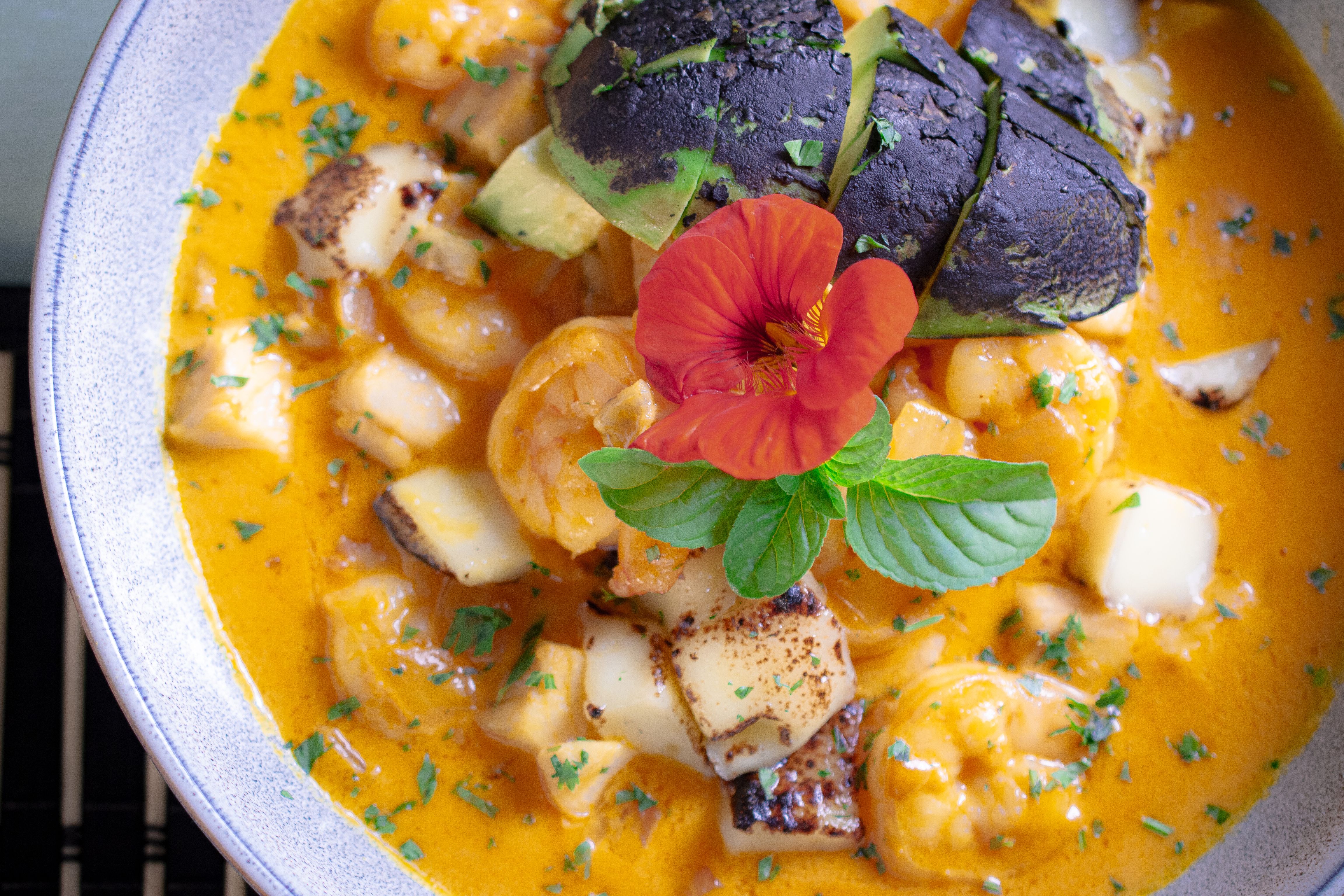
Photo: Fabiola Angulo Mejía / Pexels
Colombian
Cazuela de Mariscos
The diets react (see scores below)
Common Ingredients
- shrimp
- squid
- fish
- coconut milk
- bell pepper
- onion
- tomato
- garlic
- cream
- cilantro
Specific recipes may vary.
Incompatible with 5 of 11 diets
Diet Ratings
Cazuela de Mariscos is fundamentally keto-friendly in its protein and fat sources — shrimp, squid, and fish are lean but low-carb proteins, while coconut milk and cream provide healthy fats. The vegetables (bell pepper, onion, tomato, garlic) are the main concern: onion and tomato contribute moderate net carbs, and bell pepper adds a small amount. In a standard Colombian serving, the cumulative carb load from these vegetables, plus natural sugars in coconut milk and tomatoes, could push net carbs to roughly 10–15g per bowl, making it manageable within a daily keto budget but requiring portion discipline. The dish contains no grains, added sugars, or starches, making it structurally compatible with keto. The fat content from coconut milk and cream is a positive keto attribute.
Some strict keto practitioners flag full-fat coconut milk for its moderate carb content (~3–4g net per 100ml) and the cumulative effect of tomato and onion, arguing that repeated consumption of such dishes can crowd out carb allowance and displace higher-fat, lower-carb options. Carnivore-adjacent keto adherents may also object to the vegetable base entirely.
Cazuela de Mariscos is a Colombian seafood stew containing multiple animal products: shrimp, squid, and fish are all sea animals excluded under vegan dietary rules. Additionally, cream is a dairy product, making this dish doubly non-vegan. There is no ambiguity here — this dish is fundamentally built on animal-derived ingredients and is entirely incompatible with a vegan diet.
Cazuela de Mariscos is disqualified primarily by one ingredient: cream. Cream is a dairy product and is explicitly excluded from the paleo diet. The seafood base (shrimp, squid, fish) is excellent from a paleo standpoint, and the vegetables (bell pepper, onion, tomato, garlic, cilantro) are all fully approved. Coconut milk is a paleo-approved ingredient and would be an ideal substitute for the cream. However, as listed, the presence of cream renders this dish non-compliant. With a simple swap of cream for additional coconut milk, this dish would score an 8-9 and earn a strong approve.
Cazuela de Mariscos features an excellent Mediterranean-aligned protein base — shrimp, squid, and fish are all strongly encouraged seafood sources. The vegetable components (bell pepper, onion, tomato, garlic, cilantro) are fully consistent with Mediterranean principles. However, the dish diverges from Mediterranean tradition in two key ways: (1) coconut milk is not a traditional Mediterranean fat source, replacing the canonical extra virgin olive oil as the primary fat and flavor base; and (2) cream adds saturated fat in a way that conflicts with Mediterranean dietary patterns. These two ingredients together shift the dish from a Mediterranean-ideal seafood stew toward a richer, dairy/tropical-fat preparation. The dish is not 'avoid' territory because the seafood and vegetable foundation remains strong, but the fat profile requires a caution rating.
Some modern Mediterranean diet interpreters might view coconut milk as an acceptable plant-based fat, and the abundant seafood content could elevate the score closer to approval. Traditional coastal Mediterranean fish stews (e.g., bouillabaisse, cacciucco) do use cream sparingly in some regional variants, suggesting this dish could be adapted rather than avoided outright.
Cazuela de Mariscos contains multiple plant-derived ingredients that are explicitly excluded from the carnivore diet. While the seafood base (shrimp, squid, fish) is fully carnivore-approved, the dish is built around coconut milk (plant fat), bell pepper, onion, tomato, garlic, and cilantro — all plant foods that violate the core carnivore rule of eating exclusively animal products. Cream is the only borderline-acceptable ingredient (dairy, debated). The plant components are not incidental traces but foundational to the dish's flavor profile and liquid base, making this fundamentally incompatible with carnivore eating. This is not a dish that can be 'modified' — its identity depends on the plant ingredients.
Cazuela de Mariscos as listed contains cream, which is a dairy product explicitly excluded on the Whole30. While shrimp, squid, fish, coconut milk, bell pepper, onion, tomato, garlic, and cilantro are all fully compliant ingredients, the inclusion of cream disqualifies the dish. If cream were replaced or omitted, the dish could be made Whole30-compliant using only coconut milk as the creamy base.
Cazuela de Mariscos contains multiple high-FODMAP ingredients that make it unsuitable during the elimination phase. Garlic is one of the highest-FODMAP foods tested by Monash University, containing significant fructans even in very small amounts. Onion is similarly a major fructan source and is high-FODMAP at any reasonable culinary quantity. Cream is high in lactose and problematic at typical serving sizes. While the seafood components (shrimp, squid, fish) are all low-FODMAP, and bell pepper, tomato, and cilantro are generally low-FODMAP, the presence of garlic and onion alone would classify this dish as high-FODMAP. The combination of garlic, onion, and cream creates a triple FODMAP burden (fructans + lactose) that cannot be mitigated by portion control when these are used as core flavoring ingredients in a soup base. Coconut milk is low-FODMAP at 1/2 cup but can become high-FODMAP at larger quantities depending on concentration in the dish.
Cazuela de Mariscos contains several DASH-positive elements — lean seafood proteins (shrimp, squid, fish) rich in potassium and magnesium, and DASH-approved vegetables (bell pepper, onion, tomato, garlic, cilantro). However, two ingredients significantly conflict with DASH guidelines: coconut milk and cream. Both are high in saturated fat, and coconut milk is specifically flagged by NIH DASH guidelines as a tropical oil product to limit. The combination of coconut milk and cream substantially increases saturated fat content per serving, moving this dish from 'approve' territory into 'caution.' Additionally, shrimp is moderately high in dietary cholesterol and sodium naturally, and restaurant or traditional preparations often add salt, potentially pushing sodium levels toward or past DASH thresholds. The dish is not categorically avoided because the seafood base and vegetable content are genuinely DASH-compatible; portion control and preparation modifications (substituting light coconut milk, omitting or reducing cream) could make this more DASH-friendly.
NIH DASH guidelines explicitly limit saturated fat and tropical oils including coconut milk, placing this dish firmly in 'caution.' However, some updated DASH-oriented clinicians note that recent meta-analyses on full-fat dairy and coconut milk suggest that saturated fat from these sources may not uniformly worsen cardiovascular outcomes, and emphasize that the omega-3-rich seafood base provides meaningful cardiovascular benefit that partially offsets the saturated fat concerns.
Cazuela de Mariscos has a genuinely mixed Zone profile. The proteins — shrimp, squid, and fish — are excellent lean Zone protein sources, rich in omega-3s and aligning well with Sears' anti-inflammatory focus. The vegetables (bell pepper, onion, tomato, garlic, cilantro) are favorable low-glycemic Zone carbs that contribute polyphenols. However, the fat profile is problematic: coconut milk is high in saturated fat (lauric acid), and heavy cream adds additional saturated fat, creating a fat block that skews heavily saturated rather than monounsaturated. This conflicts with Zone's emphasis on monounsaturated fats (olive oil, avocado, almonds). The dish also lacks a significant carbohydrate component beyond the vegetables, which could make balancing the 40/30/30 ratio difficult without adding more low-GI carbs on the side. The overall caloric density from the coconut milk and cream means portions need careful control to avoid fat overconsumption. As a restaurant or home dish, the fat content likely exceeds Zone's 10-15g per meal guideline significantly. It can work in Zone with portion reduction of the coconut milk/cream components, but as typically prepared it requires meaningful modification or careful restraint.
Some Zone practitioners following Sears' later anti-inflammatory writings (notably 'The Zone Diet and Its Application' and his omega-3/polyphenol work) would note that coconut milk's medium-chain triglycerides (MCTs) are metabolized differently than long-chain saturated fats and may not be as inflammatory as traditional saturated fats. In this view, a small serving of Cazuela de Mariscos could be considered more acceptable, particularly given the strong omega-3 profile of the seafood. Conversely, strict early-Zone followers using 'Enter the Zone' would flag the coconut milk and cream more harshly, potentially pushing this toward a lower score.
Cazuela de Mariscos is a Colombian seafood stew with a genuinely mixed anti-inflammatory profile. On the positive side, it contains multiple excellent anti-inflammatory ingredients: shrimp, squid, and fish are lean seafood proteins that provide omega-3 fatty acids (especially if the fish is a fatty variety like snapper or sea bass), and all three are far preferable to red meat. Garlic, onion, tomato, bell pepper, and cilantro are all antioxidant-rich vegetables with meaningful anti-inflammatory polyphenols — garlic in particular contains allicin, which has well-documented anti-inflammatory properties. The aromatic vegetable base is a strong positive. The problematic elements are coconut milk and cream used together. Coconut milk contains medium-chain triglycerides (MCTs) and is debated in anti-inflammatory circles — its saturated fat content (primarily lauric acid) is viewed negatively by some authorities but more neutrally or even positively by others. The addition of heavy cream is the clearest concern: full-fat dairy cream is a source of saturated fat that most anti-inflammatory protocols place in the 'limit' category. A traditional cazuela often uses one or the other, but the combination of both pushes the saturated fat load higher. The dish lacks strongly emphasized anti-inflammatory ingredients like extra virgin olive oil, turmeric, or ginger, and the cream specifically conflicts with anti-inflammatory guidelines. Overall, the seafood and vegetable base earns points, but the cream drags the score down to the caution range.
Dr. Andrew Weil's anti-inflammatory framework permits moderate full-fat dairy use and recognizes seafood-heavy dishes as broadly beneficial, which could push this dish toward a low 'approve' for someone prioritizing the omega-3-rich seafood base. Conversely, stricter anti-inflammatory practitioners (and AIP-adjacent protocols) would flag both the saturated fat from cream and the coconut milk's lauric acid load as pro-inflammatory triggers, potentially scoring this lower.
Cazuela de Mariscos offers a meaningful protein base from shrimp, squid, and fish — all lean, easily digestible seafood sources that align well with GLP-1 dietary priorities. However, the combination of full-fat coconut milk and cream creates a high saturated fat load per serving that conflicts with GLP-1 guideline rule #3. Slowed gastric emptying on GLP-1 medications means high-fat, rich broths linger longer in the stomach and significantly increase the risk of nausea, bloating, and reflux. The vegetable ingredients (bell pepper, onion, tomato, garlic, cilantro) add modest fiber and micronutrients, supporting nutrient density. The soup format is portion-friendly and hydrating, which are positives. The dish is not fried, not spicy, and not ultra-processed, which keeps it out of the avoid category. The primary concern is the fat content from the dairy-coconut base — in a standard Colombian restaurant preparation, this is typically quite rich. A modified version using light coconut milk and omitting or reducing the cream would score significantly higher (7-8). As prepared traditionally, the fat content is the limiting factor.
Some GLP-1-focused registered dietitians consider seafood stews acceptable even with coconut milk bases, arguing that the lean protein quality and soup format outweigh the fat concern — particularly for patients who tolerate dietary fat without significant GI side effects. Others in the obesity medicine community flag full-fat coconut milk and added cream as a consistent nausea trigger in GLP-1 patients and advise avoidance of cream-based soups regardless of protein content.
*See how scores were generated at our methodology page.
Nutritional profile
Six traits that cut across every diet.
Fiber & Plants
How much whole-plant food and fiber it delivers.
Healthy Fats
The quality of its fats (unsaturated, omega-3).
Whole / Unprocessed
How close it is to its natural, unprocessed form.
Gut Gentle
How easy it is on digestion (low FODMAP, few irritants).
Low Glycemic
How little it spikes your blood sugar.
Protein Density
How much protein it packs per calorie.
Controversy Index
Higher controversy = more disagreement between diets.
Diet-Specific Tips
 Keto — 6/10
View tips
- Shrimp, squid, and fish are low-carb, high-quality proteins — keto compatible
- Coconut milk and cream provide significant fat content, aligning with keto macros
- Onion, tomato, and bell pepper add moderate net carbs (~10–15g per serving estimated)
- No grains, starches, or added sugars in the ingredient list
- Portion size is critical — a large bowl could approach or exceed 20g net carbs
- Coconut milk contains natural sugars (~3–4g net carbs per 100ml) that accumulate
 Mediterranean — 5/10
View tips
- Excellent seafood variety (shrimp, squid, fish) aligns strongly with Mediterranean protein guidelines
- Coconut milk is not a traditional Mediterranean fat and replaces olive oil as the primary fat source
- Cream adds saturated fat inconsistent with Mediterranean principles
- Vegetables (bell pepper, onion, tomato, garlic, cilantro) are fully Mediterranean-compatible
- Dish could be made more Mediterranean by substituting olive oil-based broth for coconut milk and cream
- No red meat, processed ingredients, or refined grains present
 DASH — 4/10
View tips
- Coconut milk is a tropical oil product high in saturated fat, explicitly limited by DASH guidelines
- Cream adds additional saturated fat, compounding cardiovascular concerns
- Shrimp, squid, and fish are lean DASH-approved protein sources rich in potassium and magnesium
- Bell pepper, onion, tomato, and garlic are core DASH vegetables contributing fiber and micronutrients
- Sodium content may be elevated depending on preparation and added salt
- Dish can be modified toward DASH compliance by substituting light coconut milk and eliminating cream
 Zone — 5/10
View tips
- Shrimp, squid, and fish are excellent lean Zone proteins with anti-inflammatory omega-3 content
- Bell pepper, onion, tomato, and garlic are favorable low-glycemic Zone carbohydrates
- Coconut milk is high in saturated fat, conflicting with Zone's monounsaturated fat preference
- Heavy cream adds additional saturated fat, likely pushing fat content well above 10-15g/meal target
- Dish is carbohydrate-light relative to Zone's 40% carb target — would need side carbs to balance
- No high-glycemic carbs or refined sugars present, which is a positive
- Strong anti-inflammatory potential from seafood omega-3s and polyphenol-rich vegetables partially offsets fat concerns
- Portion control of cream and coconut milk is essential for any Zone compatibility
 Anti-Inflammatory — 5/10
View tips
- Shrimp, squid, and fish provide lean protein and omega-3 fatty acids — strong anti-inflammatory positives
- Garlic, onion, tomato, bell pepper, and cilantro contribute antioxidants and polyphenols
- Heavy cream is a full-fat dairy product high in saturated fat — flagged as 'limit' in anti-inflammatory guidelines
- Coconut milk adds additional saturated fat; its anti-inflammatory status is debated
- No strongly emphasized anti-inflammatory additions (e.g., turmeric, EVOO, ginger)
- Overall dish is nutrient-dense seafood stew undermined by a high saturated fat dairy component
 GLP-1 Friendly — 5/10
View tips
- High-quality lean protein from shrimp, squid, and fish supports muscle preservation
- Full-fat coconut milk plus cream creates high saturated fat load — major GLP-1 side effect risk
- Soup format is hydrating and portion-friendly — positives for GLP-1 patients
- Vegetables add fiber and micronutrients, supporting nutrient density
- Not fried, not spicy, not carbonated — avoids several key GLP-1 triggers
- Slowed gastric emptying amplifies fat-related GI side effects (nausea, bloating, reflux)
- A lighter preparation with reduced or eliminated cream would substantially improve the rating