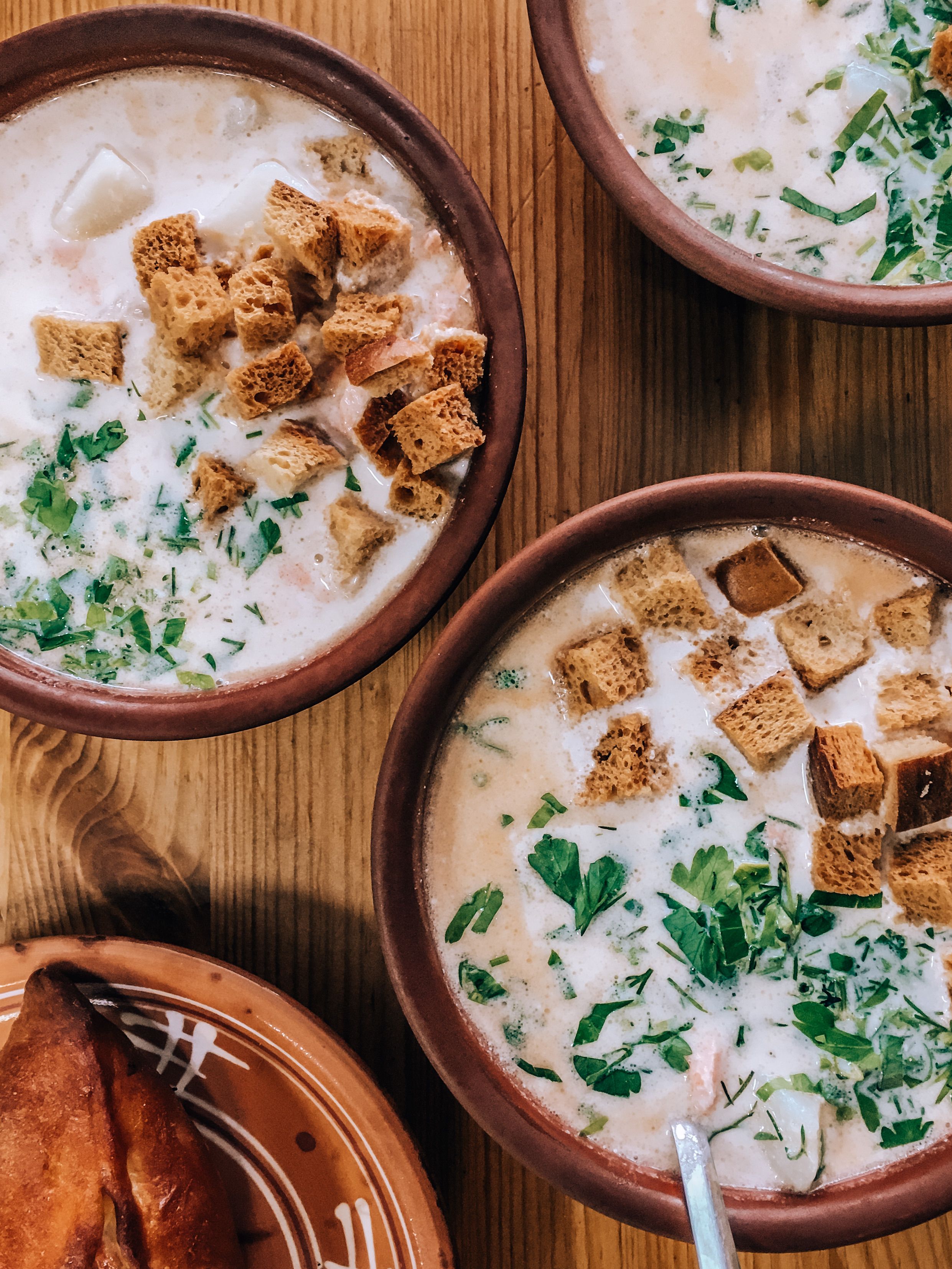
Photo: Julia Khalimova / Pexels
The diets react (see scores below)
Common Ingredients
- milk
- eggs
- scallions
- cilantro
- bread
- salt
Specific recipes may vary.
Incompatible with 6 of 11 diets
Diet Ratings
Changua is a traditional Colombian milk-based egg soup served with bread. While the eggs, scallions, and cilantro are keto-friendly, the dish has two major keto-incompatible components: milk and bread. Bread is a grain-based food with high net carbs (roughly 12-15g per slice) and is categorically excluded from keto. Whole milk adds approximately 12g of net carbs per cup. Together, these two ingredients make a standard serving of Changua far exceed the daily net carb budget in a single meal. The dish as traditionally prepared cannot fit within ketogenic guidelines without a substantial recipe overhaul (replacing bread entirely and substituting heavy cream for milk).
Changua is a traditional Colombian breakfast soup built entirely around two core animal products: milk and eggs. Both are explicitly excluded under vegan dietary rules. Milk is a dairy product derived from animals, and eggs are an animal product. There is no ambiguity here — the dish cannot be made without fundamentally altering its identity. Scallions, cilantro, and salt are plant-based, but they are peripheral ingredients that do not change the verdict. Bread may or may not be vegan depending on the recipe, but it is irrelevant given the disqualifying presence of milk and eggs.
Changua is a traditional Colombian breakfast soup that contains multiple non-paleo ingredients. Milk (dairy) is excluded from the paleo diet as it was not consumed by Paleolithic humans in liquid form. Bread is a grain-based product and is strictly off-limits. Salt (added) is also excluded. While eggs, scallions, and cilantro are fully paleo-approved, the combination of dairy, grains, and added salt makes this dish incompatible with paleo principles. Three core violations push this firmly into 'avoid' territory.
Changua is a Colombian milk-and-egg soup with scallions and cilantro — a simple, minimally processed dish. Eggs and dairy (milk) are acceptable in moderation under Mediterranean principles, typically rated as 'caution' foods eaten a few times per week. The scallions and cilantro are positive plant-based elements. The main concern is the bread, which is typically white/refined bread in this traditional preparation, contradicting the Mediterranean preference for whole grains. There is also no olive oil, which is the cornerstone Mediterranean fat. Overall, the dish is wholesome and unprocessed but relies on moderate-consumption foods (eggs, dairy) as its core components, with a refined grain side.
Some Mediterranean diet practitioners would view this dish more favorably, noting that eggs and dairy have been part of traditional Mediterranean breakfasts (e.g., Greek and Turkish morning meals often include eggs, cheese, and bread), and that the simplicity and lack of processed ingredients aligns well with the diet's whole-food philosophy. Substituting whole grain bread would bring it closer to full approval.
Changua is a Colombian milk and egg soup that contains multiple carnivore-incompatible ingredients. While milk and eggs are animal-derived and debated within carnivore circles, the dish also includes scallions (plant), cilantro (plant herb/spice), and bread (grain-based processed carbohydrate) — all of which are strictly excluded on any version of the carnivore diet. The bread alone is a disqualifying grain product, and the plant-based aromatics further push this dish firmly into avoid territory. Even the most lenient 'animal-based' carnivore frameworks (Saladino's approach) would reject bread and processed grain products outright. This dish cannot be adapted to carnivore without fundamentally changing its character.
Changua contains two excluded ingredients: milk (dairy, explicitly excluded on Whole30) and bread (a grain-based product, explicitly excluded). Eggs, scallions, cilantro, and salt are all fully compliant, but the dish cannot be made in its traditional form without violating core Whole30 rules. Both exclusions are unambiguous per official Whole30 guidelines.
Changua is a traditional Colombian milk-based egg soup that contains two significant FODMAP concerns during the elimination phase. First, regular cow's milk is high in lactose (a disaccharide) and is a primary ingredient — the dish is essentially milk-forward, making substitution fundamental rather than incidental. Second, the bread traditionally used (often stale white or wheat bread) is high in fructans. Scallions (green onions) are low-FODMAP when only the green tops are used, but high-FODMAP if the white bulb is included. Eggs and cilantro are low-FODMAP. Salt is neutral. The combination of lactose-heavy milk as the base ingredient plus wheat bread makes this dish high-FODMAP at a standard serving without significant modifications.
Monash University rates lactose-free milk as low-FODMAP, and some FODMAP practitioners would permit a modified Changua using lactose-free milk, gluten-free bread, and only scallion greens. In that adapted form the dish could be approved, but traditional Changua as typically prepared is not safe during elimination.
Changua is a Colombian milk-and-egg soup that contains several DASH-friendly ingredients — eggs provide lean protein, milk offers calcium, and scallions and cilantro contribute micronutrients with negligible sodium. However, the dish raises a few DASH considerations. Traditional Changua typically uses whole milk (full-fat dairy), which DASH specifies should be replaced with low-fat or fat-free dairy. The bread served alongside is usually white bread, a refined grain rather than a DASH-preferred whole grain. Salt is added during cooking, contributing to sodium load, though the amount is typically modest for a soup. Eggs themselves sit in a medium-confidence zone given evolving guidance. Overall, Changua is not a problematic dish, but it falls short of full DASH approval due to likely full-fat dairy, refined grain bread, and added salt. Using low-fat milk, whole grain bread, and minimizing added salt would move this dish comfortably into the approve range.
NIH DASH guidelines explicitly call for low-fat or fat-free dairy, which would flag whole milk in traditional Changua. However, updated clinical interpretations note that recent meta-analyses have not consistently shown full-fat dairy to worsen cardiovascular outcomes, and some DASH-oriented practitioners are revisiting the low-fat dairy requirement — under this lens, Changua made with whole milk might still be considered acceptable in moderate portions.
Changua is a Colombian milk-and-egg soup with scallions, cilantro, and bread. From a Zone perspective, the dish has several Zone-friendly elements alongside some challenges. Eggs provide a decent lean protein source (though whole eggs include saturated fat from yolks, making them less ideal than egg whites). Milk contributes both protein and carbohydrates, which can be incorporated into Zone blocks but adds lactose-based carbs. Scallions and cilantro are excellent low-glycemic, polyphenol-rich vegetables that align perfectly with Zone principles. The primary Zone concern is the bread — traditionally a white bread slice or stale bread is used, which is a high-glycemic, unfavorable Zone carbohydrate. This raises the glycemic load of the meal and disrupts the 40/30/30 ratio balance. The overall macro profile of Changua skews toward a protein-and-carb base (milk + eggs + bread) with relatively little monounsaturated fat present, making the fat ratio too low without modification. With modifications — substituting whole-grain or low-GI bread, using mostly egg whites, and adding a small amount of olive oil or avocado — this dish could approach Zone compliance. As traditionally prepared, it requires careful portioning and substitution.
Some Zone practitioners following Sears' later writings (particularly Toxic Fat and The Mediterranean Zone) might view the whole egg and full-fat milk combination more favorably, as Sears softened his stance on dietary fat and acknowledged the importance of nutrient density over strict fat limitation. In that context, Changua's protein-rich, warm, whole-food nature could be seen as a reasonable Zone breakfast base if bread is minimized or replaced with a low-GI alternative.
Changua is a traditional Colombian milk-and-egg soup featuring scallions, cilantro, and bread. Its anti-inflammatory profile is mixed. On the positive side, scallions and cilantro are herb-like alliums and polyphenol-rich garnishes with modest anti-inflammatory properties. Eggs contribute choline, selenium, and fat-soluble nutrients, though their arachidonic acid content is debated. Milk is a moderate-category food — low-fat dairy is acceptable in the anti-inflammatory framework, though full-fat or conventional dairy can be mildly pro-inflammatory for some individuals; the type used in Changua varies by household. The bread is the weakest link: traditional Changua uses white bread or calado (a stale white roll), which is a refined carbohydrate with minimal fiber and a high glycemic load — a category the anti-inflammatory framework recommends limiting. If whole-grain bread were substituted, the dish would score meaningfully higher. Overall, Changua is a nutrient-providing, minimally processed traditional dish with no seed oils, added sugars, or trans fats, but the refined bread and conventional dairy temper its anti-inflammatory credentials into neutral-to-moderate territory.
Eggs receive mixed treatment across anti-inflammatory frameworks: Dr. Weil classifies them as acceptable in moderation (noting quality matters), while some stricter anti-inflammatory and AIP protocols flag arachidonic acid in yolks as potentially pro-inflammatory, particularly for autoimmune-sensitive individuals. Similarly, mainstream anti-inflammatory guidance allows low-fat dairy in moderation, but dairy-free protocols (such as those advocated by Dr. Mark Hyman) argue that all conventional dairy promotes inflammatory signaling via casein and IGF-1.
Changua is a traditional Colombian milk-and-egg soup that has several GLP-1-friendly qualities but also notable drawbacks. On the positive side, eggs provide a solid, easily digestible protein source (roughly 6g per egg), the broth is warm and hydrating, and the dish is light and gentle on the stomach — well-suited to GLP-1 patients dealing with nausea or reduced appetite. Scallions and cilantro add micronutrients without caloric burden. However, the dish falls short in a few areas: milk adds saturated fat and lactose, which can worsen GI side effects (bloating, nausea) in GLP-1 patients who develop temporary lactose sensitivity; the traditional bread (often stale or day-old white bread) is a refined carbohydrate with minimal fiber and low protein density; and the overall protein content per serving is moderate at best (likely 10–15g depending on egg count), falling short of the 15–30g per meal target unless two or more eggs are used. Fiber is very low. The dish can be upgraded — whole grain or high-protein bread, additional eggs, or a side of beans — but as traditionally prepared it is a caution-level food for GLP-1 patients.
Some GLP-1-focused dietitians would rate Changua more favorably as an 'approve' for patients in early treatment phases experiencing significant nausea, citing its warm, liquid, easily digestible format as clinically practical even if nutritionally incomplete. Others would flag the milk and refined bread more strongly and recommend avoiding it until GI tolerance is established, particularly given that dairy sensitivity is elevated in GLP-1 patients.
*See how scores were generated at our methodology page.
Nutritional profile
Six traits that cut across every diet.
Fiber & Plants
How much whole-plant food and fiber it delivers.
Healthy Fats
The quality of its fats (unsaturated, omega-3).
Whole / Unprocessed
How close it is to its natural, unprocessed form.
Gut Gentle
How easy it is on digestion (low FODMAP, few irritants).
Low Glycemic
How little it spikes your blood sugar.
Protein Density
How much protein it packs per calorie.
Controversy Index
Higher controversy = more disagreement between diets.
Diet-Specific Tips
 Mediterranean — 5/10
View tips
- Eggs are a moderate-consumption food — acceptable but not a staple
- Milk/dairy is acceptable in moderation but not a core Mediterranean food
- Scallions and cilantro are positive plant-based additions
- Bread is likely refined/white, which contradicts whole grain preference
- No olive oil present — the primary Mediterranean fat is absent
- Dish is minimally processed and homemade — a positive quality
- Overall macronutrient profile is reasonable but lacks Mediterranean fat sources
 DASH — 5/10
View tips
- Whole milk is likely full-fat, conflicting with DASH low-fat dairy guidance
- Eggs are a moderate-confidence ingredient under DASH — acceptable in moderation
- Scallions and cilantro are DASH-positive vegetables with potassium and micronutrients
- Bread is typically white/refined grain rather than DASH-preferred whole grain
- Added salt increases sodium; amount depends on preparation
- Low overall saturated fat and no red meat or processed ingredients
- Substituting low-fat milk and whole grain bread would significantly improve DASH compatibility
 Zone — 5/10
View tips
- Bread is typically white or stale white bread — a high-glycemic, unfavorable Zone carbohydrate that spikes insulin
- Eggs provide good protein but whole eggs include saturated fat; egg whites would be more Zone-optimal
- Milk contributes both protein and lactose carbohydrates — usable in Zone blocks but must be measured carefully
- Scallions and cilantro are excellent low-glycemic, polyphenol-rich Zone-favorable vegetables
- Dish lacks meaningful monounsaturated fat — olive oil or avocado addition would be needed to meet the 30% fat target
- Overall macro ratio skews toward protein/carb with insufficient healthy fat as traditionally prepared
- Can be modified toward Zone compliance by swapping bread and adjusting milk quantity
 Anti-Inflammatory — 5/10
View tips
- Refined white bread raises glycemic load and reduces anti-inflammatory score
- Scallions and cilantro provide modest polyphenols and anti-inflammatory plant compounds
- Eggs are a moderate-category protein with debated inflammatory profile
- Milk/dairy is acceptable in moderation per mainstream anti-inflammatory frameworks but contested in stricter protocols
- No seed oils, trans fats, added sugars, or artificial additives — a positive
- Whole-grain bread substitution would significantly improve the dish's anti-inflammatory profile
 GLP-1 Friendly — 5/10
View tips
- Eggs provide easily digestible, high-quality protein but serving may fall below 15-30g target unless 2+ eggs are used
- Milk introduces saturated fat and lactose — both potential GI irritants for GLP-1 patients
- Traditional white bread is a refined carbohydrate with very low fiber and low nutrient density
- Warm broth format supports hydration and is gentle on a slowed digestive system
- Very low fiber overall — does not support the 25-30g daily fiber target
- Dish is portion-friendly and light, well-suited to reduced appetite
- Upgradeable: whole grain bread and additional eggs would significantly improve the GLP-1 profile