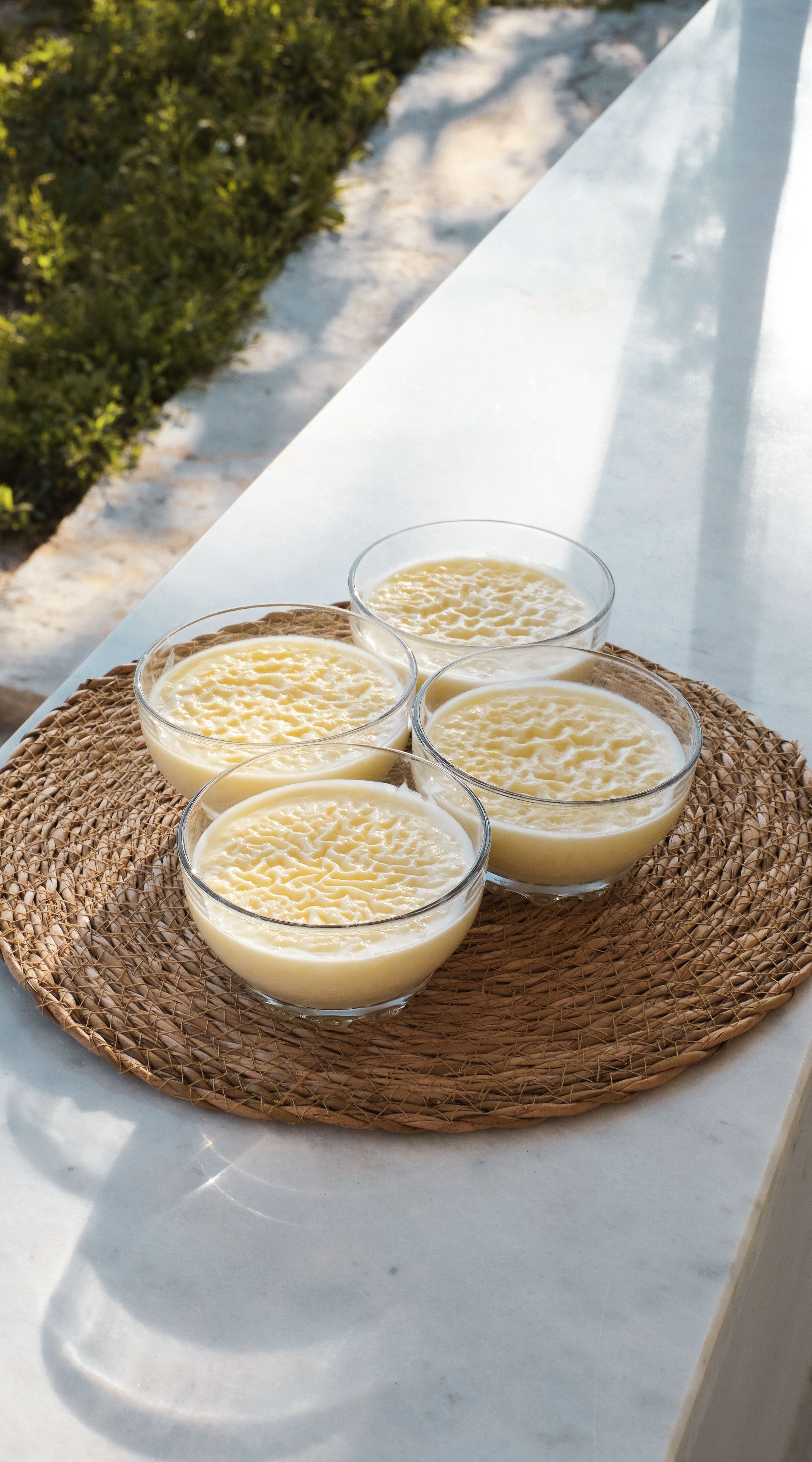
Photo: Samet Kaplan / Pexels
Colombian
Postre de Natas
The diets react (see scores below)
Common Ingredients
- milk
- sugar
- cinnamon
- raisins
- cornstarch
- cloves
Specific recipes may vary.
Incompatible with 8 of 11 diets
Diet Ratings
Postre de Natas is a Colombian milk-based dessert that is fundamentally incompatible with a ketogenic diet. It contains multiple high-carb ingredients: added sugar (a primary ingredient), raisins (very high in sugar and carbs), cornstarch (a pure starch with nearly zero fiber), and milk (which contains lactose/natural sugars). Combined, these ingredients would deliver an extremely high net carb load — easily exceeding the entire daily keto carb budget in a single serving. There is no meaningful keto adaptation possible without replacing virtually every ingredient.
Postre de Natas is a traditional Colombian milk-based dessert whose name literally translates to 'cream dessert.' Milk is a core, primary ingredient and an animal product explicitly excluded under vegan dietary rules. There is no ambiguity here — dairy is unequivocally non-vegan. The remaining ingredients (sugar, cinnamon, raisins, cornstarch, cloves) are all plant-based, but the dish cannot be considered vegan in its traditional form due to the milk. A vegan adaptation using plant-based milk (oat, almond, coconut) would be possible but would constitute a different recipe, not this traditional preparation.
Postre de Natas is a Colombian milk-based dessert that contains multiple non-paleo ingredients. Milk is a dairy product excluded from the paleo diet. Refined sugar is explicitly forbidden as a processed, non-ancestral sweetener. Cornstarch is derived from corn, a grain, making it doubly problematic. Together, these three core ingredients make this dish fundamentally incompatible with paleo principles. The only paleo-compliant ingredients are cinnamon, raisins (in moderation), and cloves.
Postre de Natas is a Colombian milk-based pudding thickened with cornstarch and sweetened with sugar, flavored with cinnamon, cloves, and raisins. From a Mediterranean diet perspective, this dish sits in a grey zone. Dairy (milk) is acceptable in moderate amounts in the Mediterranean diet, and the spices (cinnamon, cloves) and raisins are positive elements. However, the added sugar is a significant concern, as the Mediterranean diet minimizes added sugars. The cornstarch is a refined starch, which is also discouraged. The dish functions as a dessert/sweet snack, a category the Mediterranean diet limits. It is not highly processed or laden with saturated fat from red meat, but the sugar content keeps it from being endorsed. Occasional consumption as a treat is not incompatible with Mediterranean principles, but it should not be a regular fixture.
Some Mediterranean diet practitioners note that small portions of dairy-based desserts using natural spices and dried fruit (like raisins) align with the tradition of ending meals with a small, fruit-forward sweet — particularly in Southern European and Middle Eastern traditions. However, modern clinical Mediterranean diet guidelines (e.g., PREDIMED study framework) consistently flag added sugar as one of the primary foods to minimize, which limits endorsement of this dish.
Postre de Natas is a Colombian milk pudding that is fundamentally incompatible with the carnivore diet. While it does contain milk (an animal product), the dish is dominated by multiple strictly prohibited ingredients: sugar (processed sweetener), cinnamon and cloves (plant-derived spices), raisins (fruit/plant), and cornstarch (grain-derived thickener). Even setting aside the dairy debate within carnivore communities, the combination of sugar, plant spices, dried fruit, and grain starch makes this an unambiguous avoid. This is essentially a dessert built on plant-based carbohydrates and sweeteners with minimal animal-derived nutritional value.
Postre de Natas contains multiple excluded ingredients that make it clearly non-compliant with Whole30. Milk is a dairy product, which is explicitly excluded (only ghee and clarified butter are permitted dairy exceptions). Sugar is an added sugar, which is explicitly excluded on Whole30. Cornstarch is also explicitly listed as an excluded ingredient under Whole30 rules. With three independently disqualifying ingredients, this dish is firmly in the 'avoid' category.
Postre de Natas is a traditional Colombian milk-based dessert whose primary ingredient is full-fat milk, which is high in lactose. A standard serving of this dish would involve a significant quantity of milk, making lactose the dominant FODMAP concern. Raisins are also high in fructose and polyols (fructans) and are problematic even in small quantities — a standard dessert portion would likely include more than the Monash low-FODMAP threshold of 1 tablespoon. The remaining ingredients (sugar, cinnamon, cornstarch, cloves) are generally low-FODMAP in typical culinary amounts. However, the combination of high-lactose milk as the base ingredient and raisins as a key flavoring component makes this dish high-FODMAP at any realistic serving size during the elimination phase.
Monash University rates lactose-free milk as low-FODMAP, so a version of this dessert made with lactose-free milk could potentially be lower in FODMAPs — some clinical FODMAP practitioners may suggest this substitution. However, even with lactose-free milk, the raisins would still need to be omitted or kept to a very small amount (under 1 tablespoon per Monash) to make the dish truly elimination-phase safe, which would fundamentally alter the traditional recipe.
Postre de Natas is a Colombian milk-based dessert (similar to a milk pudding) made by slowly reducing whole milk with sugar, cinnamon, raisins, cornstarch, and cloves. From a DASH perspective, the dish has mixed attributes. On the positive side, it contains no sodium to speak of, uses milk (a DASH-encouraged dairy source providing calcium and potassium), and includes raisins (a fruit source with potassium and fiber) and spices like cinnamon and cloves. However, the significant concern is the substantial amount of added sugar used to sweeten this dessert, which DASH explicitly limits. Additionally, it is typically made with whole milk rather than fat-free or low-fat milk, adding saturated fat that DASH discourages. Cornstarch is a refined starch with no meaningful nutritional contribution. As a dessert/snack with high added sugar and likely whole-milk fat content, it does not align well with DASH principles but is not categorically prohibited — it could be consumed occasionally in small portions, especially if modified with low-fat milk and reduced sugar.
NIH DASH guidelines explicitly limit added sugars and sweets, making this dessert a poor fit in its traditional form. However, some DASH-oriented clinicians note that a small, portion-controlled serving of a minimally processed, homemade dairy-based dessert with no sodium and beneficial spices is preferable to commercially processed sweets, and that substituting low-fat milk and reducing sugar can make this dish more DASH-compatible.
Postre de Natas is a Colombian milk pudding whose macronutrient profile is fundamentally incompatible with Zone Diet principles. The dish is built around sugar as a primary ingredient, with cornstarch as a thickener — both high-glycemic carbohydrates that Dr. Sears explicitly identifies as unfavorable. Raisins, another key ingredient, are specifically called out in Zone literature as an unfavorable carb due to their concentrated sugar content and high glycemic load. The dish provides virtually no lean protein (no protein source is listed), negligible monounsaturated fat, and is dominated by rapidly digested carbohydrates that would spike insulin sharply — the exact hormonal response the Zone Diet is designed to prevent. Even in small portions, the macro ratio would be wildly skewed toward carbohydrates with no balancing protein or fat blocks, making it nearly impossible to incorporate into a Zone-compliant meal or snack without completely restructuring the dish. Cinnamon and cloves are anti-inflammatory spices Sears would approve of, and milk provides some protein, but these positives are overwhelmed by the sugar-heavy, starch-heavy base.
Postre de Natas is a Colombian milk-based pudding thickened with cornstarch and sweetened with sugar, with cinnamon, cloves, and raisins added for flavor. The anti-inflammatory profile is mixed. On the positive side, cinnamon and cloves are potent anti-inflammatory spices with well-documented antioxidant and anti-inflammatory properties (cinnamaldehyde, eugenol). Raisins contribute polyphenols and fiber in small amounts. However, the dish is anchored by two problematic elements from an anti-inflammatory standpoint: added sugar (a primary driver of inflammatory markers like CRP and IL-6) and full-fat dairy milk (contains saturated fat and lacks the omega-3 advantage of low-fat options). Cornstarch is a refined carbohydrate with a high glycemic index, contributing to postprandial glucose spikes that can promote inflammation. Collectively, this is a dessert-style dish where the beneficial spice contributions are outweighed by the sugar and refined starch load. It is acceptable in moderation — the spices and raisins prevent it from falling into 'avoid' territory — but it cannot be recommended as an anti-inflammatory food.
Postre de Natas is a Colombian milk-based dessert made by slowly reducing whole milk with sugar, cinnamon, cloves, cornstarch, and raisins. The result is a high-sugar, moderate-fat, low-protein dish with virtually no fiber. For GLP-1 patients, this fails on nearly every priority: it provides negligible protein (no meaningful amino acids to protect muscle mass), no fiber (zero digestive or blood sugar benefit), and is loaded with added sugar — a category explicitly flagged to avoid. The cornstarch adds refined starch with no nutritional value, and the raisins contribute concentrated sugar rather than meaningful fiber. While whole milk provides small amounts of protein and fat, the overall macronutrient profile is dominated by sugar and refined carbohydrates. This is essentially an empty-calorie dessert that offers no satiety per calorie, no muscle-protective protein, and risks blood sugar spikes. The spices (cinnamon, cloves) are the only nutritionally positive elements, and they do not offset the overall profile. Not appropriate as a snack for GLP-1 patients.
*See how scores were generated at our methodology page.
Nutritional profile
Six traits that cut across every diet.
Fiber & Plants
How much whole-plant food and fiber it delivers.
Healthy Fats
The quality of its fats (unsaturated, omega-3).
Whole / Unprocessed
How close it is to its natural, unprocessed form.
Gut Gentle
How easy it is on digestion (low FODMAP, few irritants).
Low Glycemic
How little it spikes your blood sugar.
Protein Density
How much protein it packs per calorie.
Controversy Index
Higher controversy = more disagreement between diets.
Diet-Specific Tips
 Mediterranean — 4/10
View tips
- Contains added sugar — a key item to minimize in the Mediterranean diet
- Cornstarch is a refined starch, not a whole grain
- Milk/dairy is acceptable in moderation in the Mediterranean diet
- Raisins provide a positive dried fruit element
- Cinnamon and cloves are beneficial spices consistent with Mediterranean flavors
- No olive oil or plant-forward whole foods as the base
- Functions as a sweet dessert/snack, a category the Mediterranean diet limits
 DASH — 4/10
View tips
- High added sugar content conflicts with DASH limits on sweets
- Typically made with whole milk, adding saturated fat beyond DASH recommendations
- No sodium content is a positive attribute
- Milk provides DASH-valued calcium and potassium
- Raisins contribute small amounts of potassium and fiber
- Could be improved for DASH by using low-fat milk and reducing sugar significantly
- Classified as a dessert/snack — DASH allows sweets sparingly (≤5 servings/week of small portions)
 Anti-Inflammatory — 4/10
View tips
- High added sugar content — primary pro-inflammatory concern, raises CRP and IL-6
- Cornstarch is a refined carbohydrate with high glycemic index, promoting glucose spikes
- Full-fat dairy (milk) contributes saturated fat, limited in anti-inflammatory frameworks
- Cinnamon is a well-supported anti-inflammatory spice (cinnamaldehyde, antioxidants)
- Cloves are among the highest-antioxidant spices (eugenol) — a genuine benefit
- Raisins provide small amounts of polyphenols and fiber
- Overall profile: dessert-category food where pro-inflammatory elements dominate