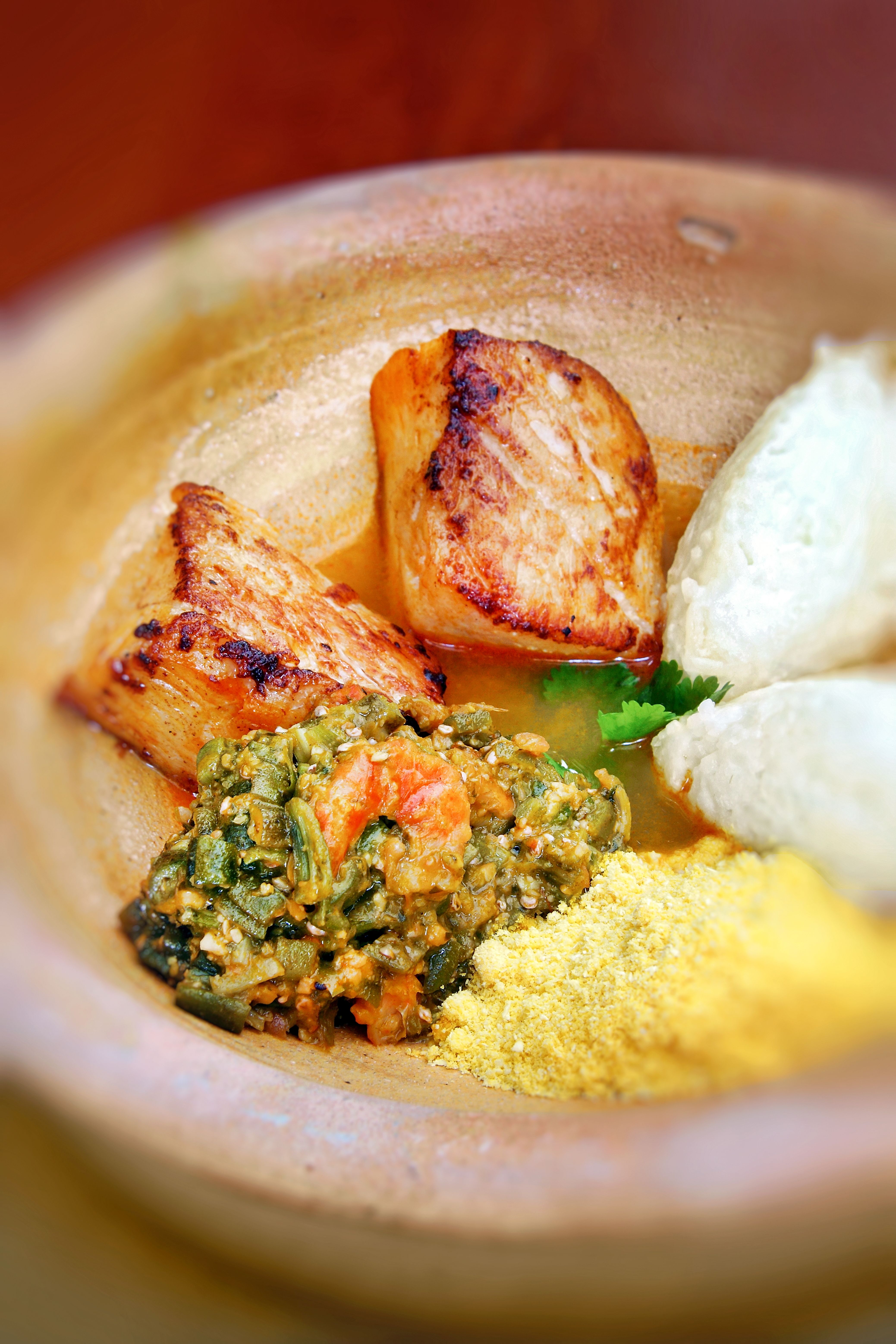
Photo: Luiz Henrique Mendes / Pexels
The diets react (see scores below)
Common Ingredients
- salted cod
- onions
- tomatoes
- garlic
- chili
- palm oil
- bell peppers
- salt
Specific recipes may vary.
Incompatible with 5 of 11 diets
Diet Ratings
Makayabu is a Congolese salted cod dish cooked in palm oil with vegetables. The base protein (salted cod) is excellent for keto — high protein, virtually zero carbs. Palm oil is a highly keto-friendly fat. The concern lies in the vegetable mix: tomatoes and bell peppers contribute moderate net carbs (tomatoes ~3-4g/100g, bell peppers ~4-5g/100g net carbs), and onions add further carbs (~7g/100g). In a typical serving with generous vegetable portions as is common in this dish, net carbs could approach or exceed 10-15g per serving, which is manageable but requires portion awareness. Garlic and chili add minimal carbs. The dish has no grains or added sugars, which is a strong positive. With controlled vegetable portions, it fits within a keto framework comfortably; with generous servings of onion, tomato, and bell pepper, it warrants caution.
Stricter keto practitioners may flag the combination of tomatoes, bell peppers, and onions as too carb-dense in realistic portions, arguing that the cumulative vegetable carb load — especially with onions — can easily push a serving over 15g net carbs and crowd out other carb allowances for the day. They would recommend significantly reducing or eliminating onions and tomatoes.
Makayabu is a traditional Congolese dish centered on salted cod (dried/salted fish), which is unambiguously an animal product and therefore incompatible with a vegan diet. Fish is excluded under all vegan frameworks without exception. The remaining ingredients — onions, tomatoes, garlic, chili, bell peppers, and salt — are all plant-based, and palm oil is technically plant-derived, but the dish cannot be considered vegan due to the fish as its primary and defining ingredient.
Makayabu is a traditional Congolese salted cod dish that fails paleo compliance on two clear grounds. First, salted cod is a heavily salt-cured, processed fish — the preservation process involves significant added salt, which falls under the 'processed foods' and 'added salt' exclusion in strict paleo. Second, the recipe explicitly lists added salt as an ingredient, compounding the issue. Palm oil occupies a gray zone — it is not a seed oil and is sometimes accepted in paleo circles, but its industrial processing raises concerns for strict practitioners. The base ingredients (cod, onions, tomatoes, garlic, chili, bell peppers) are otherwise paleo-friendly, but the two disqualifying factors — heavily salted/processed fish and added salt — are sufficient to move this dish firmly into 'avoid' territory. A paleo-adapted version using fresh cod and no added salt would be approvable.
Makayabu features salted cod as its primary protein, which aligns well with the Mediterranean diet's emphasis on fish and seafood. The vegetable base of onions, tomatoes, garlic, bell peppers, and chili is excellent — these are quintessential Mediterranean ingredients. However, two factors prevent a full approval: (1) Palm oil replaces olive oil as the cooking fat, which is not traditional to the Mediterranean diet and has a different fatty acid profile (high in saturated fat), contrasting with extra virgin olive oil's monounsaturated fat emphasis. (2) Salted cod is heavily processed and very high in sodium, which conflicts with Mediterranean diet principles around minimal processing and moderate salt intake. If palm oil were substituted with olive oil and sodium content managed through soaking/rinsing, this dish would score much higher.
Some Mediterranean diet scholars note that traditional Portuguese and Spanish Mediterranean cuisines have long used bacalhau (salted cod) as a staple, and would view the fish and vegetable combination favorably despite processing. Additionally, a small number of modern Mediterranean diet interpreters allow plant-based saturated fats like palm oil as preferable to animal fats, though this remains a minority position.
Makayabu is a Congolese salted cod dish prepared with a heavily plant-based sauce including onions, tomatoes, garlic, chili peppers, bell peppers, and palm oil. While salted cod itself is an acceptable carnivore food (fish with salt), the dish as prepared is dominated by plant-derived ingredients. The vegetables (onions, tomatoes, garlic, chili, bell peppers) are all excluded on the carnivore diet, and palm oil is a plant-derived oil also excluded. The dish cannot be considered carnivore-compatible in its traditional form — the fish is merely one component of an otherwise entirely plant-based preparation.
Makayabu is a traditional Congolese salted/dried cod dish. All listed ingredients — salted cod, onions, tomatoes, garlic, chili, palm oil, bell peppers, and salt — are Whole30-compliant. Fish is explicitly allowed, vegetables are allowed, palm oil is a natural fat, and salt is permitted. The main caution is that commercially prepared salted cod may contain additives beyond simple salt (e.g., preservatives or sulfites, though sulfites are no longer excluded per 2024 Whole30 rules). Label-reading is still advisable to confirm no sugar or non-compliant preservatives are present in the packaged salted cod. Palm oil is unrefined and natural, consistent with Whole30's allowance of natural fats. The dish as described contains no grains, legumes, dairy, or other excluded ingredients.
Some Whole30 practitioners flag heavily processed or commercially prepared salted/preserved fish products as requiring careful scrutiny, since industrial salting processes occasionally include additives. The official Whole30 guidelines permit preserved fish if no excluded ingredients appear on the label, but community members sometimes caution against heavily processed preserved proteins in the spirit of the whole-food emphasis.
Makayabu contains two high-FODMAP ingredients that make it unsuitable during the elimination phase: onions (high in fructans at any meaningful cooking quantity) and garlic (high in fructans even at very small amounts). These are among the highest-FODMAP foods tested by Monash University and are core flavor bases in this dish, not incidental additions. The remaining ingredients are largely low-FODMAP: salted cod is a fish and FODMAP-free, tomatoes are low-FODMAP at standard servings (up to ~65g per Monash), chili is low-FODMAP in small amounts, palm oil is a fat and FODMAP-free, bell peppers are low-FODMAP, and salt is FODMAP-free. However, the onion and garlic content is disqualifying — both are used as primary aromatics in authentic Makayabu and cannot be omitted without fundamentally altering the dish. Even small residual amounts of onion cooked into a dish are problematic because fructans leach into water-based cooking liquids.
Makayabu is a traditional Congolese dish built around salted cod (makayabu), which is extremely high in sodium — a single serving of salted/dried cod can contain 1,000–2,500mg of sodium before any additional preparation. The dish is then compounded by added table salt and cooked in palm oil, a tropical oil explicitly limited by DASH guidelines due to its high saturated fat content. While several ingredients are DASH-friendly (onions, tomatoes, garlic, bell peppers, chili), the two foundational components — salted cod and palm oil — directly violate core DASH principles. Even with extended soaking to reduce sodium, the base sodium load remains very high, and the saturated fat from palm oil is not mitigated by preparation. This dish as commonly prepared in Congolese cuisine is incompatible with either standard DASH (<2,300mg sodium/day) or low-sodium DASH (<1,500mg/day) targets.
Makayabu is a Congolese dish of salted cod cooked with onions, tomatoes, bell peppers, garlic, and chili in palm oil. The protein base — salted cod — is a lean, high-quality fish protein that fits Zone principles well (approximately 7g protein per ounce, low fat). The vegetable mix (onions, tomatoes, bell peppers, garlic, chili) is largely favorable in Zone terms: low-glycemic, polyphenol-rich, and providing good carbohydrate blocks. However, two concerns prevent a full 'approve': (1) Palm oil is high in saturated fat (about 50% saturated fatty acids), which conflicts with Zone's emphasis on monounsaturated fats like olive oil. Dr. Sears consistently recommends minimizing saturated fat in favor of MUFA sources. (2) The high sodium content from salted cod is not a Zone macronutrient concern per se, but the dish would need to be portioned carefully to balance the fat blocks — palm oil's saturated fat profile means it contributes less favorably than olive oil or avocado oil would. With portion control (modest palm oil use, ~3 oz cod, vegetable-heavy preparation), this dish can approximate a reasonable Zone meal, but the palm oil is a meaningful flag.
Some Zone practitioners and later Sears writings (particularly his Omega Rx Zone work) acknowledge that not all saturated fats are equally harmful — palm oil contains palmitic acid, which Sears views as pro-inflammatory, but the dish's strong polyphenol content from garlic, chili, tomatoes, and bell peppers partially offsets this concern. A strict early-Zone reading would penalize palm oil more heavily; a modern anti-inflammatory Zone lens might accept it in small quantities given the otherwise favorable ingredients.
Makayabu is a traditional Congolese dish built around salted/dried cod, which is a lean white fish with modest omega-3 content — lower than fatty fish like salmon or mackerel, but still a better protein source than red meat. The vegetable base (tomatoes, onions, garlic, bell peppers, chili) is genuinely anti-inflammatory: lycopene from tomatoes, quercetin from onions, allicin from garlic, capsaicin from chili, and carotenoids from bell peppers all reduce inflammatory markers. The critical detractor is palm oil. Red palm oil (unrefined) contains tocotrienols and carotenoids with some anti-inflammatory properties, but it is very high in saturated fat (~50%), which anti-inflammatory guidelines recommend limiting. Refined palm oil, more commonly used in everyday cooking, loses those beneficial compounds and is largely a saturated fat source comparable to butter. The heavy salting process (which defines makayabu) also raises concerns: very high sodium intake is associated with endothelial inflammation and hypertension, though sodium itself is not classically 'inflammatory' in the same way as omega-6 or trans fats. The dish sits in a clear middle zone — a strong anti-inflammatory vegetable profile partially undermined by palm oil and high sodium from the salted fish preparation.
Some anti-inflammatory practitioners who work with traditional African foods note that unrefined red palm oil has been used for millennia and contains significant levels of tocotrienols (a form of vitamin E) and beta-carotene that exhibit anti-inflammatory activity in studies — Dr. Bruce Holub and others distinguish red palm oil from refined palm oil in their assessments. Conversely, mainstream anti-inflammatory authorities including Dr. Weil and the Harvard School of Public Health place palm oil in the 'limit' category alongside butter due to its high saturated fat content, making the palm oil component genuinely contested.
Makayabu is a traditional Congolese dish built around salted cod, which is a genuinely good protein source — lean, high-density, and easy to digest when properly prepared. The vegetable base (onions, tomatoes, bell peppers, garlic) adds fiber, micronutrients, and water content, all of which are positives for GLP-1 patients. However, two factors pull this into caution territory. First, palm oil is a saturated fat and is used in meaningful quantities in traditional preparation — saturated fat worsens nausea, bloating, and reflux, which are primary GLP-1 side effects. Second, salted cod is extremely high in sodium, and while rinsing and soaking reduces this substantially, residual sodium load remains a concern, particularly for patients who are already managing fluid retention or cardiovascular risk alongside GLP-1 therapy. The chili ingredient introduces mild GI risk for patients sensitive to spice, though at typical Congolese preparation levels it is unlikely to be a major issue for most. If prepared with reduced palm oil (or substituted with a small amount of olive oil) and the cod is thoroughly desalted via soaking, this dish improves meaningfully and could approach an approve rating.
Some GLP-1-focused dietitians would rate this more favorably, arguing that the cod's high protein content and the dish's vegetable density outweigh the saturated fat concern when palm oil is used in modest amounts. Others would rate it more strictly, noting that any dish with traditional palm oil use and high sodium content poses compounded GI and cardiovascular risk for the typical GLP-1 patient population, who often carry comorbid hypertension.
*See how scores were generated at our methodology page.
Nutritional profile
Six traits that cut across every diet.
Fiber & Plants
How much whole-plant food and fiber it delivers.
Healthy Fats
The quality of its fats (unsaturated, omega-3).
Whole / Unprocessed
How close it is to its natural, unprocessed form.
Gut Gentle
How easy it is on digestion (low FODMAP, few irritants).
Low Glycemic
How little it spikes your blood sugar.
Protein Density
How much protein it packs per calorie.
Controversy Index
Higher controversy = more disagreement between diets.
Diet-Specific Tips
 Keto — 5/10
View tips
- Salted cod is zero-carb, high-protein, and fully keto-compatible
- Palm oil is an ideal keto fat source
- Tomatoes and bell peppers add moderate net carbs (~4-5g each per 100g)
- Onions are relatively high-carb for keto (~7g net carbs/100g) and commonly used in quantity
- No grains, no added sugars — structurally clean for keto
- Portion control of vegetables is critical to keep net carbs in range
- Total net carbs per serving estimated 10-15g depending on portion sizes
 Mediterranean — 5/10
View tips
- Fish as primary protein aligns with Mediterranean guidelines (2-3x weekly)
- Rich vegetable base (tomatoes, onions, garlic, bell peppers) strongly Mediterranean
- Palm oil used instead of extra virgin olive oil — high in saturated fat, not Mediterranean-traditional
- Salted cod is heavily processed with very high sodium content
- No refined grains or added sugars
- Dish is nutrient-dense and plant-forward despite fat concern
 Whole30 — 8/10
View tips
- Salted cod is fish — a Whole30-compliant protein
- All vegetables (onions, tomatoes, garlic, chili, bell peppers) are compliant
- Palm oil is a natural fat and Whole30-approved
- Salt is explicitly allowed on Whole30
- Sulfites are no longer excluded per 2024 Whole30 rule change
- Label check recommended on commercial salted cod for any added sugar or non-compliant preservatives
- No grains, dairy, legumes, or excluded sweeteners in the recipe
 Zone — 5/10
View tips
- Salted cod is a lean, high-quality protein — favorable Zone building block
- Vegetables (bell peppers, tomatoes, onions, garlic, chili) are low-glycemic and polyphenol-rich — Zone favorable
- Palm oil is ~50% saturated fat, conflicting with Zone's monounsaturated fat preference
- High sodium from salted cod is not a Zone macronutrient issue but worth noting for overall health
- Dish can fit Zone blocks if palm oil quantity is minimized and cod portion is controlled (~3 oz)
- No high-glycemic carbohydrates present — no grains, sugar, or starchy vegetables
 Anti-Inflammatory — 5/10
View tips
- Salted cod is a lean fish with modest omega-3s — beneficial vs. red meat but far below fatty fish like salmon
- High-sodium salted/dried fish preparation is a concern for inflammation-adjacent markers (blood pressure, endothelial stress)
- Palm oil is high in saturated fat (~50%) and is on the anti-inflammatory 'limit' list; rating depends heavily on whether unrefined red palm oil or refined palm oil is used
- Strong anti-inflammatory vegetable base: tomatoes (lycopene), garlic (allicin), chili (capsaicin), bell peppers (carotenoids), onions (quercetin)
- No trans fats, refined carbohydrates, added sugars, or processed additives in the ingredient list
- Traditional whole-food preparation supports a better inflammatory profile than heavily processed alternatives
 GLP-1 Friendly — 5/10
View tips
- Salted cod is a high-protein, lean fish — strong GLP-1 protein priority alignment
- Palm oil contributes saturated fat, which worsens GLP-1 GI side effects (nausea, reflux, bloating)
- Very high sodium content from salted cod requires thorough soaking/rinsing before cooking
- Vegetable base (tomatoes, peppers, onions) adds fiber, water content, and micronutrient density
- Chili may trigger reflux or nausea in GLP-1 patients with existing GI sensitivity
- Dish is portion-manageable and works well in small servings
- Preparation method significantly affects rating — reduced oil and desalted cod improve the profile substantially