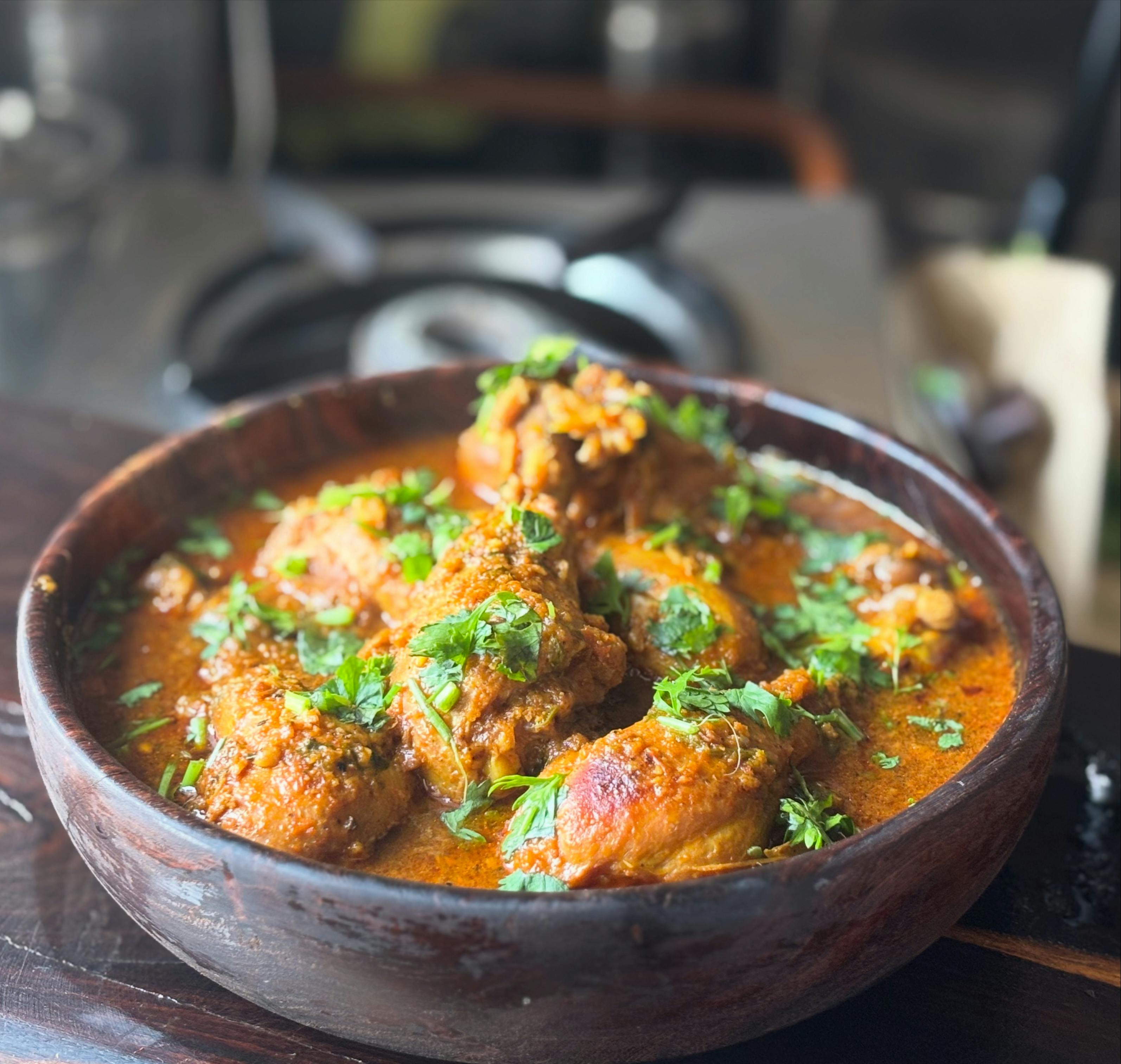
Photo: Rahul Sonawane / Pexels
Congolese
Moambe Chicken
The diets react (see scores below)
Common Ingredients
- chicken
- palm nut pulp
- onions
- garlic
- tomatoes
- chili
- bay leaf
- salt
Specific recipes may vary.
Incompatible with 5 of 11 diets
Diet Ratings
Moambe Chicken is built around chicken (keto-friendly protein) and palm nut pulp (a high-fat, low-carb base that is inherently keto-compatible). Palm nut pulp is rich in saturated fat with minimal net carbs, making it an excellent keto fat source. However, the dish includes tomatoes and onions, which add moderate net carbs per serving. Tomatoes contain roughly 3-4g net carbs per 100g and onions around 7-8g net carbs per 100g. In a traditional preparation, these ingredients are used in meaningful quantities, which could push a serving toward the upper range of acceptable daily carb limits. A moderate portion with careful control of tomato and onion quantities can fit within keto macros, but a generous traditional serving may stress the daily carb budget, especially if combined with other carb sources throughout the day.
Some strict keto practitioners would fully approve this dish, arguing that palm nut pulp's exceptional fat content and the relatively modest carb contributions from tomatoes and garlic in a single serving make it clearly keto-compatible. They would rate it higher, noting that the fiber content of whole tomatoes further reduces net carbs.
Moambe Chicken contains chicken as its primary protein, which is poultry — a direct animal product explicitly excluded under all vegan standards. There is no ambiguity here: regardless of the plant-based ingredients that accompany it (palm nut pulp, onions, garlic, tomatoes, chili, bay leaf), the dish is fundamentally defined by and built around chicken meat. It cannot be considered vegan in any form of the dish as described.
Moambe Chicken is largely paleo-compatible — chicken, onions, garlic, tomatoes, chili, and bay leaf are all approved paleo ingredients. Palm nut pulp (the base of moambe sauce) is a whole, minimally processed fruit product and is generally paleo-acceptable as a natural fat source. However, the inclusion of added salt is a clear paleo exclusion. Salt is consistently listed as a 'avoid' ingredient across mainstream paleo frameworks, pushing the dish into 'avoid' territory despite its otherwise clean profile. Without salt, this dish would score an 8-9 and earn a strong approval.
Some modern paleo practitioners, including Mark Sisson, take a pragmatic stance on small amounts of mineral-rich unrefined salts (such as sea salt or pink Himalayan salt), arguing that trace mineral content and ancestral coastal diets make moderate salt use acceptable. Under this interpretation, the dish would easily qualify as approved.
Moambe Chicken is a whole-food, minimally processed dish with many Mediterranean-compatible ingredients: chicken (acceptable in moderation), tomatoes, onions, garlic, chili, and aromatic herbs are all encouraged. The primary concern is palm nut pulp (palm oil), which is high in saturated fat and is not a traditional Mediterranean fat — extra virgin olive oil is the canonical fat source. The dish is otherwise nutrient-dense, vegetable-forward in its aromatics, and free of refined grains or added sugars. Chicken places it in the 'moderate' category (poultry is acceptable but not a daily staple), and palm oil tempers an otherwise solid profile.
Some modern Mediterranean diet researchers argue that unrefined, whole-food plant fats like palm nut pulp — consumed in traditional culinary contexts with minimal processing — are preferable to refined vegetable oils and may be acceptable as an occasional fat source. Traditional culinary diversity advocates note that the Mediterranean diet framework should not be applied rigidly to non-Mediterranean cuisines, and this dish's whole-food profile is broadly consistent with the diet's spirit.
Moambe Chicken is heavily incompatible with the carnivore diet. While chicken itself is an acceptable animal protein, virtually every other ingredient in this dish is plant-derived and explicitly excluded from carnivore eating. Palm nut pulp is a plant fat (not an animal fat), onions, garlic, tomatoes, chili, and bay leaf are all plant foods that are strictly off-limits. The dish is essentially a plant-based stew with chicken added. Only the chicken and salt would be carnivore-compliant, meaning the dish in its traditional form cannot be consumed on this diet.
Moambe Chicken is a traditional Congolese dish made with whole, unprocessed ingredients that are all Whole30 compliant. Chicken is an approved protein. Palm nut pulp is a natural plant-based fat/ingredient with no excluded components. Onions, garlic, tomatoes, and chili are all vegetables explicitly allowed on Whole30. Bay leaf and salt are permitted herbs and seasonings. There are no grains, legumes, dairy, added sugars, alcohol, or any other excluded ingredients in this dish. This is exactly the kind of whole-food, culturally rich meal the Whole30 program encourages.
Moambe Chicken contains two major high-FODMAP ingredients that make it unsuitable during the elimination phase: onions and garlic. Both are among the highest-FODMAP foods tested by Monash University, rich in fructans, and problematic at any cooking quantity used in a standard dish like this. Even small amounts of onion and garlic cooked into a sauce or stew transfer fructans into the dish liquid, making the entire dish high-FODMAP. Chicken itself is low-FODMAP, palm nut pulp (palm fruit concentrate) has limited Monash data but is a fat-based ingredient unlikely to contribute significant FODMAPs, tomatoes are low-FODMAP at standard servings (up to ~75g per Monash), chili is low-FODMAP in small amounts, bay leaf and salt are FODMAP-free. However, the presence of onion and garlic as core flavoring ingredients is disqualifying for the elimination phase.
Moambe Chicken's central ingredient — palm nut pulp — is derived from the oil palm fruit and is extremely high in saturated fat (roughly 50% of its fatty acid profile), placing it squarely in the category of tropical oils that DASH explicitly limits alongside coconut and palm kernel oil. A traditional serving delivers a substantial saturated fat load well beyond DASH targets. The chicken itself is DASH-friendly, and the vegetables (onions, garlic, tomatoes, chili) are excellent DASH components, but the palm nut base fundamentally undermines the dish's compatibility. Added salt further compounds sodium concerns. The combination of a high-saturated-fat tropical oil base plus added sodium makes this dish difficult to accommodate within DASH guidelines without radical reformulation.
NIH DASH guidelines explicitly restrict tropical oils including palm oil due to high saturated fat content. However, some updated clinical interpretations note that palm nut pulp (as used in traditional cooking) differs somewhat from refined palm oil, and emerging nutritional science questions whether all saturated fats carry equal cardiovascular risk — some DASH-oriented dietitians may allow very small, infrequent portions within an otherwise strict DASH framework, though this remains a minority position not supported by official NHLBI guidance.
Moambe Chicken is a traditional Congolese dish built around chicken (lean protein — Zone-favorable) and palm nut pulp (the problematic ingredient from a Zone perspective). The chicken provides an excellent lean protein base that aligns well with Zone block targets (~25g protein per meal). The supporting ingredients — onions, garlic, tomatoes, chili, and bay leaf — are all low-glycemic, polyphenol-rich vegetables that Dr. Sears would actively encourage. The critical concern is palm nut pulp (also called palm fruit sauce or moambe sauce), which is high in saturated fat (palmitic acid constitutes roughly 44-50% of palm oil's fat content). Early Zone Diet methodology strictly limits saturated fat in favor of monounsaturated fats like olive oil and avocado. However, Sears' later anti-inflammatory writings (particularly 'Toxic Fat' and 'The Mediterranean Zone') acknowledged that not all saturated fats are equally problematic and that whole-food fat sources in traditional diets carry polyphenol and carotenoid benefits — palm fruit pulp is notably rich in beta-carotene and tocotrienols. The dish also lacks a clear carbohydrate block to complete the 40/30/30 ratio, so it would need to be paired with low-glycemic vegetables or a small amount of legumes to achieve Zone balance. Portion control on the palm sauce is essential. This dish can fit within Zone methodology with mindful portioning but requires adjustment.
Some Zone practitioners would rate this more favorably, citing Sears' later anti-inflammatory framework where whole-food sources of saturated fat (as opposed to processed sources) are not automatically disqualifying — particularly when accompanied by the carotenoids and polyphenols in palm fruit pulp. Others following strict early Zone protocol would rate this lower (score 3-4), treating palm fat as equivalent to other saturated fat sources that crowd out favorable monounsaturated fats from the Zone fat block.
Moambe Chicken is a traditional Congolese dish whose anti-inflammatory profile is dominated by the palm nut pulp (also sold as palm cream or moambe sauce), which is the ingredient that creates the most nutritional tension. Palm nut pulp — derived from the fruit of the oil palm — is rich in carotenoids (beta-carotene, lycopene precursors) and vitamin E (tocotrienols), which are genuinely anti-inflammatory. However, it is also very high in saturated fat, particularly palmitic acid, which at high intake levels is associated with increased inflammatory markers (NF-κB activation, elevated LDL). Importantly, palm nut pulp (the whole fruit paste used in traditional African cooking) differs meaningfully from refined palm oil or palm kernel oil: it retains its phytonutrients and fiber, making it less problematic than highly processed palm products. The remaining ingredients are strongly anti-inflammatory: garlic and chili are emphasized in anti-inflammatory frameworks, tomatoes provide lycopene, onions contribute quercetin, and chicken is a moderate lean protein. Bay leaf adds minor anti-inflammatory phytochemicals. The dish contains no refined carbohydrates, added sugars, trans fats, or artificial additives. Overall, the dish has a mixed profile — genuinely beneficial base ingredients offset by the high saturated fat load of palm nut pulp consumed in typical serving quantities. It is acceptable in moderation for most people, but the saturated fat content prevents an approve rating.
Some nutrition researchers and traditional food advocates argue that whole palm nut pulp — as used in traditional African cuisine — should not be conflated with industrially refined palm oil. Its intact carotenoid and tocotrienol content may confer net anti-inflammatory effects at culinary doses, which could push this dish toward a borderline approve. Conversely, strict anti-inflammatory practitioners following Dr. Weil's pyramid or AIP protocols would flag the high saturated fat from palm nut as clearly pro-inflammatory and likely rate this dish lower (score 3–4), especially for individuals with cardiovascular risk factors or autoimmune conditions.
Moambe Chicken is a traditional Congolese dish built around chicken (good protein source) and palm nut pulp, which is the central concern for GLP-1 patients. Palm nut pulp (moambe) is extremely high in saturated fat — comparable to coconut cream in fat density — which directly conflicts with the low-fat priority for GLP-1 patients and is likely to worsen nausea, bloating, and reflux due to slowed gastric emptying. The chicken itself provides solid lean protein, and the aromatics (onion, garlic, tomatoes) add modest fiber and micronutrients. The chili ingredient introduces mild GI irritation risk. The dish is not fried, which is a point in its favor, but the fat load from palm nut pulp in a standard serving is high enough to push this into caution territory rather than approve. A modified version using reduced palm nut pulp or a lighter palm-based broth could shift the rating upward.
Some GLP-1-focused dietitians may rate this more leniently if the palm nut pulp is used in small quantities as a flavoring rather than a rich sauce base, arguing that the chicken protein and tomato-based vegetables provide net nutritional value; however, traditional preparation quantities of palm nut pulp make portion control difficult and the saturated fat load a consistent concern for GI side effect management on GLP-1 medications.
*See how scores were generated at our methodology page.
Nutritional profile
Six traits that cut across every diet.
Fiber & Plants
How much whole-plant food and fiber it delivers.
Healthy Fats
The quality of its fats (unsaturated, omega-3).
Whole / Unprocessed
How close it is to its natural, unprocessed form.
Gut Gentle
How easy it is on digestion (low FODMAP, few irritants).
Low Glycemic
How little it spikes your blood sugar.
Protein Density
How much protein it packs per calorie.
Controversy Index
Higher controversy = more disagreement between diets.
Diet-Specific Tips
 Keto — 6/10
View tips
- Palm nut pulp is a high-fat, very low net-carb ingredient — strongly keto-positive
- Chicken provides clean, moderate protein — keto-compatible
- Tomatoes add moderate net carbs (~3-4g per 100g); quantity in dish matters significantly
- Onions contribute notable net carbs (~7-8g per 100g); should be used sparingly
- No grains, added sugars, or starchy vegetables present
- Garlic, chili, bay leaf, and salt are negligible carb contributors
- Portion control is key — a large serving could approach or exceed daily carb limits
 Mediterranean — 5/10
View tips
- Palm nut pulp is high in saturated fat and not a Mediterranean-approved fat source
- Chicken is acceptable in moderation as poultry
- Tomatoes, onions, garlic, and chili are strongly Mediterranean-compatible vegetables
- No refined grains, added sugars, or highly processed ingredients
- Whole-food, minimally processed preparation method
- Absence of extra virgin olive oil as primary fat
 Whole30 — 9/10
View tips
- Chicken is a fully approved Whole30 protein
- Palm nut pulp is a natural fat/ingredient with no excluded components
- All vegetables (onions, garlic, tomatoes, chili) are Whole30 compliant
- Bay leaf and salt are permitted seasonings
- No grains, dairy, legumes, or added sugars present
- Whole, unprocessed ingredients align perfectly with Whole30 philosophy
 Zone — 5/10
View tips
- Chicken is a lean, Zone-favorable protein that aligns with the ~25g protein per meal target
- Palm nut pulp is high in saturated fat (palmitic acid ~44-50%), conflicting with Zone's preference for monounsaturated fats
- Palm fruit pulp contains beneficial carotenoids and tocotrienols, which align with Sears' later anti-inflammatory focus
- Onions, garlic, tomatoes, and chili are low-glycemic, polyphenol-rich vegetables — Zone-favorable
- Dish lacks a carbohydrate block and must be paired with low-glycemic vegetables or legumes to achieve 40/30/30 balance
- Palm sauce portion must be carefully controlled to avoid excessive saturated fat intake per meal
- No high-glycemic carbohydrates, added sugar, or processed ingredients present
 Anti-Inflammatory — 5/10
View tips
- Palm nut pulp is high in saturated fat (palmitic acid), which is associated with pro-inflammatory signaling at high intake
- Whole palm nut pulp retains carotenoids and tocotrienols (vitamin E forms) with anti-inflammatory properties, unlike refined palm oil
- Garlic and chili are anti-inflammatory ingredients emphasized in most frameworks
- Tomatoes contribute lycopene; onions contribute quercetin — both anti-inflammatory polyphenols
- Chicken is a lean, moderate protein acceptable in anti-inflammatory diets
- No refined carbohydrates, added sugars, trans fats, or seed oils present
- Net inflammatory impact depends heavily on serving size of palm nut pulp
 GLP-1 Friendly — 4/10
View tips
- Palm nut pulp is very high in saturated fat, likely to worsen GLP-1 GI side effects including nausea, bloating, and reflux
- Chicken provides good lean protein if skin is removed, supporting the #1 dietary priority
- Tomatoes, onions, and garlic contribute modest fiber and micronutrients but not significantly
- Chili ingredient may irritate GI tract in patients already sensitive on GLP-1 medications
- Dish is slow-cooked rather than fried, which partially mitigates digestibility concerns
- Standard serving fat content from palm nut pulp significantly reduces nutrient density per calorie