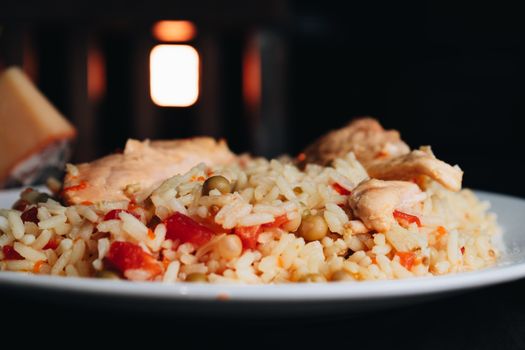
Photo: Andres Alaniz / Pexels
Costa-Rican
Arroz con Pollo
The diets react (see scores below)
Common Ingredients
- rice
- chicken
- bell pepper
- peas
- carrots
- onion
- garlic
- cilantro
- salsa lizano
Specific recipes may vary.
Incompatible with 6 of 11 diets
Diet Ratings
Arroz con Pollo is fundamentally built around white rice, which is a high-glycemic grain that is completely incompatible with ketogenic eating. A standard serving contains approximately 40-50g of net carbs from the rice alone, which meets or exceeds the entire daily keto carb allowance in a single dish. The additional ingredients — peas, carrots, and Salsa Lizano (which contains sugar and starch) — add further net carbs on top of that. While the chicken itself is keto-friendly and the vegetables like bell pepper, onion, garlic, and cilantro are used in small enough quantities to be manageable, the rice is the structural and caloric foundation of this dish and cannot be reduced to a keto-compatible portion without fundamentally changing the dish. There is no meaningful way to consume a standard serving of Arroz con Pollo and maintain ketosis.
Arroz con Pollo contains chicken as its primary protein, which is poultry and a direct animal product. This is an unambiguous violation of vegan dietary principles. There is no meaningful debate within the vegan community about whether poultry is acceptable — it is not. The remaining ingredients (rice, bell pepper, peas, carrots, onion, garlic, cilantro, salsa lizano) are plant-based, but the presence of chicken makes this dish entirely incompatible with a vegan diet.
Arroz con Pollo is fundamentally incompatible with the paleo diet. Rice is a grain and is explicitly excluded under core paleo principles. Peas are legumes and are also excluded. Salsa Lizano, the signature Costa Rican condiment, is a processed sauce containing added sugar, salt, and various additives — none of which are paleo-compliant. While several ingredients are perfectly paleo (chicken, bell pepper, carrots, onion, garlic, cilantro), the dish's two foundational components — rice and peas — are non-negotiable exclusions, and Salsa Lizano adds a third layer of non-compliance. This is not a dish that can be lightly modified; removing rice and peas would fundamentally change its identity.
Arroz con Pollo is a mixed dish featuring chicken (a Mediterranean-acceptable moderate protein), white rice (a refined grain not prioritized in modern Mediterranean guidelines), and an array of vegetables including bell pepper, peas, carrots, onion, and garlic, which are strongly aligned with Mediterranean principles. The vegetable content adds meaningful nutritional value and fiber. However, white rice is the dominant carbohydrate base rather than whole grains, which limits the score. Chicken is acceptable in moderation per Mediterranean diet rules. Salsa Lizano is a mildly processed condiment with low sugar and fat content, posing minimal concern. The dish lacks olive oil as a primary fat (preparation typically uses vegetable oil), and there is no legume emphasis or fish component. Overall, this is a moderate, home-cooked dish that is not antithetical to Mediterranean principles but is not a core staple either.
Some Mediterranean diet practitioners applying a 'traditional whole foods' lens would view this dish more favorably, noting that chicken-and-vegetable one-pot dishes closely resemble traditional Southern European and Eastern Mediterranean home cooking. The abundance of vegetables and lean poultry could push it toward a low 'approve' under flexible interpretations, particularly if prepared with olive oil.
Arroz con Pollo is almost entirely plant-based by volume and composition. Rice is a grain and a staple carbohydrate completely excluded from the carnivore diet. Bell peppers, peas, carrots, onion, garlic, and cilantro are all plant-derived vegetables and herbs — none of which are permitted. Salsa Lizano is a processed condiment made from vegetables and spices with no animal-derived components. While chicken itself is acceptable to most carnivore practitioners, it represents only a fraction of this dish. The overwhelming majority of ingredients are explicitly excluded on carnivore, leaving no meaningful path to adaptation without completely reconstructing the dish.
Arroz con Pollo contains two major Whole30-excluded ingredients. First, rice is a grain and is explicitly prohibited on the Whole30 program. Second, Salsa Lizano — the iconic Costa Rican condiment central to this dish — contains sugar and wheat, both of which are excluded. Peas are also a legume (unlike green beans, snow peas, or sugar snap peas, which are explicitly excepted); regular peas/green peas are not on the exception list. With rice as a foundational ingredient, this dish cannot be made Whole30-compliant without fundamentally changing its identity.
Costa Rican Arroz con Pollo contains multiple high-FODMAP ingredients that make it unsuitable during the elimination phase. Onion and garlic are the most problematic — both are high in fructans and are among the highest-FODMAP ingredients tested by Monash University. Peas are high in GOS and fructans at typical serving sizes (safe only at very small portions like 1/4 cup). Salsa Lizano, the signature Costa Rican condiment, contains onion and garlic derivatives and has not been tested by Monash, making its FODMAP status uncertain but likely problematic. Rice and chicken are low-FODMAP, and bell pepper, carrots, and cilantro are generally low-FODMAP at standard servings. However, the combination of onion, garlic, peas, and likely Salsa Lizano creates a high cumulative FODMAP load that makes this dish inappropriate for the elimination phase without significant modification.
Monash University clearly rates onion and garlic as high-FODMAP at any typical serving, so the base verdict is well-supported. However, some clinical FODMAP practitioners note that if garlic-infused oil is substituted for garlic, onion is omitted, peas are used in very small quantities (under 1/4 cup), and a low-FODMAP sauce replaces Salsa Lizano, a modified version of this dish could be made low-FODMAP — but this would be a substantially different recipe from the traditional preparation.
Costa Rican Arroz con Pollo is built largely on DASH-friendly ingredients: lean chicken, a variety of vegetables (bell pepper, peas, carrots, onion, garlic), and rice. The vegetable and lean protein components align well with DASH principles. However, two factors push this into 'caution' territory. First, white rice—the standard form used in this dish—is a refined grain, whereas DASH emphasizes whole grains. Second, and more significantly, Salsa Lizano is a ubiquitous Costa Rican condiment that contributes meaningful sodium (roughly 160–200mg per tablespoon) and is typically used in generous amounts; a full serving of this dish can approach 600–900mg of sodium depending on preparation, which is manageable within the 2,300mg/day standard DASH target but requires portion awareness. The dish contains no high saturated fat sources, no added sugars of concern, and no red meat or tropical oils, which are positives. Overall it is acceptable in moderation but is not a core DASH dish due to refined grains and moderate sodium from Salsa Lizano.
NIH DASH guidelines explicitly favor whole grains over refined grains and low-sodium condiments; a strict interpretation would flag white rice and Salsa Lizano. However, updated clinical interpretations note that when refined grains are consumed alongside fiber-rich vegetables and lean protein—as in this dish—the overall glycemic and cardiovascular impact is moderated, and some DASH-aligned practitioners consider this an acceptable cultural adaptation provided total daily sodium remains within target.
Arroz con Pollo is a Zone-compatible meal in concept — lean chicken protein paired with vegetables — but the white rice base makes it a 'caution' food in Zone terminology. Rice is a high-glycemic carbohydrate that Sears classifies as 'unfavorable,' meaning it can spike insulin and disrupt the 40/30/30 hormonal balance. The dish's favorable elements are significant: chicken is an ideal lean Zone protein, and the bell peppers, peas, carrots, onion, and garlic all count as favorable low-glycemic carbohydrates with good polyphenol content. Salsa Lizano adds flavor with minimal macro disruption. The core problem is that traditional Arroz con Pollo is rice-heavy, making the carbohydrate load both high and high-glycemic — the opposite of the Zone ideal of vegetable-dominant, low-GI carbs. To bring this dish into Zone balance, one would need to significantly reduce the rice portion (treating it as a small carb block, roughly 1/3 cup cooked), increase the vegetable ratio, and ensure the chicken portion is appropriately sized (~3 oz). With those adjustments, it can work within Zone blocks, but as traditionally served in Costa Rican portions, it is rice-dominant and carbohydrate-heavy.
Costa Rican Arroz con Pollo is a balanced, whole-food dish with several anti-inflammatory positives. Chicken (lean protein) is an acceptable moderate food on anti-inflammatory frameworks. The vegetable medley — bell peppers (rich in vitamin C and carotenoids), carrots (beta-carotene), peas (fiber, plant protein), onion, and garlic (quercetin, allicin) — all contribute meaningful antioxidant and anti-inflammatory value. Cilantro adds polyphenols. Garlic is a well-documented anti-inflammatory ingredient. The main limiting factor is white rice, a refined carbohydrate that offers little fiber and can modestly spike blood sugar, which is associated with low-grade inflammation. Salsa Lizano, a Costa Rican Worcestershire-style condiment, is used in small amounts and contains some spices and vegetables, but also added sugar and sodium; its processed nature is a mild concern. Overall, this dish leans toward neutral-to-moderately beneficial: it's a real-food, vegetable-rich preparation with lean protein, but the white rice base and processed condiment prevent a full approval.
Some anti-inflammatory practitioners (and Dr. Weil's framework) would view this dish more favorably, arguing that the overall dietary pattern matters more than any single refined carbohydrate, and that the generous vegetable content and lean protein make this a reasonable whole-food meal. Others following stricter anti-inflammatory or low-glycemic protocols would flag white rice more seriously, recommending substitution with brown rice or cauliflower rice to meaningfully improve the inflammatory profile.
Costa Rican Arroz con Pollo is a balanced, whole-food dish built around lean chicken and vegetables (bell pepper, peas, carrots, onion, garlic), making it a reasonable GLP-1-friendly option. The chicken provides a solid lean protein source, and the colorful vegetables contribute fiber, micronutrients, and hydration. Salsa Lizano is a low-fat, mildly spiced condiment that adds flavor without significant fat or sugar burden. The primary limitation is rice, a refined carbohydrate with moderate fiber and low protein density per calorie — it can fill a small GLP-1-reduced stomach quickly without delivering enough protein or fiber per bite. The dish's overall protein density depends heavily on the chicken-to-rice ratio in the serving; a rice-heavy portion may leave protein targets unmet at that meal. It is low in fat and easy to digest, which works in its favor. With a protein-forward plating (larger chicken portion, smaller rice portion, generous vegetables), this dish can comfortably support GLP-1 dietary goals.
Some GLP-1-focused dietitians approve this dish readily as a culturally appropriate, low-fat, whole-food meal and would not flag the rice given its role in balanced blood sugar alongside fiber from vegetables. Others caution that the rice-to-protein ratio in traditional servings makes it harder to hit the 15–30g protein-per-meal target in a small appetite window, and recommend explicitly upsizing the chicken and downsizing the rice when plating.
*See how scores were generated at our methodology page.
Nutritional profile
Six traits that cut across every diet.
Fiber & Plants
How much whole-plant food and fiber it delivers.
Healthy Fats
The quality of its fats (unsaturated, omega-3).
Whole / Unprocessed
How close it is to its natural, unprocessed form.
Gut Gentle
How easy it is on digestion (low FODMAP, few irritants).
Low Glycemic
How little it spikes your blood sugar.
Protein Density
How much protein it packs per calorie.
Controversy Index
Higher controversy = more disagreement between diets.
Diet-Specific Tips
 Mediterranean — 5/10
View tips
- Chicken is an acceptable moderate-frequency protein under Mediterranean guidelines
- White rice base is a refined grain, not preferred over whole grains like brown rice or farro
- Strong vegetable profile (bell pepper, peas, carrots, onion, garlic) aligns well with Mediterranean principles
- Salsa Lizano is a mildly processed condiment with minimal nutritional concern
- Preparation likely uses vegetable rather than olive oil, missing a key Mediterranean fat source
- No fish, legumes, or whole grains to elevate the dish to core Mediterranean status
 DASH — 6/10
View tips
- Lean chicken is a DASH-approved protein source
- Multiple vegetables (bell pepper, peas, carrots, onion, garlic) boost potassium, magnesium, and fiber
- Salsa Lizano adds moderate sodium and must be portioned carefully
- White rice is a refined grain; substituting brown rice would improve DASH alignment
- No saturated fat sources, tropical oils, red meat, or added sugars
- Total dish sodium is manageable under standard DASH (2,300mg/day) but tighter under low-sodium DASH (1,500mg/day)
- Portion size is important—larger servings increase sodium and refined carbohydrate load
 Zone — 5/10
View tips
- White rice is a high-glycemic 'unfavorable' carbohydrate in Zone methodology — primary concern
- Chicken is an ideal lean Zone protein source
- Bell peppers, carrots, peas, onion, and garlic are favorable low-GI Zone carbohydrates that partially offset the rice
- Dish is typically rice-heavy, making the carb load and glycemic index too high for easy Zone integration
- Salsa Lizano is low in fat and sugar, adding minimal Zone disruption
- Portion control and rice reduction can bring this dish into Zone compliance, but requires active adjustment from traditional serving sizes
- No significant saturated fat concerns — dish is naturally lean
 Anti-Inflammatory — 6/10
View tips
- Lean chicken is an acceptable moderate protein on anti-inflammatory diets
- Bell peppers high in vitamin C and carotenoids — anti-inflammatory
- Garlic and onion provide quercetin and allicin with documented anti-inflammatory effects
- Carrots supply beta-carotene; peas add fiber and plant protein
- Cilantro contributes polyphenols
- White rice is a refined carbohydrate with limited fiber — mildly pro-inflammatory via glycemic effect
- Salsa Lizano is a mildly processed condiment with added sugar and sodium — minor concern in typical amounts
- No trans fats, seed oils, or highly processed ingredients — overall a clean whole-food dish
 GLP-1 Friendly — 6/10
View tips
- Lean chicken is a high-quality protein source supporting muscle preservation
- Rice is a refined carbohydrate that occupies stomach volume with limited protein or fiber payoff
- Peas, carrots, and bell pepper add fiber, micronutrients, and digestive support
- Salsa Lizano is low-fat and mildly flavored — unlikely to worsen GI side effects
- Dish is low in fat and easy to digest, compatible with slowed gastric emptying
- Protein adequacy per serving is portion-ratio dependent — chicken-to-rice ratio is critical
- No fried components, no high-sugar ingredients, no carbonation or alcohol — clean ingredient profile