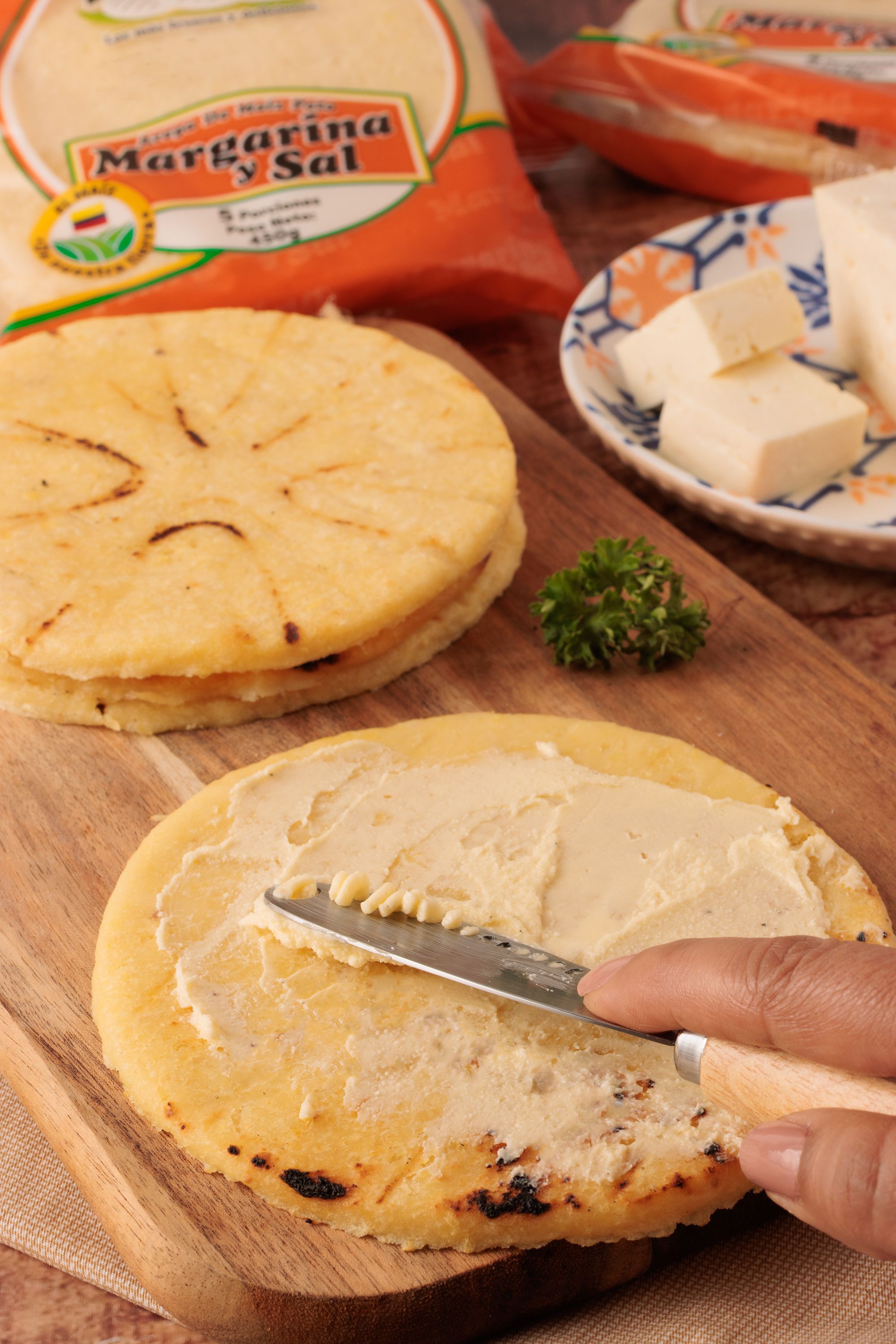
Photo: Christian Bolaños / Pexels
Costa-Rican
Chorreadas
The diets react (see scores below)
Common Ingredients
- fresh corn
- flour
- sugar
- eggs
- milk
- butter
- sour cream
Specific recipes may vary.
Incompatible with 7 of 11 diets
Diet Ratings
Chorreadas are Costa Rican corn pancakes made primarily from fresh corn, flour, and sugar — three ingredients that are fundamentally incompatible with ketogenic eating. Fresh corn alone is a starchy grain with approximately 25-30g net carbs per ear, and combined with wheat flour and added sugar, a single chorreada could easily contain 30-50g of net carbs, potentially exceeding the entire daily keto carb allowance in one serving. While the dish does contain keto-friendly ingredients like eggs, butter, milk, and sour cream, these are overwhelmed by the high-carb base. There is no meaningful modification that preserves the dish's character while making it keto-compatible, as corn and flour are its defining ingredients.
Chorreadas are Costa Rican fresh corn pancakes that contain multiple animal-derived ingredients: eggs, milk, butter, and sour cream. All four are direct animal products — eggs from poultry and the remaining three from dairy. This dish is fundamentally incompatible with a vegan diet as written. A vegan adaptation would require substituting all four ingredients (e.g., flax eggs, plant-based milk, vegan butter, and cashew or coconut-based sour cream), which would produce a different but vegan-friendly version.
Chorreadas are Costa Rican corn pancakes that contain multiple paleo-excluded ingredients. Flour (wheat) is a grain and strictly off-limits. Corn, while technically a vegetable in culinary terms, is classified as a grain in paleo and is explicitly excluded. Milk, butter, and sour cream are all dairy products, which are excluded from the paleo diet. Sugar is refined and excluded. Nearly every core ingredient in this dish violates paleo principles, making it a clear avoid with high confidence.
Chorreadas are Costa Rican fresh corn pancakes that contain several ingredients problematic for the Mediterranean diet. While fresh corn has some nutritional value, the dish combines refined flour, added sugar, butter, and sour cream — none of which align with Mediterranean principles. Butter replaces the canonical extra virgin olive oil as the primary fat, and sour cream adds saturated fat without Mediterranean precedent. The added sugar and refined flour push this firmly into 'avoid' territory. Eggs and milk are acceptable in moderation but don't redeem the overall profile of this sweetened, butter-based pancake.
Some Mediterranean diet interpreters might view this more leniently as an occasional treat, noting that eggs and dairy are permitted in moderation, and that corn-based foods appear in some Mediterranean-adjacent cuisines. The fresh corn component provides whole-food value that distinguishes it from purely refined grain products.
Chorreadas are Costa Rican corn pancakes made primarily from fresh corn, flour, and sugar — all plant-derived ingredients that are strictly excluded on the carnivore diet. While the dish does contain some animal-derived ingredients (eggs, milk, butter, sour cream), these are minor components in a recipe that is fundamentally grain- and plant-based. The corn and flour alone make this entirely incompatible with carnivore principles, and the added sugar further disqualifies it. No modification of this dish would make it carnivore-compliant without completely changing its identity.
Chorreadas are Costa Rican corn pancakes that contain multiple excluded ingredients. Flour (grain), sugar (added sugar), milk (dairy), butter (dairy — only ghee/clarified butter is allowed), and sour cream (dairy) are all explicitly prohibited on Whole30. Even setting aside the excluded ingredients, this dish is a pancake/crepe-style food that falls squarely under Whole30's rule 4 prohibition on recreating baked goods and junk food with compliant ingredients — meaning even a reformulated version would violate the program's spirit.
Chorreadas are Costa Rican corn pancakes that contain several problematic FODMAP ingredients. The most significant concern is fresh corn, which is high in polyols (sorbitol) at typical serving sizes — Monash rates sweet corn as low-FODMAP only at very small amounts (about 1/2 cob or 38g kernels), and chorreadas use corn as the primary base ingredient, meaning the corn content per serving will almost certainly exceed the safe threshold. Additionally, milk contributes lactose (high-FODMAP unless lactose-free), and sour cream also contains lactose. Wheat flour adds fructans, compounding the problem. The combination of corn (polyols), wheat flour (fructans), milk (lactose), and sour cream (lactose) makes this dish high-FODMAP across multiple FODMAP categories at any standard serving size. Butter and eggs are low-FODMAP, and sugar is fine, but they cannot offset the multiple high-FODMAP ingredients.
Monash University rates sweet corn as low-FODMAP at 38g (about 1/2 small cob), so some FODMAP practitioners might argue that if the corn content per pancake were carefully controlled and lactose-free dairy substitutions were made, a modified version could be tolerated. However, traditional preparation uses full quantities of corn and standard dairy, making safe consumption during the elimination phase highly unlikely without significant recipe modification.
Chorreadas are Costa Rican fresh corn pancakes made with whole corn, flour, sugar, eggs, milk, butter, and sour cream. They contain some DASH-friendly elements — fresh corn provides fiber and potassium, and milk adds calcium — but several ingredients raise concerns. Butter contributes saturated fat, sour cream is a full-fat dairy product (DASH specifies low-fat dairy), and added sugar is present. The refined flour component reduces whole-grain benefit. The sodium content is naturally low, which is a positive. Overall, this is an acceptable occasional breakfast item but not a core DASH food due to the saturated fat from butter and sour cream and the added sugar. Substituting low-fat dairy or Greek yogurt for sour cream, using less butter, and reducing sugar would improve DASH compatibility.
NIH DASH guidelines explicitly limit saturated fat and specify low-fat dairy, which places sour cream and butter in the 'limit' category. However, updated clinical interpretations note that emerging research challenges the cardiovascular harm of full-fat dairy specifically, and some DASH-oriented dietitians may allow small amounts of full-fat dairy in an otherwise balanced pattern, potentially rating this dish more favorably if portion-controlled.
Chorreadas are Costa Rican corn pancakes made primarily from fresh corn, flour, sugar, butter, milk, and sour cream — a combination that creates significant Zone Diet challenges. The carbohydrate base is high-glycemic: corn is classified as an 'unfavorable' carb in Zone terminology due to its higher glycemic load, flour adds more high-GI starch, and added sugar further spikes the glycemic response. The fat profile is problematic as well — butter and sour cream contribute saturated fat rather than the monounsaturated fats Sears prefers. There is essentially no lean protein in this dish (eggs are present but in a minor role as a binder, not as a primary protein source), making the 40/30/30 macro ratio nearly impossible to achieve with this dish alone. As a breakfast item, it would need to be paired with substantial lean protein (e.g., egg whites) and the portion would need to be drastically limited to manage glycemic load. The dish is borderline 'avoid' territory but earns a caution because small portions alongside a Zone-compliant protein source could technically be incorporated, and the fresh corn does provide some fiber and polyphenols compared to pure refined carb sources.
Some Zone practitioners and later Sears writings on polyphenols acknowledge that fresh/whole corn retains more fiber and phytonutrients than refined grain products, potentially moderating glycemic impact somewhat. A very small portion of chorreadas (one small pancake) alongside egg whites and avocado could approximate a Zone block structure — making this a 'use sparingly' food rather than a categorical avoid in practice-oriented Zone coaching.
Chorreadas are Costa Rican fresh corn pancakes with a mixed anti-inflammatory profile. On the positive side, fresh corn contributes fiber, carotenoids (lutein, zeaxanthin), and some antioxidant compounds. Eggs provide choline and selenium with some anti-inflammatory potential. However, the dish also contains several ingredients that raise concerns: refined flour adds refined carbohydrates with minimal nutritional value; added sugar contributes to glycemic load and can promote inflammatory signaling; butter and sour cream are full-fat dairy products high in saturated fat, which anti-inflammatory protocols advise limiting; and milk (full-fat) adds further saturated fat. The combination of refined carbs, added sugar, and saturated fat from multiple sources creates a moderately pro-inflammatory profile that offsets the modest benefits of fresh corn and eggs. Occasional consumption is acceptable, but this is not an anti-inflammatory-optimized breakfast. Modifications like reducing sugar, replacing butter with extra virgin olive oil, and using whole grain flour would improve the profile considerably.
Some anti-inflammatory practitioners take a more lenient view of whole dairy ingredients like butter and sour cream, arguing that the fat matrix in full-fat dairy has a neutral or even beneficial effect on inflammation compared to processed alternatives — a position gaining traction in recent research (e.g., work by Dariush Mozaffarian on dairy fat). Additionally, the fresh corn base gives this dish a more wholesome foundation than purely refined-grain pancakes, which some practitioners would weigh more favorably.
Chorreadas are Costa Rican fresh corn pancakes made with ground fresh corn, flour, sugar, eggs, milk, and butter, typically served with sour cream. While eggs and milk contribute modest protein, this dish is primarily a carbohydrate-forward, moderate-fat preparation with added sugar and saturated fat from butter and sour cream. The protein content per serving is low (roughly 5-8g depending on portion), falling well short of the 15-30g per meal target critical for GLP-1 patients. Fresh corn provides some fiber and micronutrients, which is a mild positive, but the overall nutrient density per calorie is poor. The butter and sour cream add saturated fat that can worsen GLP-1 side effects like nausea, bloating, and reflux. The added sugar further reduces the quality profile. Gastric emptying is already slowed on GLP-1 medications, and a fat-plus-refined-carb combination is likely to sit heavily and provoke GI discomfort. The dish is not fried, which prevents an even lower score, and the fresh corn base offers slightly more nutritional value than a purely refined-grain pancake. However, as a breakfast option for GLP-1 patients, it fails on nearly every priority: low protein, moderate-high saturated fat, added sugar, and low nutrient density per calorie. It would require significant modification — adding a high-protein side like eggs or cottage cheese and eliminating or reducing the sour cream and butter — to become acceptable.
Some GLP-1-focused dietitians may view traditional whole-food preparations like chorreadas more favorably than ultra-processed alternatives, noting that fresh corn provides natural fiber and that small portions alongside a protein source could make this workable. However, most clinicians would flag the saturated fat load from butter and sour cream as a meaningful GI risk, particularly for patients in early medication titration when side effects are most pronounced.
*See how scores were generated at our methodology page.
Nutritional profile
Six traits that cut across every diet.
Fiber & Plants
How much whole-plant food and fiber it delivers.
Healthy Fats
The quality of its fats (unsaturated, omega-3).
Whole / Unprocessed
How close it is to its natural, unprocessed form.
Gut Gentle
How easy it is on digestion (low FODMAP, few irritants).
Low Glycemic
How little it spikes your blood sugar.
Protein Density
How much protein it packs per calorie.
Controversy Index
Higher controversy = more disagreement between diets.
Diet-Specific Tips
 DASH — 5/10
View tips
- Fresh corn provides fiber and potassium — DASH-positive
- Sour cream is full-fat dairy, which DASH guidelines recommend limiting
- Butter adds saturated fat — DASH advises limiting saturated fat intake
- Added sugar present — DASH limits sweets and added sugars
- Low sodium content — favorable for DASH
- Refined white flour reduces whole-grain benefit
- Milk contributes DASH-valued calcium
- Eggs are acceptable in moderation under modern DASH interpretations
 Zone — 5/10
View tips
- Corn classified as 'unfavorable' high-glycemic carbohydrate in Zone methodology
- Added sugar compounds glycemic load, worsening insulin response
- White flour adds high-GI refined starch with minimal fiber
- Butter and sour cream provide saturated fat rather than preferred monounsaturated fat
- No meaningful lean protein source — eggs present only as minor binder
- 40/30/30 macro ratio essentially unachievable from this dish alone
- Would require pairing with substantial lean protein and limiting portion size dramatically to fit into any Zone meal
 Anti-Inflammatory — 4/10
View tips
- Fresh corn provides fiber and carotenoids (lutein, zeaxanthin) with anti-inflammatory properties
- Refined wheat flour contributes refined carbohydrates with minimal nutritional benefit
- Added sugar increases glycemic load and may promote inflammatory markers
- Butter and sour cream are full-fat dairy — high in saturated fat, flagged by anti-inflammatory protocols
- Eggs offer moderate anti-inflammatory nutrients (choline, selenium) but add arachidonic acid
- No omega-3 sources, polyphenol-rich vegetables, or key anti-inflammatory spices present
- Overall glycemic impact is high for a breakfast dish
 GLP-1 Friendly — 5/10
View tips
- Very low protein per serving (5-8g), far below the 15-30g per meal target
- Saturated fat from butter and sour cream increases nausea and bloating risk on GLP-1s
- Added sugar reduces nutrient density per calorie
- Fresh corn provides modest fiber and is a whole-food ingredient — mild positive
- No fried preparation, which limits severity
- Slowed gastric emptying makes fat-plus-carb combinations harder to tolerate
- Would require significant protein addition (eggs, cottage cheese) to be meal-appropriate