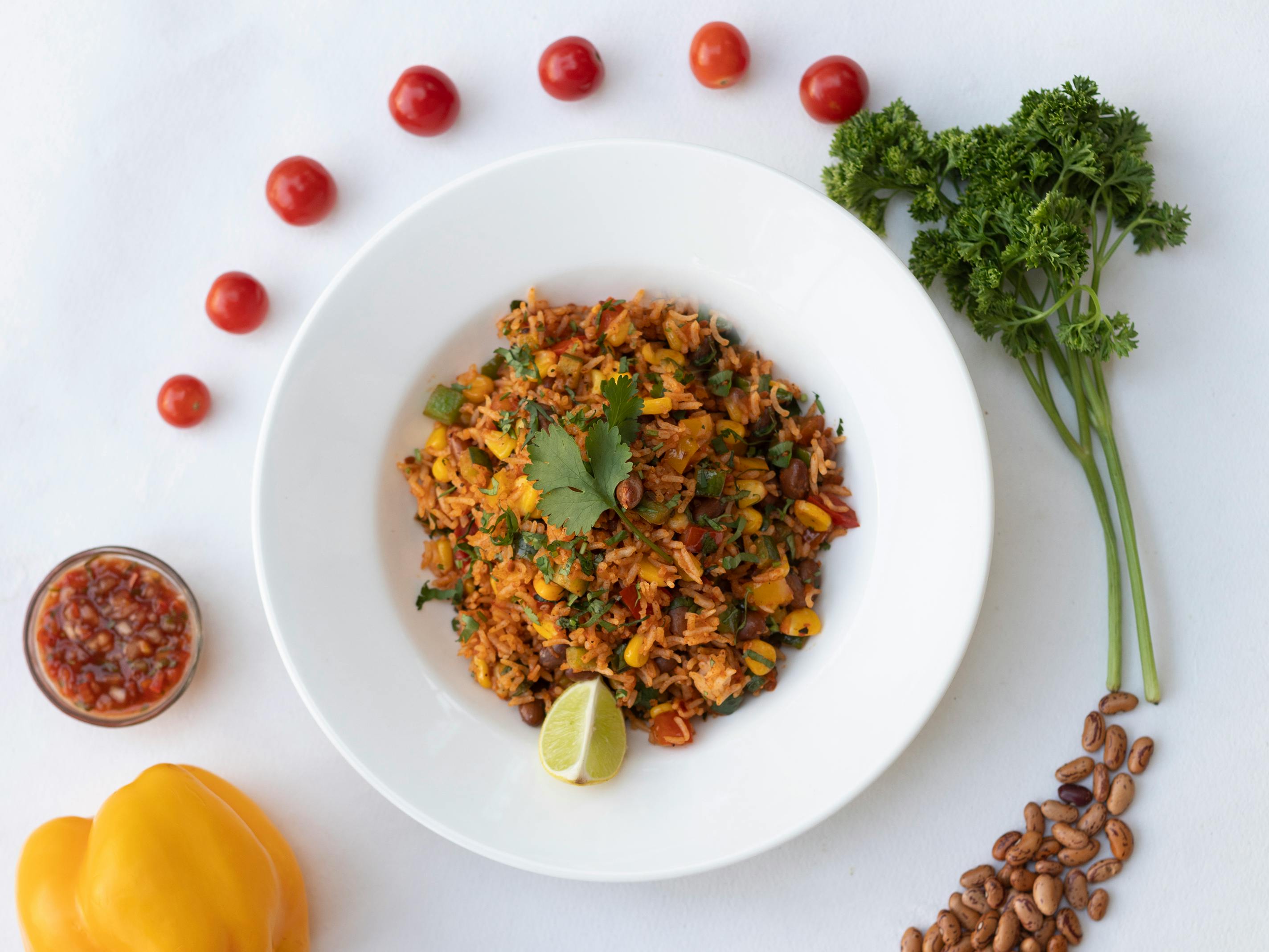
Photo: Prem Singh Tanwar / Pexels
Costa-Rican
Gallo Pinto
The diets react (see scores below)
Common Ingredients
- rice
- black beans
- onion
- bell pepper
- cilantro
- garlic
- salsa lizano
Specific recipes may vary.
Incompatible with 5 of 11 diets
Diet Ratings
Gallo Pinto is built on two of the most keto-incompatible ingredients possible: white rice and black beans. White rice is a high-glycemic refined grain with virtually no fiber, delivering roughly 45g of net carbs per cooked cup. Black beans, while containing fiber, still contribute approximately 20-25g of net carbs per half-cup serving. Together, a standard serving of Gallo Pinto easily delivers 60-80g of net carbs, which alone exceeds or severely breaches the entire daily keto carb budget in a single meal. The aromatics (onion, bell pepper, cilantro, garlic) and Salsa Lizano add minor additional carbs. There is no meaningful fat content and protein is moderate but from a high-carb legume source. This dish is fundamentally incompatible with ketosis regardless of portion size, as even a small serving would consume the majority of the daily carb allowance with no path to modification that preserves the dish's identity.
Gallo Pinto is a traditional Costa Rican rice-and-beans dish built entirely from plant-based whole foods. Rice, black beans, onion, bell pepper, cilantro, and garlic are all unambiguously vegan. Salsa Lizano, the iconic Costa Rican condiment that defines this dish's flavor, is plant-based in its standard formulation — it contains vegetables, spices, and water with no animal-derived ingredients listed. All components are whole or minimally processed foods, earning a high score within the approve range. The slight confidence reduction from high to medium reflects the fact that Salsa Lizano's exact formula can vary and some regional or homemade preparations of Gallo Pinto include lard or are served alongside eggs or sour cream, though these would be accompaniments rather than ingredients in the dish itself as listed.
Some vegans scrutinizing processed condiments like Salsa Lizano may flag uncertainty around natural flavoring additives or manufacturing practices, and strict whole-food plant-based advocates may note the dish is often served in contexts (casado plates) where animal products are added tableside — though neither concern applies to the ingredient list as presented.
Gallo Pinto is built on two of the most firmly excluded food groups in the paleo diet: grains (white rice) and legumes (black beans). Both are explicitly off-limits under every major paleo framework, including Cordain's original 'The Paleo Diet,' Robb Wolf's 'The Paleo Solution,' and Mark Sisson's 'Primal Blueprint.' Rice is a grain excluded due to its anti-nutrient profile and agricultural origin, while black beans are a legume excluded due to lectins, phytates, and their incompatibility with a hunter-gatherer food model. Salsa Lizano, the signature Costa Rican condiment, is a processed sauce containing added salt, sugar, and preservatives — further disqualifying the dish. The remaining ingredients (onion, bell pepper, cilantro, garlic) are paleo-approved, but they are minor components that cannot redeem a dish whose foundation is entirely non-paleo.
Gallo Pinto is a wholesome, plant-forward dish built on legumes and vegetables — black beans, onion, bell pepper, garlic, and cilantro all align well with Mediterranean dietary principles. Beans are a cornerstone protein in the Mediterranean diet. However, the rice used is typically white rice (refined grain), which is less preferred than whole grains under modern Mediterranean guidelines. Salsa Lizano is a mildly processed condiment containing added sugars and sodium, which is a minor concern. The dish contains no red meat, no saturated fat, and no highly processed ingredients, making it largely compatible, but the refined grain base and processed condiment prevent a full approval.
Some Mediterranean diet frameworks — particularly those drawing on traditional Southern European and Middle Eastern practices — accept white rice as a reasonable grain, especially when paired with legumes (as in rice-and-bean dishes common in Greece and the Levant). Under this lens, Gallo Pinto could score higher, as the bean-to-grain ratio and vegetable content reflect the spirit of the diet well.
Gallo Pinto is entirely plant-based and contains zero animal products. Every single ingredient — rice, black beans, onion, bell pepper, cilantro, garlic, and salsa lizano — is either a grain, legume, vegetable, herb, or plant-derived condiment. This dish is the antithesis of the carnivore diet. Legumes (black beans) and grains (rice) are among the most excluded food categories in carnivore eating due to their antinutrient content (lectins, phytates, oxalates). There is unanimous consensus across all carnivore camps — from the strictest Lion Diet to the more inclusive animal-based approach — that this dish is completely incompatible.
Gallo Pinto contains two excluded ingredients: rice (a grain) and black beans (a legume). Both are explicitly prohibited on Whole30. Unlike green beans, sugar snap peas, and snow peas — which are specifically excepted despite being legumes — black beans have no such exception. Rice is categorically excluded as a grain. Even if Salsa Lizano were compliant (it contains sugar and wheat, making it non-compliant as well), the foundational ingredients of this dish are incompatible with Whole30. This dish cannot be made Whole30-compliant without fundamentally changing its nature.
Gallo Pinto as traditionally prepared contains multiple high-FODMAP ingredients that make it unsuitable during the elimination phase. Black beans are high in GOS (galacto-oligosaccharides) and are high-FODMAP at standard serving sizes — even canned/rinsed black beans remain problematic at typical portions eaten in a full dish. Garlic is one of the highest-FODMAP foods (fructans) and is a core aromatic in this recipe. Onion is similarly high in fructans and used as a foundational ingredient. Salsa Lizano, the signature Costa Rican condiment, contains onion and garlic derivatives and has not been formally tested by Monash, adding further FODMAP risk. Rice and bell pepper are low-FODMAP and cilantro is safe, but they cannot offset the multiple high-FODMAP components. In a standard serving of Gallo Pinto, beans alone would likely exceed the low-FODMAP threshold, and combined with garlic and onion, the dish presents significant FODMAP load across GOS and fructan categories.
Monash University notes that canned lentils (and by extension some canned legumes, rinsed thoroughly) can be lower in GOS than dried, and some FODMAP practitioners allow very small portions of well-rinsed canned black beans (e.g., 40g). However, the combined presence of garlic, onion, and Salsa Lizano — all high-fructan ingredients — means the dish fails elimination criteria even if the bean portion were controlled, making modification rather than consumption the practical recommendation.
Gallo Pinto is built on a DASH-friendly foundation: black beans provide excellent plant-based protein, fiber, potassium, and magnesium; rice (ideally brown) contributes whole-grain nutrients; onion, bell pepper, cilantro, and garlic are all DASH-encouraged vegetables with negligible sodium. The primary concern is Salsa Lizano, the signature Worcestershire-style condiment that defines the dish's flavor. Salsa Lizano contains a meaningful amount of sodium — roughly 160–200mg per tablespoon — and the dish typically uses several tablespoons, potentially adding 400–600mg of sodium to a single serving. This doesn't make the dish off-limits, but it meaningfully erodes the sodium budget, especially under the stricter 1,500mg/day DASH target. White rice (the most common preparation) is also less ideal than brown rice on DASH, as it lacks the fiber and micronutrient profile of whole grains. Overall, this is a nutritionally dense, low-saturated-fat, plant-forward meal that aligns well with DASH principles but requires portion control on the Salsa Lizano and ideally a brown rice substitution.
NIH DASH guidelines emphasize limiting sodium to 1,500–2,300mg/day, which puts Salsa Lizano under scrutiny. However, updated clinical interpretations note that a predominantly plant-based meal rich in potassium and magnesium (from beans) may partially offset sodium's blood pressure impact, and some DASH practitioners consider this dish acceptable as a regular breakfast if Salsa Lizano is used sparingly or a reduced-sodium version is chosen.
Gallo Pinto presents a classic Zone Diet challenge: it combines two carbohydrate-dense ingredients (rice and black beans) with no dedicated lean protein source and no fat component. In Zone terms, both rice and black beans count primarily as carbohydrate blocks, though beans do contribute some protein. White rice is a high-glycemic, 'unfavorable' carb that Sears explicitly discourages, and it dominates this dish alongside beans. The result is a meal heavily skewed toward carbohydrates with an inadequate protein-to-carb ratio and essentially no fat. The vegetable components — onion, bell pepper, cilantro, garlic — are excellent low-glycemic, polyphenol-rich additions that Sears would applaud. Salsa Lizano adds minimal macronutrient concern. However, as a standalone meal, Gallo Pinto cannot achieve the 40/30/30 Zone ratio without significant additions: a dedicated lean protein (eggs, low-fat cheese, or another source) and a monounsaturated fat (avocado is the natural pairing here). With those additions, a small portion of Gallo Pinto could serve as the carbohydrate block component of a Zone breakfast. The traditional serving size, however, is too carbohydrate-heavy to balance easily.
Some Zone practitioners argue that black beans, being a high-fiber legume with a moderate glycemic load and dual protein-carb contribution, partially offset the white rice's glycemic impact. In later writings, Dr. Sears acknowledged that fiber-rich legumes are among the better carbohydrate choices due to their effect on insulin response. A small portion of Gallo Pinto paired with eggs and avocado could approximate a reasonable Zone breakfast — the dish is not inherently Zone-incompatible, just structurally incomplete as a standalone meal.
Gallo Pinto is a traditional Costa Rican dish built on a foundation of anti-inflammatory staples. Black beans are rich in fiber, polyphenols (particularly anthocyanins), and plant protein — all associated with reduced inflammatory markers like CRP. Rice provides whole-grain energy, though white rice (the typical form used) is more neutral than pro-inflammatory. Onion, garlic, and bell pepper contribute quercetin, allicin, and vitamin C respectively — well-established anti-inflammatory compounds. Cilantro adds antioxidant flavonoids. Salsa Lizano, a mild Worcestershire-style sauce popular in Costa Rica, is the one ingredient warranting scrutiny: it contains some sugar and additives, but is used in relatively small quantities as a condiment, keeping its impact modest. The dish is naturally low in saturated fat, free of trans fats, and high in fiber and plant-based nutrients. The main limitation is the use of white rice rather than a whole grain, which makes the glycemic profile less ideal than it could be, and Salsa Lizano's processed nature introduces a small concern. Overall, Gallo Pinto aligns well with anti-inflammatory principles as a legume-forward, vegetable-rich, minimally processed meal.
Some anti-inflammatory practitioners following low-glycemic or autoimmune-adjacent protocols (e.g., AIP-influenced guidance) would flag white rice as a refined carbohydrate with higher glycemic impact, and Salsa Lizano's processed ingredients and added sugars as mildly problematic. Pairing beans with white rice also raises concerns about overall glycemic load in grain-sensitive individuals, though mainstream anti-inflammatory nutrition (including Dr. Weil's framework) treats beans and rice as beneficial whole foods worthy of emphasis.
Gallo Pinto is a nutritionally respectable traditional dish but presents a mixed profile for GLP-1 patients. Black beans contribute meaningful fiber (roughly 7-8g per half cup) and plant-based protein (around 7-8g per half cup), and the vegetable aromatics (onion, bell pepper, garlic, cilantro) add micronutrients with minimal caloric cost. Salsa Lizano is low in fat and used in small quantities, so it poses little concern. However, the combination of rice and beans creates a carbohydrate-heavy, calorie-moderate meal that is relatively low in protein density per calorie — a standard serving is unlikely to reach the 15-30g protein target per meal on its own. Rice is a refined-adjacent starch that digests quickly and adds caloric bulk without proportional nutritional return. The dish is low in fat and easy to digest, which are positives for GLP-1 tolerability, but the protein gap is a significant drawback for muscle preservation. As a standalone breakfast, it would need a protein complement (eggs, cottage cheese, Greek yogurt) to meet GLP-1 dietary priorities. Portion sensitivity is also relevant — the rice-to-bean ratio matters, and larger servings increase carbohydrate load without meaningfully improving protein intake.
Some GLP-1-focused dietitians view bean-based dishes favorably as a practical high-fiber, plant-protein option that supports satiety and gut motility, particularly for patients who struggle with meat-based proteins due to nausea. Others caution that the protein-per-calorie ratio of rice-and-bean combinations is too low to meet GLP-1 muscle preservation goals without significant dietary additions, and prefer patients prioritize animal proteins or concentrated plant proteins like tofu or edamame at breakfast.
*See how scores were generated at our methodology page.
Nutritional profile
Six traits that cut across every diet.
Fiber & Plants
How much whole-plant food and fiber it delivers.
Healthy Fats
The quality of its fats (unsaturated, omega-3).
Whole / Unprocessed
How close it is to its natural, unprocessed form.
Gut Gentle
How easy it is on digestion (low FODMAP, few irritants).
Low Glycemic
How little it spikes your blood sugar.
Protein Density
How much protein it packs per calorie.
Controversy Index
Higher controversy = more disagreement between diets.
Diet-Specific Tips
 Vegan — 8/10
View tips
- Rice and black beans are whole plant foods and primary components
- All aromatics (onion, bell pepper, garlic, cilantro) are unambiguously vegan
- Salsa Lizano standard formula is plant-based with no animal-derived ingredients
- No dairy, eggs, or meat in the listed ingredients
- Dish is protein-complete via beans and complementary grain
- Traditional preparations sometimes use lard, but none is listed here
- High nutritional value with fiber, plant protein, and micronutrients
 Mediterranean — 6/10
View tips
- Black beans are an excellent plant-based protein strongly encouraged in the Mediterranean diet
- Aromatics (onion, garlic, bell pepper, cilantro) are core Mediterranean-style vegetables
- White rice is a refined grain, less preferred than whole grains under modern Mediterranean guidelines
- Salsa Lizano is a mildly processed condiment with added sugar and sodium
- No red meat, no saturated fat, no highly processed ingredients
- Overall dish is plant-forward and nutrient-dense despite the refined grain component
 DASH — 6/10
View tips
- Black beans are a DASH star food — high in fiber, potassium, magnesium, and plant protein
- Salsa Lizano adds significant sodium (est. 400–600mg per serving depending on amount used), the dish's main DASH liability
- Vegetables (onion, bell pepper, garlic, cilantro) are fully DASH-compatible with negligible sodium
- White rice is the typical base — brown rice would improve whole-grain alignment with DASH
- No saturated fat, no added sugar, no red meat — strong profile in those dimensions
- Portion size matters: a large serving increases sodium and carbohydrate load
- Low-sodium Salsa Lizano or reduced quantities would push the score into approve territory
 Zone — 4/10
View tips
- White rice is a high-glycemic 'unfavorable' carbohydrate that Sears explicitly discourages
- Black beans serve dual role as carb and partial protein source, but count primarily as a carbohydrate block in Zone accounting
- Dish is carbohydrate-dominant with no dedicated lean protein or fat — cannot achieve 40/30/30 as served
- Bell pepper, onion, garlic, and cilantro are excellent low-glycemic, polyphenol-rich Zone-favorable vegetables
- Would require significant additions (eggs or lean protein, avocado or olive oil) to function as a Zone-compliant meal
- Portion size is critical — a small amount as a carb block paired with proper protein and fat is more workable than a full traditional serving
 Anti-Inflammatory — 7/10
View tips
- Black beans: rich in fiber, anthocyanins, and plant protein — strongly anti-inflammatory
- Garlic and onion: allicin and quercetin contribute meaningful anti-inflammatory activity
- Bell pepper: high in vitamin C and carotenoids, supports antioxidant defense
- White rice: glycemically neutral to mildly unfavorable; whole grain rice would improve score
- Salsa Lizano: small amount of processed condiment with added sugar — minor concern
- No saturated fat, trans fats, or pro-inflammatory oils present
- Plant-based, high-fiber meal profile supports gut microbiome and reduces systemic inflammation
 GLP-1 Friendly — 5/10
View tips
- Moderate plant-based protein from black beans (~7-8g per half cup), insufficient to meet 15-30g per meal target alone
- Good fiber contribution from black beans supports digestion and helps counter GLP-1-related constipation
- Rice adds carbohydrate bulk with lower nutrient density per calorie — a drawback given reduced appetite
- Low fat content supports GLP-1 tolerability and minimizes nausea/reflux risk
- Easy to digest — compatible with slowed gastric emptying
- Salsa Lizano is low-risk in typical condiment quantities
- Needs a protein complement (eggs, cottage cheese) to function as a GLP-1-appropriate breakfast
- Portion-sensitive: rice-to-bean ratio and serving size significantly affect the nutritional profile