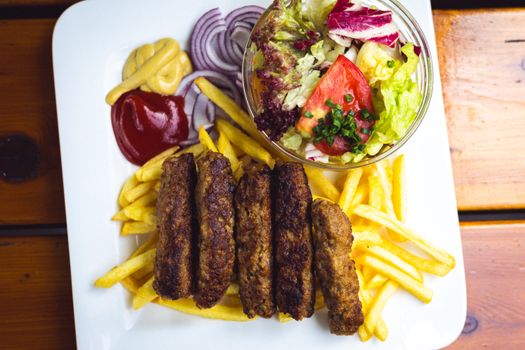
The diets react (see scores below)
Common Ingredients
- ground beef
- ground pork
- garlic
- paprika
- salt
- black pepper
- onion
- baking soda
Specific recipes may vary.
Incompatible with 5 of 11 diets
Diet Ratings
Cevapi is a grilled ground meat sausage made almost entirely of keto-friendly ingredients. The base is ground beef and pork, providing high fat and quality protein. Seasonings (garlic, paprika, salt, pepper) contribute negligible carbs at typical quantities. Onion adds a small amount of carbs but in the modest amounts used for flavoring in the mixture, net carbs remain minimal. Baking soda is carb-free and used only as a leavening agent in trace amounts. The dish is unprocessed, contains no grains, no added sugars, and no starchy ingredients. Net carbs per serving are effectively near zero, making this an excellent keto snack or meal component on its own (without the traditional accompaniment of lepinja flatbread or ajvar in large quantities).
Cevapi is a Balkan/Croatian grilled meat dish made primarily from ground beef and ground pork — both are animal flesh and are unambiguously excluded from a vegan diet. The remaining ingredients (garlic, paprika, salt, black pepper, onion, baking soda) are all plant-based, but the dish is fundamentally defined by its meat content and cannot be considered vegan in any form.
Cevapi is a Balkan/Croatian grilled minced meat dish that is fundamentally paleo-incompatible due to two key violations. First, salt is an added ingredient — refined/added salt is excluded under strict paleo rules. Second, and more significantly, baking soda is used as a leavening agent and is a processed additive with no place in a paleolithic framework. The meats themselves (ground beef and ground pork) are paleo-approved, and the aromatics and spices (garlic, onion, paprika, black pepper) are all paleo-friendly. However, the combination of added salt and baking soda — both non-paleo ingredients — pulls this dish into avoid territory. Traditionally, cevapi is also served in flatbread (lepinja), which would be an additional grain-based violation, though the dish itself is being evaluated without the bread here.
Cevapi is a grilled minced meat dish made primarily from ground beef and ground pork — two red meats that the Mediterranean diet restricts to only a few times per month. The combination of both beef and pork in a single dish compounds the concern, delivering a high saturated fat load. While the spices (garlic, paprika, black pepper, onion) are Mediterranean-friendly, they do nothing to offset the core issue: this is an essentially protein-heavy, red-meat-centric dish with no vegetables, legumes, whole grains, or olive oil involvement. It directly contradicts the foundational Mediterranean principle of minimizing red meat consumption and centering meals on plant-based foods.
Cevapi is a grilled ground meat sausage made primarily from beef and pork — both carnivore-approved animal proteins. However, the recipe includes several plant-derived ingredients: garlic, paprika, black pepper, and onion are all excluded plant foods on a strict carnivore diet. Baking soda is a non-animal mineral additive. Salt is acceptable. The meat base is solid carnivore food, but the spice and vegetable additions push this into caution territory. Many carnivore practitioners tolerate small amounts of spices and aromatics like garlic and onion as flavoring agents, but strict adherents reject all plant matter regardless of quantity.
Strict carnivore purists following protocols like the Lion Diet or Baker's meat-only approach would reject cevapi outright due to garlic, onion, paprika, and black pepper — all plant compounds with potentially inflammatory properties. Some practitioners also question the pork component, preferring ruminant-only meats for fatty acid profile reasons.
Cevapi made with ground beef, ground pork, garlic, paprika, salt, black pepper, onion, and baking soda contains no excluded Whole30 ingredients. All components are either whole meats, vegetables/aromatics, or compliant spices and seasonings. Baking soda is a leavening agent used here as a meat tenderizer (a common technique in Balkan cooking), not to recreate a baked good or junk food — so the 'no baked goods' rule does not apply. The dish is essentially a seasoned grilled meat sausage, which is a whole, minimally processed food in its core form. Traditional cevapi is served without casing, making it straightforwardly compliant.
Cevapi contains two high-FODMAP ingredients that make it unsuitable during the elimination phase: garlic and onion. Both are among the highest-fructan foods tested by Monash University and are consistently flagged as 'avoid' even in small quantities. Garlic in particular is problematic because it is typically mixed directly into the ground meat, meaning the fructans are distributed throughout the dish and cannot be removed. Onion is similarly high in fructans at any standard serving size. Ground beef and ground pork are themselves low-FODMAP, as are paprika, salt, black pepper, and baking soda. However, the presence of garlic and onion as core structural ingredients — not optional garnishes — makes the dish high-FODMAP as traditionally prepared.
Cevapi is a grilled minced meat dish made from a blend of ground beef and ground pork, which raises several red flags under DASH diet guidelines. The combination of red meat (beef) and higher-fat pork significantly increases saturated fat intake, which DASH explicitly limits. The inclusion of added salt as a primary ingredient means sodium content is typically high — traditional cevapi recipes can contain 400–700mg sodium per 100g depending on preparation. DASH guidelines specifically recommend limiting red meat, avoiding high-fat or heavily seasoned processed meat products, and controlling sodium strictly. Ground pork in particular tends to carry significant saturated fat. While the dish does include beneficial aromatics (garlic, onion, paprika), these do not offset the core issues. This is not a food category the NIH/NHLBI DASH plan endorses, and the dual red-meat/high-sodium profile places it firmly in the 'avoid' category.
Cevapi is a Balkan grilled sausage made from a mixture of ground beef and ground pork, seasoned with garlic, paprika, onion, salt, pepper, and baking soda. From a Zone perspective, it provides a solid protein source but the mixed beef-pork composition raises concerns. Ground pork and regular ground beef typically carry higher saturated fat content than the lean proteins Dr. Sears favors (skinless chicken, fish, lean beef). The fat profile is predominantly saturated rather than monounsaturated, which conflicts with Zone's anti-inflammatory principles. However, cevapi does deliver meaningful protein per serving and contains no carbohydrates (making it a pure protein/fat block), and can be portioned to fit Zone meal architecture when paired with low-glycemic vegetables and a monounsaturated fat source. The absence of carbs means it functions well as the protein component of a Zone meal, but the saturated fat load requires careful attention to overall daily fat balance.
Earlier Zone writings (Enter the Zone) placed a strong emphasis on limiting saturated fat broadly, which would push cevapi toward a lower score. However, Sears' later anti-inflammatory work (e.g., Toxic Fat, The Mediterranean Zone) softened the stance on saturated fat somewhat, acknowledging that fat quality matters in context of overall dietary pattern. Some Zone practitioners consider lean versions of ground beef (90%+ lean) acceptable Zone protein blocks, and if leaner meat ratios are used in the cevapi preparation, the saturated fat concern diminishes, potentially pushing this closer to a score of 6-7.
Cevapi are grilled mixed-meat sausages made primarily from ground beef and pork. From an anti-inflammatory standpoint, the dish has both problematic and neutral elements. On the negative side, red meat (beef) and pork are both classified as foods to limit or avoid in anti-inflammatory protocols due to their saturated fat content, potential arachidonic acid load, and association with elevated inflammatory markers (CRP, IL-6) in epidemiological research. The combination of two such meats in one dish compounds this concern. On the positive side, the seasoning profile includes garlic (well-documented anti-inflammatory properties via allicin and organosulfur compounds), paprika (contains capsaicin and carotenoids with antioxidant activity), black pepper (piperine has modest anti-inflammatory properties), and onion (quercetin, a potent flavonoid). The preparation method — grilling — is relatively clean and doesn't add pro-inflammatory fats. Baking soda and salt are neutral. The dish contains no refined carbohydrates, added sugars, trans fats, or seed oils in its base form. Overall, this is a protein-centered dish with meaningful anti-inflammatory spices but a fundamentally pro-inflammatory protein base. It falls squarely in the 'moderate/limit' category — acceptable occasionally but not a regular feature of an anti-inflammatory diet.
Cevapi are grilled mixed ground beef and pork sausages — a protein-containing food but with meaningful drawbacks for GLP-1 patients. The beef-pork blend is typically higher in saturated fat than lean proteins like chicken breast or fish, and ground meat mixtures often contain 15–25g fat per serving depending on the fat percentage used. On the positive side, cevapi are grilled (not fried), reasonably small in portion size, and deliver meaningful protein (~15–20g per 4–5 pieces). The garlic, paprika, and black pepper seasoning is generally well-tolerated in moderate amounts. However, the saturated fat load can worsen GLP-1 side effects (nausea, reflux, slowed gastric emptying compounded by high fat), the pork component adds additional fat density, and there is zero fiber in this dish. As a snack category item, it also lacks the vegetable or grain accompaniments (like ajvar or flatbread) that could add fiber or nutrient density. Acceptable occasionally in small portions, but not a preferred protein source for GLP-1 patients.
Some GLP-1-focused dietitians accept fatty red meat and pork blends as a pragmatic protein source when patients struggle to meet protein targets, particularly given reduced appetite — arguing that adequate protein intake outweighs saturated fat concerns in the short term. Others more strictly limit high-saturated-fat proteins due to compounded GI side effects and cardiovascular risk in metabolically compromised patients.
*See how scores were generated at our methodology page.
Nutritional profile
Six traits that cut across every diet.
Fiber & Plants
How much whole-plant food and fiber it delivers.
Healthy Fats
The quality of its fats (unsaturated, omega-3).
Whole / Unprocessed
How close it is to its natural, unprocessed form.
Gut Gentle
How easy it is on digestion (low FODMAP, few irritants).
Low Glycemic
How little it spikes your blood sugar.
Protein Density
How much protein it packs per calorie.
Controversy Index
Higher controversy = more disagreement between diets.
Diet-Specific Tips
 Keto — 9/10
View tips
- High-fat ground beef and pork base — ideal keto macros
- Zero grains or added sugars in the meat mixture
- Negligible net carbs from spices and small onion quantity
- Whole, unprocessed ingredients align with strict keto principles
- Traditional serving with lepinja bread should be avoided — evaluate the meat alone
- Baking soda is carb-free and used in trace amounts
 Carnivore — 5/10
View tips
- Ground beef and pork are carnivore-approved animal proteins
- Garlic and onion are plant-derived aromatics excluded on strict carnivore
- Paprika and black pepper are plant-derived spices not permitted on carnivore
- Salt and baking soda are non-plant additives; salt is acceptable
- Spice quantities are small but still technically violate carnivore plant-exclusion rules
- Pork inclusion is debated by ruminant-focused carnivore practitioners
 Whole30 — 9/10
View tips
- Ground beef and ground pork are fully compliant proteins
- Garlic, onion, paprika, black pepper, and salt are all allowed seasonings
- Baking soda used as a meat tenderizer does not trigger the baked goods exclusion
- No grains, dairy, legumes, added sugar, or other excluded ingredients present
- Dish as described is a whole-food, unprocessed meat preparation consistent with Whole30 principles
 Zone — 5/10
View tips
- Mixed ground beef and pork increases saturated fat content beyond Zone ideals
- No carbohydrate content — functions as a protein/fat block only
- Good protein delivery per serving (~7g protein per small sausage link)
- Seasonings (garlic, paprika, onion) are Zone-friendly and anti-inflammatory
- Must be paired with low-glycemic vegetables and monounsaturated fats to complete a Zone meal
- Fat profile is saturated-dominant rather than the monounsaturated fats Zone prefers
- Leanness of the ground meat used significantly affects Zone compatibility
 Anti-Inflammatory — 4/10
View tips
- Red meat (beef) is a 'limit' food in anti-inflammatory frameworks due to saturated fat and arachidonic acid
- Pork compounds the saturated fat and inflammatory protein concern
- Garlic contains allicin and organosulfur compounds with well-established anti-inflammatory effects
- Paprika and onion provide carotenoids and quercetin — meaningful antioxidant contributors
- Black pepper (piperine) has modest anti-inflammatory and bioavailability-enhancing properties
- Grilling is a clean cooking method with no added inflammatory oils
- No refined carbohydrates, added sugars, trans fats, or seed oils present
- Occasional consumption is acceptable; regular intake is not aligned with anti-inflammatory principles
 GLP-1 Friendly — 4/10
View tips
- High saturated fat from beef-pork blend may worsen nausea and reflux
- Grilled preparation (not fried) is a meaningful positive
- Delivers ~15–20g protein per standard serving — useful but not exceptional
- Zero fiber — does nothing to address GLP-1-related constipation risk
- Small portion format is compatible with reduced appetite
- No nutrient density beyond protein — no vitamins, minerals, or fiber
- Pork increases fat density compared to all-beef or leaner alternatives