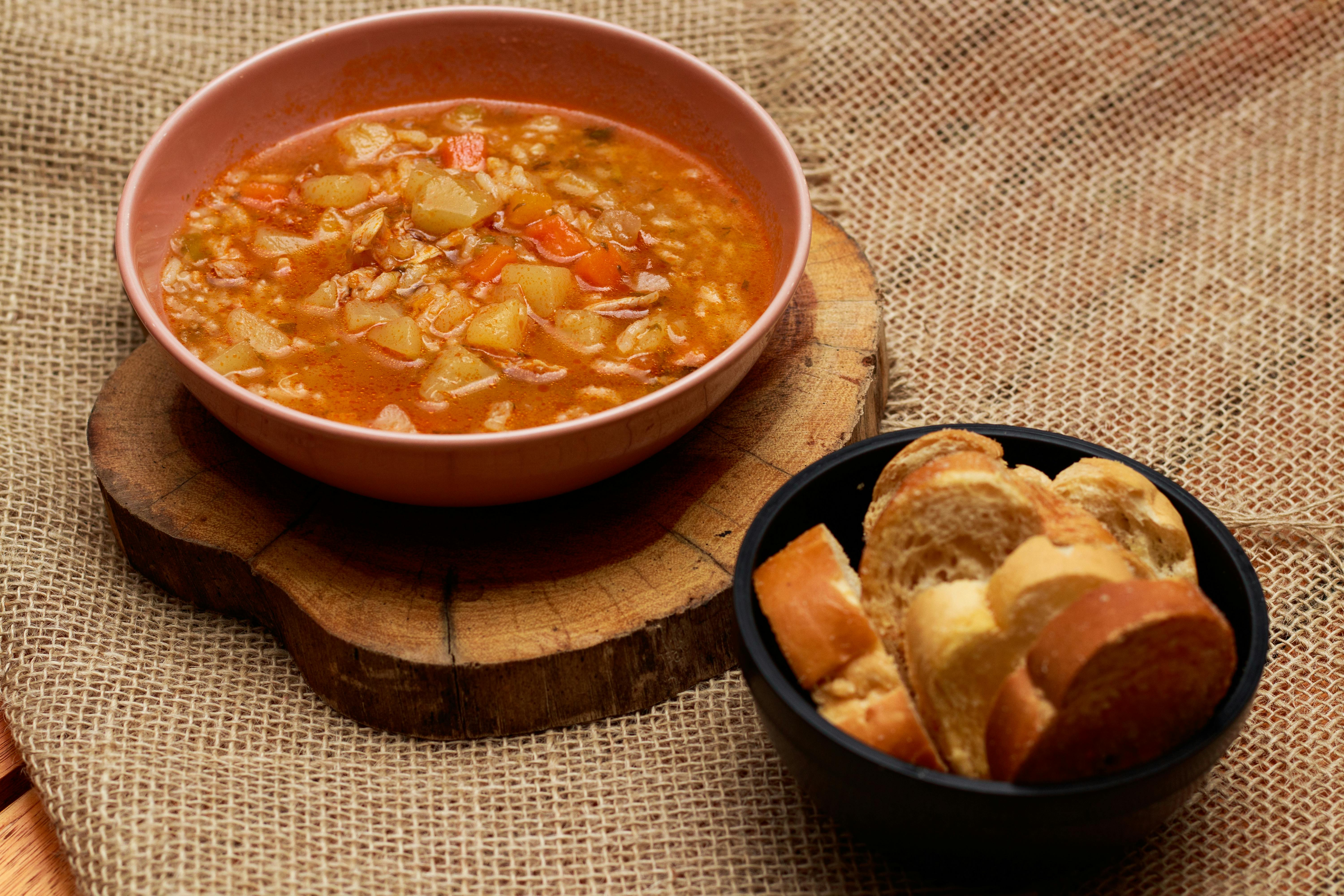
Photo: Victor Cayke / Pexels
The diets react (see scores below)
Common Ingredients
- beans
- pasta
- smoked pork
- potatoes
- onion
- carrot
- garlic
- bay leaf
Specific recipes may vary.
Incompatible with 6 of 11 diets
Diet Ratings
Manestra is fundamentally incompatible with a ketogenic diet. It contains multiple high-carbohydrate ingredients that individually would exceed or severely strain daily net carb limits, let alone combined. Beans are legumes with roughly 20-30g net carbs per half cup. Pasta is a grain product with ~35-40g net carbs per serving. Potatoes are starchy vegetables with ~15-20g net carbs per medium potato. Together, these three ingredients alone could deliver 70-90g+ of net carbs in a single bowl, which is 2-4x the entire daily keto allowance. The smoked pork is the only keto-friendly component. There is no realistic portion size that would make this dish compatible with ketosis.
Manestra contains smoked pork, which is a direct animal product and a clear violation of vegan dietary rules. Regardless of the otherwise plant-based ingredients (beans, pasta, potatoes, onion, carrot, garlic, bay leaf), the inclusion of smoked pork makes this dish entirely incompatible with a vegan diet. There is no ambiguity here — pork is animal flesh.
Manestra contains multiple ingredients that are explicitly excluded from the paleo diet. Beans (legumes) and pasta (grain-based) are two of the most fundamental 'avoid' categories in paleo — both contain anti-nutrients like lectins and phytates that paleo philosophy identifies as harmful. Smoked pork is a processed meat product that typically contains added salt, nitrates, and preservatives, making it non-compliant. With three core non-paleo ingredients in one dish, this Croatian bean-and-pasta soup is incompatible with the paleo framework regardless of the compliant elements (onion, carrot, garlic, bay leaf, potatoes).
Manestra is a hearty Croatian bean and pasta soup with strong Mediterranean foundations—beans, vegetables (onion, carrot, garlic), and aromatics are all staple Mediterranean ingredients. However, smoked pork is a significant concern: it is a processed red meat, which the Mediterranean diet limits to a few times per month, and smoking adds preservatives and sodium. The pasta is likely refined (white), which is less preferred than whole grain. Potatoes are nutritionally acceptable but starchy. The dish's plant-forward base (beans as primary protein, vegetable broth components) keeps it from being an 'avoid,' but the smoked pork ingredient prevents a full 'approve.' As an occasional dish with a small amount of smoked pork used primarily for flavoring rather than as the main protein, it can be tolerated in moderation.
Some Mediterranean diet frameworks, particularly those rooted in traditional Adriatic and Dalmatian coastal cuisines, accept small amounts of cured or smoked pork as a flavoring agent rather than a primary protein—a practice seen in Italian ribollita variations and Istrian cooking. In this framing, if the smoked pork is used sparingly, the dish's legume base could earn a more lenient assessment.
Manestra is a Croatian bean and pasta soup that is fundamentally incompatible with the carnivore diet. The dish is predominantly plant-based: beans (legumes) are the primary protein source, pasta is a grain-based carbohydrate, potatoes are a starchy vegetable, and onion, carrot, garlic, and bay leaf are all plant foods. While smoked pork is the one carnivore-compatible ingredient, it is a minor component in a dish that is overwhelmingly plant-derived. No amount of reinterpretation makes this dish carnivore-appropriate — virtually every ingredient except the pork violates the core rule of eating exclusively animal products.
Manestra contains two major Whole30-excluded ingredient categories: legumes (beans) and grains (pasta). Beans are explicitly excluded from the Whole30 program — unlike green beans, sugar snap peas, or snow peas, standard leguminous beans (kidney, borlotti, cannellini, etc.) are not among the permitted exceptions. Pasta is a grain-based product and falls under both the grains exclusion and the 'no recreating noodles/pasta' rule. Smoked pork may also contain added sugar or sulfites in processed/cured form, but even setting that aside, the beans and pasta alone make this dish clearly non-compliant. The remaining ingredients (potatoes, onion, carrot, garlic, bay leaf) are all Whole30-compatible.
Manestra contains multiple high-FODMAP ingredients that make it unsuitable during the elimination phase. Beans (the primary protein) are high in GOS (galacto-oligosaccharides) and are a major FODMAP trigger — even canned/rinsed beans contain significant GOS at standard serving sizes. Garlic is one of the highest-FODMAP foods known, rich in fructans, and is a core flavoring in this dish. Onion is similarly high in fructans and problematic at any standard serving. Regular wheat pasta is high in fructans. Potatoes and carrot are low-FODMAP, and smoked pork and bay leaf are generally safe. However, with four significant high-FODMAP ingredients (beans, garlic, onion, wheat pasta), this dish is essentially incompatible with the FODMAP elimination phase as traditionally prepared. There is no realistic way to modify it while retaining its character.
Manestra is a Croatian bean and pasta soup with several DASH-friendly components — beans (excellent source of fiber, potassium, magnesium, and plant protein), vegetables (onion, carrot, garlic), and potatoes. These align well with DASH principles. However, the inclusion of smoked pork is the primary concern: smoked/cured pork products are typically high in sodium and saturated fat, both of which DASH explicitly limits. The sodium contribution from smoked pork can be substantial, potentially pushing a single serving well above DASH's per-meal sodium budget. Pasta, if refined, is less ideal than whole-grain alternatives but is acceptable in moderation. The dish is borderline — the vegetable and legume base is genuinely DASH-positive, but the smoked pork ingredient introduces enough sodium and saturated fat to prevent a full approval.
NIH DASH guidelines clearly flag smoked and cured meats as high-sodium foods to limit. However, some DASH-oriented dietitians note that in a large-batch soup where smoked pork is used in small quantity primarily for flavor (e.g., a ham hock or small amount of smoked meat), the per-serving sodium may remain within acceptable limits — particularly if no additional salt is added and the recipe relies on the bean-vegetable base for bulk. In this interpretation, a portion-controlled serving with reduced smoked pork could score closer to the approve threshold.
Manestra is a hearty Croatian bean and pasta soup that presents significant Zone Diet challenges. The dish stacks multiple high-glycemic or borderline carbohydrate sources — pasta, potatoes, and beans — in a single meal, making it very difficult to achieve the 40/30/30 ratio without radical portion reduction. Potatoes are explicitly 'unfavorable' carbs in Zone terminology due to their high glycemic index, and pasta is a high-glycemic grain. Beans, while offering protein and fiber (lowering net carbs), still contribute substantial carbohydrate load. The smoked pork introduces saturated fat and is not a lean Zone-approved protein like skinless chicken or fish. On the positive side, the dish includes favorable vegetables (onion, carrot, garlic), and the beans do provide some protein and fiber that blunts glycemic impact somewhat. Garlic and onion are anti-inflammatory polyphenol sources Sears would approve of. However, the triple carb stacking (beans + pasta + potatoes) means a typical serving would be heavily carbohydrate-skewed, the protein source is fatty rather than lean, and balancing this into proper Zone blocks would require very small portions and significant modification. As served in traditional Croatian cuisine, it is unlikely to approximate Zone ratios without intentional restructuring.
Some Zone practitioners note that beans are a 'favorable' carbohydrate in Dr. Sears' system because their fiber content significantly reduces net carbs and they provide simultaneous protein — making bean-based dishes more Zone-adaptable than purely starchy meals. If the potato and pasta quantities are kept minimal and the smoked pork is used as flavoring rather than a primary protein, a small bowl of Manestra could be balanced into a Zone meal with added lean protein on the side. Sears' later anti-inflammatory writings also acknowledge that polyphenol-rich ingredients like garlic and onion add value beyond macronutrient ratios.
Manestra is a traditional Croatian bean and pasta soup with a genuinely mixed anti-inflammatory profile. On the positive side, beans are an anti-inflammatory staple — high in fiber, plant protein, polyphenols, and associated with reduced CRP levels. Garlic, onion, carrot, and bay leaf all contribute beneficial anti-inflammatory compounds (allicin, quercetin, carotenoids, and volatile oils respectively). Potatoes are a neutral-to-modest contributor with some potassium and vitamin C. The overall vegetable base and legume content align well with anti-inflammatory principles. The problematic element is smoked pork, which introduces saturated fat and, critically, the smoked/cured processing that adds sodium, nitrates/nitrites, and potentially polycyclic aromatic hydrocarbons (PAHs) — all linked to increased inflammatory markers. Anti-inflammatory guidelines place processed and cured meats firmly in the 'limit' or 'avoid' category. Pasta is a refined carbohydrate that is neutral to mildly inflammatory depending on quantity. As a whole-dish assessment, the bean-heavy, vegetable-rich base partially offsets the smoked pork, but that processed meat component prevents an 'approve' rating. The dish lands in 'caution' territory — meaningful beneficial elements, but a notable inflammatory ingredient that should ideally be minimized or substituted (e.g., a small amount of smoked paprika for flavor instead).
Some anti-inflammatory practitioners following a Mediterranean or traditional food framework would note that smoked pork used in small quantities as a flavoring agent (rather than as a primary protein) is contextually acceptable in a dish dominated by legumes and vegetables — Dr. Weil's pyramid permits lean poultry and even occasional pork in moderation. However, strict anti-inflammatory protocols and cancer-risk-focused researchers (e.g., WCRF guidelines) would flag any processed/cured meat regardless of quantity, pushing this dish closer to 'avoid' territory.
Manestra is a traditional Croatian bean and pasta soup with a nutritionally mixed profile for GLP-1 patients. On the positive side, beans provide both meaningful plant-based protein and substantial fiber, supporting two of the top dietary priorities. The broth-based, soup format is easy to digest, hydrating, and portion-friendly — all well-suited to GLP-1 side effect management. Vegetables (onion, carrot, garlic) add micronutrient density. However, smoked pork is a significant concern: it is a processed, high-saturated-fat, high-sodium meat that GLP-1 guidelines consistently flag as problematic. The pasta and potatoes together create a high refined-carbohydrate, high-glycemic load that offers limited protein or fiber per calorie relative to the volume. The combination of refined starch, legumes, and fatty pork also increases bloating and gas risk, which is amplified on GLP-1 medications. The dish is not a poor choice in the way fried or high-sugar foods are, but it requires meaningful modification — substituting smoked pork with a lean protein (chicken breast, turkey), reducing pasta or potato quantity, and using whole-grain pasta if possible — to become reliably GLP-1-friendly.
Some GLP-1-focused dietitians would rate bean-based soups more favorably across the board, arguing that the fiber and protein from legumes outweigh the saturated fat from a small amount of smoked pork used primarily as a flavoring agent rather than a primary protein; others would flag the dual starch load (pasta plus potato) and processed meat content as sufficient reason to recommend avoidance rather than caution.
*See how scores were generated at our methodology page.
Nutritional profile
Six traits that cut across every diet.
Fiber & Plants
How much whole-plant food and fiber it delivers.
Healthy Fats
The quality of its fats (unsaturated, omega-3).
Whole / Unprocessed
How close it is to its natural, unprocessed form.
Gut Gentle
How easy it is on digestion (low FODMAP, few irritants).
Low Glycemic
How little it spikes your blood sugar.
Protein Density
How much protein it packs per calorie.
Controversy Index
Higher controversy = more disagreement between diets.
Diet-Specific Tips
 Mediterranean — 5/10
View tips
- Beans as primary protein — strongly Mediterranean-approved legume
- Smoked pork is a processed red meat — limited to a few times per month in Mediterranean diet
- Vegetable-rich base (onion, carrot, garlic, bay leaf) aligns well with Mediterranean principles
- Pasta likely refined (white) — whole grain preferred but not disqualifying
- Potatoes add starchy carbohydrates — acceptable in moderation
- Overall dish is plant-forward but compromised by processed meat inclusion
 DASH — 5/10
View tips
- Smoked pork is high in sodium and saturated fat, both limited on DASH
- Beans provide excellent fiber, potassium, magnesium, and plant protein — core DASH foods
- Vegetables (onion, carrot, garlic) and potatoes contribute potassium and micronutrients
- Pasta ideally should be whole-grain for DASH compliance; refined pasta is less ideal
- Overall sodium level of dish likely high due to smoked pork, even without added salt
- Dish could be modified (reduce/omit smoked pork, use low-sodium broth) to score higher
 Zone — 4/10
View tips
- Triple carb stacking: beans, pasta, AND potatoes in one dish makes Zone ratio balancing very difficult
- Potatoes are explicitly 'unfavorable' high-glycemic carbs in Zone Diet
- Pasta is a high-glycemic refined grain, unfavorable in Zone
- Smoked pork is a fatty, processed protein — not lean Zone-approved protein
- Beans partially favorable: high fiber reduces net carbs and provides some protein
- Vegetables (onion, carrot, garlic) are Zone-favorable anti-inflammatory ingredients
- Typical serving size would yield a heavily carbohydrate-skewed macronutrient ratio
- Saturated fat from smoked pork conflicts with Zone's preference for monounsaturated fats
 Anti-Inflammatory — 5/10
View tips
- Beans are a strongly anti-inflammatory ingredient — high fiber, polyphenols, and associated with reduced inflammatory markers
- Smoked pork is a processed/cured meat containing nitrates, sodium, and saturated fat — a pro-inflammatory ingredient
- Garlic and onion provide allicin and quercetin with well-documented anti-inflammatory properties
- Carrots contribute carotenoids (beta-carotene), a beneficial antioxidant
- Pasta adds refined carbohydrates, which are mildly inflammatory, especially in larger quantities
- Potatoes are neutral on the anti-inflammatory spectrum for most people
- The vegetable-and-legume-heavy base partially offsets the inflammatory impact of the smoked pork
 GLP-1 Friendly — 5/10
View tips
- Smoked pork is a processed, high-saturated-fat, high-sodium meat — a known GLP-1 concern
- Beans provide both plant protein and dietary fiber, supporting the top two GLP-1 dietary priorities
- Dual starch load from pasta and potatoes raises glycemic concern and displaces protein density
- Broth-based soup format is hydrating, easy to digest, and portion-friendly for GLP-1 patients
- High bloating and gas risk from legume-pasta-starch combination, amplified by GLP-1 slowed gastric emptying
- Dish is salvageable with modification: remove or minimize smoked pork, substitute lean protein, reduce starch volume