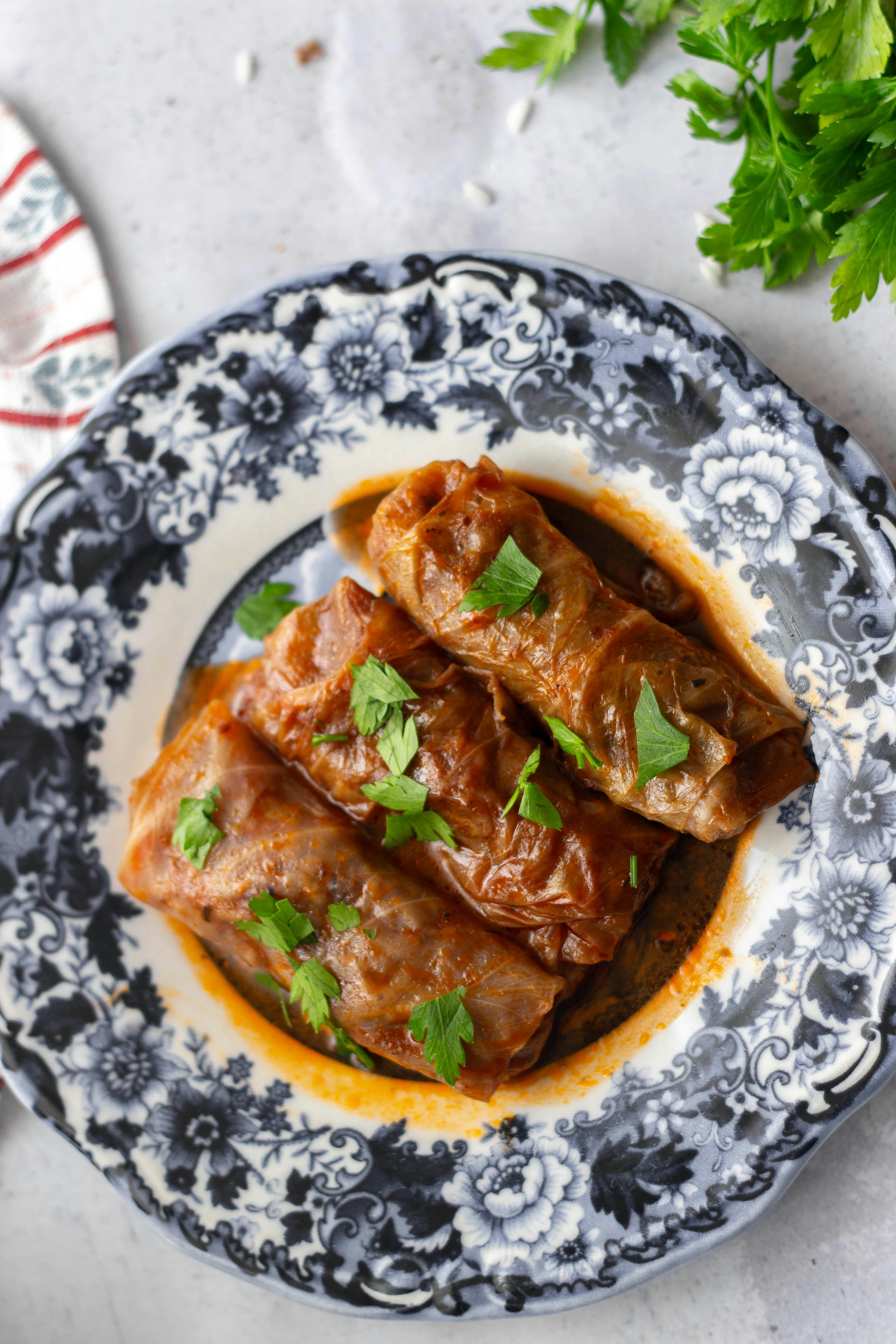
Photo: Zehra Yılmaz / Pexels
The diets react (see scores below)
Common Ingredients
- cabbage leaves
- ground pork
- rice
- onion
- smoked meat
- paprika
- bay leaf
- garlic
Specific recipes may vary.
Incompatible with 8 of 11 diets
Diet Ratings
Sarma is fundamentally incompatible with ketogenic diet in its traditional form due to the inclusion of rice in the filling. Rice is a high-glycemic grain that contributes significant net carbs — a typical serving of sarma contains roughly 20-35g of net carbs from rice alone, which can easily consume or exceed the entire daily keto carb budget. The cabbage leaves themselves add modest carbs (though relatively low), and the onion adds a small amount. The pork and smoked meat are keto-friendly, and the spices are fine, but the rice is a disqualifying ingredient. A keto-adapted version could substitute rice with cauliflower rice, which is a well-known swap in the keto community.
Sarma is a Croatian stuffed cabbage dish that explicitly contains ground pork and smoked meat as primary ingredients. Both are animal flesh and are categorically excluded from a vegan diet. There is no ambiguity here — this dish is built around animal products as its core protein sources.
Sarma is a Croatian stuffed cabbage dish that contains two clear paleo violations: rice (a grain, excluded from all mainstream paleo frameworks) and smoked meat (a processed meat product that typically contains added salt, preservatives, and smoke flavoring). Rice alone is a disqualifying grain under strict paleo rules. Smoked meat further compounds the issue as a processed food. The remaining ingredients — cabbage leaves, ground pork, onion, paprika, bay leaf, and garlic — are all paleo-compliant, but the dish as traditionally prepared cannot be considered paleo-friendly due to these two core violations.
Sarma is a Croatian stuffed cabbage dish centered on ground pork and smoked meat as the primary proteins, both of which fall into the red/processed meat category that Mediterranean diet principles restrict to a few times per month. While cabbage, onion, garlic, paprika, and bay leaf are Mediterranean-friendly vegetables and aromatics, they play a supporting role here. The rice component is refined/white, adding another mild concern. The combination of ground pork plus smoked (processed) meat in a single dish means this dish delivers double the meat load the Mediterranean diet seeks to limit, and smoked/cured meats are considered processed, placing them in the most restricted category. Occasional consumption is not catastrophic, but this is not a dish compatible with regular Mediterranean eating patterns.
Some Mediterranean diet researchers acknowledge that traditional Balkan and Eastern Mediterranean cuisines have long used fermented and stuffed cabbage preparations, and that the vegetable-to-meat ratio can be adjusted to reduce pork quantity significantly. In a modified version with minimal pork used as a flavoring rather than the main protein, and with whole-grain rice, this dish could edge toward occasional-caution territory.
Sarma is a traditional Croatian stuffed cabbage dish that is fundamentally incompatible with the carnivore diet. While it contains animal-based ingredients (ground pork, smoked meat), the dish is built around multiple plant-derived components: cabbage leaves serve as the wrapper, rice is a grain filler mixed into the meat, onion and garlic are alliums, paprika is a plant spice, and bay leaf is an herb. The majority of the dish's volume and structure comes from plant foods. Rice alone is a grain that is strictly excluded on carnivore. No adaptation short of a complete recipe overhaul would make this dish carnivore-compatible.
Sarma contains rice, which is a grain explicitly excluded from the Whole30 program. Rice is listed among the prohibited grains (wheat, oats, rice, corn, quinoa, etc.) and is a core ingredient in the filling of this Croatian stuffed cabbage dish. All other ingredients — cabbage leaves, ground pork, onion, smoked meat (depending on preparation), paprika, bay leaf, and garlic — are otherwise Whole30-compatible, but the inclusion of rice makes this dish non-compliant as traditionally prepared. Additionally, smoked meat should be checked for added sugars or sulfites, though sulfites are no longer excluded per 2024 rule changes.
Sarma contains multiple high-FODMAP ingredients that make it unsuitable during the elimination phase. Onion is one of the highest-FODMAP foods (fructans) and is a core ingredient in the filling — it cannot be omitted without fundamentally changing the dish. Garlic is equally problematic, also being very high in fructans. These two ingredients alone disqualify this dish. The smoked meat component may also contain onion or garlic as part of its preparation or seasoning. Cabbage leaves (savoy or regular) can be moderate-to-high in FODMAPs depending on quantity used — Monash rates savoy cabbage as high-FODMAP at standard servings. Rice and ground pork are low-FODMAP, paprika and bay leaf are fine in culinary amounts, but the dish as traditionally prepared cannot be made low-FODMAP without major reformulation (removing onion, garlic, and checking smoked meat ingredients).
Sarma is a traditional Croatian stuffed cabbage dish that poses significant concerns for the DASH diet primarily due to its sodium content and saturated fat profile. The combination of ground pork and smoked meat creates a dual sodium problem: ground pork already contributes moderate sodium, while smoked meat is typically heavily cured with salt, often adding 600-1,000mg+ of sodium per serving. Together, a single serving of sarma can easily exceed 1,000-1,500mg of sodium, consuming the majority of even the standard DASH daily sodium limit (2,300mg) in one dish. Ground pork is also higher in saturated fat than DASH-recommended lean proteins such as poultry, fish, or legumes. DASH guidelines explicitly limit red meat and processed/smoked meats. While cabbage, onion, garlic, rice, and the spices (paprika, bay leaf) are individually DASH-friendly ingredients, they do not offset the sodium and saturated fat burden introduced by the pork and smoked meat components.
Sarma is a traditional Croatian dish of cabbage leaves stuffed with ground pork and rice, slow-cooked with smoked meat, onion, garlic, paprika, and bay leaf. From a Zone perspective, it has both favorable and unfavorable elements. The cabbage wrapping is excellent — a low-glycemic, high-polyphenol vegetable that Zone actively promotes. Onion, garlic, and paprika are also favorable Zone carb sources with anti-inflammatory properties. However, the dish has notable Zone challenges: (1) White rice is an 'unfavorable' high-glycemic carbohydrate in Zone terminology, spiking insulin response. (2) Ground pork and smoked meat are not lean proteins — they carry higher saturated fat content than Zone's preferred chicken breast, fish, or egg whites. (3) The fat profile is predominantly saturated rather than monounsaturated, which conflicts with Zone's anti-inflammatory fat emphasis. (4) The protein-to-fat ratio will likely be off — smoked meat and fatty ground pork push fat calories well above the 30% Zone target. With careful modification (using extra-lean ground pork or turkey, replacing or dramatically reducing rice with more vegetables, and controlling portion size), Sarma could be adapted toward Zone compliance. As traditionally prepared, it requires significant portion control and is best treated as an 'unfavorable' Zone meal requiring careful block balancing.
Some Zone practitioners following Sears' later anti-inflammatory framework (The Anti-Inflammation Zone, 2005) would note that pork fat, while saturated, is not as inflammatory as omega-6-heavy seed oils and contains some oleic acid. The cabbage provides meaningful polyphenols and fermentable fiber. If portion size is kept small (one or two rolls) alongside a large vegetable salad with olive oil dressing, this could be worked into a broader Zone-compliant meal plan. The rice, while unfavorable, is present in a small amount per roll and partially offset by the cabbage's fiber content, lowering the net glycemic impact.
Sarma is a traditional Croatian stuffed cabbage dish with a mixed anti-inflammatory profile. On the positive side, cabbage is a cruciferous vegetable rich in glucosinolates and vitamin C with well-documented anti-inflammatory properties. Garlic, paprika, and bay leaf contribute meaningful polyphenols and antioxidants. Onion provides quercetin, a notable anti-inflammatory flavonoid. These ingredients collectively offer real anti-inflammatory benefit. However, the protein foundation is problematic: ground pork is red meat, which anti-inflammatory guidelines recommend limiting due to saturated fat content and association with elevated inflammatory markers like CRP. The smoked meat component compounds this concern — processed and smoked meats are generally flagged as pro-inflammatory due to nitrates, advanced glycation end-products (AGEs) generated by smoking, and additional saturated fat. White rice is a refined carbohydrate that offers little anti-inflammatory value compared to whole grains. The dish is not heavily processed or loaded with seed oils, trans fats, or added sugars, so it avoids the worst category. Sarma lands squarely in 'caution' — occasional consumption is acceptable, but it should not be a dietary staple for someone following an anti-inflammatory protocol. Modifications such as substituting turkey or a mix of legumes for some of the pork, using brown rice, and minimizing the smoked meat would meaningfully improve the profile.
Sarma is a traditional Croatian stuffed cabbage dish combining ground pork, rice, smoked meat, and cabbage leaves, typically slow-cooked. It has several GLP-1-relevant strengths and weaknesses. On the positive side, cabbage is a high-fiber, high-water-content vegetable that supports digestion and hydration, and the dish does provide meaningful protein from the ground pork. However, the combination of ground pork and smoked meat raises significant concerns for GLP-1 patients: ground pork is typically higher in saturated fat than lean proteins like chicken breast or turkey, and smoked meat (often bacon, smoked pork belly, or smoked ribs) adds additional saturated fat, sodium, and preservatives. The fat load per serving can worsen GLP-1 side effects including nausea, bloating, and reflux, particularly because slowed gastric emptying means fatty foods linger longer. Rice adds refined carbohydrates with moderate glycemic impact and low fiber contribution. The dish is not fried and is slow-cooked, which aids digestibility somewhat, but the overall fat profile from two pork-based proteins is the primary concern. A modified version using lean ground turkey or chicken instead of pork, and omitting or minimizing the smoked meat, would score considerably higher.
Some GLP-1-focused dietitians may view a small portion of traditional sarma as acceptable, noting that the cabbage wrapper and slow-cooked format make it easier to digest than fried or heavily processed pork dishes, and that the overall protein contribution supports the primary GLP-1 dietary goal. Others would flag the dual pork proteins and high sodium from smoked meat as meaningful barriers to tolerability, particularly in patients who are injection-day sensitive or in early treatment phases.
*See how scores were generated at our methodology page.
Nutritional profile
Six traits that cut across every diet.
Fiber & Plants
How much whole-plant food and fiber it delivers.
Healthy Fats
The quality of its fats (unsaturated, omega-3).
Whole / Unprocessed
How close it is to its natural, unprocessed form.
Gut Gentle
How easy it is on digestion (low FODMAP, few irritants).
Low Glycemic
How little it spikes your blood sugar.
Protein Density
How much protein it packs per calorie.
Controversy Index
Higher controversy = more disagreement between diets.
Diet-Specific Tips
 Zone — 4/10
View tips
- Cabbage leaves are an excellent low-glycemic Zone-favorable carbohydrate and polyphenol source
- White rice is an 'unfavorable' high-glycemic carbohydrate in Zone methodology — spikes insulin
- Ground pork and smoked meat are higher-fat, higher-saturated-fat proteins — not Zone's preferred lean protein
- Saturated fat dominates the fat profile rather than Zone's preferred monounsaturated fats (olive oil, avocado, almonds)
- Smoked/processed meat adds sodium and potentially inflammatory compounds
- Garlic, onion, paprika, and bay leaf are Zone-favorable anti-inflammatory seasonings
- Macronutrient ratio likely skews toward fat-heavy, making 40/30/30 balance difficult without modification
- Dish can be partially rehabilitated by using lean ground turkey, reducing rice, and controlling portion to 1-2 rolls
 Anti-Inflammatory — 4/10
View tips
- Ground pork is red meat — anti-inflammatory guidelines recommend limiting due to saturated fat and association with elevated CRP
- Smoked meat is a processed meat — smoking generates AGEs and nitrates linked to pro-inflammatory response
- Cabbage is a cruciferous vegetable with glucosinolates and vitamin C — genuinely anti-inflammatory
- Garlic, onion, paprika, and bay leaf contribute polyphenols and antioxidants
- White rice is a refined carbohydrate with minimal anti-inflammatory benefit
- No trans fats, seed oils, added sugars, or artificial additives present
- Occasional consumption acceptable; not suitable as a regular staple on an anti-inflammatory diet
 GLP-1 Friendly — 4/10
View tips
- Ground pork is moderate-to-high in saturated fat — not a lean protein
- Smoked meat adds additional saturated fat, sodium, and preservatives
- Combined fat load from two pork proteins likely to worsen nausea, bloating, and reflux
- Slowed gastric emptying amplifies the impact of high-fat ingredients
- Cabbage is a high-fiber, high-water-content vegetable — a meaningful positive
- Slow-cooked preparation improves digestibility versus fried or heavy alternatives
- Rice contributes refined carbohydrates with limited fiber
- High sodium from smoked meat may worsen water retention and bloating
- Portion-sensitive: a small serving is more manageable than a full traditional portion