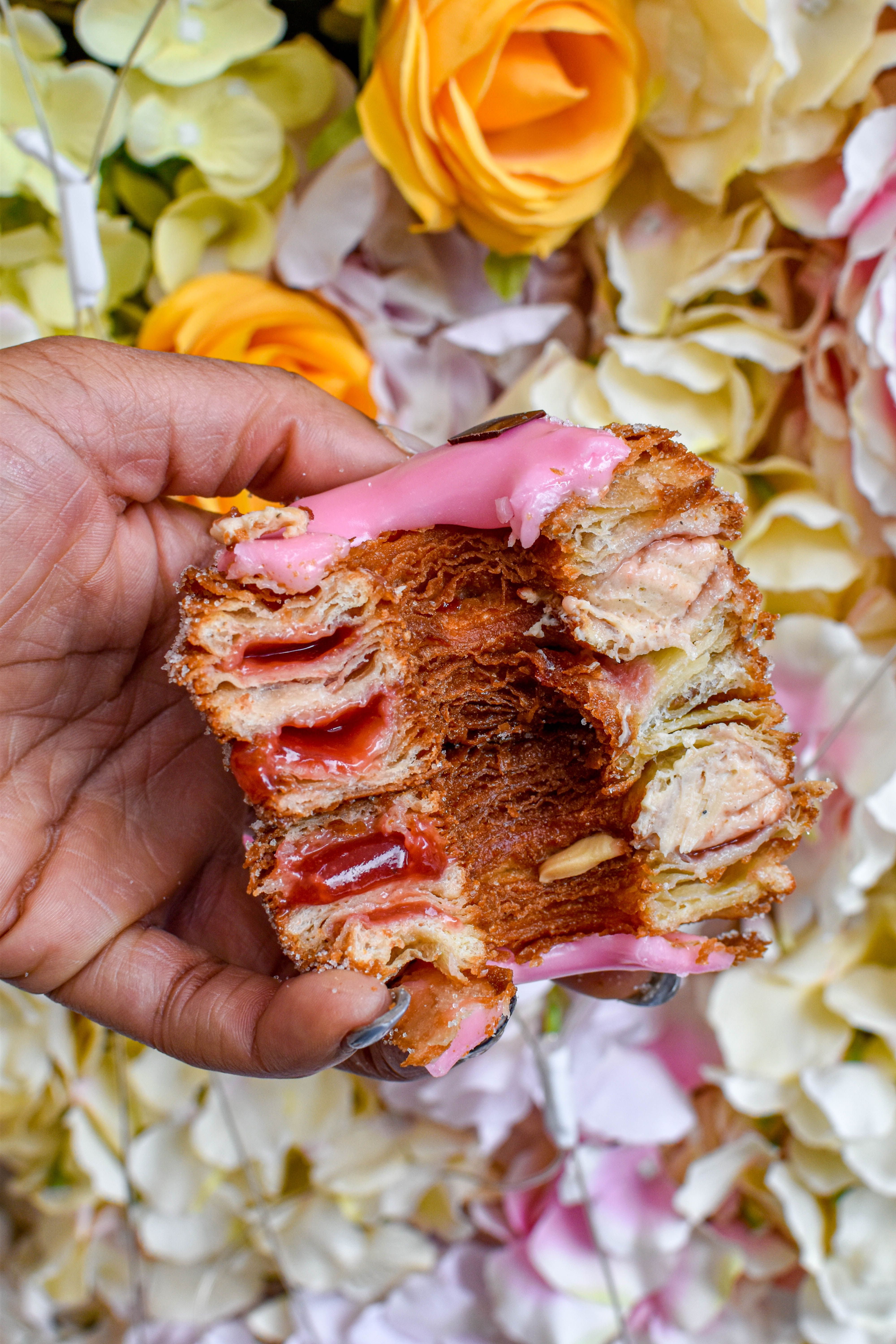
Photo: Cree Payton / Pexels
The diets react (see scores below)
Common Ingredients
- flour
- butter
- yeast
- milk
- eggs
- sugar
- salt
- vanilla
- oil
Specific recipes may vary.
Incompatible with 11 of 11 diets
Diet Ratings
A Cronut is a croissant-doughnut hybrid made primarily from flour, sugar, and yeast — all fundamentally incompatible with ketogenic eating. The flour alone delivers an enormous carbohydrate load (a single Cronut contains roughly 30-40g of net carbs), and the added sugar compounds the glycemic impact. While butter and eggs are keto-friendly ingredients, they are far outweighed by the high-carb base. This pastry would almost certainly knock someone out of ketosis with a single serving and has no viable place in a standard ketogenic diet.
A cronut contains multiple animal-derived ingredients that disqualify it from a vegan diet. Butter and milk are dairy products, and eggs are explicitly excluded under vegan rules. With three distinct animal products present, this is unambiguously non-vegan. There is no meaningful debate within the vegan community on this assessment.
The Cronut is a croissant-doughnut hybrid that is fundamentally incompatible with the Paleo diet. Its core ingredients are nearly all non-Paleo: flour (wheat grain), butter and milk (dairy), refined sugar, added salt, and frying oil (likely a seed or vegetable oil). While eggs and vanilla are Paleo-approved, they are minor components that do nothing to redeem the dish. This is a highly processed, grain-and-dairy-heavy pastry with refined sugar — hitting multiple 'avoid' categories simultaneously. There is no version of a Cronut that could be considered Paleo without completely reconstructing it from different ingredients.
The Cronut is a highly processed pastry that fundamentally contradicts Mediterranean diet principles on multiple levels. It is made with refined white flour (not a whole grain), butter as the primary fat (not olive oil), and significant added sugar. The deep-frying in oil adds further processed fat content. This combination of refined grains, saturated fat from butter, and added sugars places it firmly in the 'avoid' category. It provides virtually no nutritional value aligned with the Mediterranean diet — no vegetables, legumes, or whole grains — and represents exactly the type of Western processed food the Mediterranean diet discourages.
A cronut is a croissant-doughnut hybrid that is fundamentally incompatible with the carnivore diet. The primary ingredient is flour (a grain), which alone disqualifies it entirely. It also contains sugar, yeast, and vanilla — all plant-derived or fermentation-based ingredients explicitly excluded from carnivore. The frying oil is plant-based. While butter, milk, and eggs are animal-derived components, they are minor players in a dish that is structurally and calorically dominated by plant-based carbohydrates and sugar. There is no scenario in any tier of carnivore eating — from the most liberal 'animal-based' approach to strict Lion Diet — where a flour-and-sugar pastry would be acceptable.
A Cronut is a croissant-donut hybrid pastry that violates Whole30 on multiple fronts. It contains flour (a grain, excluded), butter (dairy, excluded), milk (dairy, excluded), and sugar (added sugar, excluded). Even setting aside individual excluded ingredients, the Cronut is precisely the type of baked/fried junk food the program explicitly prohibits — it is a pastry that falls squarely into the 'no recreating baked goods' rule. There is no compliant version of this item possible.
A Cronut is a croissant-doughnut hybrid made primarily from wheat flour, which is high in fructans — one of the most significant FODMAPs. Wheat flour is a clear avoid during the elimination phase per Monash University. A standard serving of a Cronut would involve a substantial amount of wheat flour, making it definitively high-FODMAP. Additionally, regular cow's milk contributes lactose, adding a second FODMAP source. Butter and eggs are low-FODMAP. Sugar, salt, vanilla, and oil are also low-FODMAP. However, the wheat flour alone is sufficient to classify this as high-FODMAP at any reasonable serving size. There is no realistic portion reduction that would make a Cronut safe during elimination phase.
A cronut is a croissant-doughnut hybrid that is deep-fried and made with large quantities of butter, refined flour, sugar, and oil. It is the antithesis of DASH diet principles: high in saturated fat from abundant butter, high in refined carbohydrates with no whole grain content, high in added sugars, and deep-fried in oil adding significant total fat. DASH explicitly limits sweets, added sugars, saturated fats, and refined grains while emphasizing whole grains, fiber, and nutrient-dense foods. The cronut provides virtually none of the potassium, magnesium, calcium, or fiber that DASH prioritizes, while delivering excessive calories from fat and sugar in a single serving. It falls squarely in the 'sweets' category that DASH limits to 5 or fewer servings per week and even then recommends low-fat options.
A cronut is a croissant-donut hybrid that is deep-fried in oil and made primarily from refined white flour, butter, and sugar — representing nearly everything the Zone Diet considers unfavorable. The macronutrient profile is completely misaligned with the 40/30/30 Zone ratio: it is dominated by high-glycemic refined carbohydrates and saturated fat, with virtually no lean protein. The refined flour spikes blood sugar rapidly (high glycemic load), the deep-frying adds heavy omega-6 seed oils, and the saturated fat from butter is substantial. There is no meaningful protein to balance the blocks, no low-glycemic carbohydrates, and no monounsaturated fat emphasis. Even with careful portioning, a single cronut cannot be made Zone-compatible without pairing it with a large block of lean protein and essentially treating it as a tiny, wasteful carb portion — at which point the food's inherent fat content throws off the fat block ratio simultaneously. This is one of the rare cases where a food is genuinely difficult to incorporate into any Zone-balanced meal without severely distorting all three macronutrient ratios at once.
The Cronut is a deep-fried croissant-donut hybrid that combines multiple pro-inflammatory ingredients and preparation methods. It is made from refined white flour (high glycemic, stripped of fiber and nutrients), large amounts of butter (high saturated fat), sugar (added sugar drives insulin spikes and inflammatory markers like CRP and IL-6), and is deep-fried in oil (high-heat frying generates oxidation byproducts and potential trans-fat-adjacent compounds). There are essentially no anti-inflammatory redeeming qualities — no omega-3s, no significant antioxidants, no polyphenols, no fiber, no beneficial phytonutrients. The combination of refined carbohydrates, saturated fat, added sugar, and deep-frying places this squarely in the 'avoid' category under virtually every anti-inflammatory framework. It is a calorie-dense, nutrient-poor food that would reliably promote inflammatory pathways with regular consumption.
A cronut is a croissant-donut hybrid that is deep-fried in oil after being laminated with large amounts of butter, then typically filled with cream and topped with glaze or sugar. It is essentially the convergence of every category GLP-1 patients should avoid: high saturated fat from butter lamination, deep-fried in oil, high refined sugar, made from refined white flour with negligible fiber, and virtually zero protein. The combination of high fat and high sugar is particularly problematic for GLP-1 patients, as fat slows gastric emptying further (already impaired by the medication), worsening nausea, bloating, and reflux. The refined carbohydrates cause rapid blood sugar spikes with no nutritional buffer. A single cronut typically contains 25-35g of fat, 30-40g of sugar, and fewer than 5g of protein, representing nearly pure empty calories. This is not a portion-sensitivity issue — even a small portion delivers a concentrated hit of the exact macronutrient profile GLP-1 patients must avoid.
*See how scores were generated at our methodology page.
Nutritional profile
Six traits that cut across every diet.
Fiber & Plants
How much whole-plant food and fiber it delivers.
Healthy Fats
The quality of its fats (unsaturated, omega-3).
Whole / Unprocessed
How close it is to its natural, unprocessed form.
Gut Gentle
How easy it is on digestion (low FODMAP, few irritants).
Low Glycemic
How little it spikes your blood sugar.
Protein Density
How much protein it packs per calorie.
Controversy Index
Higher controversy = more disagreement between diets.