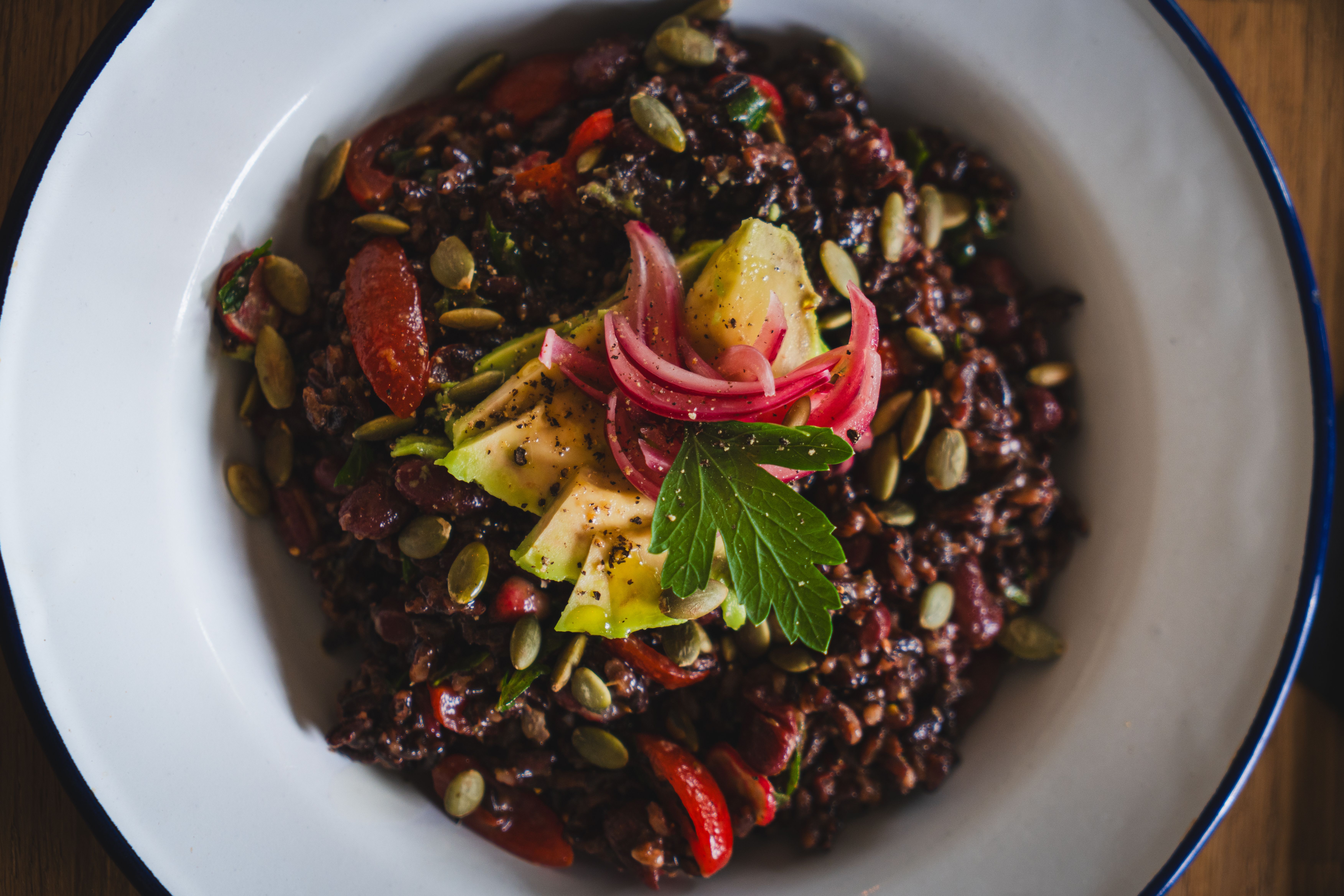
Photo: Mohammed-Ali Hamadache / Pexels
Cuban
Frijoles Negros
The diets react (see scores below)
Common Ingredients
- black beans
- onion
- green bell pepper
- garlic
- cumin
- oregano
- bay leaf
- vinegar
Specific recipes may vary.
Incompatible with 5 of 11 diets
Diet Ratings
Black beans are a legume with very high net carbohydrate content. A standard 1/2 cup serving of cooked black beans contains approximately 20g net carbs (roughly 20g total carbs minus about 7-8g fiber), which can single-handedly consume or exceed an entire day's keto carb budget. The aromatics (onion, green bell pepper, garlic) and seasonings add minimal additional carbs, but the beans themselves are the overwhelming problem. Frijoles Negros is fundamentally incompatible with ketosis regardless of portion size, as even a small side serving would likely break ketosis for most people.
Frijoles Negros as listed is a wholly plant-based dish. Every ingredient — black beans, onion, green bell pepper, garlic, cumin, oregano, bay leaf, and vinegar — is derived entirely from plants. Black beans are an excellent source of plant protein and fiber, and the aromatics and spices are classic whole-food additions. Traditional Cuban Frijoles Negros is sometimes prepared with lard or pork (tocino/chorizo), but the ingredient list provided contains none of those. As evaluated, this version is a nutritious, minimally processed whole-food dish that aligns fully with vegan principles.
Frijoles Negros is built entirely around black beans, which are legumes — one of the most clearly excluded food groups in the paleo diet. Legumes contain lectins, phytates, and other antinutrients that paleo authorities consistently cite as reasons for exclusion. The remaining ingredients (onion, green bell pepper, garlic, cumin, oregano, bay leaf) are all paleo-compliant, but the foundational ingredient disqualifies the dish entirely. Vinegar in small amounts is generally tolerated by many paleo practitioners, but it cannot redeem a legume-based dish.
Frijoles Negros is an excellent Mediterranean diet-compatible dish despite its Cuban origins. Black beans are a premier legume — one of the most encouraged food groups in the Mediterranean diet, consumed multiple times daily. The aromatics (onion, garlic, green bell pepper) are quintessentially Mediterranean plant foods. The herbs and spices (cumin, oregano, bay leaf) are anti-inflammatory and calorie-free flavor enhancers. Vinegar is a traditional Mediterranean condiment. There are no red meats, processed ingredients, refined grains, or added sugars. The dish is entirely whole-food and plant-based, making it a near-perfect side dish by Mediterranean standards.
Frijoles Negros is entirely plant-based with zero animal-derived ingredients. Black beans are legumes — one of the most explicitly excluded food categories on the carnivore diet due to their carbohydrate content, antinutrients (lectins, phytates), and plant origin. Every single ingredient in this dish — black beans, onion, green bell pepper, garlic, cumin, oregano, bay leaf, and vinegar — is plant-derived. This is about as far from carnivore-compatible as a dish can get. There is universal consensus across all carnivore diet authorities and practitioners that legumes and vegetables are completely off the table.
Frijoles Negros (Cuban Black Beans) is built on black beans as its primary ingredient. Black beans are legumes, and legumes are explicitly excluded from the Whole30 program. Unlike green beans, sugar snap peas, and snow peas — which are specifically excepted despite being in the legume family — black beans have no such exception and are firmly on the excluded list. The remaining ingredients (onion, green bell pepper, garlic, cumin, oregano, bay leaf, vinegar) are all Whole30-compatible, but the foundational ingredient disqualifies the entire dish.
Frijoles Negros contains multiple high-FODMAP ingredients that make it unsuitable during the elimination phase. Black beans are high in GOS (galacto-oligosaccharides) and are high-FODMAP even at small servings — Monash rates canned black beans as high-FODMAP at a standard serving (around 1/2 cup). Onion is one of the highest-fructan foods tested by Monash and is high-FODMAP at any culinary quantity. Garlic is similarly one of the highest-fructan foods and is high-FODMAP even in tiny amounts. Green bell pepper is low-FODMAP in small amounts but is often used in quantity in this dish. The combination of black beans + onion + garlic creates a triple-FODMAP hit that is clearly incompatible with the elimination phase.
Frijoles Negros as described is an excellent DASH diet dish. Black beans are a DASH-emphasized food, explicitly listed as a legume/bean serving in the NIH/NHLBI DASH eating plan. They are rich in potassium, magnesium, fiber, and plant-based protein — exactly the nutrients DASH prioritizes. The aromatics (onion, green bell pepper, garlic) add vegetables and beneficial phytonutrients with negligible sodium. The spices (cumin, oregano, bay leaf) add flavor without sodium, which is ideal for DASH since flavor substitutes for salt. Vinegar similarly adds brightness without sodium. The dish contains no saturated fat, no added sugar, no red meat, and no high-sodium processed ingredients. The only consideration is that canned black beans (a common shortcut) can add significant sodium (~400mg per half-cup); if canned beans are used, rinsing reduces sodium by ~40%, and low-sodium canned options score even higher. As described with dried or low-sodium beans, this is a near-perfect DASH side dish.
Frijoles Negros (Cuban black beans) is a nutritionally dense dish that presents a classic Zone challenge: beans are simultaneously a carbohydrate AND a protein source, making block assignment complex. Black beans provide significant fiber (reducing net carbs), moderate protein (~15g per cup), and virtually no fat — meaning they don't neatly fit a single macro block category. The dish scores well for its low-glycemic vegetables (onion, green bell pepper, garlic), anti-inflammatory spices (cumin, oregano), and the vinegar which may help moderate glycemic response. However, black beans are moderately high in carbohydrates even after fiber subtraction (~26g net carbs per cup), and as a Cuban side dish they're typically served in portions that would overload the carb block without sufficient protein or fat to balance the 40/30/30 ratio. The protein in beans is incomplete and comes packaged with significant starch. In Zone terminology, beans are 'unfavorable' carbs but usable — Sears acknowledges legumes as acceptable carb sources in moderation. A half-cup portion could fit as a Zone carb block (~13g net carbs ≈ 1.5 carb blocks) if paired with lean protein and monounsaturated fat, but the dish as a standalone side lacks the protein and fat to complete a Zone-balanced meal or snack.
Some Zone practitioners, particularly those following Sears' later anti-inflammatory and longevity-focused writings, view beans more favorably due to their high polyphenol content, resistant starch, and prebiotic fiber — all of which align with Sears' 'SuperZone' recommendations. The fiber content significantly reduces the net carb load, and the combination of protein + carb in one food can actually simplify block construction for vegetarian Zone meals. This dish could score higher (6-7) if treated as a vegetarian protein-carb hybrid block source rather than a pure carb side.
Cuban black beans (Frijoles Negros) are an outstanding anti-inflammatory dish. Black beans are a nutritional powerhouse — rich in fiber, plant-based protein, folate, and polyphenolic antioxidants (particularly anthocyanins in the black seed coat) that have been linked to reduced inflammatory markers including CRP and IL-6. The aromatic base of onion, garlic, and green bell pepper provides quercetin, allicin, and vitamin C — all compounds with well-documented anti-inflammatory and antioxidant activity. Cumin and oregano contribute additional anti-inflammatory phytochemicals, with oregano being one of the highest antioxidant-density herbs measured by ORAC value. Bay leaf contains linalool and eugenol, which have demonstrated anti-inflammatory properties in research. A splash of vinegar (acetic acid) has a neutral-to-mildly beneficial profile and may support glycemic regulation. There are no pro-inflammatory ingredients — no refined oils, no added sugars, no processed additives, no saturated fat. This dish aligns closely with Dr. Weil's emphasis on beans and legumes as a cornerstone of an anti-inflammatory diet. The whole-food, plant-forward profile makes this a near-ideal anti-inflammatory side dish.
Cuban black beans (frijoles negros) are an excellent GLP-1-friendly side dish. Black beans deliver roughly 7-8g of protein and 7-8g of fiber per half-cup serving, addressing both top nutritional priorities simultaneously. The fat content is negligible — no added oils or fatty ingredients are present in this traditional preparation. The aromatics (onion, bell pepper, garlic) add micronutrients with minimal calories, and the spices (cumin, oregano, bay leaf) are mild and well-tolerated. Vinegar may even support digestion and glycemic response. As a side dish served in a modest portion, this fits naturally within small-meal patterns. The beans are soft-cooked, making them easy to digest despite their fiber content. The primary consideration is gas and bloating, which some GLP-1 patients find more pronounced due to slowed gastric emptying — portion control (half-cup serving) is advisable, especially early in treatment.
Some GLP-1-focused dietitians express caution with legumes early in treatment, as slowed gastric emptying can amplify the gas and bloating that beans naturally cause, making GI side effects more uncomfortable — particularly in the first weeks on the medication. Others consider this manageable with gradual introduction and smaller portions, and strongly endorse beans as a best-in-class protein-and-fiber source for this patient population.
*See how scores were generated at our methodology page.
Nutritional profile
Six traits that cut across every diet.
Fiber & Plants
How much whole-plant food and fiber it delivers.
Healthy Fats
The quality of its fats (unsaturated, omega-3).
Whole / Unprocessed
How close it is to its natural, unprocessed form.
Gut Gentle
How easy it is on digestion (low FODMAP, few irritants).
Low Glycemic
How little it spikes your blood sugar.
Protein Density
How much protein it packs per calorie.
Controversy Index
Higher controversy = more disagreement between diets.
Diet-Specific Tips
 Vegan — 9/10
View tips
- Black beans are a whole-food plant protein — core vegan staple
- All aromatics (onion, bell pepper, garlic) and spices (cumin, oregano, bay leaf) are fully plant-based
- Vinegar is plant-derived (no animal involvement)
- No lard, pork fat, or other animal ingredients present in this version
- Traditional restaurant versions of this dish may include pork — worth verifying when eating out
 Mediterranean — 9/10
View tips
- Black beans are a top-tier legume, strongly encouraged in Mediterranean eating patterns
- All aromatics (onion, garlic, bell pepper) are core Mediterranean plant foods
- Herbs and spices align perfectly with Mediterranean flavor principles
- No animal products, processed ingredients, or refined carbohydrates
- Vinegar is a traditional Mediterranean condiment used in many regional dishes
- High fiber, plant protein, and complex carbohydrates support Mediterranean health goals
 DASH — 9/10
View tips
- Black beans are an explicitly endorsed DASH food (legumes/beans group)
- High in potassium, magnesium, fiber, and plant protein — core DASH nutrients
- No saturated fat, cholesterol, or added sugar
- Spices and vinegar provide flavor without sodium — ideal DASH cooking strategy
- Aromatics (onion, bell pepper, garlic) contribute vegetable servings
- Canned beans can raise sodium significantly; recommend dried or rinsed/low-sodium canned beans
- No processed, high-fat, or high-sodium ingredients in ingredient list
 Zone — 5/10
View tips
- Black beans are classified as 'unfavorable' carbs in classic Zone due to moderate glycemic load, but are usable in controlled portions
- Beans are a dual protein-carb source: ~15g protein and ~40g total carbs (26g net) per cup — requires careful portion control
- High fiber content meaningfully reduces net carb load, improving Zone compatibility
- Anti-inflammatory spices (cumin, oregano) and vinegar align with Zone's polyphenol and inflammation-reduction goals
- Low-glycemic vegetables (onion, bell pepper, garlic) are Zone-favorable carb sources
- No added fat means the dish lacks monounsaturated fat — must be paired with avocado, olive oil, or similar to complete Zone ratios
- No lean protein source present — must be paired with chicken, fish, or similar to balance the meal
- Typical Cuban serving portions (~1 cup as a side) would over-allocate carb blocks without proper pairing
 Anti-Inflammatory — 9/10
View tips
- Black beans high in anthocyanins and fiber — associated with reduced CRP and IL-6
- Garlic and onion provide allicin and quercetin with potent anti-inflammatory effects
- Oregano and cumin among the highest antioxidant-density spices
- Green bell pepper contributes vitamin C and flavonoids
- No pro-inflammatory ingredients — no refined oils, sugars, or additives
- Aligns directly with Dr. Weil's anti-inflammatory pyramid emphasis on beans and legumes
- Whole-food, plant-based dish with strong research backing
 GLP-1 Friendly — 8/10
View tips
- High fiber per serving (~7-8g per half-cup) supports digestion and constipation prevention
- Meaningful plant protein (~7-8g per half-cup) contributes to daily protein targets
- Near-zero fat — no oil in preparation, no saturated fat concerns
- Mild spice profile unlikely to trigger reflux or nausea
- Soft texture supports easy digestibility
- Beans may cause gas/bloating, amplified by GLP-1 slowed gastric emptying — portion sensitivity applies
- Nutrient-dense per calorie — no empty calories
- Works well as a small side portion