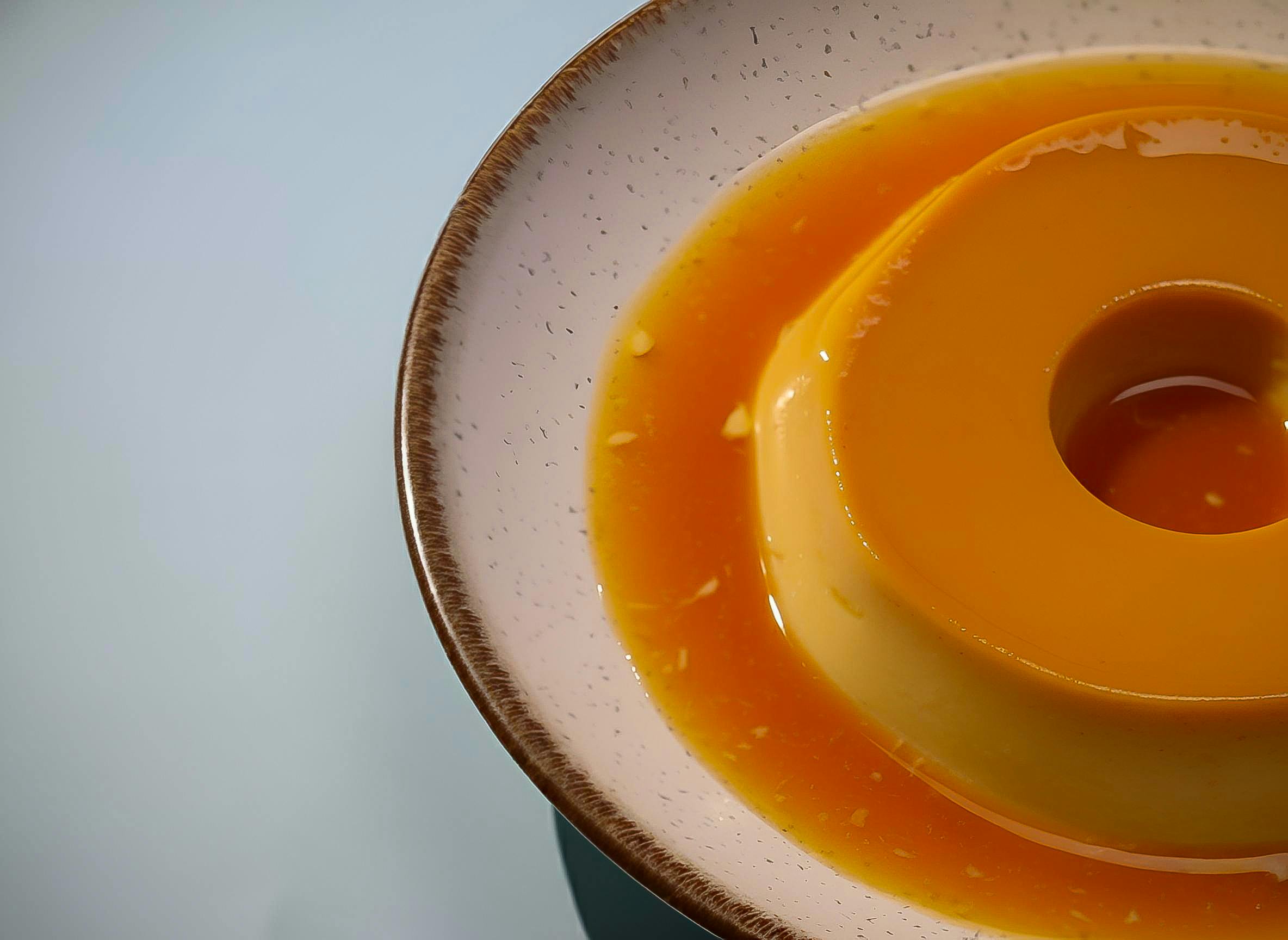
Photo: Nascimento Jr. / Pexels
The diets react (see scores below)
Common Ingredients
- milk
- heavy cream
- egg yolks
- sugar
- vanilla extract
- salt
Specific recipes may vary.
Incompatible with 6 of 11 diets
Diet Ratings
Traditional American custard contains sugar as a primary ingredient alongside milk, both of which are significant sources of carbohydrates. A standard serving of custard (roughly 1/2 cup or 120g) can contain 20-30g of net carbs from added sugar alone, plus additional carbs from the milk (lactose). This easily meets or exceeds the entire daily net carb allowance for strict keto. While the heavy cream and egg yolks are keto-friendly components, the sugar and milk content make traditional custard fundamentally incompatible with ketosis. A keto-adapted version using a sugar substitute and replacing milk with additional heavy cream could theoretically work, but the dish as described with sugar and milk is a clear avoid.
Custard is fundamentally incompatible with a vegan diet. It contains multiple animal-derived ingredients: milk and heavy cream (dairy products) and egg yolks (animal product). These are core, non-incidental ingredients — the dish cannot exist without them. There is no ambiguity here; this is a classic animal-product-based food by definition.
Custard is firmly non-paleo. The dish is built on milk and heavy cream — both are dairy products explicitly excluded from the paleo diet, as Paleolithic humans did not consume the milk of other animals. Sugar (refined) is also a clear violation, contributing empty calories with no place in a hunter-gatherer diet. Salt is added, which is also discouraged. While egg yolks and vanilla extract are individually paleo-compliant, they cannot redeem a dish whose foundational ingredients — dairy and refined sugar — are among the most clearly excluded categories in paleo guidelines. There is no meaningful gray area here.
Custard sits at the boundary of acceptable and problematic within Mediterranean diet principles. The dairy components (milk, heavy cream) and eggs are individually permitted in moderation, but the combination with added sugar and heavy cream makes this a rich, calorie-dense dessert rather than a nourishing staple. Dairy and eggs are acceptable a few times per week, but the added sugar and heavy cream push this toward the less favorable end of the spectrum. As an occasional treat it is not forbidden, but it should not be a regular snack. The American custard style is richer and sweeter than Mediterranean dairy preparations, which tend to be simpler (e.g., plain yogurt, small portions of cheese).
Traditional Mediterranean cuisines do include egg- and milk-based desserts such as Greek 'crema' or Cypriot 'anari' preparations, and some authorities note that moderate dairy and egg consumption fits within the diet; a small portion of plain custard using whole milk and minimal sugar could be viewed as an acceptable occasional indulgence within this tradition.
Custard contains multiple problematic ingredients for carnivore. While eggs and dairy (milk, heavy cream) have varying degrees of acceptance in the carnivore community, this dish is disqualifying due to sugar and vanilla extract — both plant-derived, processed non-animal ingredients explicitly excluded from any tier of carnivore eating. Sugar is a pure carbohydrate with no place in carnivore, and vanilla extract is a plant-derived flavoring. Even the most liberal 'animal-based' practitioners (Saladino) who permit raw dairy and honey would not endorse added refined sugar and vanilla extract in a processed dessert context. The dish is fundamentally a sweetened, flavored dessert rather than an animal product preparation.
Custard contains multiple excluded ingredients. Milk and heavy cream are dairy products, which are explicitly prohibited on Whole30 (only ghee and clarified butter are excepted from the dairy exclusion). Sugar is an added sweetener, also explicitly excluded. These are clear, unambiguous violations of the Whole30 rules with no workarounds possible in a traditional custard.
Custard's FODMAP status hinges primarily on its milk content. Milk is high in lactose, a disaccharide FODMAP, and a standard custard serving contains a meaningful amount of milk. Heavy cream is low-FODMAP (fat-based, very low lactose) even at standard servings. Egg yolks, sugar, vanilla extract, and salt are all low-FODMAP and pose no concern. The critical issue is the milk: Monash rates regular cow's milk as high-FODMAP at amounts as low as 1/2 cup (125ml) due to lactose content. A typical custard serving will contain enough milk to push lactose levels into the high-FODMAP range for most people during the elimination phase. However, the ratio of milk to heavy cream matters — recipes with a higher cream-to-milk ratio dilute the lactose load significantly, potentially bringing a small serving into a tolerable range. Lactose-free milk would make this dish fully low-FODMAP.
Monash University rates regular cow's milk as high-FODMAP at standard servings due to lactose, making traditional custard a caution-to-avoid item during strict elimination. Many clinical FODMAP practitioners advise avoiding any dish where cow's milk is a primary ingredient unless substituted with lactose-free milk, as the portion of custard needed to reach a 'safe' lactose threshold is smaller than most people would consume in practice.
Custard made with milk, heavy cream, egg yolks, sugar, and vanilla is a mixed dish from a DASH perspective. The milk component provides calcium and aligns with DASH's dairy emphasis, but heavy cream is a high-saturated-fat, full-fat dairy product that DASH explicitly discourages. Egg yolks contribute cholesterol and saturated fat. The added sugar content is a concern, as DASH limits sweets. Sodium is low from the small amount of salt used, which is a positive. Overall, custard is an occasional treat — not a core DASH food — but not as problematic as fried foods, processed meats, or high-sodium items. Portion size and frequency matter significantly here.
NIH DASH guidelines specify low-fat or fat-free dairy and limiting sweets, which would place custard firmly in the 'caution-to-avoid' range due to heavy cream and added sugar. However, updated clinical interpretations note that emerging evidence questions the link between full-fat dairy and adverse cardiovascular outcomes, and some DASH-oriented dietitians allow small portions of custard as an infrequent dessert if the rest of the dietary pattern is adherent — particularly if the heavy cream is reduced or substituted with low-fat milk.
Custard presents a mixed Zone Diet profile. It contains dairy protein (milk, egg yolks) which contributes some lean protein, but egg yolks also bring significant saturated fat alongside the heavy cream. The macronutrient ratio is problematic: heavy cream and egg yolks skew fat content high (and toward saturated fat rather than the preferred monounsaturated), sugar is a high-glycemic carbohydrate that Sears explicitly discourages, and the overall ratio will be far from the target 40/30/30. The carbohydrate load comes almost entirely from added sugar rather than low-glycemic vegetables or fruits. However, custard is not nutritionally empty — egg yolks provide protein and micronutrients, and dairy contributes calcium — so it is not in 'avoid' territory. A small portion could technically be worked into a Zone snack block structure if paired with lean protein and the overall meal is adjusted, but it requires significant portion restriction and is classified as an 'unfavorable' food in Zone terminology. As a standalone snack, it fails to deliver a Zone-balanced ratio.
Some Zone practitioners in Sears' later anti-inflammatory framework note that the fat in custard (from dairy and eggs) is not as categorically harmful as once thought, particularly since egg yolks contain some beneficial nutrients including choline and omega-3s if from pasture-raised hens. A very small portion (half-cup or less) might be viewed as an acceptable occasional treat if the rest of the day's meals are tightly Zone-balanced — the key concern remains the added sugar rather than the fat per se.
Classic American custard combines several ingredients with mixed inflammatory profiles. Heavy cream is high in saturated fat, which anti-inflammatory guidelines recommend limiting — Dr. Weil's pyramid places full-fat dairy in the 'use sparingly' category. Egg yolks contain arachidonic acid (a pro-inflammatory omega-6 precursor) but also choline, lutein, and fat-soluble vitamins with some anti-inflammatory benefit. Milk adds additional saturated fat and lactose. Added sugar is a meaningful concern — anti-inflammatory frameworks consistently flag added sugar as a driver of inflammatory markers (CRP, IL-6), and custard typically requires a non-trivial amount. On the positive side, vanilla extract contains small amounts of vanillin with antioxidant properties, and eggs provide some beneficial nutrients. The dish is not heavily processed and contains no trans fats or artificial additives, which keeps it from the 'avoid' tier. Overall, custard is a moderate-indulgence food: high in saturated fat and added sugar, low in anti-inflammatory compounds, acceptable occasionally but not supportive of an anti-inflammatory eating pattern as a regular snack.
Some ancestral and traditional food advocates (e.g., Weston A. Price–aligned practitioners) argue that full-fat dairy from quality sources is not inherently inflammatory and may support gut and hormonal health, contrasting with mainstream anti-inflammatory guidance that limits saturated fat and full-fat dairy. Conversely, stricter anti-inflammatory and AIP protocols would rate custard lower due to the combined burden of full-fat dairy, arachidonic acid from egg yolks, and added sugar.
Custard is a mixed bag for GLP-1 patients. On the positive side, eggs and dairy provide some protein and the dish is soft, easy to digest, and gentle on a slowed GI tract — properties that make it tolerable during nausea flares. However, heavy cream significantly raises the fat content per serving, saturated fat in particular, which can worsen nausea, bloating, and reflux — the exact side effects GLP-1 medications already amplify. Sugar adds empty calories with no fiber or micronutrient benefit, undercutting the nutrient density requirement that is critical when appetite is suppressed. Protein yield is modest (roughly 4-6g per half-cup serving) relative to calorie load, making it a poor protein-per-calorie performer compared to Greek yogurt or cottage cheese. Fiber is essentially zero. As a small occasional treat or a vehicle for getting some nutrition down during a difficult GI day, it is acceptable, but it should not be a routine snack for GLP-1 patients trying to meet protein and nutrient targets.
Some GLP-1-focused dietitians permit custard cautiously as a soft, palatable option during severe nausea phases when patients struggle to eat anything at all, prioritizing caloric adequacy over ideal macros in the short term. Others recommend avoiding it entirely due to the high saturated fat from heavy cream worsening GI side effects, and suggest Greek yogurt-based preparations as a higher-protein, lower-fat substitute.
*See how scores were generated at our methodology page.
Nutritional profile
Six traits that cut across every diet.
Fiber & Plants
How much whole-plant food and fiber it delivers.
Healthy Fats
The quality of its fats (unsaturated, omega-3).
Whole / Unprocessed
How close it is to its natural, unprocessed form.
Gut Gentle
How easy it is on digestion (low FODMAP, few irritants).
Low Glycemic
How little it spikes your blood sugar.
Protein Density
How much protein it packs per calorie.
Controversy Index
Higher controversy = more disagreement between diets.
Diet-Specific Tips
 Mediterranean — 4/10
View tips
- Added sugar is discouraged in Mediterranean diet guidelines
- Heavy cream is high in saturated fat, not aligned with olive oil as primary fat
- Eggs and dairy are permitted in moderation but not as a daily snack
- No plant-forward or whole-food components present
- Richer and sweeter than typical Mediterranean dairy preparations
- Acceptable only as an occasional treat, not a regular snack
 DASH — 4/10
View tips
- Heavy cream is a high-saturated-fat full-fat dairy product, explicitly limited on DASH
- Added sugar from granulated sugar; DASH limits sweets and added sugars
- Egg yolks contribute saturated fat and cholesterol, though modern DASH interpretations are less strict on dietary cholesterol
- Milk provides calcium and aligns with DASH dairy goals
- Sodium is relatively low — a positive attribute
- Small portions infrequently may be acceptable within an otherwise DASH-adherent diet
 Zone — 4/10
View tips
- Added sugar is a high-glycemic carbohydrate explicitly unfavorable in Zone Diet
- Heavy cream contributes high saturated fat, not the preferred monounsaturated fat
- Egg yolks provide some protein but also increase saturated fat load
- Macronutrient ratio skews toward fat and unfavorable carbs, far from 40/30/30 target
- No low-glycemic vegetables or fruits to balance the carbohydrate quality
- Small portions could technically fit into a Zone block structure but require careful adjustment
- Not nutritionally empty — dairy and eggs provide real nutrients — so not an 'avoid'
 Anti-Inflammatory — 4/10
View tips
- Heavy cream is high in saturated fat — anti-inflammatory guidelines recommend limiting full-fat dairy
- Added sugar drives inflammatory markers (CRP, IL-6) and is consistently flagged across anti-inflammatory frameworks
- Egg yolks contain arachidonic acid, a precursor to pro-inflammatory eicosanoids, though also provide beneficial micronutrients
- No trans fats, artificial additives, or processed ingredients keep it out of the 'avoid' tier
- Vanilla extract provides minor antioxidant (vanillin) benefit but not meaningful at culinary doses
- Not a supportive snack choice for an anti-inflammatory diet; occasional treat status at best
 GLP-1 Friendly — 4/10
View tips
- High saturated fat from heavy cream may worsen nausea, bloating, and reflux
- Added sugar contributes empty calories with no fiber or micronutrient return
- Low protein density relative to calorie load — poor protein-per-calorie ratio
- Zero dietary fiber — does not support GLP-1 digestion or constipation prevention
- Soft texture and easy digestibility are genuine advantages during GI side effect flares
- Small portion tolerance is acceptable but nutrient return remains low