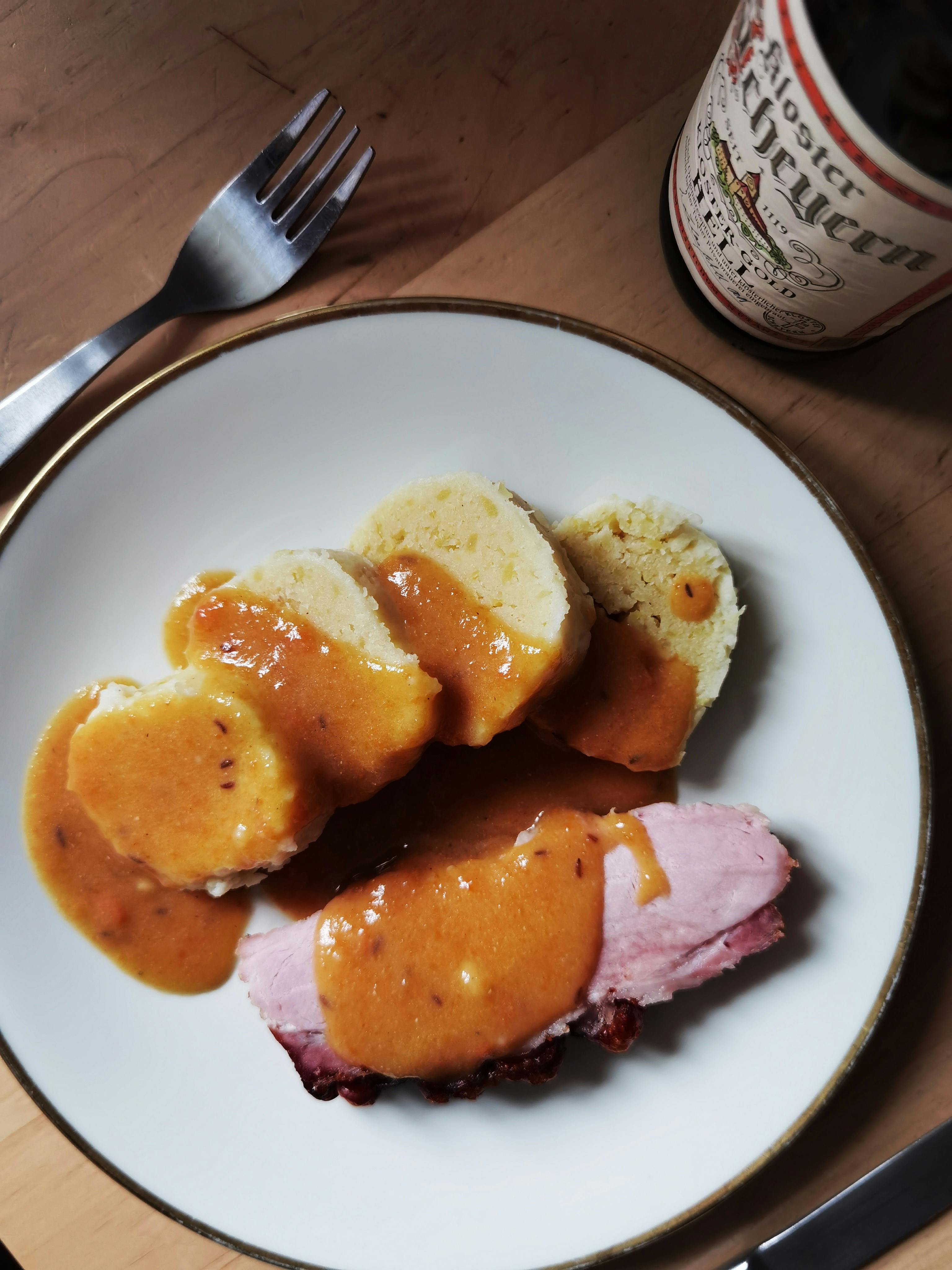
The diets react (see scores below)
Common Ingredients
- flour
- yeast
- eggs
- milk
- stale bread
- salt
Specific recipes may vary.
Incompatible with 9 of 11 diets
Diet Ratings
Knedliky (Czech bread dumplings) are fundamentally incompatible with a ketogenic diet. The dish is made almost entirely from high-carbohydrate ingredients: white flour and stale bread form the bulk of the dumpling, with yeast and milk adding additional carbs. A single serving of knedliky (2-3 slices) can contain 40-60g of net carbs, far exceeding the entire daily keto allowance. There is no meaningful fat content and no mechanism to reduce the carb load without completely reformulating the dish. This is a grain-based food by definition.
Knedliky (Czech bread dumplings) in this traditional recipe contain both eggs and milk, which are clear animal-derived ingredients excluded from a vegan diet. There is no ambiguity here — both are dairy and egg products respectively, making this dish incompatible with veganism as defined by all major vegan organizations. Vegan versions can be made by substituting plant-based milk (oat, soy) and a flax or aquafaba egg replacer, but the traditional dish as described is not vegan.
Knedliky (Czech bread dumplings) are fundamentally incompatible with the paleo diet. The dish is built almost entirely from non-paleo ingredients: wheat flour and stale bread are grains, which are categorically excluded from paleo; yeast-leavened bread represents a processed grain product; milk is dairy, which is excluded; and salt is an added ingredient that is also discouraged. Eggs are the only paleo-approved ingredient in the entire recipe. There is no meaningful way to argue this dish fits within a paleo framework — it is a grain-and-dairy-based food that would not have been available to Paleolithic hunter-gatherers.
Knedliky (Czech bread dumplings) are made primarily from refined white flour and stale white bread, making them a refined grain product with minimal nutritional value by Mediterranean diet standards. The Mediterranean diet strongly de-emphasizes refined grains in favor of whole grains, and this dish is essentially a dense refined carbohydrate with no vegetables, legumes, olive oil, or other Mediterranean-aligned components. The eggs and milk are minor components and do not offset the fundamentally refined-grain nature of the dish. This is a Central European staple with no meaningful place in a Mediterranean eating pattern.
Knedliky (Czech bread dumplings) are almost entirely plant-based and grain-derived. The primary ingredients — flour, yeast, and stale bread — are all plant foods explicitly excluded from the carnivore diet. While eggs and milk are animal-derived, they are minor components in what is fundamentally a grain-based dish. Flour and bread are among the most anti-carnivore foods possible, being processed grains high in carbohydrates. This dish has no place on a carnivore diet in any tier or variation.
Knedliky (Czech bread dumplings) are made from flour and stale bread, both of which are grain-based and strictly excluded on the Whole30 program. Additionally, milk is a dairy product, which is also excluded. Multiple core ingredients violate Whole30 rules, making this dish clearly non-compliant. There is no compliant workaround that would preserve the identity of this dish.
Knedliky (Czech bread dumplings) are made primarily from wheat flour and stale wheat bread, both of which are high in fructans — a key FODMAP oligosaccharide. Wheat flour and wheat bread are among the most clearly high-FODMAP ingredients per Monash University, and they form the bulk of this dish. The yeast used for leavening is not a FODMAP concern in small quantities, eggs are low-FODMAP, and salt is neutral. However, milk contains lactose, which is a disaccharide FODMAP — though the amount per serving may be moderate. The dominant issue is the double wheat hit from flour AND stale bread, making this dish high-FODMAP at any realistic serving size during the elimination phase.
Knedliky (Czech bread dumplings) are made from refined white flour, stale bread, eggs, milk, yeast, and salt. From a DASH perspective, they are a refined-grain, high-carbohydrate side dish with notable concerns: (1) refined flour and stale bread contribute no meaningful fiber and lack the nutrient density of whole grains that DASH emphasizes; (2) the salt used in preparation, combined with the sodium already present in stale bread, can push sodium content to a moderate-to-high range per serving; (3) the dish provides minimal potassium, magnesium, calcium, or fiber — the key micronutrients DASH prioritizes. On the positive side, knedliky are not high in saturated fat, contain no red meat or added sugar, and the eggs and milk provide modest protein and calcium. They are not categorically 'avoid' territory, but they fall short of DASH ideals. Consumed as an occasional, portion-controlled side (1-2 slices) alongside DASH-friendly mains (lean protein, abundant vegetables), they are acceptable. Whole-grain flour substitution would meaningfully improve the profile.
Knedliky (Czech bread dumplings) are made almost entirely from high-glycemic carbohydrates — white flour, stale white bread, milk, and yeast — with essentially no lean protein and negligible fat. This makes them nearly impossible to incorporate into a Zone-balanced meal as a component, as they would massively skew the macro ratio toward carbohydrates with very high glycemic impact. The carb load is dense and refined, exactly the type of 'unfavorable' carbohydrate Dr. Sears consistently warns against. There is minimal fiber to blunt the glycemic response. While eggs and milk contribute small amounts of protein and fat, the ratio is overwhelmingly carb-dominant (likely 70-80%+ of calories from high-GI carbs). Even as a small side portion, the glycemic hit would disrupt eicosanoid balance — the central concern of Zone methodology. This is not a case where careful portioning rescues the food; the fundamental macro profile is incompatible with Zone ratios.
Knedliky (Czech bread dumplings) are made from refined white flour, stale white bread, eggs, milk, yeast, and salt. The ingredient profile is dominated by refined carbohydrates — white flour and stale bread — which are low in fiber and have a high glycemic index, capable of spiking blood glucose and promoting inflammatory pathways over time. There are no meaningful anti-inflammatory ingredients: no omega-3 sources, no antioxidant-rich vegetables, no herbs or spices, no whole grains. The eggs contribute some choline and selenium, and the milk provides modest nutrients, but neither shifts the overall profile meaningfully. The dish is not inherently 'pro-inflammatory' in the same way as processed foods with trans fats, seed oils, or added sugars — it is essentially a plain, starchy side dish — but refined grain-heavy foods are consistently flagged in anti-inflammatory frameworks as foods to limit due to their glycemic load and displacement of more beneficial fiber-rich carbohydrates. As an occasional side dish in an otherwise anti-inflammatory diet, knedliky pose little acute harm, but they offer no anti-inflammatory benefit and represent a pattern of eating that anti-inflammatory guidelines discourage.
Knedliky (Czech bread dumplings) are made from refined white flour, stale bread, eggs, milk, and yeast — a combination that is essentially a dense, starchy carbohydrate with minimal protein, minimal fiber, and high glycemic impact. As a side dish with no primary protein source, it contributes almost exclusively refined carbohydrates and empty calories. For GLP-1 patients eating significantly reduced volumes of food, knedliky occupies stomach space with very little nutritional return. The dense, doughy texture may also be difficult to digest given slowed gastric emptying, potentially worsening bloating, nausea, or reflux. It contains no meaningful fiber, negligible protein per serving, and is not nutrient-dense per calorie — failing on nearly every GLP-1 dietary priority.
*See how scores were generated at our methodology page.
Nutritional profile
Six traits that cut across every diet.
Fiber & Plants
How much whole-plant food and fiber it delivers.
Healthy Fats
The quality of its fats (unsaturated, omega-3).
Whole / Unprocessed
How close it is to its natural, unprocessed form.
Gut Gentle
How easy it is on digestion (low FODMAP, few irritants).
Low Glycemic
How little it spikes your blood sugar.
Protein Density
How much protein it packs per calorie.
Controversy Index
Higher controversy = more disagreement between diets.
Diet-Specific Tips
 DASH — 4/10
View tips
- Refined white flour and stale bread — low fiber, not a whole grain as DASH recommends
- Moderate-to-elevated sodium from added salt plus sodium in bread
- Negligible potassium, magnesium, and dietary fiber per serving
- Low in saturated fat — not a red-meat or full-fat dairy product
- Eggs and milk contribute modest protein and calcium
- Acceptable in small portions as an occasional side; whole-grain version would score higher
 Anti-Inflammatory — 4/10
View tips
- High refined carbohydrate content from white flour and stale bread — low fiber, high glycemic index
- No anti-inflammatory ingredients: no omega-3s, antioxidants, polyphenols, or beneficial spices
- Eggs and milk contribute minor nutritional value but do not offset the refined carb profile
- No trans fats, seed oils, added sugars, or artificial additives — not actively pro-inflammatory
- Occasional consumption in an otherwise healthy diet is unlikely to be harmful, but offers no anti-inflammatory benefit