Czech
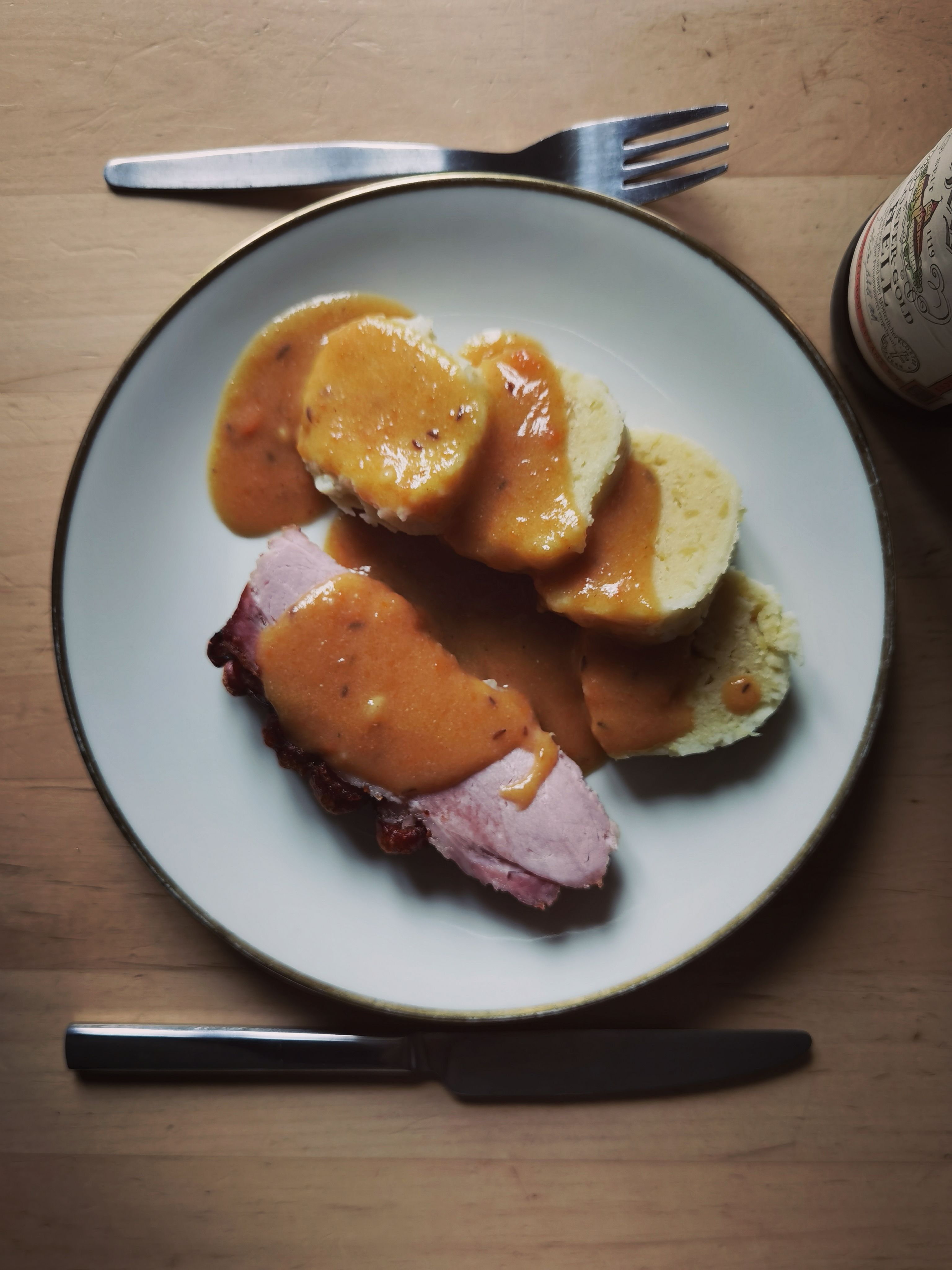
Vepro Knedlo Zelo
The diets react (see scores below)
Common Ingredients
- pork shoulder
- bread dumplings
- sauerkraut
- caraway seeds
- onion
- garlic
- flour
- salt
Specific recipes may vary.
Incompatible with 10 of 11 diets
Diet Ratings
Vepro Knedlo Zelo is a classic Czech dish that combines roasted pork shoulder with bread dumplings (knedlíky) and sauerkraut. While the pork shoulder and sauerkraut are keto-friendly components, the bread dumplings are the critical disqualifying element. Made from flour, bread, and eggs, a typical serving of bread dumplings (2-3 slices, ~150-200g) contributes 40-60g of net carbs on its own — immediately exceeding or maxing out the entire daily keto carb budget. The flour used in the dumpling preparation also adds additional carbs. The dish as traditionally prepared and served is fundamentally incompatible with ketosis. The pork and sauerkraut components could be eaten in isolation on keto, but the dish cannot be evaluated without its defining dumpling component.
Vepro Knedlo Zelo is a traditional Czech dish whose name literally translates to 'pork, dumplings, cabbage.' The primary protein is pork shoulder, a direct animal product. This dish is fundamentally incompatible with a vegan diet. There is no ambiguity here — pork is animal flesh and is categorically excluded under all definitions of veganism.
Vepro Knedlo Zelo is a traditional Czech dish that is fundamentally incompatible with the paleo diet. While the pork shoulder and sauerkraut are paleo-friendly, the dish is defined by bread dumplings (knedlíky) made from flour — a grain-based ingredient that is strictly excluded from paleo. Salt is also added, which is discouraged. The flour used in the dumplings is wheat-based, placing it firmly in the 'avoid' category. The paleo-compliant components (pork, sauerkraut, caraway seeds, onion, garlic) cannot redeem the dish when its structural centerpiece is a grain product. This is not a borderline case — grains are one of the clearest exclusions in paleo, with consensus across all major paleo authorities including Loren Cordain, Mark Sisson, and Robb Wolf.
Vepro Knedlo Zelo is a classic Czech dish that conflicts with Mediterranean diet principles on multiple fronts. Pork shoulder is a fatty red/processed meat, consumed here as the primary protein and centerpiece of the meal — the Mediterranean diet limits red meat to a few times per month and never as a dietary staple. Bread dumplings are made from refined white flour, a refined grain with minimal nutritional value that the Mediterranean diet discourages. There is no olive oil, no emphasis on plant-forward ingredients, and no whole grains. The sauerkraut, caraway, onion, and garlic are the only redeeming elements, but they do not offset the core issues of a fat-heavy pork cut paired with refined-grain dumplings. This dish is fundamentally rooted in Central European culinary traditions that are nearly the inverse of Mediterranean dietary patterns.
Vepro Knedlo Zelo is a traditional Czech dish that combines pork shoulder (carnivore-approved) with multiple plant-based and grain-based components that are entirely incompatible with the carnivore diet. Bread dumplings are made from flour and bread — pure grain products that are strictly excluded. Sauerkraut is fermented cabbage, a plant food. Caraway seeds, onion, and garlic are all plant-derived ingredients. Flour is a grain. The only carnivore-compatible element is the pork shoulder itself and salt. The dish as a whole is a classic omnivore meal dominated by carbohydrates and plant foods, making it firmly in the 'avoid' category with high confidence.
Vepro Knedlo Zelo contains bread dumplings (knedlíky), which are made from flour and bread — both grain-based ingredients explicitly excluded on Whole30. Flour is a grain product and a core component of this dish. Additionally, the dish structure itself revolves around dumplings, which are a grain-based starch that cannot be substituted away without fundamentally changing the dish. The pork shoulder, sauerkraut, caraway seeds, onion, garlic, and salt are all individually Whole30-compatible, but the bread dumplings make this dish non-compliant as traditionally prepared.
Vepro Knedlo Zelo is a classic Czech dish that contains multiple high-FODMAP ingredients making it unsuitable during the elimination phase. The bread dumplings (knedlíky) are made primarily from wheat flour, which is high in fructans — a major FODMAP trigger. Onion and garlic are among the highest-FODMAP foods tested by Monash University, both rich in fructans, and they are used as core flavoring components in the pork preparation. While pork shoulder itself is a protein and contains no FODMAPs, and sauerkraut is generally considered low-FODMAP at a standard serving (around 75g, as fermentation reduces fructans), and caraway seeds are low-FODMAP in typical culinary amounts, the combination of wheat-based dumplings, onion, and garlic makes this dish clearly high-FODMAP overall. There is no realistic way to make a traditional version of this dish compliant during the elimination phase without fundamentally altering the recipe.
Vepro Knedlo Zelo is a traditional Czech pork roast served with bread dumplings and sauerkraut, and it conflicts with DASH diet principles on multiple fronts. Pork shoulder is a high-fat cut with significant saturated fat content, which DASH explicitly limits. Sauerkraut, while containing beneficial probiotics and vegetables, is extremely high in sodium — a single cup can contain 900–1,200mg of sodium, approaching or exceeding the entire daily sodium budget for low-sodium DASH (1,500mg). Bread dumplings are made from refined white flour, offering little fiber and minimal DASH-relevant nutrients like potassium, calcium, or magnesium. The dish is also heavily salted during preparation. Together, these components create a meal that is high in saturated fat, very high in sodium, and low in the fiber-rich vegetables, whole grains, and lean proteins that DASH emphasizes. This dish as traditionally prepared is a poor fit for the DASH eating plan.
Vepro Knedlo Zelo is a traditional Czech dish that presents multiple Zone Diet challenges simultaneously. Pork shoulder is a fatty cut with significant saturated fat, unlike the lean proteins Zone favors (skinless chicken, fish, egg whites). The bread dumplings (knedlíky) are made from white flour or stale bread, placing them squarely in the high-glycemic, 'unfavorable' carbohydrate category — the kind of starchy, refined carb the Zone explicitly discourages. The sauerkraut is actually a Zone-friendly element: fermented cabbage is low-glycemic, anti-inflammatory, and rich in polyphenols. However, the overall macronutrient ratio is severely skewed: the dish is dominated by high-glycemic carbohydrates from dumplings and fatty protein from pork shoulder, making the 40/30/30 Zone ratio nearly impossible to achieve without radical modification. As served in traditional portions, this meal would deliver far too many unfavorable carbs and too much saturated fat relative to its protein content. To make it Zone-compatible would require replacing bread dumplings with a low-GI vegetable side, swapping pork shoulder for a leaner cut (pork tenderloin), and reducing fat significantly — at which point it is no longer recognizably this dish.
Vepro Knedlo Zelo is a traditional Czech dish centered on pork shoulder, bread dumplings, and sauerkraut. From an anti-inflammatory perspective, it stacks several problematic elements. Pork shoulder is a fatty red/processed-adjacent meat high in saturated fat, which falls into the 'limit' category. Bread dumplings are made from refined white flour, a refined carbohydrate that drives glycemic spikes and is associated with increased inflammatory markers like CRP. The combination of a large portion of fatty pork with refined starch creates a pro-inflammatory meal profile. On the positive side, sauerkraut is a fermented food that supports gut microbiome health (and thus may have indirect anti-inflammatory effects), and caraway seeds, garlic, and onion all carry modest anti-inflammatory and prebiotic properties. However, these beneficial elements are relatively minor contributors in the context of the dish as a whole. The overall macronutrient profile — high saturated fat, high refined carbohydrate, large protein from a fatty cut — makes this a dish that anti-inflammatory frameworks would place firmly in the 'limit' or 'avoid' category when consumed regularly.
Vepro Knedlo Zelo is a traditional Czech pork roast served with bread dumplings and sauerkraut — a combination that presents multiple serious concerns for GLP-1 patients. Pork shoulder is a high-fat cut with significant saturated fat content, directly worsening GLP-1 side effects including nausea, bloating, and reflux due to slowed gastric emptying. Bread dumplings are made from refined white flour with minimal fiber and protein, representing essentially empty caloric carbohydrates in a dense, heavy format — poorly suited for the small stomach capacity GLP-1 patients experience. The overall meal is calorically dense, high in saturated fat, and low in nutrient density per calorie. The one partial redeeming element is sauerkraut, which provides some fiber and probiotics beneficial for GLP-1-related digestive issues, but this does not meaningfully offset the other concerns. This dish as traditionally prepared is heavy, fatty, and difficult to digest — nearly the opposite profile of what GLP-1 patients need.
*See how scores were generated at our methodology page.
Nutritional profile
Six traits that cut across every diet.
Fiber & Plants
How much whole-plant food and fiber it delivers.
Healthy Fats
The quality of its fats (unsaturated, omega-3).
Whole / Unprocessed
How close it is to its natural, unprocessed form.
Gut Gentle
How easy it is on digestion (low FODMAP, few irritants).
Low Glycemic
How little it spikes your blood sugar.
Protein Density
How much protein it packs per calorie.
Controversy Index
Higher controversy = more disagreement between diets.
Diet-Specific Tips
 Zone — 5/10
View tips
- Pork shoulder is high in saturated fat, an unfavorable Zone protein source
- Bread dumplings are made from refined white flour — high-glycemic, unfavorable carbs per Zone classification
- Sauerkraut is Zone-friendly: low-glycemic, anti-inflammatory, polyphenol-rich fermented vegetable
- Caraway seeds, onion, and garlic are Zone-favorable flavor components
- Overall macronutrient ratio is far from 40/30/30 — carb-heavy and saturated-fat-heavy
- No monounsaturated fat sources present in the dish
- Traditional Czech portion sizes emphasize dumplings as the bulk of the meal, compounding the glycemic load