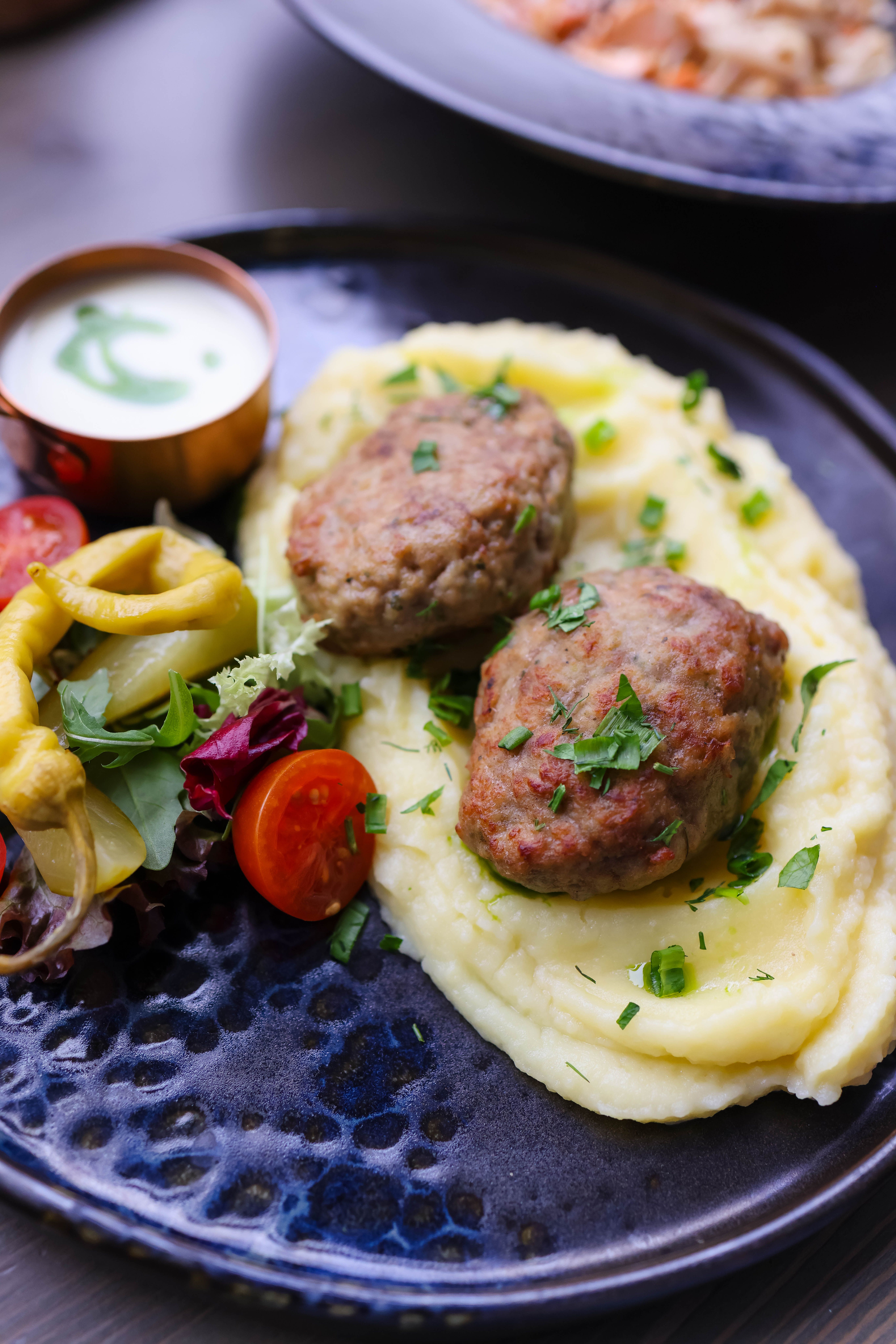
Photo: Valeria Boltneva / Pexels
The diets react (see scores below)
Common Ingredients
- ground pork
- onion
- breadcrumbs
- eggs
- butter
- peas
- carrots
Specific recipes may vary.
Incompatible with 7 of 11 diets
Diet Ratings
Karbonader (Danish breaded pork patties) are fundamentally incompatible with keto due to breadcrumbs as a binding agent, which introduce significant grain-based carbohydrates. The dish is further complicated by peas and carrots as typical accompaniments — both are starchy/sugary vegetables that add meaningful net carbs. While the ground pork and eggs are keto-friendly, and butter is excellent for keto, the breadcrumbs alone disqualify the dish in its traditional form. A standard serving would easily exceed the daily net carb budget. The combination of breadcrumbs + peas + carrots creates a triple carb load that makes this dish a clear avoid.
Karbonader is a traditional Danish pork patty dish containing multiple animal-derived ingredients. Ground pork is a direct animal product (meat), eggs are an animal product excluded by veganism, and butter is a dairy product also excluded. These three ingredients alone make this dish fundamentally incompatible with a vegan diet. There is no ambiguity here — this dish is built on animal products at its core.
Karbonader are traditional Danish pork patties that contain breadcrumbs as a binding agent — a clear grain/gluten ingredient that is strictly excluded from the paleo diet. Peas are legumes, also firmly on the avoid list. Butter is a dairy product excluded under strict paleo guidelines. While ground pork, onion, eggs, and carrots are paleo-compatible, the non-compliant ingredients (breadcrumbs, peas, butter) are structural to the dish, not optional garnishes. The dish as traditionally prepared cannot be considered paleo-friendly.
Karbonader is a Danish dish of fried ground pork patties, which conflicts with core Mediterranean diet principles on multiple levels. Ground pork is red/processed meat, recommended only a few times per month. The patties are pan-fried in butter rather than olive oil, adding saturated fat from a non-recommended source. Breadcrumbs likely derive from refined grains. While peas and carrots are positive plant-based elements, they cannot offset the dominant issues: a red meat protein base, butter as the cooking fat, and a preparation style (breaded, fried) that runs contrary to Mediterranean cooking methods. This dish is fundamentally Northern European in character and sits far outside Mediterranean dietary patterns.
Karbonader is a Danish pork patty dish that contains multiple plant-based ingredients making it incompatible with the carnivore diet. While the base ingredient (ground pork) and eggs are carnivore-approved, the dish includes breadcrumbs (grain-derived), onion (vegetable), peas (legume), and carrots (vegetable). These plant foods are explicitly excluded from the carnivore diet. Breadcrumbs alone are a disqualifying grain product, and the combination of vegetables and legumes makes this dish firmly in the 'avoid' category. The dish would need to be completely reformulated — stripped of all plant ingredients — to be carnivore-compatible.
Karbonader contains two clearly excluded ingredients: breadcrumbs (a grain product made from wheat bread) and butter (dairy — only ghee/clarified butter is permitted on Whole30). These are not edge cases or ambiguous ingredients; both are explicitly excluded by the official Whole30 program. The breadcrumbs serve as a binder in the ground pork patties, making them integral to the dish's structure. Butter is used for frying, which could theoretically be swapped for ghee, but the breadcrumbs cannot be simply omitted without fundamentally changing the dish. The remaining ingredients — ground pork, onion, eggs, peas, carrots — are all Whole30-compliant.
Karbonader contains multiple high-FODMAP ingredients that make it unsuitable during the elimination phase. Onion is one of the highest-FODMAP foods tested by Monash University, rich in fructans, and is problematic at any serving size. Traditional breadcrumbs are wheat-based, adding fructans as a second significant source. Peas are high in GOS (galacto-oligosaccharides) and are high-FODMAP at standard serving sizes. Ground pork, eggs, butter, and carrots are individually low-FODMAP and safe, but the combination of onion, wheat breadcrumbs, and peas makes this dish a clear avoid during the FODMAP elimination phase without substantial recipe modification.
Karbonader are Danish pork patties made with ground pork, breadcrumbs, egg, and butter — fried or pan-cooked. While the dish includes DASH-friendly vegetables (peas, carrots, onion), several components work against DASH compliance. Ground pork is a red meat with moderate-to-high saturated fat content, which DASH limits. Butter adds saturated fat, and breadcrumbs can contribute sodium. The overall saturated fat load from the combination of ground pork and butter is a notable concern. The vegetables (peas, carrots, onion) provide potassium, fiber, and magnesium that partially offset negatives. If made with lean ground pork, minimal butter, and low-sodium breadcrumbs, this dish moves toward acceptable territory under DASH, but as traditionally prepared it requires caution.
NIH DASH guidelines categorically limit red meat and saturated fat, placing traditional Karbonader in the caution-to-avoid zone. However, updated clinical interpretations note that lean pork cuts can fit within DASH when consumed in small portions (≤6 oz/day lean meat), and some DASH-aligned dietitians would permit a modified version using lean ground pork, minimal butter, and whole-grain breadcrumbs occasionally.
Karbonader (Danish pan-fried ground pork patties) present a mixed Zone profile. Ground pork is a moderate-fat protein — not as lean as skinless chicken or fish, but acceptable when leaner cuts are used. The breadcrumbs are a higher-glycemic, refined carbohydrate binder that disrupts the carb block quality, though the quantity per serving is relatively small. Butter for frying adds saturated fat rather than preferred monounsaturated fat. On the positive side, peas and carrots are favorable Zone carbohydrate blocks — low-to-moderate glycemic, rich in fiber and polyphenols, and easy to portion. Onion and eggs are also Zone-friendly. With careful portioning — leaner ground pork, minimal breadcrumbs, substituting olive oil for butter, and emphasizing the peas and carrots as the carb blocks — this dish can be reasonably Zone-balanced. However, as traditionally prepared with butter and standard breadcrumb quantities, the saturated fat load is elevated and the carb quality is reduced. It requires meaningful modification to fit well within Zone ratios.
Some Zone practitioners would rate this more favorably, noting that ground pork with a modest fat content (e.g., 90/10) can serve as a workable protein block, and that the breadcrumb quantity per patty is small enough not to significantly spike glycemic load. Dr. Sears' later anti-inflammatory writings also soften the strict stance against all saturated fat, suggesting that in the context of an overall anti-inflammatory diet, modest butter use is not categorically problematic. Conversely, stricter Zone adherents would flag the butter and breadcrumbs more harshly and push toward a lower score.
Karbonader are Danish pan-fried pork patties made from ground pork, onion, breadcrumbs, and eggs, cooked in butter and served with peas and carrots. The dish has a mixed anti-inflammatory profile. On the positive side, peas and carrots provide fiber, carotenoids (beta-carotene in carrots), and antioxidants. Onion contributes quercetin and other flavonoids. Eggs offer choline and selenium with some anti-inflammatory properties. However, the primary protein — ground pork — is red/processed-adjacent meat with saturated fat, and anti-inflammatory frameworks recommend limiting red meat consumption. Butter as the cooking fat adds saturated fat, which anti-inflammatory guidelines advise limiting (extra virgin olive oil would be preferred). Breadcrumbs represent refined carbohydrates, a mild pro-inflammatory element. The overall dish is a home-cooked, minimally processed traditional meal without trans fats, additives, or high-fructose corn syrup, which prevents it from falling into 'avoid' territory. The vegetable sides are genuinely beneficial. Moderated consumption of this dish — particularly if butter is reduced and leaner cuts of pork or partial substitution with poultry is considered — fits the 'acceptable in moderation' category of the anti-inflammatory framework.
Some anti-inflammatory practitioners, particularly those following stricter protocols, would argue that ground pork's saturated fat and arachidonic acid content, combined with refined breadcrumbs and butter, push this dish closer to a 3–4 score and warrant more active avoidance. Conversely, whole-food nutrition advocates note that this is a minimally processed, home-cooked meal with meaningful vegetable content, and that context and overall dietary pattern matter more than any single dish.
Karbonader are Danish pan-fried ground pork patties made with breadcrumbs and egg as binders, cooked in butter, typically served with peas and carrots. The dish has real nutritional merit — ground pork provides meaningful protein (roughly 20-25g per standard serving depending on patty size), and the side vegetables add fiber, vitamins, and color. However, several GLP-1 concerns apply. Ground pork is a moderate-to-high fat protein: even lean ground pork typically runs 15-20g of fat per 100g, and the butter used for pan-frying adds saturated fat on top. The breadcrumb binder reduces protein density per calorie and adds refined carbohydrate with minimal fiber value. Pan-frying in butter increases the overall fat load of each serving, which is a meaningful concern for GLP-1 patients prone to nausea, bloating, and reflux from high-fat meals. The peas and carrots are genuinely beneficial — they contribute fiber and micronutrients in a small-portion-friendly format. The dish is not fried in the deep-fry sense and is not ultra-processed, which keeps it out of avoid territory. With modifications — using extra-lean ground pork, minimizing butter, swapping breadcrumbs for oat-based binders or reducing the quantity — it can be acceptable. As traditionally prepared, it lands in caution territory for GLP-1 patients.
Some GLP-1-focused dietitians would rate traditional Karbonader more favorably, arguing that pork provides complete protein and that the fat content is not extreme compared to other commonly consumed proteins; they emphasize that individual GI tolerance to pan-fried foods varies considerably and that a single moderate-fat meal is unlikely to cause significant side effects in patients who have stabilized on their medication. Others hold a stricter position, noting that the combination of butter-frying, moderate saturated fat from pork, and low-fiber breadcrumb filler represents a poor calorie-to-nutrient ratio for patients whose appetite is severely reduced and who need maximum nutritional efficiency from every meal.
*See how scores were generated at our methodology page.
Nutritional profile
Six traits that cut across every diet.
Fiber & Plants
How much whole-plant food and fiber it delivers.
Healthy Fats
The quality of its fats (unsaturated, omega-3).
Whole / Unprocessed
How close it is to its natural, unprocessed form.
Gut Gentle
How easy it is on digestion (low FODMAP, few irritants).
Low Glycemic
How little it spikes your blood sugar.
Protein Density
How much protein it packs per calorie.
Controversy Index
Higher controversy = more disagreement between diets.
Diet-Specific Tips
 DASH — 4/10
View tips
- Ground pork is a red meat; DASH limits red meat due to saturated fat
- Butter adds saturated fat, conflicting with DASH's emphasis on limiting saturated fat
- Breadcrumbs may contribute sodium depending on preparation
- Peas and carrots are DASH-approved vegetables providing fiber, potassium, and magnesium
- Onion is a DASH-friendly aromatic with negligible sodium
- Dish can be modified (lean pork, less butter, low-sodium breadcrumbs) to better align with DASH
- As traditionally prepared, saturated fat content is the primary concern
 Zone — 5/10
View tips
- Ground pork is moderately fatty — not ideal lean Zone protein, but usable with lean varieties
- Breadcrumbs are refined, higher-glycemic carbs that reduce carb block quality
- Butter adds saturated fat; olive oil substitution would improve Zone compatibility
- Peas and carrots are favorable Zone carbohydrate choices — low-glycemic, high-fiber
- Eggs and onion are Zone-friendly supporting ingredients
- Dish can be Zone-adapted with lean pork, minimal breadcrumbs, and olive oil
 Anti-Inflammatory — 4/10
View tips
- Ground pork is a red meat high in saturated fat — anti-inflammatory frameworks recommend limiting red meat
- Butter as cooking fat contributes saturated fat; EVOO would be preferred
- Breadcrumbs are refined carbohydrates with low nutritional value
- Peas provide fiber, plant protein, and anti-inflammatory phytonutrients
- Carrots are rich in beta-carotene and carotenoids with antioxidant properties
- Onion contributes quercetin and flavonoids with anti-inflammatory activity
- No trans fats, artificial additives, or high-fructose corn syrup — minimally processed home-cooked dish
- Eggs add moderate nutritional value; their inflammatory profile is debated but generally accepted in moderation
 GLP-1 Friendly — 4/10
View tips
- Ground pork is a moderate-fat protein — higher saturated fat than chicken breast, turkey, or fish
- Pan-frying in butter adds saturated fat and increases GLP-1 side effect risk (nausea, bloating, reflux)
- Breadcrumb binder dilutes protein density per calorie and contributes refined carbohydrate with minimal fiber
- Peas and carrots are a genuine positive — fiber, micronutrients, easy to digest
- Protein per serving is reasonable but not high-density relative to fat content
- Not ultra-processed and not deep-fried — avoids the worst GLP-1 triggers
- Portion-sensitive: a smaller patty with generous vegetable sides improves the nutritional profile meaningfully
- Modification potential is high — leaner pork and less butter would move this toward approve