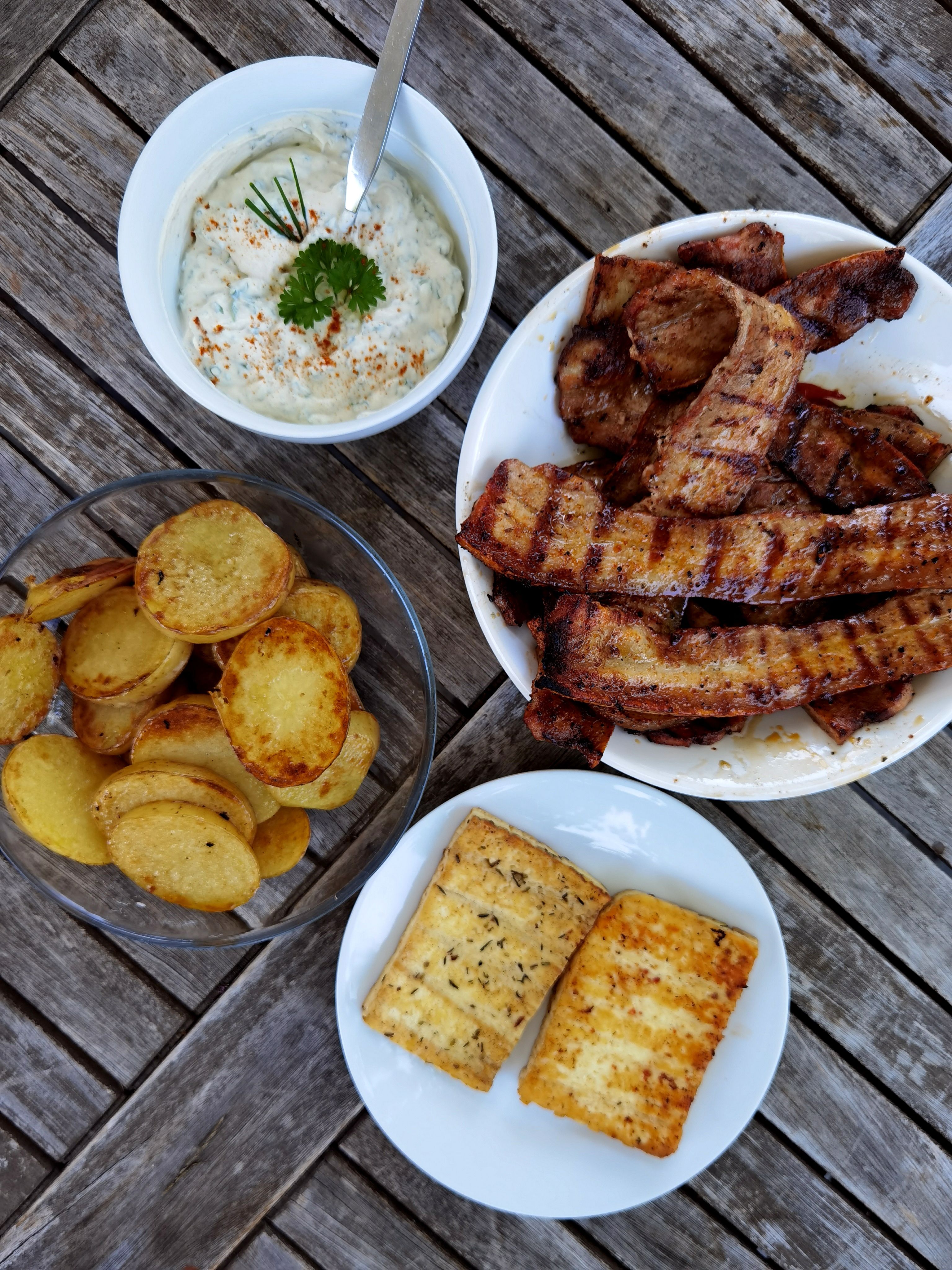
Danish
Stegt Flaesk
The diets react (see scores below)
Common Ingredients
- pork belly
- potatoes
- milk
- butter
- flour
- parsley
- salt
Specific recipes may vary.
Incompatible with 10 of 11 diets
Diet Ratings
Stegt Flæsk is a traditional Danish dish of crispy fried pork belly served with boiled potatoes and a white parsley sauce made from milk, butter, and flour. While the pork belly itself is an ideal keto food — high fat, zero carbs — the dish as traditionally prepared is fundamentally incompatible with ketosis. Boiled potatoes are a high-starch vegetable with roughly 15-17g net carbs per 100g, and a typical serving would push well over the daily 20-50g carb limit on its own. The parsley sauce adds further carbs through flour (a grain thickener) and milk. The combination of potatoes and flour-thickened sauce makes this dish, in its standard form, a high-carbohydrate meal that would disrupt ketosis for virtually any keto practitioner.
Stegt Flæsk is Denmark's national dish consisting of crispy fried pork belly served with a white parsley sauce made from milk and butter, accompanied by boiled potatoes. This dish contains multiple animal products: pork belly (meat), milk (dairy), and butter (dairy). It is entirely incompatible with a vegan diet. There is no ambiguity here — every protein and sauce component is animal-derived.
Stegt Flæsk is a traditional Danish dish of crispy fried pork belly served with boiled potatoes and a parsley cream sauce. While the pork belly itself is paleo-compatible (unprocessed pork), the dish contains multiple clear paleo violations. The parsley sauce is made with milk, butter, and flour — milk and butter are dairy (excluded), and wheat flour is a grain (excluded). Salt is also added. Potatoes are debated but even setting that aside, the dairy-based cream sauce and flour thickener are definitive disqualifiers. This dish cannot be considered paleo-friendly in its traditional form.
Stegt Flæsk is a traditional Danish dish centered on fried pork belly — a fatty, red/processed meat that directly contradicts Mediterranean diet principles. Pork belly is high in saturated fat and falls into the 'red meat' category that the Mediterranean diet restricts to a few times per month at most. The accompanying white sauce (milk, butter, flour) adds further saturated fat and refined grain content, with butter replacing the canonical extra virgin olive oil as the fat source. Boiled potatoes are acceptable but not whole-grain. Overall, this dish is Northern European comfort food with almost no alignment to Mediterranean dietary principles.
Stegt Flæsk is a traditional Danish dish of crispy fried pork belly served with a white parsley sauce and boiled potatoes. While the pork belly itself is carnivore-approved, the dish as a whole is heavily disqualifying. The potatoes are a starchy plant food completely excluded from the carnivore diet. The white sauce is made from flour (grain-based thickener), milk (debated dairy), butter (debated dairy), and parsley (plant herb) — multiple plant-derived ingredients. The dish cannot be adapted without fundamentally changing its character. The only carnivore-compatible element is the pork belly itself.
Stegt Flæsk is a classic Danish dish of crispy fried pork belly served with boiled potatoes and a white parsley sauce. The pork belly and potatoes are Whole30-compliant, but the traditional parsley sauce contains three excluded ingredients: milk (dairy), butter (dairy — only ghee/clarified butter is allowed), and flour (a grain). These are core, non-optional components of the dish as traditionally prepared, making the dish as described non-compliant.
Stegt Flæsk is a Danish classic of crispy fried pork belly served with boiled potatoes and a parsley cream sauce. The pork belly itself is low-FODMAP (plain pork, no added high-FODMAP ingredients). Potatoes are low-FODMAP at a standard serving (~1 medium potato). Parsley in small culinary amounts is fine. Salt is neutral. The problematic element is the cream/white sauce (parsley sauce) made with milk, butter, and flour. Wheat flour contains fructans (high-FODMAP), and regular cow's milk contains lactose (high-FODMAP at quantities used in a sauce). The combination of both flour and milk in the sauce makes this dish likely high-FODMAP as traditionally prepared. However, simple modifications — using a gluten-free flour (e.g., rice flour or cornstarch) and lactose-free milk — would make the sauce low-FODMAP, and butter is low-FODMAP (very low lactose). The dish is borderline: the pork and potatoes are safe, but the traditional parsley sauce is the primary FODMAP concern.
Monash University has tested both wheat flour and regular milk individually as high-FODMAP ingredients at typical serving amounts. However, some clinical FODMAP practitioners note that the quantity of flour used as a thickener in a sauce may be small enough per serving to fall below the fructan threshold (~1 tsp or less per portion), and lactose-free milk substitution is an easy swap — leading some dietitians to classify this as 'modifiable' rather than 'avoid.' The verdict depends heavily on sauce portion size and preparation method.
Stegt Flæsk is a traditional Danish dish of crispy fried pork belly served with a cream-based parsley sauce and boiled potatoes. Pork belly is one of the highest-fat cuts of pork, extremely rich in saturated fat and total fat — both of which DASH explicitly limits. The white parsley sauce is made with butter, whole milk, and flour, adding additional saturated fat and refined carbohydrates. NIH/NHLBI DASH guidelines directly restrict red meat (especially high-fat cuts), full-fat dairy, and butter. While the potatoes and parsley offer some potassium and micronutrients, they cannot offset the dominant nutritional concerns. The dish as a whole is fundamentally incompatible with DASH principles. Only the boiled potatoes and parsley are DASH-friendly components.
Stegt Flæsk is a classic Danish dish of crispy fried pork belly served with boiled potatoes and a parsley cream sauce (made from milk, butter, and flour). From a Zone Diet perspective, this dish fails on virtually every macronutrient dimension. Pork belly is extremely high in saturated fat — the opposite of the lean proteins Zone recommends. The primary carbohydrate source is potatoes, which Dr. Sears explicitly lists as a high-glycemic 'unfavorable' carbohydrate to avoid. The cream sauce adds butter (saturated fat) and flour (refined carbohydrate), neither of which contribute positively. The fat profile is dominated by saturated animal fat rather than the monounsaturated fats (olive oil, avocado, almonds) the Zone promotes. Achieving anything close to a 40/30/30 ratio from this dish in a balanced way is essentially impossible without replacing most of its core components. There are no meaningfully Zone-favorable ingredients — no low-glycemic vegetables, no lean protein, no monounsaturated fats. This is one of the rare cases where the dish scores in the 'avoid' range because its foundational components (pork belly + potatoes + butter sauce) are all unfavorable in Zone terminology simultaneously.
Stegt Flæsk is a traditional Danish dish of crispy fried pork belly served with boiled potatoes and a creamy parsley sauce made from milk, butter, and flour. From an anti-inflammatory perspective, this dish is heavily pro-inflammatory across multiple components. Pork belly is one of the fattiest cuts of pork, extremely high in saturated fat, which is well-established as promoting inflammatory markers including CRP and IL-6. The creamy parsley sauce combines butter (saturated fat) with full-fat milk and refined white flour, compounding the saturated fat load while adding refined carbohydrates. The dish is also typically pan-fried or baked at high heat, which can produce advanced glycation end-products (AGEs) in the fatty pork skin, further promoting inflammation. The only redeeming elements are the potatoes (a whole food carbohydrate with some nutrients, though a nightshade) and parsley (a mild anti-inflammatory herb). These are insufficient to offset the dominant pro-inflammatory profile. This dish essentially combines the two things anti-inflammatory eating most strongly limits — high saturated fat from a fatty red/processed meat cut and full-fat dairy — in a single meal.
Stegt Flæsk is a traditional Danish dish of crispy fried pork belly served with boiled potatoes and a parsley cream sauce (milk, butter, flour). It is one of the worst possible combinations for GLP-1 patients. Pork belly is extremely high in saturated fat and is fried to render that fat — directly violating the low-fat and easy-digestibility rules. The cream sauce adds additional saturated fat and butter. GLP-1 medications slow gastric emptying, meaning a fatty, heavy meal like this will sit in the stomach far longer than normal, dramatically worsening nausea, bloating, and reflux. Protein density per calorie is poor relative to the fat load. The boiled potatoes provide some fiber and nutrients but are a minor redeeming factor in an otherwise problematic dish. The preparation method (frying) and the primary ingredient (pork belly) are both on the avoid list, making this a clear avoid verdict with high confidence.
*See how scores were generated at our methodology page.
Nutritional profile
Six traits that cut across every diet.
Fiber & Plants
How much whole-plant food and fiber it delivers.
Healthy Fats
The quality of its fats (unsaturated, omega-3).
Whole / Unprocessed
How close it is to its natural, unprocessed form.
Gut Gentle
How easy it is on digestion (low FODMAP, few irritants).
Low Glycemic
How little it spikes your blood sugar.
Protein Density
How much protein it packs per calorie.
Controversy Index
Higher controversy = more disagreement between diets.
Diet-Specific Tips
 Low-FODMAP — 5/10
View tips
- Pork belly is low-FODMAP — plain pork contains no FODMAPs
- Potatoes are low-FODMAP at standard serving sizes
- Wheat flour in the parsley sauce contains fructans (high-FODMAP)
- Regular milk in the sauce contains lactose (high-FODMAP at typical sauce quantities)
- Butter is low-FODMAP due to negligible lactose content
- Parsley and salt are low-FODMAP
- Dish is easily modified to low-FODMAP with gluten-free flour and lactose-free milk