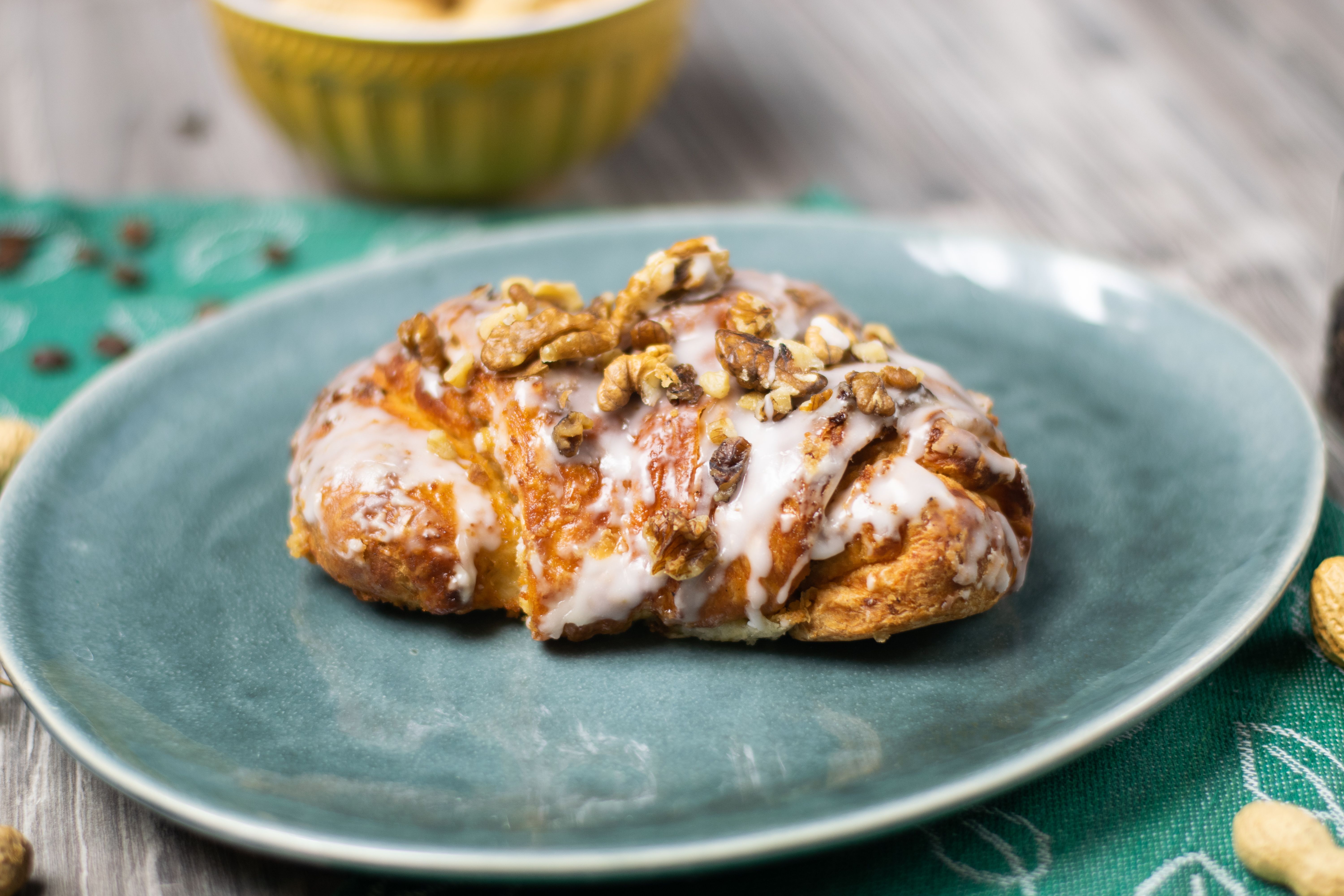
Photo: Damian Sochacki / Pexels
The diets react (see scores below)
Common Ingredients
- flour
- butter
- yeast
- sugar
- eggs
- milk
- vanilla custard
- cardamom
Specific recipes may vary.
Incompatible with 11 of 11 diets
Diet Ratings
Wienerbrod (Danish pastry) is fundamentally incompatible with a ketogenic diet. Its base is wheat flour, a high-carb grain, combined with sugar and milk, making the net carb content extremely high — a single piece can contain 30-50g of net carbs, easily exceeding the entire daily keto limit. The vanilla custard filling adds additional sugar and starch. While butter and eggs are keto-friendly ingredients, they are vastly outweighed by the carbohydrate load from flour, sugar, and custard. There is no meaningful portion size that would make this compatible with ketosis.
Wienerbrod (Danish pastry) contains multiple animal-derived ingredients that make it entirely incompatible with a vegan diet. Butter is a dairy product, eggs are an animal product, milk is a dairy product, and vanilla custard is typically made with eggs and milk. All four of these ingredients are clear animal products excluded under any standard vegan definition. There is no ambiguity here — this dish is fundamentally built on animal ingredients and cannot be considered vegan in its traditional form. Vegan versions could theoretically be made using plant-based butter, egg replacers, plant milk, and vegan custard, but that would be a different product entirely.
Wienerbrod (Danish pastry) is fundamentally incompatible with the Paleo diet. The dish is built on wheat flour, a grain that is strictly excluded from Paleo eating. It also contains dairy (butter, milk, vanilla custard) and refined sugar — all of which are explicitly prohibited. Yeast is a borderline ingredient, but it is rendered irrelevant here given the multiple hard exclusions. There are no redeeming Paleo-compliant components that could salvage this dish, which is essentially a grain-based, dairy-laden, sugar-sweetened processed pastry — the antithesis of Paleolithic eating.
Wienerbrod (Danish pastry) is a highly processed, refined-grain product built around butter, white flour, and added sugar — a combination that directly contradicts Mediterranean diet principles at nearly every level. The primary fat is saturated butter rather than olive oil; the grain base is refined white flour rather than a whole grain; and significant added sugar is present in both the dough and vanilla custard filling. While eggs and dairy (milk) are acceptable in moderation, they are minor concerns here compared to the dominant issues. This is essentially a Northern European confection with no meaningful place in a Mediterranean dietary pattern.
Wienerbrod (Danish pastry) is fundamentally incompatible with the carnivore diet. Its primary ingredient is flour, a grain-based product that is strictly excluded from all tiers of carnivore eating. It also contains sugar and yeast, both of which are completely off-limits. Cardamom is a plant-derived spice, also excluded. While it does contain some animal-derived ingredients (butter, eggs, milk, vanilla custard), these are incidental and do not redeem a food that is structurally a grain-based, sugar-laden pastry. This is a processed baked good with no place on any carnivore protocol.
Wienerbrød (Danish pastry) contains multiple excluded ingredients and also falls squarely into the 'no recreating baked goods' rule. Flour (grain) is excluded, butter (dairy) is excluded, sugar (added sugar) is excluded, and milk (dairy) is excluded. The vanilla custard filling also typically contains milk/cream and sugar. Even setting aside the spirit-of-the-program concerns, this dish fails on multiple hard exclusions. It is also explicitly the type of baked good (pastry/bread) that Whole30 prohibits even when made with compliant ingredients.
Wienerbrod (Danish pastry) is high-FODMAP due to multiple problematic ingredients. Regular wheat flour is the primary ingredient and is high in fructans, which are a major FODMAP trigger. Vanilla custard typically contains milk, which is high in lactose (a disaccharide FODMAP). Milk used in the dough itself also adds lactose. These two ingredients alone — wheat flour and dairy-based custard/milk — make this a high-FODMAP food at any standard serving size. There is no realistic portion reduction that would make a typical piece of Wienerbrod safe during the elimination phase.
Wienerbrod (Danish pastry) is a laminated pastry made by folding large amounts of butter into enriched dough, resulting in extremely high saturated fat content. It also contains refined white flour, added sugar, and vanilla custard — all items that DASH explicitly limits or discourages. The high saturated fat from butter (used generously in lamination), refined carbohydrates, and added sugars directly conflict with DASH dietary principles. It provides negligible potassium, fiber, calcium, or magnesium relative to its caloric density, and offers none of the lean protein, whole grain, or vegetable content DASH emphasizes. This is a classic pastry/sweet that falls squarely in the DASH 'sweets' category, which is limited to 5 or fewer servings per week and only in small portions.
Wienerbrod (Danish pastry) is a laminated dough pastry made with refined white flour, substantial butter, sugar, and vanilla custard filling. This combination creates an extremely high-glycemic, high-saturated-fat food with almost no Zone-favorable qualities. The macronutrient profile is dominated by refined carbohydrates and saturated fat, with minimal lean protein — essentially the opposite of the 40/30/30 Zone ratio. The refined flour and sugar spike blood sugar rapidly, promoting the pro-inflammatory eicosanoid response that the Zone Diet is specifically designed to prevent. There is no realistic portioning strategy that would allow this pastry to fit into a Zone-balanced meal without massive compensatory adjustments to the rest of the day. It has no lean protein contribution, no monounsaturated fat dominance, and no low-glycemic carbohydrate content. This is one of the clearest 'avoid' cases in Zone methodology.
Wienerbrød (Danish pastry) is a laminated dough pastry built on a foundation of refined white flour, substantial butter, added sugar, and vanilla custard — all of which are pro-inflammatory in the anti-inflammatory framework. Refined flour spikes blood glucose and insulin, promoting inflammatory cytokines. Butter and custard contribute significant saturated fat, linked to elevated inflammatory markers like CRP and IL-6. The high sugar content further drives the inflammatory cascade via advanced glycation end-products (AGEs) and oxidative stress. The only saving grace is cardamom, a mildly anti-inflammatory spice, and the modest egg content (which has mixed but not strongly pro-inflammatory effects). However, these minor positives are entirely overwhelmed by the pro-inflammatory load of the pastry as a whole. This is essentially the archetype of a food anti-inflammatory diets advise against: refined carbohydrates, added sugars, and saturated fat combined in a calorie-dense format with negligible fiber, omega-3s, or antioxidant polyphenols.
Wienerbrod (Danish pastry) is a laminated dough pastry made with large amounts of butter, refined flour, and sugar, filled with vanilla custard. It is essentially the archetype of what GLP-1 patients should avoid: high in saturated fat from the butter layers, high in refined carbohydrates with minimal fiber, high in sugar, negligible protein, and very low in nutrient density per calorie. The slow gastric emptying caused by GLP-1 medications means a high-fat, high-sugar pastry like this will sit heavily in the stomach, significantly increasing the risk of nausea, bloating, and reflux. It offers almost nothing nutritionally — no meaningful protein to protect muscle mass, no fiber to support digestion or blood sugar stability — while delivering a large caloric load in a small volume. Empty calories are especially counterproductive when total intake is already severely reduced on GLP-1 therapy.
*See how scores were generated at our methodology page.
Nutritional profile
Six traits that cut across every diet.
Fiber & Plants
How much whole-plant food and fiber it delivers.
Healthy Fats
The quality of its fats (unsaturated, omega-3).
Whole / Unprocessed
How close it is to its natural, unprocessed form.
Gut Gentle
How easy it is on digestion (low FODMAP, few irritants).
Low Glycemic
How little it spikes your blood sugar.
Protein Density
How much protein it packs per calorie.
Controversy Index
Higher controversy = more disagreement between diets.