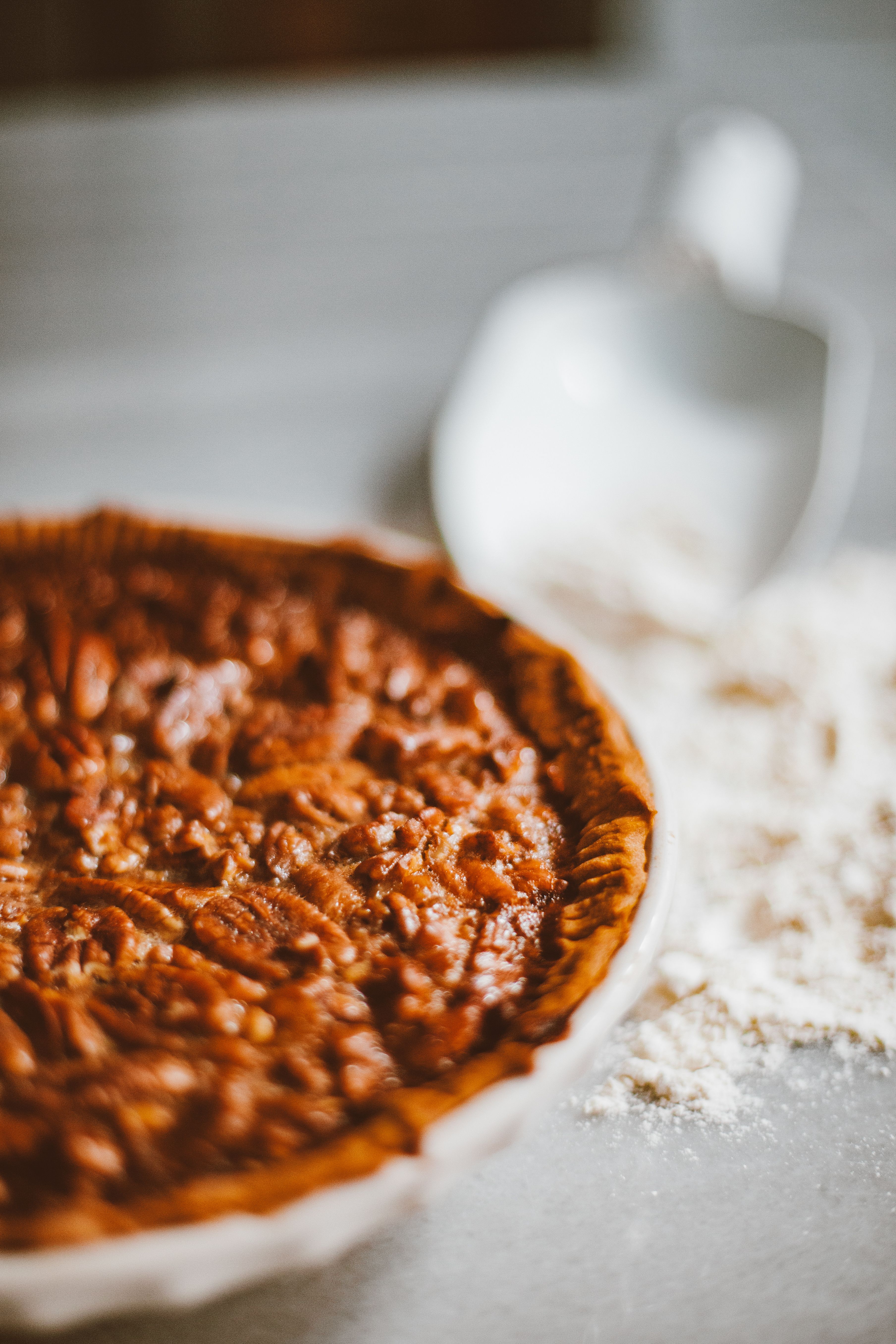
Photo: ROMAN ODINTSOV / Pexels
The diets react (see scores below)
Common Ingredients
- pie crust
- butter
- sugar
- eggs
- flour
- chocolate chips
- walnuts
- vanilla extract
- salt
Specific recipes may vary.
Incompatible with 11 of 11 diets
Diet Ratings
Derby Pie is fundamentally incompatible with a ketogenic diet. It contains multiple high-carb, keto-forbidden ingredients: a traditional wheat flour pie crust, refined sugar as a primary ingredient, and all-purpose flour in the filling. These alone would push a single serving far above the entire daily net carb budget of 20-50g. The chocolate chips add additional sugar and carbs. While walnuts, eggs, and butter are keto-friendly, they cannot redeem a dish whose foundation is sugar, flour, and a grain-based crust. There is no portion size small enough to make this compatible with ketosis.
Derby Pie contains multiple animal-derived ingredients that disqualify it from a vegan diet. Eggs and butter are direct animal products — eggs are excluded as an animal byproduct, and butter is a dairy product. Additionally, the pie crust as typically made contains butter and sometimes lard. All three of these violations are unambiguous under any mainstream vegan standard. There is no version of this dish that could be considered vegan without significant substitutions (e.g., flax eggs, vegan butter, plant-based crust).
Derby Pie contains multiple non-paleo ingredients that are clearly excluded from the paleolithic diet. The pie crust is made from wheat flour, which is a grain and strictly forbidden. Additional flour in the filling is another grain violation. Refined sugar is explicitly excluded as a processed food with no place in a hunter-gatherer diet. Butter is a dairy product, excluded under strict paleo guidelines. Chocolate chips typically contain refined sugar, dairy, and processed cacao. Salt is an added ingredient discouraged on paleo. Walnuts and eggs are the only paleo-compliant ingredients in this dish. With multiple core violations including grains, dairy, refined sugar, and processed ingredients, this dessert is incompatible with the paleo diet.
Derby Pie is a heavily sweetened American dessert that contradicts Mediterranean diet principles at nearly every level. The filling is built around large amounts of added sugar and butter (a saturated animal fat, not olive oil), combined with a refined flour pie crust. While eggs and walnuts have some Mediterranean merit, they are overwhelmed by the sugar load and refined grain base. Chocolate chips typically contain added sugars and may include dairy. This is a high-sugar, high-saturated-fat, refined-grain dessert with no meaningful plant-forward or whole-food redeeming qualities in context.
Derby Pie is fundamentally incompatible with the carnivore diet. The dish is built almost entirely on plant-derived and processed ingredients: pie crust (grain-based flour and shortening), sugar, flour, chocolate chips, walnuts, and vanilla extract are all strictly excluded on any tier of carnivore eating. While eggs and butter are animal-derived, they serve only as minor supporting ingredients in what is essentially a dessert loaded with grains, sugar, nuts, and plant compounds. The primary protein is listed as 'none,' confirming this is a carbohydrate- and plant-fat-dominant food with no meaningful animal nutrition profile.
Derby Pie contains multiple excluded ingredients and violates core Whole30 rules. Pie crust typically contains wheat flour (a grain) and butter (dairy). The filling includes added sugar (explicitly excluded), flour (a grain), and chocolate chips (which typically contain added sugar and often dairy). Beyond individual ingredients, Derby Pie is a classic dessert pie — exactly the type of baked good/junk food recreation that the Whole30 program explicitly prohibits, even if compliant ingredient substitutions were attempted.
Derby Pie contains multiple high-FODMAP ingredients that make it unsuitable during the elimination phase. The pie crust and flour both contain wheat, which is high in fructans — a primary FODMAP concern. Walnuts are high-FODMAP at typical serving sizes (Monash rates them as high-FODMAP at 10 walnut halves/30g due to GOS and polyols, though a small portion of ~10g may be acceptable). Chocolate chips can be problematic depending on quantity and type — dark chocolate is low-FODMAP at ~30g but milk chocolate contains lactose. The cumulative FODMAP load from wheat-based pie crust, flour, and walnuts together makes this dish high-FODMAP even at a small slice. Butter, sugar, eggs, vanilla extract, and salt are all low-FODMAP and not concerns.
While walnuts are technically low-FODMAP at very small amounts (around 10g per Monash), most clinical FODMAP practitioners recommend caution with walnuts given typical portion sizes in baked goods. The wheat-based crust and flour are the primary concerns that most practitioners and Monash University agree make this dish high-FODMAP during elimination regardless of portion size.
Derby Pie is a high-sugar, high-saturated-fat dessert that conflicts with nearly every core DASH diet principle. The primary ingredients — butter, sugar, chocolate chips, and a butter-based pie crust — contribute significant saturated fat, added sugar, and calories. DASH explicitly limits saturated fat, total fat, and sweets/added sugars. While walnuts and eggs have some nutritional merit (healthy fats, protein, potassium), they are minor components overwhelmed by the overall nutritional profile. This is a calorie-dense, nutrient-poor dessert with no meaningful contribution of potassium, calcium, magnesium, or fiber relative to its fat and sugar load. It is firmly in the 'limit sweets' category that DASH allows only rarely and in very small portions (≤5 servings per week of sweets, with servings being very small). As a primary snack item, it does not align with DASH snack recommendations (e.g., unsalted nuts, fresh fruit, low-fat dairy).
Derby Pie is a dessert composed almost entirely of Zone-unfavorable ingredients: a butter-based pie crust (high saturated fat, refined flour), large amounts of sugar (pure high-glycemic carbohydrate), refined white flour as filler, chocolate chips (sugar plus saturated fat), and butter throughout. While walnuts and eggs are individually Zone-friendly components, they are overwhelmed by the sugar and refined carb load. The macronutrient ratio is catastrophically off — this dish is dominated by high-glycemic carbohydrates and saturated fat, with virtually no lean protein. There is no realistic portioning strategy that would bring a Derby Pie slice into Zone balance for any meal or snack. The sugar and refined flour spike insulin dramatically, directly opposing the Zone's core goal of insulin control. Even as a rare indulgence, the complete absence of lean protein, the refined carb overload, and the saturated fat profile make this essentially impossible to work into Zone methodology.
Derby Pie is a classic American dessert that presents significant anti-inflammatory concerns. The ingredient list is dominated by pro-inflammatory components: butter (saturated fat), sugar (added refined sugar is a primary driver of inflammatory markers like CRP and IL-6), and a refined flour pie crust (refined carbohydrates spike blood glucose and promote inflammation). These three ingredients form the structural backbone of the dish and are all on the 'limit' or 'avoid' list for anti-inflammatory eating. The redeeming ingredients — walnuts (omega-3 ALA, polyphenols) and chocolate chips (potential flavanols if high-cacao) — are present but in quantities that cannot offset the heavy pro-inflammatory load of butter, sugar, and refined flour. Chocolate chips used in baking are typically semi-sweet with significant added sugar, not the >70% dark chocolate emphasized in anti-inflammatory frameworks. Eggs and vanilla extract are neutral to mildly positive. Overall, Derby Pie is a high-sugar, high-saturated-fat, refined-carbohydrate dessert with minimal fiber or antioxidant density, making it a poor fit for an anti-inflammatory dietary pattern. It is an occasional treat at best.
Derby Pie is a dessert pie composed almost entirely of nutritionally counterproductive ingredients for GLP-1 patients. The filling is a sugar-and-butter-heavy custard loaded with chocolate chips and walnuts, set in a buttery pastry crust. This combination delivers very high saturated fat, very high sugar, minimal fiber, and negligible protein per serving — the opposite of what GLP-1 patients need. High fat content will worsen nausea, bloating, and reflux by further slowing gastric emptying on top of the medication's own effect. The high sugar load provides empty calories with no nutritional payoff at a time when every calorie must count. Walnuts do offer omega-3 fats and a small amount of fiber, but in this context they are a minor footnote in an otherwise deeply problematic dish. As a snack category item it is especially poorly suited — snacks for GLP-1 patients should anchor around protein and fiber, not refined sugar and saturated fat.
*See how scores were generated at our methodology page.
Nutritional profile
Six traits that cut across every diet.
Fiber & Plants
How much whole-plant food and fiber it delivers.
Healthy Fats
The quality of its fats (unsaturated, omega-3).
Whole / Unprocessed
How close it is to its natural, unprocessed form.
Gut Gentle
How easy it is on digestion (low FODMAP, few irritants).
Low Glycemic
How little it spikes your blood sugar.
Protein Density
How much protein it packs per calorie.
Controversy Index
Higher controversy = more disagreement between diets.