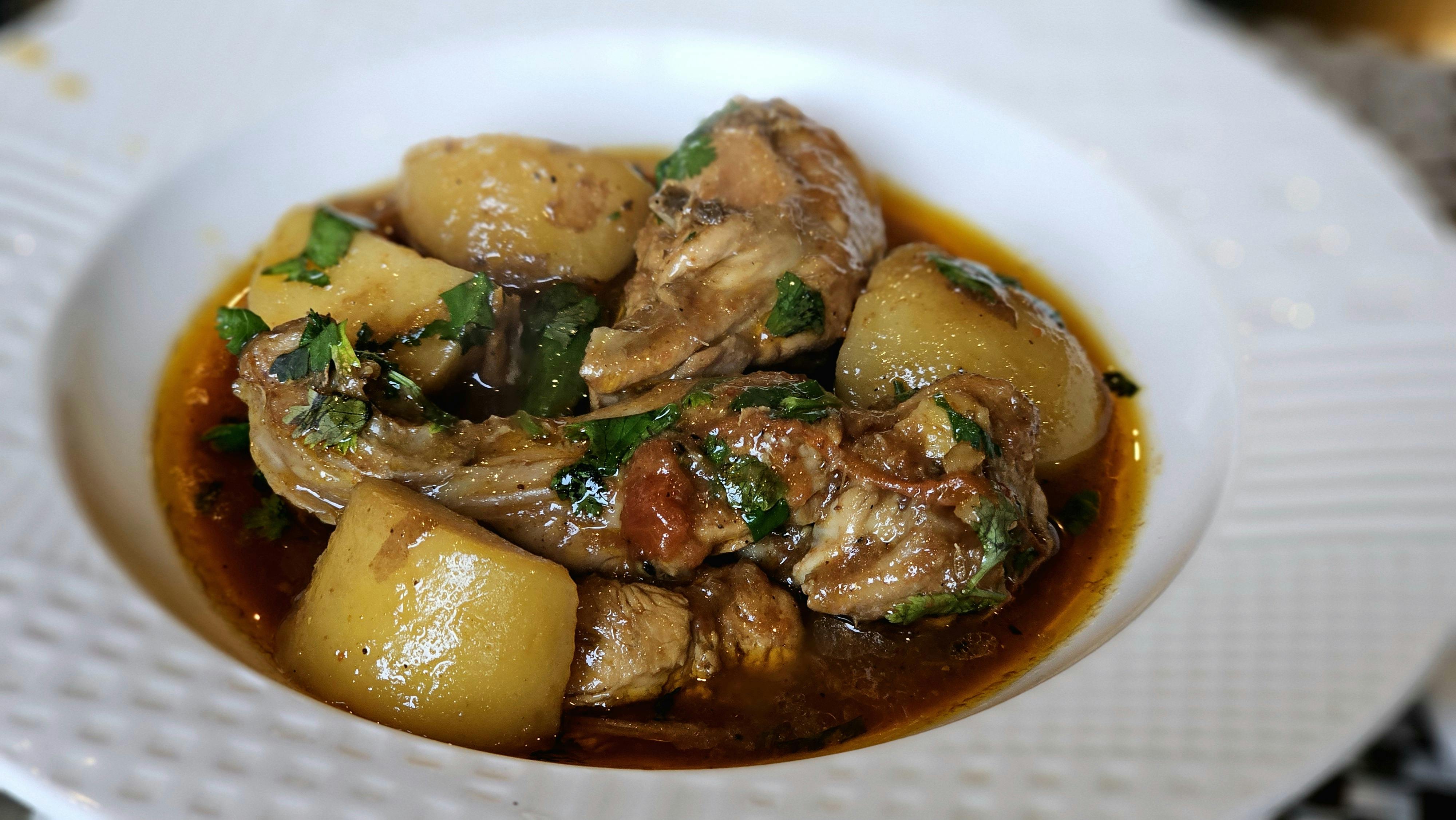
Photo: Muhammad Khawar Nazir / Pexels
Dominican
Pollo Guisado
The diets react (see scores below)
Common Ingredients
- chicken
- tomato paste
- onion
- bell pepper
- garlic
- cilantro
- oregano
- annatto
- olives
Specific recipes may vary.
Incompatible with 3 of 11 diets
Diet Ratings
Pollo Guisado is a braised chicken dish that is generally keto-compatible, but requires attention to a few ingredients. Chicken is an excellent keto protein. The aromatics—onion, bell pepper, garlic, cilantro, oregano—contribute some carbs but are used in moderate cooking quantities. Tomato paste is concentrated and adds meaningful net carbs (roughly 3-4g per tablespoon), so portion matters. Annatto is essentially zero-carb. Olives add healthy fat and are keto-friendly. The main concern is cumulative carb load from tomato paste, onion, and bell pepper together. A standard serving is likely manageable within daily limits, but the dish sits in caution territory due to these moderate-carb ingredients stacking together. No grains, added sugars, or starchy vegetables are present, which is positive.
Strict keto practitioners may flag this as approve rather than caution, arguing that the tomato paste and vegetable quantities spread across multiple servings are negligible and the dish is fundamentally a fatty braised protein with no disqualifying ingredients. Conversely, those following clinical or very low-carb (<20g) protocols may be more cautious about the combined carb load from tomato paste, onion, and bell pepper if portions are generous.
Pollo Guisado is a Dominican braised chicken dish. Chicken is an animal product and is explicitly excluded under all vegan definitions. There is no ambiguity here — poultry is animal flesh and is never compatible with a vegan diet regardless of how it is prepared or what plant-based ingredients accompany it.
Pollo Guisado is a Dominican braised chicken dish built almost entirely on paleo-approved whole foods. Chicken is an unprocessed animal protein, and the aromatics — onion, bell pepper, garlic, cilantro, and oregano — are all vegetables and herbs well within paleo guidelines. Annatto (achiote) is a natural seed-derived spice with no paleo objections. Tomato paste is a concentrated whole-food ingredient with no additives in its pure form and is generally accepted. Olives are a whole fruit and paleo-approved. The one flag is that traditional Dominican Pollo Guisado often includes added salt and may use a small amount of vinegar or sazón seasoning packets containing additives — strict paleo excludes added salt and processed spice blends. Assuming the dish is prepared with plain, additive-free tomato paste and no processed seasoning packets, this dish is solidly paleo-compliant.
Strict Cordain-school paleo flags added salt, which is common in this dish, and would caution against tomato paste if it contains added salt or citric acid as a preservative. Practitioners following Loren Cordain's original framework would recommend seasoning with only fresh herbs and lemon juice rather than any salted or processed condiments.
Pollo Guisado is a braised chicken dish with a strong vegetable and herb base — tomato paste, onion, bell pepper, garlic, cilantro, oregano, and olives — which closely mirrors Mediterranean flavor profiles and cooking techniques. Chicken is an acceptable moderate protein in the Mediterranean diet (poultry a few times per week). The aromatic vegetables, olives, and tomato paste are explicitly Mediterranean-aligned staples. Annatto adds color and mild flavor without nutritional concern. The primary caution is that the dish centers on poultry rather than fish or plant proteins, and the cooking fat is unspecified — if lard or neutral vegetable oil is used (common in Dominican preparation) rather than extra virgin olive oil, it moves away from Mediterranean principles. Overall, this dish is quite compatible but lands in 'caution' due to the protein category and the ambiguity around cooking fat.
Some Mediterranean diet practitioners would rate this closer to an 'approve' given the exceptional vegetable and herb density, olive inclusion, and the fact that chicken braised with tomatoes and aromatics is nearly identical to dishes like Greek stifado or Spanish pollo en salsa. The non-Mediterranean origin is irrelevant if the ingredient composition aligns.
Pollo Guisado is a Dominican braised chicken dish that is fundamentally incompatible with the carnivore diet. While chicken itself is an accepted animal protein, this dish is built around a base of plant-derived ingredients that dominate the recipe: tomato paste, onion, bell pepper, garlic, cilantro, oregano, annatto (achiote), and olives. The majority of the ingredients are vegetables, herbs, and plant-based seasonings — all of which are explicitly excluded from the carnivore diet. The dish cannot be meaningfully modified while retaining its identity; removing the plant ingredients would leave plain braised chicken, not Pollo Guisado. This is a clear avoid regardless of which carnivore tier is applied.
Pollo Guisado is a Dominican braised chicken stew whose core ingredients — chicken, tomato paste, onion, bell pepper, garlic, cilantro, oregano, and annatto — are all Whole30-compliant whole foods. Olives are also compliant (they are a fruit/vegetable, not a legume). The dish is a genuine, traditional savory meal and does not fall into the 'recreating junk food' category. The main caution is that store-bought or restaurant versions may include added sugar in tomato paste or seasoning packets, sofrito blends with non-compliant additives, or olives packed with non-compliant preservatives. When made at home with clean ingredients — plain tomato paste with no added sugar, and olives with no questionable additives — this dish is solidly Whole30-compliant.
Official Whole30 guidelines approve this dish when made with compliant ingredients, but community practitioners note that Dominican-style sofrito blends and commercial tomato paste often contain added sugar or MSG-adjacent seasonings (like sazón packets), requiring careful label scrutiny. Some Whole30 coaches recommend making all components from scratch to be safe.
Pollo Guisado as traditionally prepared contains two significant high-FODMAP ingredients: onion and garlic. Both are among the highest-fructan foods tested by Monash University and are problematic even in small amounts during the elimination phase. Garlic in particular is considered high-FODMAP at even 1/4 clove. Onion is similarly high-FODMAP at any culinary serving size. These two ingredients are structural to the dish's flavor base and cannot simply be omitted without fundamentally changing the recipe. The remaining ingredients — chicken (approve), tomato paste (low-FODMAP at ≤2 tablespoons), bell pepper (low-FODMAP at ≤½ cup), cilantro (approve), oregano (approve), annatto (approve), and olives (low-FODMAP at ~15g) — are individually acceptable. However, the presence of onion and garlic makes this dish unsuitable during the elimination phase.
Pollo Guisado (Dominican braised chicken) contains many DASH-friendly ingredients — lean chicken as the primary protein, tomato paste, onion, bell pepper, garlic, cilantro, and oregano all align well with DASH principles, providing potassium, fiber, and beneficial plant nutrients. Annatto (achiote) is a natural colorant with negligible nutritional concern. However, olives are the key complicating factor: they are high in sodium (a single tablespoon of olives can contribute 100-200mg sodium) and are commonly used in generous quantities in Dominican-style guisado. Additionally, the dish as traditionally prepared often includes sofrito with added salt, sazón packets, or bouillon cubes that dramatically increase sodium content. The chicken skin, if left on, adds saturated fat. As commonly served, the dish sits in caution territory due to sodium load from olives and seasoning practices, though the base ingredients are largely DASH-compatible.
NIH DASH guidelines emphasize limiting sodium to under 2,300mg/day and would flag traditional preparations using sazón or bouillon as problematic. However, updated clinical interpretations note that home-prepared versions with controlled salt, skinless chicken, reduced olive quantities, and no processed seasonings could reasonably approach DASH approval, since the core vegetable and lean protein profile is strong.
Pollo Guisado is an excellent fit for the Zone Diet. The primary protein is chicken, a lean, Zone-favorable protein source. The vegetable base — tomato paste, onion, bell pepper, garlic, and cilantro — provides low-glycemic carbohydrates rich in polyphenols and antioxidants, exactly what Dr. Sears recommends. Olives contribute monounsaturated fat, the preferred Zone fat source. Annatto and oregano add anti-inflammatory polyphenols with negligible macro impact. The dish naturally trends toward the 40/30/30 ratio: lean protein from chicken, low-GI carbs from the vegetable sofrito base, and monounsaturated fat from olives. There are no high-glycemic carbohydrates, no refined sugars, no trans fats, and no heavy saturated fat sources. The main Zone consideration is portion control — specifically ensuring the chicken portion aligns with approximately 3 protein blocks (~21g protein) per serving and that olive quantities are accounted for in fat blocks. As typically prepared, this dish is one of the more Zone-compatible traditional Latin dishes available, requiring minimal modification.
Pollo Guisado is a Dominican braised chicken stew built on a strong anti-inflammatory foundation. Lean chicken (moderate protein category) is braised with an aromatic sofrito base of onion, bell pepper, garlic, and cilantro — all well-documented anti-inflammatory foods rich in quercetin, vitamin C, organosulfur compounds, and polyphenols. Tomato paste is a concentrated source of lycopene, a powerful carotenoid antioxidant whose bioavailability is actually enhanced by cooking. Oregano is one of the highest-ORAC-scored herbs, delivering rosmarinic acid and other potent antioxidants. Annatto (achiote) provides bixin and norbixin — carotenoid-class pigments with demonstrated antioxidant and anti-inflammatory activity in research. Olives contribute oleic acid and polyphenols consistent with the anti-inflammatory Mediterranean food pattern. The dish contains no refined carbohydrates, seed oils, added sugars, trans fats, or processed additives. The only mild caveat is that chicken skin (if included) adds saturated fat, and sodium content depends on olive brine and cooking salt — but neither is a significant anti-inflammatory concern in moderation. Overall, this is an excellent example of a traditional dish that aligns naturally with anti-inflammatory principles.
Pollo Guisado is a braised chicken dish built on a lean protein base with a vegetable-forward sofrito (tomato paste, onion, bell pepper, garlic, cilantro). Braising in liquid rather than frying keeps fat content low and makes the chicken easy to digest — an important advantage given GLP-1-slowed gastric emptying. The sofrito base adds meaningful micronutrients and some fiber. Annatto is a natural colorant with no meaningful nutritional downside. Olives contribute small amounts of heart-healthy monounsaturated fat and sodium; in typical quantities used for seasoning this is acceptable, though portion should be noted. Oregano and garlic are well tolerated by most GLP-1 patients. The dish is naturally portion-friendly, nutrient-dense per calorie, and provides 20-30g protein per standard serving depending on cut used. Skin-on, bone-in thighs are traditional and raise fat content moderately; skinless breast or skinless thigh lowers fat meaningfully and is the preferred preparation for GLP-1 patients.
Confidence is medium because the rating depends significantly on the chicken cut used — skin-on thighs or drumsticks are traditional and increase saturated fat content enough that some GLP-1-focused RDs would drop this to caution, while others accept the fat level given the overall nutrient profile of the dish. Sodium from olives and seasoning blends may also be a consideration for patients with comorbid hypertension.
*See how scores were generated at our methodology page.
Nutritional profile
Six traits that cut across every diet.
Fiber & Plants
How much whole-plant food and fiber it delivers.
Healthy Fats
The quality of its fats (unsaturated, omega-3).
Whole / Unprocessed
How close it is to its natural, unprocessed form.
Gut Gentle
How easy it is on digestion (low FODMAP, few irritants).
Low Glycemic
How little it spikes your blood sugar.
Protein Density
How much protein it packs per calorie.
Controversy Index
Higher controversy = more disagreement between diets.
Diet-Specific Tips
 Keto — 6/10
View tips
- Chicken is a quality keto protein source
- Tomato paste contributes concentrated net carbs—use sparingly
- Onion and bell pepper add moderate carbs that stack with tomato paste
- Olives contribute beneficial monounsaturated fats
- Annatto and herbs are essentially zero-carb
- No grains, sugar, or starchy vegetables present
- Portion control on the sauce is key to staying within daily carb limits
 Paleo — 8/10
View tips
- Chicken is a fully approved paleo protein
- All vegetables and aromatics (onion, bell pepper, garlic, cilantro, oregano) are paleo-approved
- Annatto is a natural spice derived from achiote seeds — no paleo concerns
- Olives are a whole, paleo-approved fruit
- Tomato paste is accepted when free of added salt or preservatives
- Traditional preparation often includes added salt, which is excluded under strict paleo
- Commercial sazón or seasoning packets, if used, would contain non-paleo additives — homemade preparation assumed
 Mediterranean — 6/10
View tips
- Chicken is acceptable poultry protein — moderate, not a daily staple
- Rich vegetable and herb base (tomato paste, onion, bell pepper, garlic, cilantro, oregano) strongly aligned with Mediterranean principles
- Olives are a core Mediterranean ingredient, adding healthy fats
- Cooking fat unspecified — lard or refined oil would be a concern vs. extra virgin olive oil
- Annatto is a neutral spice with no adverse impact on compatibility
- No processed ingredients, added sugars, or refined grains present
 Whole30 — 5/10
View tips
- Chicken is a fully compliant Whole30 protein
- All vegetables and herbs (onion, bell pepper, garlic, cilantro, oregano) are compliant
- Annatto (achiote) is a natural spice/colorant — Whole30 compliant
- Olives are compliant; check label for non-compliant additives or preservatives
- Tomato paste must be checked for added sugar — common in commercial brands
- No grains, dairy, legumes, or other excluded categories present
- Traditional savory stew — not a recreation of junk food or baked goods
 DASH — 5/10
View tips
- Lean chicken protein aligns with DASH lean meat recommendations
- Vegetables (onion, bell pepper, garlic, tomato paste) support DASH nutrient targets (potassium, fiber)
- Olives add significant sodium — a major DASH concern
- Traditional Dominican preparation often uses high-sodium sazón, bouillon, or seasoning packets
- Chicken skin if included adds saturated fat
- Low-sodium version with skinless chicken, reduced olives, and no processed seasonings would score 7-8
- Annatto is a natural colorant with no meaningful DASH impact
 Zone — 8/10
View tips
- Chicken is a lean, Zone-favorable protein — ideal building block
- Bell pepper, onion, garlic, and tomato paste are low-glycemic, polyphenol-rich Zone carbohydrates
- Olives provide monounsaturated fat, the preferred Zone fat source
- No high-glycemic carbohydrates, refined sugars, or processed ingredients
- Annatto and oregano contribute anti-inflammatory polyphenols with negligible macro impact
- Portion control needed to balance chicken (~25g protein) and olive quantities within block targets
- Naturally approaches 40/30/30 ratio without significant modification
 Anti-Inflammatory — 8/10
View tips
- Lean chicken is an approved moderate protein source in anti-inflammatory frameworks
- Tomato paste provides highly bioavailable lycopene, enhanced by cooking
- Garlic and onion deliver organosulfur compounds that reduce inflammatory markers (CRP, IL-6)
- Bell pepper and cilantro contribute vitamin C and polyphenols
- Oregano is one of the most antioxidant-dense herbs available
- Annatto provides bixin/norbixin carotenoids with antioxidant properties
- Olives add oleic acid and anti-inflammatory polyphenols
- No refined carbohydrates, seed oils, trans fats, or added sugars
 GLP-1 Friendly — 8/10
View tips
- Lean braised chicken is high in protein and easy to digest
- Sofrito base (tomato paste, onion, bell pepper, garlic) adds micronutrients and fiber
- Braising method avoids added fat from frying
- Olives add monounsaturated fat in small amounts — acceptable at typical seasoning quantities
- Fat content is cut-dependent: skinless breast or thigh strongly preferred over skin-on cuts
- No fried, sugary, carbonated, or high-fat processed ingredients
- Portion-friendly and nutrient-dense per calorie
- Sodium content may be elevated depending on preparation