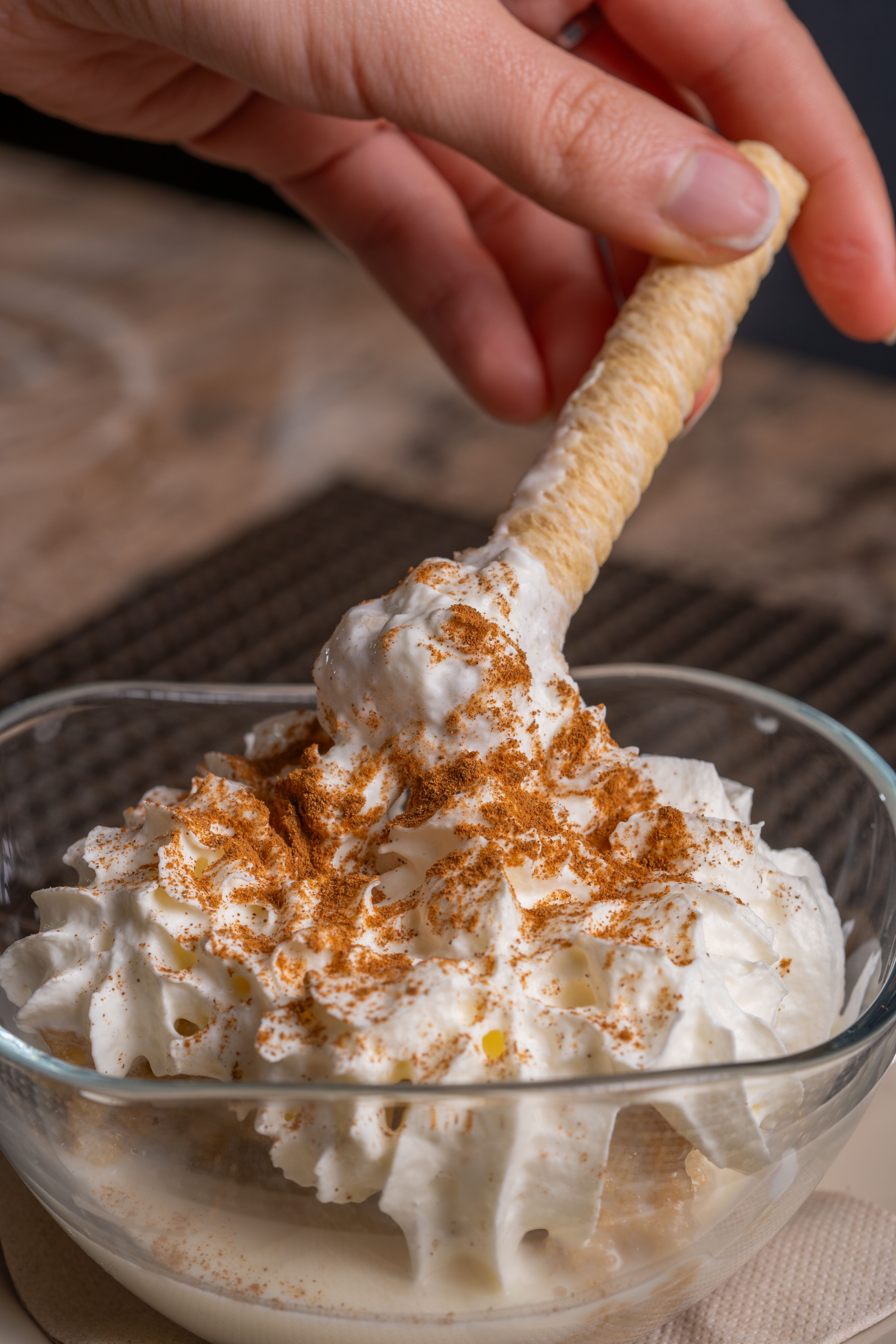
Photo: Nano Erdozain / Pexels
South-African
Don Pedro
The diets react (see scores below)
Common Ingredients
- vanilla ice cream
- chocolate ice cream
- chocolate sauce
- condensed milk
- butter
- cocoa powder
- peanuts
Specific recipes may vary.
Incompatible with 11 of 11 diets
Diet Ratings
Don Pedro is a South African dessert drink/sundae built almost entirely on high-sugar, high-carb ingredients that are fundamentally incompatible with ketosis. Vanilla and chocolate ice cream are sugar-laden, condensed milk is essentially concentrated sugar and milk (extremely high in carbs — roughly 55g net carbs per 100g), and chocolate sauce adds further sugar. Even in a small serving, the combined net carbs from these ingredients would far exceed the entire daily keto allowance of 20-50g. The butter and peanuts are the only marginally keto-friendly components, but they are completely overwhelmed by the carbohydrate load of the other ingredients.
The Don Pedro is a South African dessert that is fundamentally built on multiple animal-derived dairy products. Vanilla ice cream and chocolate ice cream are both dairy-based, condensed milk is a concentrated dairy product, and butter is an animal fat derived from cow's milk. These ingredients are core to the dish and cannot be considered incidental — they constitute the primary structure and flavor profile of the dessert. There is no ambiguity here: this dish is incompatible with a vegan diet in its standard form. Vegan alternatives exist for each ingredient (plant-based ice cream, coconut condensed milk, vegan butter), so a vegan version could theoretically be constructed, but the default dish as described is clearly non-vegan.
Don Pedro is a South African dessert/milkshake made almost entirely of non-paleo ingredients. Vanilla ice cream and chocolate ice cream are dairy products with added sugar and artificial additives. Condensed milk is heavily processed dairy loaded with refined sugar. Chocolate sauce typically contains refined sugar, dairy, and often artificial ingredients. Butter, while sometimes debated, is a dairy product excluded under strict paleo. Peanuts are legumes, explicitly excluded from the paleo diet. Cocoa powder is the only ingredient with any paleo-adjacent standing, and even that is debated in processed form. This dish has virtually no paleo-compatible components and represents a heavily processed, dairy- and sugar-laden dessert that is fundamentally incompatible with Paleolithic eating principles.
The Don Pedro is a South African dessert/snack that fundamentally contradicts Mediterranean diet principles. It combines multiple high-sugar, high-saturated-fat components: vanilla and chocolate ice cream (heavily processed dairy with added sugars), chocolate sauce, condensed milk (extremely high in added sugar), and butter. This dish is essentially a concentrated source of refined sugars, saturated fats, and processed ingredients — everything the Mediterranean diet minimizes. The only marginally compatible ingredient is peanuts, which provide some plant-based protein and healthy fats, but they are a minor component overwhelmed by the problematic ingredients. There is no meaningful pathway to reconcile this dessert with Mediterranean dietary principles.
Don Pedro is a South African dessert that is almost entirely incompatible with the carnivore diet. While it contains some dairy-derived ingredients (vanilla ice cream, chocolate ice cream, butter, condensed milk), the dish is loaded with multiple plant-based and heavily processed components. Cocoa powder is a plant product. Peanuts are legumes — strictly excluded. Chocolate sauce typically contains sugar, cocoa, and other plant-based additives. Condensed milk is heavily processed with added sugar. The ice creams contain sugar and flavorings. Even setting aside the plant-based ingredients, the extreme sugar content from condensed milk, chocolate sauce, and ice cream makes this incompatible with carnivore principles. There is no meaningful animal-product-only version of this dish — its entire identity depends on plant-derived and processed ingredients.
Don Pedro contains multiple excluded ingredients that make it entirely incompatible with Whole30. Ice cream (both vanilla and chocolate) is dairy and almost certainly contains added sugar. Condensed milk is dairy with added sugar. Butter is excluded dairy (only ghee/clarified butter is allowed). Chocolate sauce typically contains added sugar. Peanuts are legumes, explicitly excluded. Cocoa powder alone might be compliant, but in this context the entire dish is fundamentally non-compliant across nearly every ingredient.
Don Pedro is a South African dessert/snack made primarily from ice cream and dairy-based sauces, and it contains multiple high-FODMAP ingredients that make it unsuitable during the elimination phase. The two most problematic ingredients are vanilla and chocolate ice cream, both of which are lactose-rich dairy products — lactose is a disaccharide and a primary FODMAP. Standard servings of regular ice cream (roughly 1/2 cup or more as typically served) significantly exceed the Monash-rated low-FODMAP threshold. Condensed milk is extremely high in lactose and is present in a concentrated, sweetened form, making it one of the highest-lactose ingredients possible. Chocolate sauce and cocoa powder may be acceptable at small doses but are often made with milk solids or paired with high-fructose sweeteners. Peanuts are low-FODMAP at a standard serving (~32g), and butter is low-FODMAP. However, the lactose load from vanilla ice cream, chocolate ice cream, and especially condensed milk collectively makes this dish a high-FODMAP food by any reasonable serving definition. There is no practical portion size at which this dish could be considered low-FODMAP during the elimination phase.
The Don Pedro is a South African dessert/snack consisting primarily of full-fat ice cream (vanilla and chocolate), condensed milk, chocolate sauce, butter, cocoa powder, and peanuts. This combination is fundamentally incompatible with DASH diet principles. Full-fat dairy (ice cream, condensed milk, butter) is explicitly limited on DASH due to high saturated fat and cholesterol content. Condensed milk and chocolate sauce contribute significant added sugars, which DASH restricts. Butter is a saturated fat source that DASH discourages. The overall dish is calorie-dense, high in saturated fat, high in added sugar, and offers minimal potassium, magnesium, or fiber relative to its macronutrient load. While peanuts are acceptable on DASH in small portions, they do not offset the numerous DASH-incompatible ingredients. This dessert represents almost the opposite nutritional profile from what DASH emphasizes.
The Don Pedro is a South African dessert drink/snack consisting primarily of ice cream (vanilla and chocolate), chocolate sauce, condensed milk, butter, and cocoa powder with peanuts. This dish is essentially a high-sugar, high-saturated-fat confection with virtually no Zone-friendly macronutrient balance. The carbohydrate load comes almost entirely from high-glycemic sources — condensed milk (extremely high sugar), chocolate sauce (added sugar), and ice cream (sugar plus saturated fat). There is no lean protein to speak of; the dairy protein present is dwarfed by the sugar and fat content. The fat profile is dominated by saturated fat from ice cream, condensed milk, and butter, rather than the monounsaturated fats Zone favors. Peanuts provide a small amount of monounsaturated fat and protein, but they are a minor component that cannot redeem the overall profile. The 40/30/30 ratio is essentially impossible to achieve with this dish — carbohydrates from sugar would be massively overrepresented, protein would be negligible, and fat would be predominantly saturated. This is one of the clearest 'avoid' cases in Zone methodology, comparable to candy or soda — a nutritionally empty, high-glycemic, high-saturated-fat item with no practical path to Zone balance even with portion control.
The Don Pedro is a South African dessert/snack combining multiple scoops of ice cream (vanilla and chocolate) with chocolate sauce, condensed milk, butter, and cocoa powder — essentially a concentrated delivery system for added sugars, saturated fat, and full-fat dairy. Every major ingredient raises anti-inflammatory red flags: vanilla and chocolate ice cream are high in sugar and full-fat dairy; condensed milk is extremely high in added sugar; chocolate sauce typically contains high-fructose corn syrup or refined sugar; and butter is a concentrated source of saturated fat. The cocoa powder is the only genuinely anti-inflammatory component, offering flavanols and polyphenols, and peanuts provide some monounsaturated fats and resveratrol — but these minor positives are overwhelmed by the inflammatory load of the rest of the dish. High sugar intake drives glycation and raises inflammatory cytokines (IL-6, CRP); high saturated fat from full-fat dairy and butter is associated with increased inflammatory markers in multiple studies. This dish is effectively the opposite of anti-inflammatory dietary principles across nearly every ingredient.
The Don Pedro is a South African dessert typically made by blending or layering vanilla and chocolate ice cream with chocolate sauce, condensed milk, butter, and cocoa powder, topped with peanuts. It is essentially a high-sugar, high-fat, calorie-dense indulgence with virtually no redeeming nutritional profile for a GLP-1 patient. The combination of full-fat ice cream, condensed milk, butter, and chocolate sauce delivers an enormous hit of saturated fat and added sugar in a single serving. Sugar is the dominant macronutrient, protein content is negligible, fiber is near zero, and the fat load is precisely the type that worsens GLP-1 side effects including nausea, bloating, and reflux — since high-fat meals interact badly with already-slowed gastric emptying. The condensed milk and chocolate sauce add concentrated sugar that causes blood sugar spikes incompatible with GLP-1 metabolic goals. Peanuts provide a small amount of protein and unsaturated fat but are entirely insufficient to offset the rest of the dish. This is a textbook example of empty, counterproductive calories for a GLP-1 patient.
*See how scores were generated at our methodology page.
Nutritional profile
Six traits that cut across every diet.
Fiber & Plants
How much whole-plant food and fiber it delivers.
Healthy Fats
The quality of its fats (unsaturated, omega-3).
Whole / Unprocessed
How close it is to its natural, unprocessed form.
Gut Gentle
How easy it is on digestion (low FODMAP, few irritants).
Low Glycemic
How little it spikes your blood sugar.
Protein Density
How much protein it packs per calorie.
Controversy Index
Higher controversy = more disagreement between diets.