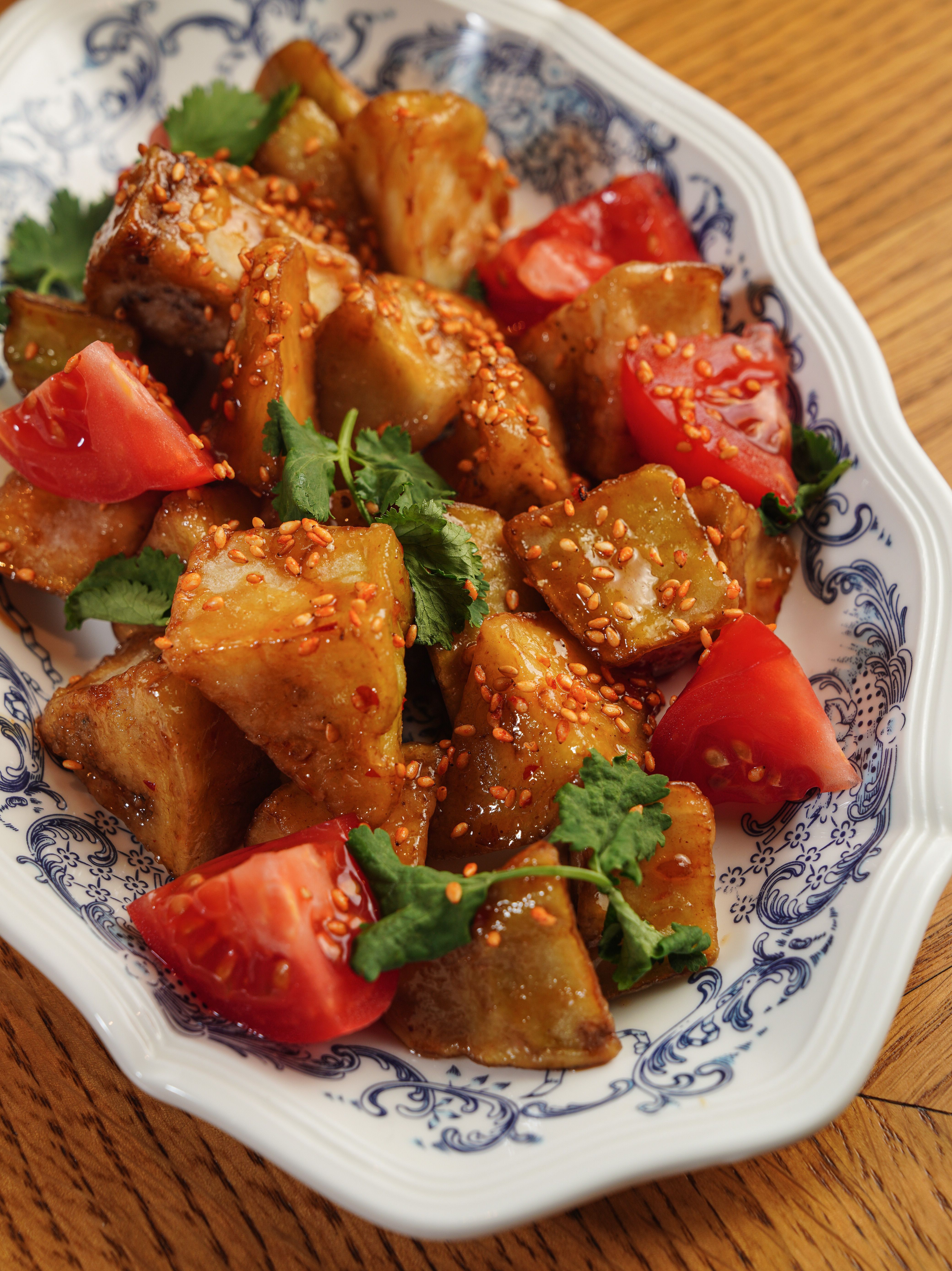
The diets react (see scores below)
Common Ingredients
- potatoes
- eggplant
- green peppers
- garlic
- soy sauce
- sugar
- cornstarch
- scallions
Specific recipes may vary.
Incompatible with 6 of 11 diets
Diet Ratings
Di San Xian is fundamentally incompatible with a ketogenic diet. Potatoes are extremely high in net carbs (~17g per 100g), making them one of the most keto-incompatible vegetables. The dish is compounded by added sugar in the sauce and cornstarch used as a thickener, both of which spike blood glucose and disrupt ketosis. Even a modest serving of this dish would likely exceed an entire day's carb budget. While eggplant and green peppers are individually keto-friendly, they are overwhelmed by the high-carb dominant ingredients.
Di San Xian is a classic northeastern Chinese dish composed entirely of whole plant foods. Every ingredient — potatoes, eggplant, green peppers, garlic, soy sauce, sugar, cornstarch, and scallions — is fully plant-based with no animal products or animal-derived ingredients. The dish is typically stir-fried or lightly deep-fried in vegetable oil, and the sauce is built from soy sauce, sugar, and cornstarch, all of which are vegan. It is a naturally whole-food, vegetable-forward dish with no processing concerns. It scores very high as it relies on minimally processed whole vegetables with simple pantry condiments.
Di San Xian contains multiple non-paleo ingredients that disqualify it outright. Soy sauce is a fermented soy and wheat product — both legume and grain derivatives are strictly excluded from paleo. Sugar (refined) is explicitly avoided. Cornstarch is a grain-derived thickener and also excluded. While eggplant, garlic, and scallions are fully paleo-approved vegetables, and potatoes occupy a debated gray area, the non-negotiable disqualifiers (soy sauce, refined sugar, cornstarch) make this dish incompatible with a paleo diet in its traditional preparation. To make a paleo-adapted version, one would need to substitute coconut aminos for soy sauce, eliminate refined sugar or replace with a small amount of a natural sweetener, and use arrowroot flour instead of cornstarch.
Di San Xian is a plant-based Chinese dish featuring vegetables (eggplant, green peppers) and a starchy tuber (potatoes) that align well with Mediterranean diet principles. Eggplant is a staple of Mediterranean cooking, and peppers and garlic are core ingredients. However, the dish deviates from Mediterranean practice in several ways: it is traditionally deep-fried before being stir-fried, adding significant refined oil rather than extra virgin olive oil; soy sauce is not a Mediterranean ingredient; cornstarch is a refined starch; and small amounts of added sugar are present. The cooking method and seasoning profile are distinctly non-Mediterranean. If prepared with olive oil and minimal frying, the vegetable base would be highly approved, but as traditionally made, it sits in caution territory.
Some modern Mediterranean diet interpreters focus primarily on ingredient quality and plant-forward composition, arguing that the core vegetables (eggplant, peppers, garlic) are so Mediterranean-friendly that the dish warrants approval if adapted slightly — swapping soy sauce for herbs and using olive oil. Others note that the deep-frying method and refined cornstarch thickener meaningfully contradict Mediterranean cooking principles regardless of the vegetables involved.
Di San Xian is entirely plant-based with zero animal-derived ingredients. It consists of potatoes, eggplant, and green peppers — all vegetables explicitly excluded from the carnivore diet. The dish is further compounded by soy sauce (a fermented grain/legume product), sugar, cornstarch (a grain derivative), garlic, and scallions. Every single ingredient violates carnivore principles. This is about as far from carnivore-compatible as a dish can get.
Di San Xian contains multiple Whole30-excluded ingredients: soy sauce (contains soy, a legume, and often wheat, both excluded), sugar (added sugar is excluded), and cornstarch (excluded). The base vegetables — potatoes, eggplant, green peppers, garlic, and scallions — are all Whole30-compliant, but the sauce components make this dish incompatible as traditionally prepared. Coconut aminos could substitute for soy sauce, but sugar and cornstarch have no compliant replacements in this context.
Di San Xian contains two major high-FODMAP triggers that make it unsuitable during the elimination phase. Garlic is one of the highest-FODMAP foods tested by Monash University, rich in fructans, and is a core flavoring agent in this dish — even small amounts are problematic. Eggplant (aubergine) is also rated high-FODMAP by Monash above 75g due to fructans, and a standard serving of this dish would easily exceed that threshold. Scallions/green onions are low-FODMAP only when using the green tops exclusively, but recipes typically use the whole scallion including the white bulb (high in fructans). The remaining ingredients are largely safe: potatoes are low-FODMAP, green peppers (capsicum) are low-FODMAP in standard serves, soy sauce is low-FODMAP in small amounts, sugar and cornstarch are low-FODMAP. However, the combination of garlic and eggplant as primary ingredients makes this dish clearly high-FODMAP at any standard serving size.
Di San Xian is a Chinese stir-fry featuring three DASH-friendly vegetables — potatoes, eggplant, and green peppers — which are excellent sources of potassium, fiber, and magnesium. However, the dish as commonly prepared has several DASH concerns. First, it is traditionally deep-fried before stir-frying, which significantly increases total fat content and calories. Second, soy sauce contributes substantial sodium (one tablespoon of regular soy sauce contains ~900mg), which can push the dish toward or beyond DASH sodium thresholds in a single serving. Third, added sugar and cornstarch increase refined carbohydrate load. The vegetable base is genuinely DASH-positive, but the preparation method and soy sauce content require modification for full DASH compatibility. Using low-sodium soy sauce, minimizing added oil (avoiding deep-frying in favor of light stir-frying), and reducing sugar would meaningfully improve the DASH score.
NIH DASH guidelines would flag the high sodium from soy sauce and deep-frying fat as problematic for standard DASH compliance. However, an updated clinical interpretation might note that the vegetable base (potassium-rich potatoes and eggplant, antioxidant-rich peppers) aligns well with DASH nutrient targets, and with low-sodium soy sauce substitution and modified cooking technique, this dish could reasonably be considered DASH-compatible — some DASH-oriented dietitians allow such dishes with ingredient swaps rather than categorical avoidance.
Di San Xian is a classic Chinese stir-fry of potatoes, eggplant, and green peppers. From a Zone perspective, it presents a mixed picture. The eggplant and green peppers are favorable Zone carbohydrates — low glycemic, rich in polyphenols and fiber. However, potatoes are explicitly listed by Dr. Sears as an unfavorable, high-glycemic carbohydrate to avoid or strictly limit, putting significant downward pressure on this dish's Zone score. The sugar added to the sauce compounds the glycemic concern. Cornstarch used as a thickener is another high-glycemic element. The dish contains no meaningful protein, making it impossible to construct a complete Zone meal from it alone — it would need lean protein added alongside it. The garlic, scallions, and soy sauce are benign from a Zone standpoint, and the dish is likely stir-fried in oil which could be Zone-friendly if monounsaturated oil is used. As a side dish, small portions could be incorporated into a Zone meal, but the potato base and added sugar make careful portioning essential. This dish leans unfavorable but is not categorically off-limits in very controlled portions.
Di San Xian is a Chinese stir-fry featuring three nightshade vegetables — potato, eggplant, and green pepper — plus garlic, soy sauce, sugar, cornstarch, and scallions. The dish has meaningful anti-inflammatory strengths: eggplant is rich in nasunin and chlorogenic acid (antioxidant polyphenols), green peppers provide vitamin C and carotenoids, and garlic contains allicin with well-documented anti-inflammatory properties. Scallions add quercetin. However, the traditional preparation typically involves deep- or shallow-frying the vegetables in a substantial amount of oil — often a high-omega-6 seed oil (soybean or vegetable oil is standard in Chinese restaurant cooking) — before finishing in a sauce. This significantly alters the inflammatory profile. Added sugar in the sauce is a mild concern, and cornstarch adds refined starch with no anti-inflammatory benefit. The nightshade issue adds further uncertainty (see dissenting view). A home-prepared version using extra virgin olive oil or avocado oil with minimal sugar would score higher (6-7), while a typical restaurant preparation with seed oils and frying drops it closer to a 4.
All three primary vegetables — potato, eggplant, and green pepper — are nightshades. Mainstream anti-inflammatory nutrition (including Dr. Weil's framework) considers nightshades beneficial due to their high antioxidant and polyphenol content, and the research broadly supports this for the general population. However, the Autoimmune Protocol (AIP) and practitioners like Dr. Tom O'Bryan argue that solanine alkaloids and lectins in nightshades can trigger intestinal permeability and inflammatory cascades, particularly in individuals with autoimmune conditions — leading AIP protocols to exclude all nightshades entirely.
Di San Xian is a traditional Chinese dish where potatoes, eggplant, and green peppers are deep-fried before being stir-fried together with garlic, soy sauce, and sugar. The deep-frying step — which is standard and essential to the dish's texture — is the critical disqualifier for GLP-1 patients. Eggplant in particular absorbs large amounts of oil during frying, making the fat content per serving very high. The dish contains no meaningful protein source, added sugar, cornstarch (refined carbohydrate thickener with no fiber benefit), and the heavy oil load directly worsens GLP-1 side effects including nausea, bloating, and reflux due to slowed gastric emptying. While the vegetables themselves (eggplant, green pepper) have some fiber and micronutrient value, that benefit is negated by the preparation method. The sugar-soy glaze also adds empty calories and sodium. As a side dish with no protein, it contributes almost nothing toward the 100–120g daily protein target. Every calorie in this dish is working against the GLP-1 patient's nutritional priorities.
*See how scores were generated at our methodology page.
Nutritional profile
Six traits that cut across every diet.
Fiber & Plants
How much whole-plant food and fiber it delivers.
Healthy Fats
The quality of its fats (unsaturated, omega-3).
Whole / Unprocessed
How close it is to its natural, unprocessed form.
Gut Gentle
How easy it is on digestion (low FODMAP, few irritants).
Low Glycemic
How little it spikes your blood sugar.
Protein Density
How much protein it packs per calorie.
Controversy Index
Higher controversy = more disagreement between diets.
Diet-Specific Tips
 Vegan — 9/10
View tips
- All ingredients are whole plant foods or simple plant-derived condiments
- No meat, dairy, eggs, or animal-derived additives present
- Soy sauce is fermented from soybeans and wheat — fully vegan
- Cornstarch is plant-derived (from corn)
- Sugar in standard Chinese cooking is typically refined cane or beet sugar — generally considered vegan, though a small minority of vegans avoid bone-char processed sugar
- No ethical edge cases or contested ingredients in this combination
 Mediterranean — 5/10
View tips
- Eggplant and green peppers are Mediterranean staples — strongly positive
- Garlic is a core Mediterranean flavoring — positive
- Potatoes are acceptable but not emphasized in traditional Mediterranean diets
- Traditional preparation involves deep-frying — contradicts Mediterranean cooking methods
- Soy sauce and cornstarch are not Mediterranean ingredients
- Small amount of added sugar is a minor negative
- No olive oil used in traditional preparation — primary fat source is missing
- Overall plant-based with no red meat or processed proteins — positive
 DASH — 5/10
View tips
- Potatoes, eggplant, and green peppers are potassium- and fiber-rich DASH-favorable vegetables
- Traditional preparation involves deep-frying, significantly increasing total fat intake
- Regular soy sauce is high in sodium (~900mg/tbsp), posing a major DASH concern
- Added sugar and cornstarch contribute refined carbohydrates
- No saturated fat or red meat concerns
- Low-sodium soy sauce and stir-fry (non-deep-fry) preparation would improve DASH compatibility substantially
 Zone — 4/10
View tips
- Potatoes are explicitly 'unfavorable' high-glycemic carbohydrates in Zone methodology and should be avoided
- Eggplant and green peppers are favorable, low-glycemic Zone carbohydrates rich in polyphenols
- Added sugar in the sauce increases glycemic load unnecessarily
- Cornstarch thickener adds additional high-glycemic carbohydrates
- No protein source present — cannot form a Zone-balanced meal without lean protein addition
- Small portions could be incorporated as part of a Zone meal pairing with lean protein and monounsaturated fat
 Anti-Inflammatory — 5/10
View tips
- Eggplant provides nasunin and chlorogenic acid — potent anti-inflammatory polyphenols
- Green pepper is rich in vitamin C and carotenoids supporting antioxidant defense
- Garlic contains allicin with well-established anti-inflammatory and immune-modulating properties
- Traditional preparation involves deep- or pan-frying in high-omega-6 seed oils, significantly increasing pro-inflammatory potential
- Added sugar in the sauce is a mild concern under anti-inflammatory principles
- Cornstarch is a refined starch with no anti-inflammatory value
- All three main vegetables are nightshades — beneficial for most but contested for autoimmune-sensitive individuals
- Soy sauce adds sodium but in typical quantities is not a significant inflammatory driver