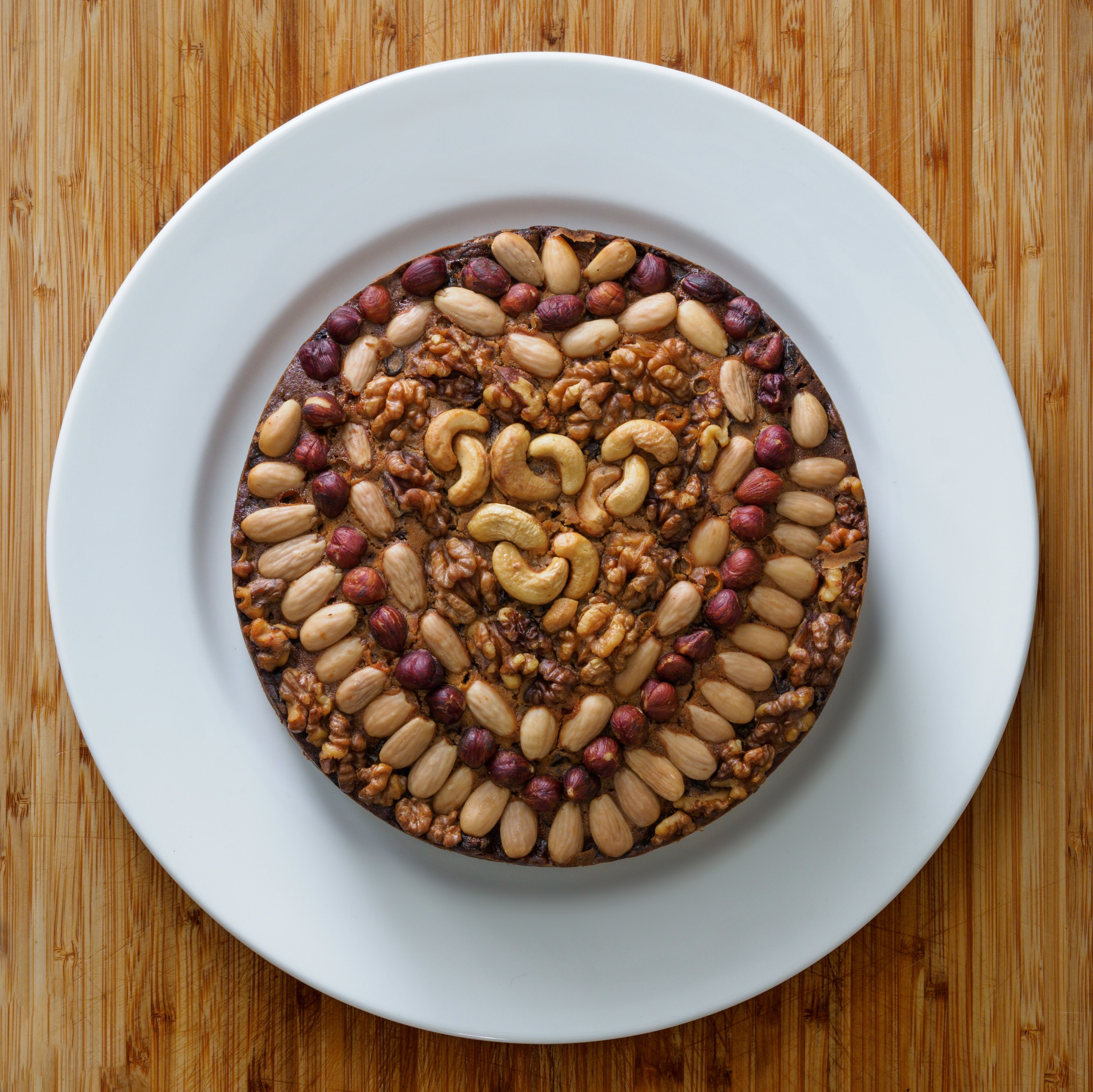
Photo: Brett Jordan / Pexels
Scottish
Dundee Cake
The diets react (see scores below)
Common Ingredients
- butter
- sugar
- eggs
- flour
- dried fruit
- almonds
- baking powder
- salt
- spices
Specific recipes may vary.
Incompatible with 10 of 11 diets
Diet Ratings
Dundee Cake is fundamentally incompatible with a ketogenic diet. Its core ingredients — wheat flour, sugar, and dried fruit — are among the most keto-incompatible foods possible. Wheat flour is a high-glycemic grain, sugar is pure carbohydrate, and dried fruit is extremely concentrated in natural sugars and net carbs. A typical slice of Dundee Cake likely contains 40-60g of net carbs, which alone exceeds or nearly exhausts an entire day's keto carb budget. While the recipe does include butter, eggs, and almonds (which are keto-friendly), they are entirely overwhelmed by the carbohydrate-heavy ingredients. No portion size makes this cake compatible with maintaining ketosis.
Dundee Cake contains multiple animal-derived ingredients that disqualify it from a vegan diet. Butter is a dairy product, and eggs are a direct animal product — both are explicitly excluded under vegan dietary rules. These are core, structural ingredients in the recipe, not trace contaminants, meaning the cake cannot be considered vegan in its traditional form. The remaining ingredients (flour, dried fruit, almonds, baking powder, salt, spices) are all plant-based, so a vegan adaptation is possible by substituting butter with a plant-based fat (e.g., vegan margarine or coconut oil) and replacing eggs with a suitable binder (e.g., flax eggs, aquafaba). However, the dish as described with its listed ingredients is not vegan-compliant.
Dundee Cake is a traditional Scottish fruit cake that contains multiple core non-paleo ingredients. Flour (wheat) is a grain and strictly excluded from the paleo diet. Sugar is refined and explicitly forbidden. Butter is a dairy product. Baking powder is a processed additive. Salt is excluded as an added ingredient. While eggs, dried fruit, almonds, and spices are paleo-compliant, the foundation of this cake — grain flour, refined sugar, and dairy butter — makes it fundamentally incompatible with the paleo diet. There are no meaningful substitutions that would preserve the dish as 'Dundee Cake'; it would require a complete reformulation.
Dundee Cake is a traditional Scottish fruit cake that conflicts with core Mediterranean diet principles on multiple fronts. Butter is the primary fat rather than extra virgin olive oil, introducing saturated fat in place of heart-healthy monounsaturated fat. Refined white flour and significant added sugar are central to the recipe, both of which are minimized in Mediterranean eating. While dried fruit and almonds are positive elements aligned with Mediterranean principles, they are embedded in a cake matrix dominated by butter, sugar, and refined grains. The overall profile — a sweet, butter-rich baked good — places it firmly in the 'avoid' category as an occasional indulgence rather than a diet staple.
Dundee Cake is a traditional Scottish fruit cake that is almost entirely plant-based and processed. The ingredient list is dominated by carnivore-incompatible foods: flour (grain), sugar (processed carbohydrate), dried fruit (high-sugar plant food), almonds (nuts), baking powder (plant-derived leavening), and spices (plant compounds). While it does contain eggs and butter, these are minor components in a fundamentally grain-and-sugar-based baked good. There is no meaningful animal protein source. This dish violates virtually every core carnivore principle — it contains grains, sugar, plant fats, dried fruit, and nuts. Even the most liberal carnivore practitioners, including those following Paul Saladino's 'animal-based' approach, would not endorse a flour-and-sugar cake as a dietary staple. This is as far from carnivore as a food can get.
Dundee Cake contains multiple excluded ingredients and also violates the 'no recreating baked goods' rule. Butter (regular dairy butter, not ghee) is excluded. Sugar is an excluded added sweetener. Flour is a grain and therefore excluded. Baking powder typically contains corn starch, which is also excluded. Even if these individual ingredients could somehow be substituted with compliant alternatives, Dundee Cake is a classic baked good — a fruitcake — which falls squarely into the category of baked goods that Whole30 explicitly prohibits recreating regardless of ingredient compliance.
Dundee Cake is a traditional Scottish fruit cake that contains multiple high-FODMAP ingredients. The primary concern is wheat flour, which is high in fructans — a key FODMAP that must be avoided during the elimination phase. Dried fruit is the second major problem: most dried fruits (raisins, currants, sultanas, mixed peel) are high-FODMAP due to concentrated fructose and polyols, and Dundee Cake is characteristically dense with them. A typical slice would contain a significant quantity of dried fruit well above safe Monash thresholds. Almonds (used decoratively on top and sometimes in the batter) are moderate-FODMAP and become high-FODMAP above approximately 10 whole almonds, though the quantity per slice may be borderline. Sugar, eggs, and butter are low-FODMAP. The combination of wheat flour and high-load dried fruit makes this cake unsuitable during the FODMAP elimination phase at any standard slice size.
Some FODMAP practitioners note that if Dundee Cake were reformulated with gluten-free flour and FODMAP-safe dried fruit (e.g., small portions of raisins under 1 tablespoon), a modified version could theoretically be low-FODMAP. However, the traditional recipe as described is not safe during elimination, and Monash University has not tested this specific product — so individual ingredient stacking must govern the assessment.
Dundee Cake is a traditional Scottish fruit cake made primarily with butter, sugar, and refined white flour — all ingredients that conflict with core DASH diet principles. Butter is high in saturated fat, which DASH explicitly limits. Refined flour lacks the fiber of whole grains emphasized by DASH. The significant added sugar content places this firmly in the 'sweets' category that DASH advises minimizing. While dried fruit and almonds offer some redeeming nutritional value (potassium, fiber, healthy fats), they are present in relatively small proportions compared to the butter, sugar, and refined flour that dominate the recipe. Salt is also added, contributing to sodium load. As a snack, this provides calories primarily from saturated fat and added sugar with minimal nutritional benefit aligned with DASH goals. DASH guidelines explicitly limit sweets to 5 or fewer servings per week (and small servings at that), placing rich baked goods like this firmly in the avoid or very occasional indulgence category.
Dundee Cake is a traditional Scottish fruit cake that presents multiple Zone Diet conflicts simultaneously. The primary macronutrient profile is heavily skewed toward carbohydrates and saturated fat, with virtually no lean protein. It is built on a foundation of refined white flour and sugar — two of the highest-glycemic, most 'unfavorable' carbohydrate sources in Zone terminology. The butter contributes saturated fat rather than the preferred monounsaturated fats (olive oil, avocado, almonds). Dried fruit, while containing some polyphenols, is a concentrated sugar source that Zone explicitly flags as unfavorable (similar to raisins). The only Zone-friendly element is the almond topping, which provides some monounsaturated fat. As a snack, it provides essentially zero lean protein, making the 40/30/30 block balance nearly impossible to achieve even with creative pairing. It would require an implausibly large amount of external lean protein supplementation to bring a single serving into Zone ratio territory, and the high-glycemic carbohydrate load would still drive an insulin spike inconsistent with Zone goals. This is one of the clearest 'avoid' cases: a calorie-dense, sugar-and-saturated-fat-laden baked good with no meaningful protein content.
Dundee Cake is a traditional Scottish fruit cake with a mixed inflammatory profile. On the pro-inflammatory side, butter contributes saturated fat, and sugar (typically used in significant quantities in this recipe) is a well-established driver of inflammation. White refined flour provides little fiber and raises blood sugar rapidly. These three ingredients together represent meaningful inflammatory burden. On the anti-inflammatory side, dried fruit contributes polyphenols, antioxidants, and fiber. Almonds are a genuinely positive element — they provide monounsaturated fats, vitamin E, and have demonstrated anti-inflammatory properties in research. Any spices used (commonly mixed spice, nutmeg, or cinnamon) add modest anti-inflammatory benefit. Eggs contribute choline and selenium. This is a treat food — not a health food — and the butter-sugar-flour base keeps it firmly in the 'caution' territory. It is not as inflammatory as a heavily processed snack with trans fats or seed oils, but it cannot be considered anti-inflammatory. Acceptable occasionally as part of an otherwise anti-inflammatory diet, but not a food to emphasize.
Dundee Cake is a traditional Scottish butter cake built on a foundation of butter, sugar, flour, and dried fruit — a nutritional profile that is nearly the opposite of what GLP-1 patients need. It is high in saturated fat (from butter), high in refined sugar and simple carbohydrates (flour, dried fruit, added sugar), low in protein, and low in fiber relative to calorie density. The dried fruit contributes concentrated sugar rather than meaningful micronutrients at the calorie cost. Almonds provide a small amount of healthy fat and protein but not in quantities sufficient to offset the overall profile. For GLP-1 patients eating significantly reduced calorie volumes, every bite must deliver protein and fiber — this cake delivers neither in meaningful amounts. The high fat and sugar content also risk worsening GLP-1 side effects including nausea, bloating, and delayed gastric emptying discomfort. This is a treat food with essentially no role in a GLP-1-supportive eating pattern.
*See how scores were generated at our methodology page.
Nutritional profile
Six traits that cut across every diet.
Fiber & Plants
How much whole-plant food and fiber it delivers.
Healthy Fats
The quality of its fats (unsaturated, omega-3).
Whole / Unprocessed
How close it is to its natural, unprocessed form.
Gut Gentle
How easy it is on digestion (low FODMAP, few irritants).
Low Glycemic
How little it spikes your blood sugar.
Protein Density
How much protein it packs per calorie.
Controversy Index
Higher controversy = more disagreement between diets.
Diet-Specific Tips
 Anti-Inflammatory — 4/10
View tips
- Butter (saturated fat) is a limited food in anti-inflammatory frameworks
- Sugar in typical cake quantities drives inflammation and glycemic response
- Refined white flour provides minimal fiber and spikes blood sugar
- Almonds are a genuinely anti-inflammatory ingredient rich in vitamin E and monounsaturated fats
- Dried fruit contributes polyphenols, antioxidants, and fiber
- Spices (cinnamon, nutmeg) add modest anti-inflammatory benefit
- Overall: treat food with both beneficial and inflammatory components; acceptable occasionally