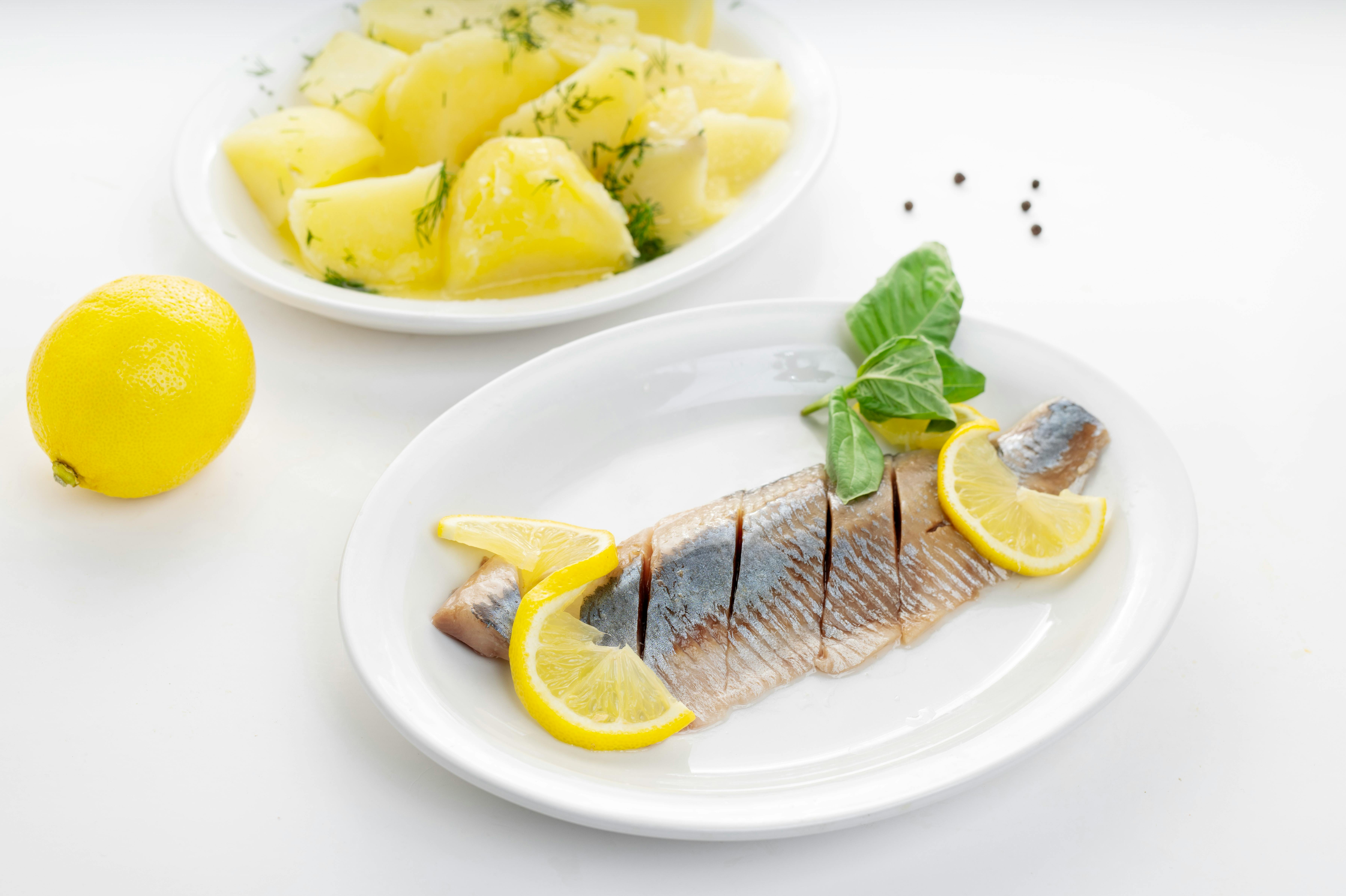
Photo: Jacob Yavin / Pexels
The diets react (see scores below)
Common Ingredients
- herring
- onion
- salt
- pickles
- white bread roll
Specific recipes may vary.
Incompatible with 6 of 11 diets
Diet Ratings
Haring as traditionally served in the Netherlands is a major keto problem due to the white bread roll (broodje haring). A standard white bread roll adds 25-35g of net carbs per serving, immediately threatening or exceeding the daily keto carb limit in a single snack. The herring itself is excellent for keto — it is fatty, high in omega-3s, and virtually zero-carb. Onion adds minimal carbs in small quantities, and pickles are generally low-carb. However, the white bread roll is a grain-based product with high net carbs that is fundamentally incompatible with ketosis. The dish as traditionally served cannot be recommended for keto.
Haring (Dutch raw herring) contains herring as its primary ingredient, which is a fish and therefore an animal product. Fish is unambiguously excluded from a vegan diet under all recognized vegan standards. No preparation method or accompanying plant-based ingredients (onion, pickles, white bread roll) can offset the inclusion of a fish. This dish is entirely incompatible with veganism.
Haring (Dutch raw herring) is served in a white bread roll, which is a wheat-based grain product and a clear paleo violation. Salt is also added, which is excluded under paleo rules. The pickles may contain added salt, vinegar, and preservatives, making them processed. The herring itself is an excellent paleo food — raw, unprocessed fish is ideal — and onion is fully paleo-approved. However, the white bread roll is the defining component of this dish as traditionally served, and its presence alone pushes the overall verdict to avoid. Without the bread roll and salt, herring with onion would be a strong paleo approval.
Haring (Dutch raw herring) is built around herring, an oily fish rich in omega-3 fatty acids and a cornerstone of the Mediterranean diet. The onion and pickles are low-calorie, plant-based accompaniments that fit well. However, the traditional serving with a white bread roll introduces a refined grain that Mediterranean guidelines discourage in favor of whole grains. The salt-curing process also adds significant sodium, which is a minor concern. The dish is not a Mediterranean preparation, but its core ingredient is highly valued; the refined bread roll and high sodium content prevent a full approval.
Some Mediterranean diet practitioners would rate this more favorably, arguing that the dominant ingredient — fatty, nutrient-dense herring — is so strongly endorsed that the refined bread roll is a minor concession, especially if consumed occasionally as a snack. Traditional coastal Mediterranean communities also used salt-preserved fish liberally, making the curing method less of a concern in historical context.
Haring as traditionally served is almost entirely incompatible with the carnivore diet. While the raw herring itself is an excellent carnivore food (fatty fish, minimally processed, high in omega-3s), the dish as presented includes multiple plant-based and processed ingredients: onion (plant), pickles (plant, typically with vinegar and spices), and a white bread roll (grain-based, a core exclusion on any version of the carnivore diet). The bread alone makes this a hard avoid — it is a processed grain product that violates the foundational rule of eating exclusively animal products. The onion and pickles compound the issue. Only the herring and salt are carnivore-compliant. This dish cannot be adapted without stripping it of its defining characteristics.
Haring (Dutch raw herring) is traditionally served in or with a white bread roll, which is a grain-based product and explicitly excluded on Whole30. The herring itself, onion, salt, and pickles (assuming no added sugar or non-compliant ingredients) could be compliant on their own, but the white bread roll is a clear violation. Additionally, pickles should be checked for added sugar or sulfites, though sulfites are no longer excluded per 2024 rules. The dish as classically prepared and served cannot be considered Whole30 compliant due to the bread roll component.
Traditional Dutch Haring (raw herring with onions, served in a white bread roll with pickles) contains multiple high-FODMAP ingredients that make it unsuitable during the elimination phase. The white bread roll is wheat-based and high in fructans — a primary FODMAP trigger. Raw onion is one of the highest-FODMAP foods tested by Monash University, containing significant fructans even at very small amounts (1/4 of a small onion can exceed safe thresholds). Herring itself is low-FODMAP and safe as a protein, and pickles (cucumber-based) are generally low-FODMAP. However, the combination of wheat bread and onion creates a double fructan hit that makes this dish clearly unsuitable during elimination. Even if the bread roll were omitted, the onion garnish — which is traditionally generous in Dutch haring service — remains a significant problem.
Haring (Dutch raw herring) presents a mixed DASH profile. The herring itself is an excellent DASH-compatible food — a fatty fish rich in omega-3s, potassium, and lean protein, explicitly encouraged by DASH guidelines. However, traditional Dutch haring preparation involves salt-curing, which significantly raises sodium content (a single serving can contain 500–900mg sodium). The pickles add additional sodium. The white bread roll is a refined grain rather than a whole grain, which DASH de-emphasizes. The onion is a positive, DASH-friendly ingredient. Consumed as a snack, the sodium load from the cured fish plus pickles is a notable concern for DASH adherents, particularly those on the stricter 1,500mg/day sodium target. If prepared with minimal added salt and served with a whole-grain roll, the score would be higher (7–8), as herring is otherwise a model DASH protein.
NIH DASH guidelines broadly endorse fatty fish like herring as a lean protein source, which supports a more favorable rating. However, updated clinical interpretation recognizes that the traditional salt-cured preparation dramatically alters the sodium profile, leading most DASH-oriented clinicians to advise caution despite the fish's inherent nutritional benefits — particularly for hypertensive patients managing daily sodium intake.
Haring (Dutch raw herring) is a mixed Zone dish. The herring itself is an excellent Zone protein and fat source — rich in lean protein and omega-3 fatty acids, which are strongly aligned with Dr. Sears' anti-inflammatory principles. The onion and pickles are low-glycemic, favorable Zone carb additions. However, the white bread roll (broodje) is a high-glycemic refined carbohydrate that Sears classifies as 'unfavorable' — it spikes insulin and disrupts the Zone's 40/30/30 balance. The traditional serving as a snack also tends to be carb-light (fish + onion without the roll) which would score much higher. With the roll included as described, the overall glycemic load is elevated and the macronutrient ratio skews toward carbs from low-quality sources. Portioning carefully — using a small portion of roll or omitting it — can bring this into Zone compliance, but as traditionally served it requires caution.
Some Zone practitioners and later Sears anti-inflammatory writings would emphasize the exceptional omega-3 content of herring as nearly ideal Zone food, and argue the small white roll can be accommodated within a single carb block if portioned to ~30g. The traditional Dutch practice of eating haring without the roll (just onion and pickles) would likely score 8-9 as a near-ideal Zone snack.
Haring (Dutch raw herring) is a nutritionally interesting dish with significant anti-inflammatory strengths and a notable weakness. Herring itself is one of the richest dietary sources of omega-3 fatty acids (EPA and DHA), placing it firmly in the 'approve' category on its own — comparable to wild salmon. Raw preparation preserves these omega-3s intact. Onions contribute quercetin, a well-researched anti-inflammatory flavonoid, and pickles add minimal concern. However, the white bread roll is a refined carbohydrate with a high glycemic index, offering little fiber or nutritional value and mildly promoting inflammatory signaling. The salt content from curing is also a consideration, though not a direct inflammatory driver. Without the bread roll, this dish would score an 8-9. The roll drags the overall dish into 'caution' territory for the anti-inflammatory framework, though the herring component remains exemplary. Eaten without the bread (as is traditional when eaten 'Hollandse Nieuwe' style, held by the tail), it would clearly approve.
Most anti-inflammatory authorities would agree the herring component is highly beneficial due to its exceptional omega-3 profile. The debate is around the white bread roll: some practitioners following a strict anti-inflammatory protocol (e.g., Dr. Weil's refined-carb guidance) would flag it as a meaningful negative, while others in mainstream nutrition science consider an occasional refined roll negligible in the context of an otherwise nutrient-dense, omega-3-rich dish.
Haring (Dutch raw herring) is a nutritionally interesting snack with meaningful GLP-1 pros and cons. The herring itself is a strong positive: it is a cold-water fatty fish rich in omega-3s, delivers roughly 15-20g of quality protein per standard serving (one whole fish), and is easy to digest in its raw, cured form. Omega-3 fats from fish are explicitly preferred over saturated fats in GLP-1 dietary guidance. However, herring is also moderately high in total fat (~10-15g per fish), which can contribute to nausea, bloating, or reflux in GLP-1 patients sensitive to fat content. The sodium content from curing/salt and pickles is high, which may affect fluid retention and hydration balance — a concern given that GLP-1 patients already have reduced thirst sensation. The white bread roll is the clearest negative: it is a refined carbohydrate with low fiber, low protein density, and low nutrient density per calorie — exactly the empty calories the dietary framework penalizes. Onion and pickles are fine in small amounts. Eaten without the roll (fish and onion only), this dish would score higher (6-7). With the roll as traditionally served, it earns a caution rating. Portion size is appropriate as a snack — one fish is a reasonable small serving.
Some GLP-1-focused dietitians view fatty fish like herring as an unqualified approve due to the omega-3 and protein benefits, accepting the fat content as the healthy, unsaturated variety that does not carry the same GI risk profile as saturated fats. Others flag that fat content — regardless of type — is the primary driver of delayed gastric emptying side effects, making even omega-3-rich fish a tolerance-dependent food for GLP-1 patients, particularly in the early dose-escalation phase.
*See how scores were generated at our methodology page.
Nutritional profile
Six traits that cut across every diet.
Fiber & Plants
How much whole-plant food and fiber it delivers.
Healthy Fats
The quality of its fats (unsaturated, omega-3).
Whole / Unprocessed
How close it is to its natural, unprocessed form.
Gut Gentle
How easy it is on digestion (low FODMAP, few irritants).
Low Glycemic
How little it spikes your blood sugar.
Protein Density
How much protein it packs per calorie.
Controversy Index
Higher controversy = more disagreement between diets.
Diet-Specific Tips
 Mediterranean — 5/10
View tips
- Herring is an oily fish rich in omega-3s, strongly encouraged 2-3 times weekly
- Onion and pickles are wholesome plant-based accompaniments
- White bread roll is a refined grain, discouraged in favor of whole grains
- Salt-curing adds high sodium content
- Not a traditional Mediterranean dish but aligns with core fish-forward principles
 DASH — 4/10
View tips
- Herring is an omega-3-rich fatty fish strongly supported by DASH guidelines
- Salt-curing process substantially elevates sodium content (est. 500–900mg per serving)
- Pickles contribute additional sodium, compounding the concern
- White bread roll is a refined grain, not the whole grain DASH recommends
- Onion is a DASH-positive ingredient
- Sodium burden is especially problematic for those on the 1,500mg/day low-sodium DASH plan
- Unsalted or low-sodium preparation would significantly improve DASH compatibility
 Zone — 5/10
View tips
- Herring is an excellent lean protein and omega-3 source, strongly Zone-favorable
- Omega-3 fatty acids align with Sears' anti-inflammatory focus
- White bread roll is a high-glycemic refined carbohydrate classified as 'unfavorable' in Zone
- Onion and pickles are low-glycemic, Zone-compatible carb additions
- As a snack, the white roll disrupts the 40/30/30 ratio by adding poor-quality carbs
- Removing or minimizing the roll would significantly improve Zone compatibility
 Anti-Inflammatory — 5/10
View tips
- Herring is exceptionally high in anti-inflammatory omega-3 fatty acids (EPA and DHA)
- Raw/lightly cured preparation preserves omega-3 content
- Onions provide quercetin, an anti-inflammatory flavonoid
- White bread roll is a refined carbohydrate — pro-inflammatory and low in fiber
- High sodium from salt curing — not directly inflammatory but worth noting
- Dish score would be significantly higher without the refined bread roll
 GLP-1 Friendly — 5/10
View tips
- Good quality protein (~15-20g per fish) supports GLP-1 protein priority
- Omega-3 fatty acids from herring are preferred unsaturated fats
- Moderate-to-high total fat content may worsen nausea or reflux in GLP-1 patients
- High sodium from curing and pickles is a hydration and fluid balance concern
- White bread roll adds refined carbohydrates with minimal fiber or protein — reduces overall nutritional density
- Without the roll, dish would rate higher; the roll is the key downgrade factor
- Appropriate small portion size as a snack aligns with GLP-1 small-meal guidance