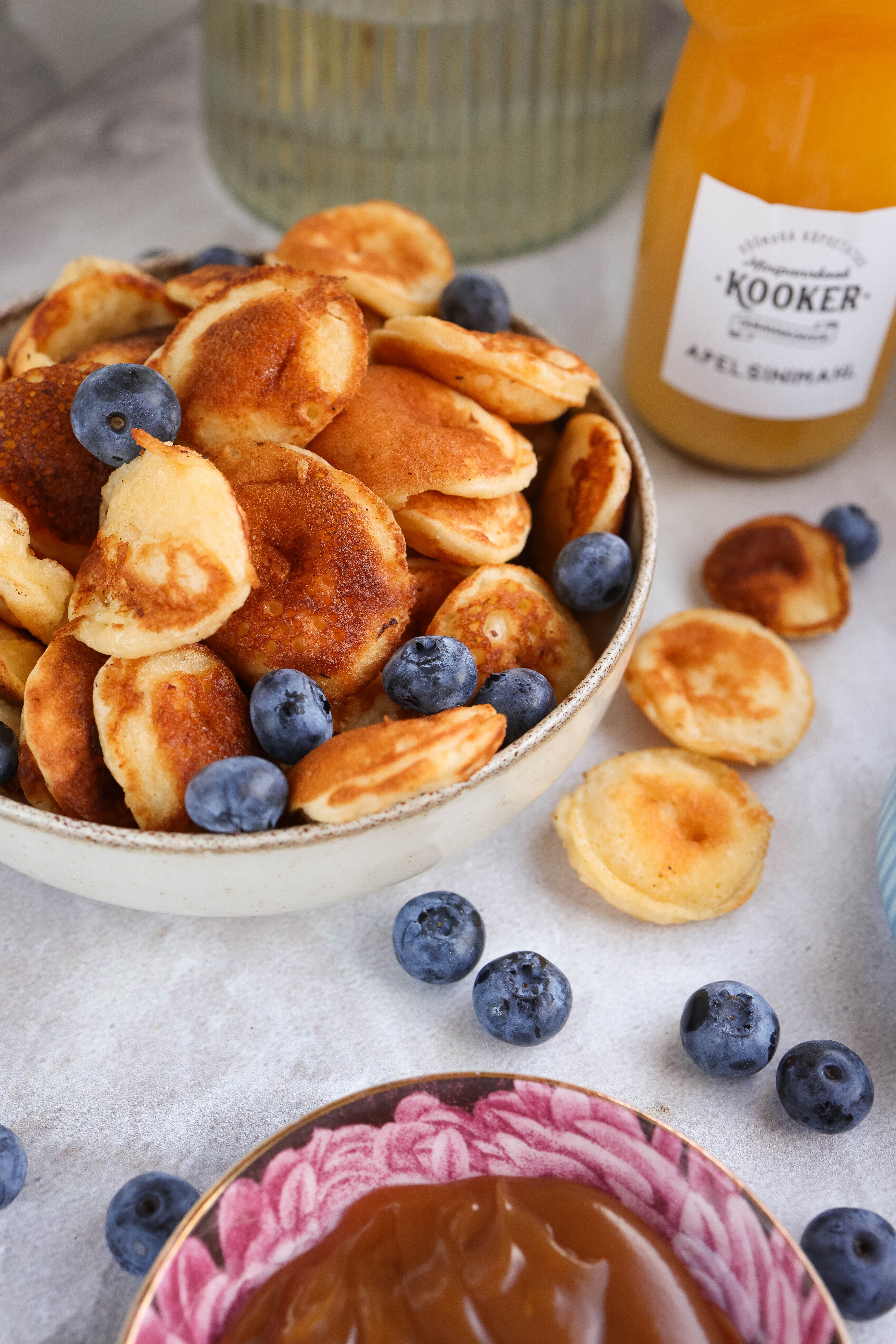
Photo: Valeria Boltneva / Pexels
The diets react (see scores below)
Common Ingredients
- flour
- yeast
- eggs
- milk
- butter
- powdered sugar
- salt
Specific recipes may vary.
Incompatible with 10 of 11 diets
Diet Ratings
Poffertjes are small Dutch pancakes made primarily from wheat flour and yeast, topped with powdered sugar. Flour is a high-carb grain product, and powdered sugar is pure added sugar — both are strictly incompatible with ketogenic diets. A typical serving of poffertjes (6-8 pieces) would contain 30-50g of net carbs from flour alone, plus additional sugar from the topping, making it virtually impossible to fit within a daily keto carb budget without exceeding limits immediately. While eggs, butter, and milk are present, they are minor contributors and cannot offset the dominant carb load from flour and sugar.
Poffertjes contain multiple animal-derived ingredients that are unambiguously non-vegan: eggs, milk, and butter are all direct animal products excluded under any definition of veganism. There is no meaningful debate within the vegan community about these ingredients — all three are clearly animal-derived. The dish as traditionally prepared is fundamentally incompatible with a vegan diet. Vegan versions can be made using plant-based milk, vegan butter, and egg replacers, but the traditional recipe evaluated here contains three separate animal product violations.
Poffertjes are small Dutch pancakes made almost entirely from non-paleo ingredients. Flour (wheat) is a grain and a core paleo exclusion. Milk and butter are dairy products, excluded from strict paleo. Powdered sugar is refined sugar, also excluded. Salt is added and discouraged. Yeast, while a natural organism, is used here only in the context of a grain-based processed batter. The only paleo-compliant ingredient in this dish is eggs. With the overwhelming majority of ingredients being explicitly excluded under paleo guidelines, this dish receives the lowest possible rating.
Poffertjes are small Dutch pancakes made from refined white flour, butter, eggs, milk, and topped with powdered sugar. This combination strongly contradicts Mediterranean diet principles: refined flour is a processed grain with little nutritional value compared to whole grains, powdered sugar is added sugar, and butter is a saturated animal fat rather than the preferred extra virgin olive oil. The dish is also a sweet snack with no vegetables, legumes, or other plant-forward components. While eggs and milk are acceptable in moderation in the Mediterranean diet, they play a supporting role in a nutritionally poor, high-sugar, refined-grain product here.
Poffertjes are Dutch mini pancakes made primarily from flour and yeast — both plant-derived grain products that are strictly excluded from the carnivore diet. The dish is essentially a grain-based baked good. While it contains some animal-derived ingredients (eggs, milk, butter), these are minor components in a recipe that is fundamentally built around flour. The addition of powdered sugar adds further disqualifying processed sugar. There is no meaningful animal protein as the primary component, and the dominant macronutrient profile is carbohydrate from grain flour. This food is incompatible with carnivore principles at every level.
Poffertjes are Dutch mini pancakes that violate Whole30 on multiple fronts. They contain flour (a grain, excluded), milk and butter (dairy, excluded), and powdered sugar (added sugar, excluded). Even setting aside individual ingredients, poffertjes are explicitly the type of 'recreated baked goods/pancakes' that the Whole30 program prohibits by name — pancakes are listed as a disallowed recreation even when made with compliant ingredients. This dish fails both the ingredient rules and the 'no recreating baked goods' rule simultaneously.
Poffertjes are traditional Dutch mini-pancakes made primarily with wheat flour and milk — two significant FODMAP sources. Wheat flour is high in fructans, one of the most problematic FODMAP categories, and there is no low-FODMAP threshold at which a standard serving of wheat-flour-based poffertjes becomes safe during the elimination phase. Milk contains lactose (a disaccharide), which is also restricted. A standard serving of poffertjes (typically 6–12 mini-pancakes) would deliver a substantial dose of both fructans from wheat and lactose from milk, making this dish clearly high-FODMAP. Butter is low-FODMAP (fat-soluble, negligible lactose), eggs are low-FODMAP, salt is low-FODMAP, and powdered sugar in small amounts is generally low-FODMAP. However, the two primary structural ingredients — wheat flour and milk — are sufficient to classify the dish as avoid during the elimination phase. Yeast itself is low-FODMAP, and while yeast fermentation can reduce fructans (as in long-fermented sourdough), standard poffertjes recipes do not use prolonged fermentation sufficient to meaningfully reduce fructan content.
Poffertjes are small Dutch pancakes made with refined white flour, butter, eggs, milk, and topped with powdered sugar. From a DASH perspective, several elements are problematic: refined (non-whole-grain) flour lacks the fiber DASH emphasizes, butter contributes saturated fat which DASH limits, and powdered sugar adds empty calories with no nutritional benefit. The added salt contributes to sodium load. While eggs and milk provide some protein and calcium aligned with DASH principles, the overall profile — refined carbs, saturated fat, added sugar — positions this as an occasional treat rather than a DASH staple. A small portion (3-4 mini poffertjes) could fit within a DASH plan on occasion, but regular consumption is not encouraged.
Poffertjes are small Dutch pancakes made primarily from refined white flour, finished with butter and powdered sugar — a combination that is essentially pure high-glycemic carbohydrate with saturated fat and negligible lean protein. The macronutrient profile is deeply incompatible with Zone ratios: heavily carb-dominant (refined, high-GI flour plus pure sugar topping), moderate saturated fat from butter, and virtually no lean protein. As a snack category item with no protein block to speak of, poffertjes would spike blood glucose rapidly and offer no pathway to achieving anything close to a 40/30/30 balance. Even in small portions, the refined flour and powdered sugar make it extremely difficult to incorporate into a Zone meal without fundamentally altering the dish. The Zone Diet explicitly classifies refined grain products and sugar as unfavorable carbohydrates to be avoided, and this dish is essentially nothing but those ingredients.
Poffertjes are small Dutch pancakes made from refined white flour, butter, eggs, milk, and topped with powdered sugar. From an anti-inflammatory perspective, this dish is problematic on multiple fronts. The base is refined white flour, which ranks high on the glycemic index and promotes insulin spikes and inflammatory markers like CRP. Powdered sugar adds significant refined sugar, further driving glycemic load and advanced glycation end-products (AGEs). Butter contributes saturated fat, which anti-inflammatory guidelines recommend limiting. There are no meaningful anti-inflammatory components — no omega-3s, antioxidants, polyphenols, or fiber of note. Eggs and milk offer minor nutritional value (protein, some micronutrients), but these are not enough to offset the inflammatory profile. Yeast fermentation is a marginal positive but does not significantly alter the overall assessment. As a refined-carbohydrate, high-sugar, saturated-fat snack with no redeeming anti-inflammatory ingredients, poffertjes fit squarely in the 'avoid' category for anyone following an anti-inflammatory dietary pattern.
Poffertjes are small Dutch pancakes made primarily from refined white flour and yeast, served with butter and powdered sugar. They are nutritionally poor for GLP-1 patients on nearly every key dimension: minimal protein, negligible fiber, high in refined carbohydrates, topped with saturated fat (butter) and added sugar (powdered sugar). The refined flour causes rapid blood sugar spikes with no fiber to buffer the glycemic response. The butter topping adds saturated fat, which can worsen GLP-1 side effects like nausea and bloating. Powdered sugar adds empty calories with zero nutritional value. As a snack-category food with no meaningful protein contribution, it does nothing to support the 100–120g daily protein target, and with small portion sizes being critical on GLP-1 medications, spending stomach capacity on nutritionally empty refined carb snacks is especially counterproductive. The yeast-leavened batter may also cause some mild bloating. This food fails on protein density, fiber, glycemic load, fat quality, and nutrient density per calorie simultaneously.
*See how scores were generated at our methodology page.
Nutritional profile
Six traits that cut across every diet.
Fiber & Plants
How much whole-plant food and fiber it delivers.
Healthy Fats
The quality of its fats (unsaturated, omega-3).
Whole / Unprocessed
How close it is to its natural, unprocessed form.
Gut Gentle
How easy it is on digestion (low FODMAP, few irritants).
Low Glycemic
How little it spikes your blood sugar.
Protein Density
How much protein it packs per calorie.
Controversy Index
Higher controversy = more disagreement between diets.
Diet-Specific Tips
 DASH — 4/10
View tips
- Refined white flour — not a whole grain, low in fiber and nutrients DASH prioritizes
- Butter adds saturated fat, which DASH limits
- Powdered sugar topping adds significant added sugar with no nutritional value
- Salt contributes to daily sodium intake
- Milk and eggs provide modest calcium and protein, which partially align with DASH
- No fruits, vegetables, legumes, or other DASH-emphasized nutrients present
- Acceptable as an occasional small-portion treat, but not a regular DASH food