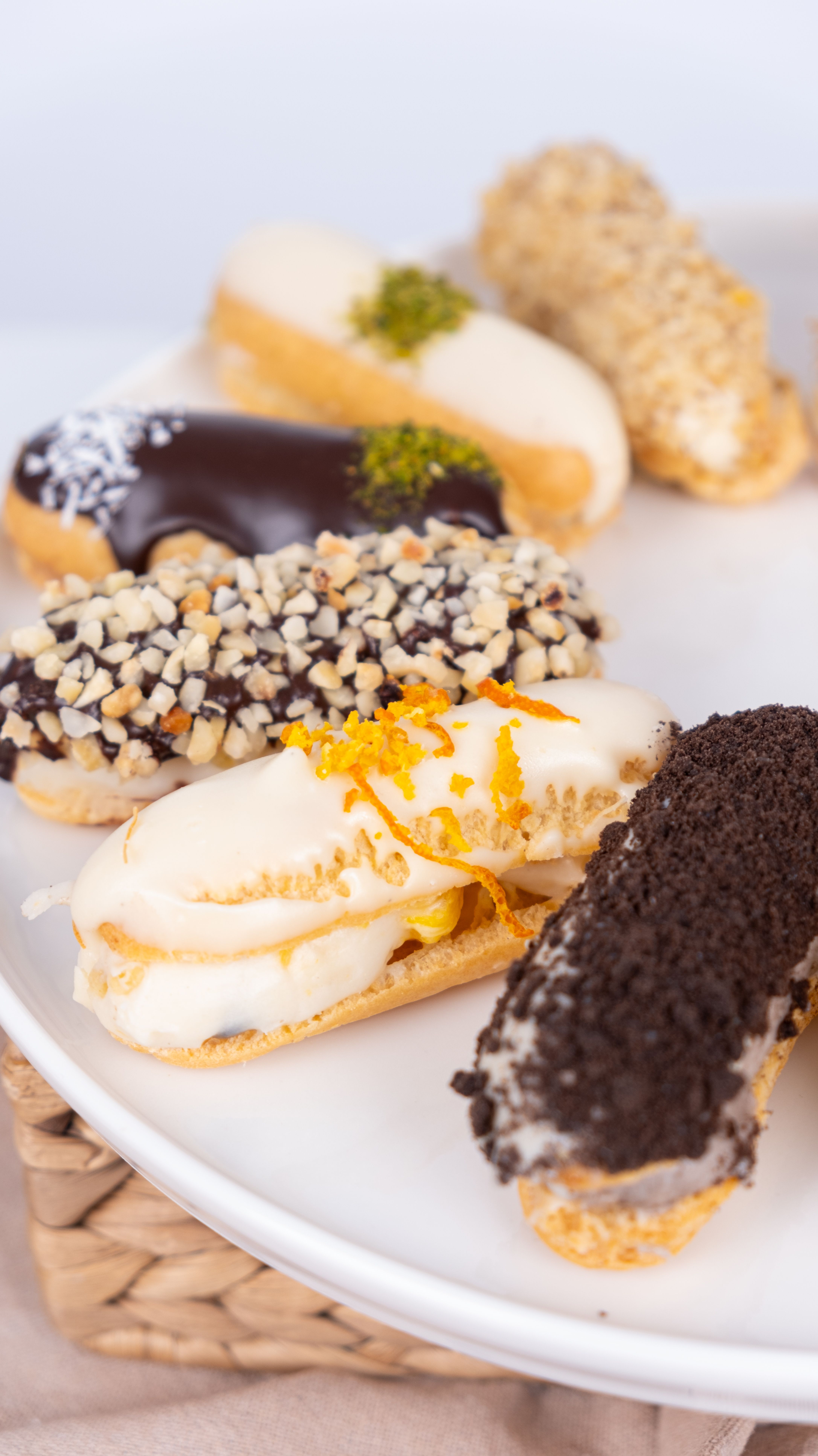
The diets react (see scores below)
Common Ingredients
- choux dough
- butter
- flour
- eggs
- milk
- sugar
- chocolate
- vanilla
Specific recipes may vary.
Incompatible with 11 of 11 diets
Diet Ratings
An éclair is fundamentally incompatible with a ketogenic diet. The choux pastry shell is made primarily from wheat flour, which is a high-carb grain, and the filling contains sugar and milk. The chocolate glaze adds additional sugar. A single standard éclair contains approximately 25-35g of net carbs, which could consume an entire day's carb allowance in one snack, and that's before any other food is consumed. There is no meaningful way to make a traditional éclair keto-compatible without replacing virtually every core ingredient.
A classic éclair contains multiple animal-derived ingredients that are core to the recipe, not incidental. The choux pastry dough is made with butter, eggs, and milk — all direct animal products. The pastry cream filling traditionally uses eggs, milk, and butter as well. These are structural ingredients that cannot simply be omitted; the entire recipe depends on them. There are no plant-based substitutes present in this version. Vegan éclairs do exist using plant milks, vegan butter, and egg replacers, but the dish as described here is firmly non-vegan.
An éclair is fundamentally incompatible with the Paleolithic diet. It is built on choux pastry, which requires wheat flour — a grain explicitly excluded from paleo. Beyond the flour, the filling and shell rely on milk and sugar (refined carbohydrate), both of which are categorically non-paleo. Butter is a dairy product excluded under strict paleo guidelines. While eggs and vanilla are paleo-approved, and dark chocolate occupies a gray area, these minor ingredients cannot redeem a dish whose entire structure depends on grains, dairy, and refined sugar. This is a highly processed, agriculture-era confection with no meaningful paleo-compatible adaptation possible without completely reinventing the dish.
An éclair is a classic French pastry that fundamentally contradicts Mediterranean diet principles. It is made from refined white flour (choux pastry), butter as the primary fat, added sugars, and chocolate glaze — all foods the Mediterranean diet minimizes or avoids. The dough is refined and processed, butter replaces olive oil as the fat source, and the dish is high in added sugar. There are no whole grains, vegetables, legumes, or other plant-forward components. As a processed, sugar-laden pastry built on refined grains and saturated fat, it falls squarely in the 'avoid' category.
An éclair is fundamentally incompatible with the carnivore diet. It is a pastry made primarily from plant-based ingredients: flour (grain), sugar, chocolate (plant-derived), and vanilla (plant-derived). While it does contain some animal-derived ingredients — butter, eggs, and milk — these are minor components embedded in a predominantly plant-based, heavily processed confection. The choux dough base is flour and water/milk cooked together, making it a grain product. Sugar adds further disqualification. There is no scenario within any tier of carnivore eating where a flour-and-sugar pastry is acceptable. This is essentially a dessert with negligible animal-protein content and maximum plant-based, processed carbohydrate content.
An éclair is a classic French pastry made from choux dough, which itself contains flour (a grain) and butter (dairy). The filling is typically a pastry cream made with milk (dairy) and sugar (added sugar), and the topping is a chocolate glaze also containing sugar. Beyond the multiple excluded ingredients, an éclair is the archetypal baked good that Whole30 explicitly prohibits — it is a pastry/dessert that falls squarely into the 'no recreating baked goods/junk food' rule even if one were to imagine a compliant version. There is no compliant version of this dish possible.
Eclairs are high-FODMAP due to multiple problematic ingredients. The choux pastry is made with wheat flour, which is high in fructans — a major FODMAP trigger. The pastry cream filling typically contains full-fat milk or cream and sometimes lactose-heavy custard, contributing lactose. Sugar in moderate amounts is generally low-FODMAP, eggs and butter are low-FODMAP, and dark chocolate in small amounts can be low-FODMAP, but the wheat flour alone is sufficient to classify this as a high-FODMAP food during the elimination phase. A standard eclair serving (one eclair, ~70-100g) would contain a significant amount of wheat flour, making it unsuitable for the elimination phase.
An éclair is a classic French pastry that conflicts with DASH diet principles on multiple fronts. The choux dough is made with butter (saturated fat), white flour (refined grain), and eggs. The filling is typically a custard cream made with whole milk, sugar, and eggs, and the topping is chocolate glaze containing added sugar and saturated fat. Together, this results in a high saturated fat, high added sugar, refined carbohydrate-heavy food with negligible potassium, magnesium, calcium, or fiber. The DASH diet explicitly limits sweets, added sugars, and saturated fats. An éclair represents exactly the category of foods DASH guidelines recommend minimizing, fitting squarely into the 'sweets' group, which DASH limits to 5 or fewer servings per week, and only in small portions — and even then, lower-fat, lower-sugar options are preferred.
An éclair is a quintessential high-glycemic, high-saturated-fat dessert that is extremely difficult to incorporate into Zone-balanced eating. The choux pastry is made from refined white flour and butter — providing high-glycemic carbohydrates and saturated fat simultaneously. The chocolate glaze and custard filling add significant sugar, more saturated fat, and negligible protein. The macronutrient profile is roughly the inverse of Zone targets: heavy on refined carbs and saturated fat, very low on lean protein, and contains no monounsaturated fat to speak of. There is no meaningful lean protein source, no low-glycemic carbohydrates, and no favorable fat to bring this into Zone balance. Unlike most foods that can be portion-controlled into a Zone meal, an éclair's very small serving size relative to its caloric density and its near-zero protein content make it essentially impossible to use as a Zone block without consuming an excess of unfavorable macros. This is as close to a categorically excluded food as the Zone Diet produces.
An éclair is a classic French pastry built almost entirely from ingredients that are problematic from an anti-inflammatory standpoint. Choux dough is a refined flour base with no meaningful fiber, antioxidants, or beneficial phytonutrients. Butter contributes saturated fat, which at this level of concentration is a recognized pro-inflammatory driver. The filling (pastry cream) is made from whole milk, sugar, egg yolks, and vanilla — the dairy fat and added sugar compound the inflammatory load. The chocolate glaze is typically made with standard milk chocolate or a chocolate-sugar blend rather than high-cacao dark chocolate (>70%), so the potential polyphenol benefit of cacao does not apply here. Refined sugar is one of the most consistently identified pro-inflammatory dietary components, raising CRP and IL-6 in clinical studies. The combination of refined carbohydrates + saturated fat + added sugar with essentially zero fiber, omega-3s, antioxidants, or anti-inflammatory phytonutrients makes this a clear 'avoid' within the anti-inflammatory framework. Occasional consumption as a treat is a personal choice, but the food itself scores very poorly against every anti-inflammatory criterion.
An éclair is a poor fit for GLP-1 patients on virtually every relevant dimension. It is a high-sugar, high-fat, refined-carbohydrate pastry with negligible protein and essentially no fiber. The choux dough is made with butter, flour, eggs, and milk — then filled with cream and topped with chocolate glaze — delivering a significant saturated fat and sugar load in a small, calorie-dense package. With GLP-1 medications already slowing gastric emptying, high-fat and high-sugar foods like this are more likely to cause nausea, bloating, and reflux. The calorie density is high relative to nutritional value, directly violating the nutrient-density-per-calorie principle that is critical when patients are eating significantly less overall. There is no meaningful protein to support muscle preservation, no fiber to aid digestion or blood sugar stability, and no micronutrient density to justify inclusion. It represents the archetype of an empty-calorie food that is especially counterproductive on GLP-1 therapy.
*See how scores were generated at our methodology page.
Nutritional profile
Six traits that cut across every diet.
Fiber & Plants
How much whole-plant food and fiber it delivers.
Healthy Fats
The quality of its fats (unsaturated, omega-3).
Whole / Unprocessed
How close it is to its natural, unprocessed form.
Gut Gentle
How easy it is on digestion (low FODMAP, few irritants).
Low Glycemic
How little it spikes your blood sugar.
Protein Density
How much protein it packs per calorie.
Controversy Index
Higher controversy = more disagreement between diets.