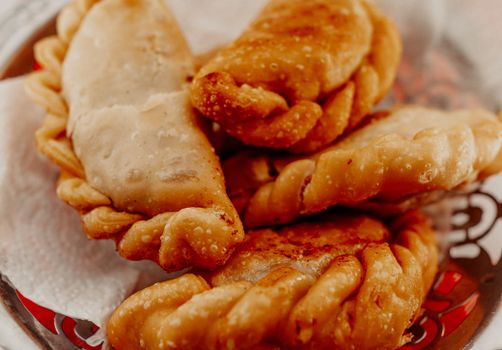
Photo: Gera Cejas / Pexels
Ecuadorian
Empanadas de Viento
The diets react (see scores below)
Common Ingredients
- wheat flour
- cheese
- eggs
- butter
- onion
- sugar
- oil
Specific recipes may vary.
Incompatible with 9 of 11 diets
Diet Ratings
Empanadas de Viento are fundamentally incompatible with a ketogenic diet. The primary structural ingredient is wheat flour, a high-glycemic grain that is strictly excluded from keto. A single empanada can easily contain 20-30g of net carbs from the dough alone, which meets or exceeds the entire daily net carb allowance. Additionally, sugar is listed as an ingredient, which has zero place in any keto protocol. While the cheese and egg fillings are keto-friendly, and butter is an approved fat, these ingredients cannot offset the disqualifying carbohydrate load from the wheat flour shell and added sugar.
Empanadas de Viento contain multiple animal-derived ingredients that are incompatible with a vegan diet. Cheese is a dairy product made from animal milk, eggs are an animal product, and butter is a dairy derivative made from cow's cream. All three are explicitly excluded under vegan dietary rules. The remaining ingredients — wheat flour, onion, sugar, and oil — are plant-based, but the presence of cheese, eggs, and butter makes this dish clearly non-vegan with no ambiguity.
Empanadas de Viento are fundamentally incompatible with the paleo diet. The dish's defining structure is a wheat flour pastry shell — a grain that is unambiguously excluded from paleo. The filling contains cheese, a dairy product equally excluded. Butter is also dairy. Sugar is refined and off-limits. Multiple core ingredients violate foundational paleo principles simultaneously, leaving virtually nothing paleo-compliant in this dish beyond the egg and onion.
Empanadas de Viento are deep-fried pastries made from refined wheat flour, butter, and sugar — a combination that directly contradicts Mediterranean diet principles on multiple fronts. The dough relies on refined white flour (not whole grain), butter as the primary fat (not olive oil), and added sugar in the dough. The dish is deep-fried in oil, adding significant processed fat load. While cheese and eggs are acceptable in moderation within the Mediterranean pattern, they are not the main concern here. The overall profile — refined grain shell, saturated animal fat, added sugar, deep-frying — aligns this snack firmly in the 'avoid' category.
Empanadas de Viento are fundamentally incompatible with the carnivore diet. The dish is built on a wheat flour dough — a grain-based carbohydrate that is entirely excluded from carnivore. Additional plant-derived ingredients include onion, sugar, and oil, all of which are strictly prohibited. While the filling contains cheese and eggs (animal-derived), and butter is an animal fat, these acceptable components are completely overshadowed by the dominant plant-based and grain-based ingredients. No amount of animal-derived filling redeems a wheat flour shell on the carnivore diet.
Empanadas de Viento contains multiple Whole30-excluded ingredients. Wheat flour is a grain and is explicitly prohibited. Cheese is dairy and is explicitly prohibited. Butter (regular, not ghee) is dairy and is explicitly prohibited. Sugar is an added sugar and is explicitly prohibited. Beyond individual ingredients, the dish itself is an empanada — a filled dough pastry — which falls squarely into the 'no recreating baked goods' rule (wraps, crusts, pastry doughs). This dish is excluded on multiple independent grounds.
Empanadas de Viento contain two clearly high-FODMAP ingredients that make them unsuitable during the elimination phase. Wheat flour is high in fructans at any standard serving size — a single empanada would contain a significant amount of wheat-based dough, well above safe FODMAP thresholds. Onion is one of the highest-fructan foods in the Monash database and is high-FODMAP even in very small quantities. These two ingredients alone disqualify this dish. The remaining ingredients — eggs, butter, oil, and sugar — are low-FODMAP. Cheese is typically low-FODMAP in moderate servings (hard and semi-hard cheeses are low in lactose), but it cannot offset the primary FODMAP load from wheat and onion. There is no realistic way to consume a standard serving of this dish within low-FODMAP limits without fundamentally altering the recipe.
Empanadas de Viento are deep-fried pastries filled with cheese, which presents several DASH diet concerns. The wheat flour dough made with butter contributes refined carbohydrates and saturated fat. The cheese filling, while providing calcium and protein, typically adds moderate-to-high sodium and saturated fat. Deep-frying in oil significantly increases total fat content, though the type of oil matters (vegetable oil is less problematic than tropical oils). Sugar is added to the dough, contributing to added sugar intake. On the positive side, the dish contains eggs (moderate protein) and onion (a DASH-friendly vegetable). The overall profile — refined grain crust, full-fat cheese, butter, deep frying, and added sugar — makes this a food to consume only occasionally and in strict portion control within a DASH framework. It is not categorically excluded but aligns poorly with core DASH principles.
NIH DASH guidelines emphasize limiting saturated fat, refined grains, and sodium-dense foods like typical cheese, making this a poor fit. However, some DASH-oriented clinicians note that occasional small portions of culturally significant foods with moderate nutrient profiles (the cheese provides calcium, eggs provide protein) can be accommodated within the broader DASH eating pattern without significantly undermining cardiovascular outcomes, particularly if low-sodium cheese and baking rather than frying are substituted.
Empanadas de Viento are a traditional Ecuadorian fried pastry that present multiple Zone Diet challenges. The primary carbohydrate source is wheat flour (refined, high-glycemic), which is an 'unfavorable' carb in Zone terminology. The addition of sugar further elevates the glycemic load. The protein source is cheese, which is acceptable in Zone but comes paired with significant saturated fat from both the cheese and butter. The dish is deep-fried in oil, adding substantial fat — and depending on the oil type, this may be omega-6-heavy seed oil rather than the preferred monounsaturated fat. The macro ratio is heavily skewed: high carbohydrate from the refined flour shell, moderate protein from cheese, and high fat from frying and butter/cheese — nowhere near the 40/30/30 Zone target. While technically a 'caution' dish in that it contains some real food ingredients (eggs, cheese, onion), the combination of refined flour, sugar, deep frying, and saturated fat makes this one of the harder snacks to incorporate into a Zone framework. It scores at the low end of caution (3) because the structural problems — refined carb shell, added sugar, frying method — collectively make Zone-balancing this dish extremely difficult without fundamentally altering the recipe.
Empanadas de Viento are a deep-fried Ecuadorian pastry with a profile that conflicts with anti-inflammatory principles on multiple fronts. The dough is made from refined wheat flour, a refined carbohydrate with minimal fiber and a high glycemic impact that can promote inflammatory signaling. Butter contributes saturated fat, which at regular intake is associated with elevated inflammatory markers. The cheese filling adds additional saturated fat and full-fat dairy. Deep-frying (implied by the dish name 'de Viento,' meaning they puff with air from frying) in oil — likely a refined vegetable/seed oil — introduces oxidized lipids and excessive omega-6 fatty acids, both pro-inflammatory. Added sugar in the dough further compounds the glycemic burden. The only mildly redeeming ingredient is onion, which contains quercetin, an anti-inflammatory flavonoid, but its contribution is minimal in this context. As an occasional indulgence this dish may be tolerable, but its regular consumption is clearly at odds with anti-inflammatory dietary principles.
Empanadas de Viento are deep-fried pastries made from refined wheat flour and filled with cheese, with butter and oil contributing to both the dough and the frying process. This profile is problematic on nearly every GLP-1 dietary criterion. The cooking method (deep-frying) is a primary disqualifier — fried foods are among the worst triggers for GLP-1 side effects including nausea, bloating, and reflux, driven by the medication's slowed gastric emptying. The dough is made from refined white flour, offering minimal fiber and low nutrient density per calorie. Fat content is high from multiple sources: butter in the dough, cheese in the filling, and the frying oil itself — predominantly saturated fats. Protein contribution from cheese is modest relative to the caloric load and fat burden; this is not a protein-dense food by any meaningful measure. The dusting of sugar added at serving adds empty calories with no nutritional benefit. Small portions are theoretically possible, but even a single empanada delivers a concentrated hit of fat, refined carbs, and fried content that is difficult to justify for GLP-1 patients. This is a celebration or occasional food with essentially no GLP-1-friendly attributes.
*See how scores were generated at our methodology page.
Nutritional profile
Six traits that cut across every diet.
Fiber & Plants
How much whole-plant food and fiber it delivers.
Healthy Fats
The quality of its fats (unsaturated, omega-3).
Whole / Unprocessed
How close it is to its natural, unprocessed form.
Gut Gentle
How easy it is on digestion (low FODMAP, few irritants).
Low Glycemic
How little it spikes your blood sugar.
Protein Density
How much protein it packs per calorie.
Controversy Index
Higher controversy = more disagreement between diets.
Diet-Specific Tips
 DASH — 4/10
View tips
- Deep-fried preparation significantly increases total fat content
- Cheese adds saturated fat and sodium, both limited on DASH
- Butter in dough contributes additional saturated fat
- Refined wheat flour rather than whole grain — not DASH-preferred
- Added sugar in dough is discouraged on DASH
- Onion is a DASH-friendly ingredient
- Eggs provide moderate protein and are acceptable in moderation
- No fruits, vegetables, or whole grains as primary components
- Portion control critical — single empanada may be acceptable occasionally
 Zone — 5/10
View tips
- Refined wheat flour shell is a high-glycemic 'unfavorable' carb in Zone terminology
- Added sugar increases glycemic load, further pushing away from Zone principles
- Deep-fried preparation adds excess fat — likely omega-6-heavy if using seed oils
- Butter and full-fat cheese contribute significant saturated fat, conflicting with Zone's lean protein and monounsaturated fat emphasis
- Macro ratio is skewed far from 40/30/30 — carb and fat heavy with insufficient lean protein
- Onion and egg provide minor favorable Zone contributions but do not offset the overall profile
- As a snack category item, it lacks the vegetable base that Zone recommends for carbohydrate sourcing