Photo: Valeria Boltneva / Pexels
The diets react (see scores below)
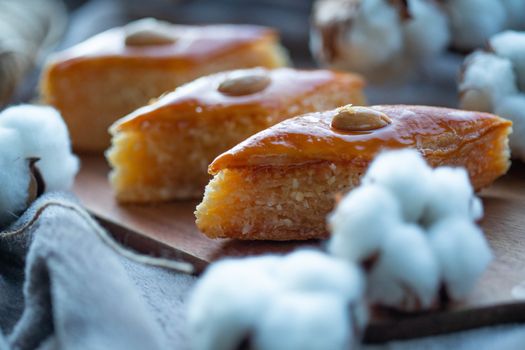
Common Ingredients
- semolina
- sugar
- yogurt
- butter
- coconut
- almonds
- vanilla
- lemon
Specific recipes may vary.
Incompatible with 10 of 11 diets
Diet Ratings
Basbousa is fundamentally incompatible with a ketogenic diet. Its two primary ingredients — semolina (a refined grain) and sugar — are among the most keto-incompatible foods possible. Semolina is high-gluten durum wheat with extremely high net carbs (~70g per 100g), and sugar adds a direct glucose load. A single standard serving of basbousa can easily contain 40-60g of net carbs, blowing the entire daily keto carb budget in one snack. While the recipe does include some keto-friendly components (butter, almonds, coconut), they are minor supporting ingredients that do nothing to offset the massive carbohydrate load from the semolina and sugar base. There is no portion size small enough to make this dish compatible with ketosis.
Basbousa contains two clear animal-derived ingredients: yogurt (dairy) and butter (dairy). Both are direct animal products excluded under all vegan definitions. The remaining ingredients — semolina, sugar, coconut, almonds, vanilla, and lemon — are all plant-based, but the presence of dairy makes the traditional dish non-vegan. Vegan versions of basbousa can be made by substituting plant-based yogurt (e.g., coconut or soy yogurt) and vegan butter or coconut oil, which are widely available.
Basbousa is fundamentally incompatible with the Paleo diet. Its base ingredient is semolina, a coarse wheat flour — a grain that is explicitly excluded from all versions of the Paleo framework. Refined sugar is the second major ingredient, also firmly on the avoid list. Yogurt and butter are dairy products, excluded by strict paleo guidelines (and butter, unlike ghee, retains milk solids). Multiple core ingredients are non-negotiable violations, making this one of the clearest possible 'avoid' foods regardless of which paleo school of thought is consulted. The coconut, almonds, vanilla, and lemon are paleo-friendly, but they represent a small fraction of the dish and cannot redeem it.
Basbousa is a traditional Egyptian semolina cake that heavily features added sugar as a primary ingredient, refined semolina (not whole grain), and butter as the fat source rather than olive oil. The high sugar content directly contradicts Mediterranean diet principles of minimal added sugars, and butter replaces the canonical extra virgin olive oil. While almonds and yogurt are Mediterranean-friendly ingredients, and semolina is a grain used in some Mediterranean cuisines, the overall profile of this dish — essentially a sweet dessert with significant added sugar and saturated fat — places it firmly in the 'avoid' category for regular consumption.
Some traditional Mediterranean diet interpretations, particularly those rooted in North African and Levantine culinary traditions, acknowledge that small portions of semolina-based sweets made with nuts and yogurt can fit within a dietary pattern where such treats are genuinely occasional (a few times per month). The presence of almonds, yogurt, and lemon offers modest nutritional redemption, and certain researchers note that whole semolina retains more nutrients than refined white flour.
Basbousa is an Egyptian semolina cake that is almost entirely plant-based and incompatible with the carnivore diet. The primary ingredient is semolina (a wheat-derived grain), which is strictly excluded. Sugar is a processed carbohydrate with no place on carnivore. Coconut, almonds, vanilla, and lemon are all plant-derived ingredients. Yogurt and butter are the only animal-derived components, but they are minor ingredients in a dish dominated by grains, sugar, nuts, and plant flavorings. This dish represents essentially everything the carnivore diet excludes: grains, sugar, plant oils/fats from nuts, fruit (lemon), and plant-based flavorings.
Basbousa contains multiple excluded ingredients that make it clearly non-compliant with Whole30. Semolina is a wheat-based grain (excluded under the grains rule), sugar is an excluded added sweetener, yogurt is dairy (excluded), and butter is excluded dairy (only ghee/clarified butter is permitted). Beyond the ingredient violations, Basbousa is a sweet cake/dessert, which falls squarely under the 'no recreating baked goods/junk food' rule even if one were to attempt substitutions. This dish fails on multiple independent grounds.
Basbousa is problematic for the low-FODMAP elimination phase due to multiple high-FODMAP ingredients. Semolina is made from durum wheat, which is high in fructans — the primary FODMAP concern here. Yogurt contains lactose and is high-FODMAP at standard serving sizes used in baking (full-fat plain yogurt is only low-FODMAP at 23g per Monash). Coconut is moderate-to-high FODMAP at typical baking quantities (desiccated coconut is low-FODMAP only at 14g per Monash). Almonds are low-FODMAP only at 10 almonds (23g); larger quantities used in basbousa as a topping or mixed in exceed this threshold. The combination of wheat-based semolina (fructans) and lactose-containing yogurt alone makes this dish unsuitable during the elimination phase. Sugar, butter (lactose-free fat), vanilla, and lemon zest/juice are generally low-FODMAP, but the foundational ingredients create an unavoidable high-FODMAP profile.
Basbousa is a Middle Eastern/Egyptian semolina cake that is problematic for DASH adherence on multiple fronts. The dish centers on refined semolina (not a whole grain), significant added sugar as a primary ingredient, and butter (a source of saturated fat). Coconut — whether shredded or desiccated — is a tropical ingredient high in saturated fat, which DASH explicitly limits. The combination of high added sugar, refined carbohydrates, saturated fat from both butter and coconut, and the typical syrup soaking (sugar syrup or simple syrup is standard in basbousa preparation) makes this a poor fit for the DASH eating plan. While almonds and yogurt are DASH-friendly components, they are present in minor amounts and do not offset the core concerns. This is a dessert-style snack that fundamentally conflicts with DASH's limits on sweets, added sugars, saturated fat, and tropical oils.
Basbousa is a traditional Egyptian semolina cake that is fundamentally incompatible with Zone Diet principles. Its primary ingredients — semolina and sugar — are high-glycemic carbohydrates that would cause a rapid insulin spike, the exact hormonal disruption Dr. Sears' protocol is designed to prevent. The dish is almost entirely carbohydrate-dominant with virtually no lean protein and significant saturated fat from butter, making it impossible to construct any approximation of a 40/30/30 macro ratio from a standard serving. Semolina is a refined grain with a high glycemic load, and sugar is among the most categorically 'unfavorable' carbs in Zone terminology. While almonds and yogurt offer minor redeeming qualities (monounsaturated fat and a small protein contribution respectively), they are too minor in proportion to offset the glycemic and macro imbalance. With no primary protein source listed, this dish cannot serve as a Zone-balanced snack without radical reformulation. It falls into the rare category of foods genuinely difficult to fit into any Zone meal structure.
Basbousa is a traditional Egyptian semolina cake with a mixed anti-inflammatory profile. On the positive side, almonds provide vitamin E, healthy monounsaturated fats, and have mild anti-inflammatory properties. Yogurt offers probiotics that support gut health and reduce systemic inflammation. Lemon adds some vitamin C and flavonoids. Vanilla contributes minor antioxidant compounds. However, the dish is fundamentally a sweet dessert/snack defined by significant added sugar (a primary inflammatory driver) and butter (saturated fat that can promote inflammation at higher intakes). Semolina is a refined grain — not whole grain — offering limited fiber and a moderate-to-high glycemic impact, particularly in the context of a sugar-heavy preparation. Coconut adds saturated fat. The overall composition — refined carbohydrate + substantial added sugar + saturated fat — is a pattern consistently associated with increased inflammatory markers (CRP, IL-6) in research, despite the presence of a few beneficial minor ingredients. This dish is not inherently toxic, but it does not align with anti-inflammatory principles when consumed regularly. Occasional consumption as a treat is acceptable.
Basbousa is a traditional Egyptian semolina cake that is poorly suited for GLP-1 patients. It is built around refined semolina and sugar as its base, delivering a high glycemic load with minimal protein and minimal fiber. Butter adds saturated fat, which can worsen GLP-1 side effects including nausea, bloating, and reflux. The yogurt contributes a negligible amount of protein in the context of a dessert portion. Coconut adds additional saturated fat. Almonds provide some protein and healthy fat but are present in small garnish quantities that do not meaningfully improve the nutritional profile. Overall, this is a high-sugar, high-refined-carb, moderate-to-high saturated fat food with near-zero protein contribution and very low fiber — essentially the opposite of what GLP-1 patients need per calorie consumed. It represents empty or near-empty calories that crowd out nutritionally critical foods in an already reduced appetite window.
*See how scores were generated at our methodology page.
Nutritional profile
Six traits that cut across every diet.
Fiber & Plants
How much whole-plant food and fiber it delivers.
Healthy Fats
The quality of its fats (unsaturated, omega-3).
Whole / Unprocessed
How close it is to its natural, unprocessed form.
Gut Gentle
How easy it is on digestion (low FODMAP, few irritants).
Low Glycemic
How little it spikes your blood sugar.
Protein Density
How much protein it packs per calorie.
Controversy Index
Higher controversy = more disagreement between diets.
Diet-Specific Tips
 Anti-Inflammatory — 4/10
View tips
- High added sugar content — primary pro-inflammatory concern
- Semolina is a refined (not whole) grain with moderate-to-high glycemic load in this preparation
- Butter contributes saturated fat, which is flagged as limit/moderate in anti-inflammatory frameworks
- Almonds provide vitamin E and monounsaturated fats — modest anti-inflammatory benefit
- Yogurt offers probiotics with gut-health and anti-inflammatory associations
- Lemon contributes flavonoids and vitamin C — minor positive factor
- Coconut adds additional saturated fat
- Overall macronutrient pattern (refined carbs + sugar + saturated fat) is associated with elevated inflammatory markers