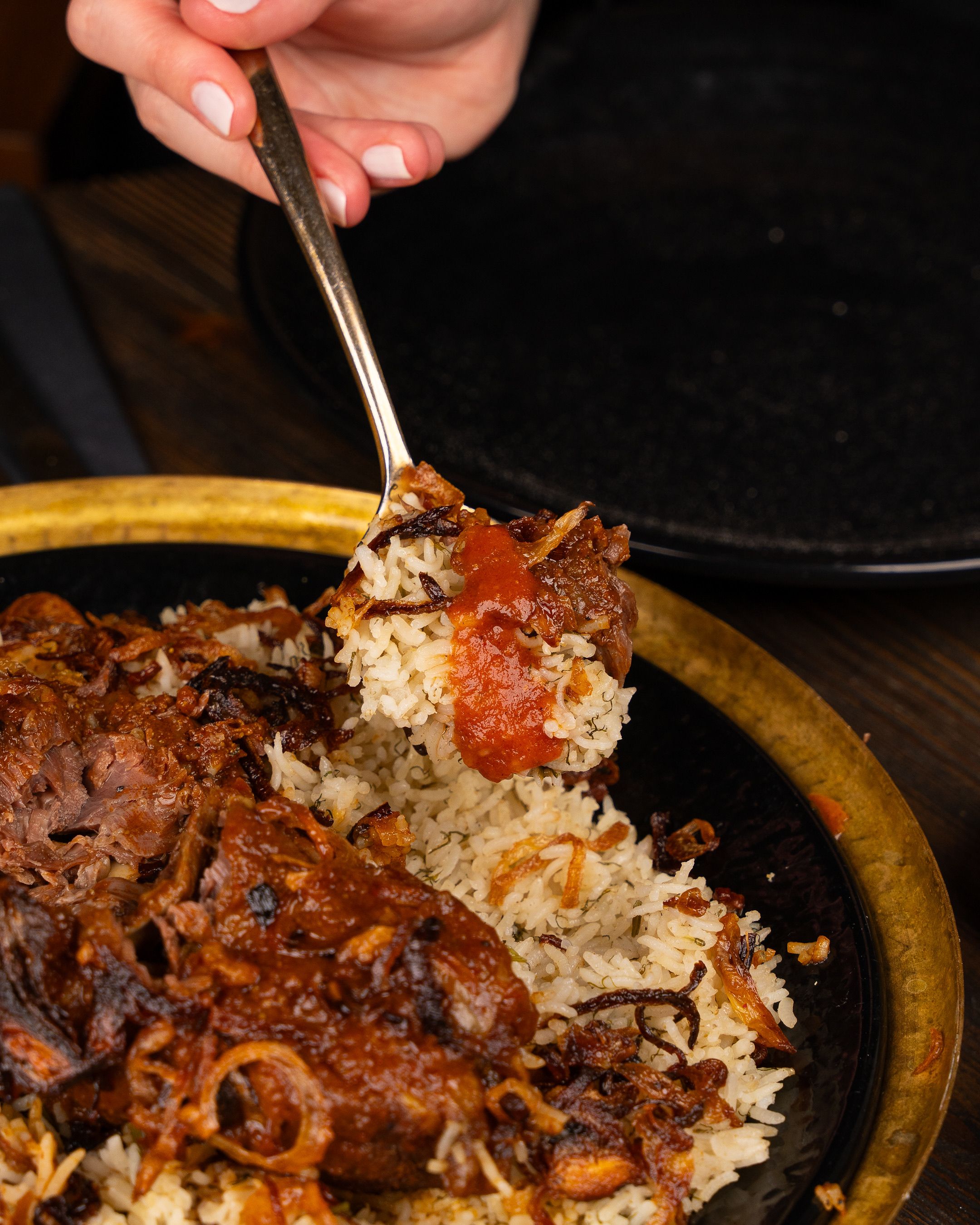
Photo: Ali Dashti / Pexels
The diets react (see scores below)
Common Ingredients
- rice
- bread
- beef
- garlic
- vinegar
- tomato sauce
- butter
- vinegar
Specific recipes may vary.
Incompatible with 7 of 11 diets
Diet Ratings
Fattah is fundamentally incompatible with a ketogenic diet. The dish is built on two major keto-incompatible staples: rice and bread, both of which are high-glycemic grains that would immediately spike blood glucose and knock the body out of ketosis. A single serving would deliver well over 50g of net carbs from these two ingredients alone, far exceeding the entire daily keto carb allowance. While the beef and butter components are keto-friendly, and vinegar and garlic are negligible, the structural foundation of rice and bread makes this dish a definitive avoid with no portion adjustment that could salvage it.
Fattah contains multiple animal-derived ingredients that disqualify it from a vegan diet. Beef is a direct animal product (meat), and butter is a dairy derivative. Both are clearly excluded under vegan principles. The remaining ingredients — rice, bread, garlic, vinegar, and tomato sauce — are plant-based, but the presence of beef and butter makes this dish firmly non-vegan with no ambiguity.
Fattah contains multiple non-paleo ingredients that are clearly excluded from the paleo diet. Rice is a grain and strictly prohibited under all mainstream paleo frameworks. Bread (typically wheat-based) is another grain product and one of the most definitively excluded foods in paleo. Butter is a dairy product, also excluded under standard paleo guidelines. These three core ingredients — rice, bread, and butter — are all fundamental violations of paleo principles, making this dish incompatible regardless of the other ingredients (beef, garlic, vinegar, tomato sauce) which would otherwise be acceptable.
Fattah is a traditional Egyptian dish that combines several elements problematic for the Mediterranean diet. The primary protein is beef, which should be limited to a few times per month. The dish is built on a base of white rice and fried or toasted bread (refined grains), neither of which aligns with the whole grain emphasis. Butter rather than olive oil is used as the fat source, contradicting the core principle of olive oil primacy. The combination of red meat, refined grains, and butter in a single dish stacks multiple Mediterranean diet concerns simultaneously, making this a dish to avoid or reserve for very occasional consumption.
Some Mediterranean diet scholars argue that traditional Middle Eastern and North African cuisines, which share historical and cultural overlap with Mediterranean eating patterns, deserve contextual consideration. In this view, the tomato sauce, garlic, and vinegar components provide plant-based value, and a smaller beef portion with homemade bread could be seen as an occasional acceptable cultural dish rather than a strict violation.
Fattah is a traditional Egyptian dish that is fundamentally incompatible with the carnivore diet. The dish is built on a base of rice and bread — both grains that are strictly excluded from carnivore. While beef is a core carnivore-approved protein, it is overwhelmed by plant-based components: rice (grain), bread (grain), garlic (plant), vinegar (plant-derived fermented product), and tomato sauce (plant). Butter is the only other marginally acceptable ingredient, though it is a dairy derivative. The dish's very foundation — layers of toasted bread and rice soaked in broth — makes it structurally impossible to adapt to carnivore without ceasing to be Fattah entirely.
Fattah contains multiple excluded ingredients that make it incompatible with the Whole30 program. Rice is a grain and is explicitly excluded. Bread is also a grain-based product and is excluded. Butter (regular dairy butter) is excluded — only ghee/clarified butter is permitted on Whole30. These are clear, hard rule violations with no ambiguity.
Fattah contains two high-FODMAP ingredients that make it unsuitable during the elimination phase. First, the bread used in traditional Fattah is wheat-based (typically toasted or fried flatbread/pita), which is high in fructans — a major FODMAP trigger. Second, garlic is one of the highest-FODMAP foods tested by Monash University, containing significant fructans even in very small amounts. These two ingredients alone disqualify the dish during elimination. The tomato sauce may also contain onion or garlic as a base (common in Egyptian cooking), further compounding the FODMAP load. Rice and beef are individually low-FODMAP, but they cannot offset the high-FODMAP components in this dish.
Fattah is an Egyptian dish combining white rice, toasted or fried bread (often butter-fried), beef, garlic, vinegar, and tomato sauce. Several components raise DASH concerns: (1) White rice and white bread are refined carbohydrates with little fiber, contrasting with DASH's emphasis on whole grains. (2) Butter adds saturated fat, which DASH limits. (3) Beef, depending on the cut, can be high in saturated fat and cholesterol; DASH recommends lean meats in limited portions (≤6 oz/day). (4) Tomato sauce and preparation methods can introduce significant sodium. On the positive side, garlic and tomato sauce offer potassium and beneficial phytonutrients, and vinegar is benign. The dish can be made more DASH-compatible by substituting brown rice, using whole-grain bread, choosing a lean cut of beef (e.g., sirloin), using minimal butter or substituting olive oil, and using low-sodium tomato sauce. As traditionally prepared, however, the combination of refined grains, saturated fat from butter, and potentially fatty beef with moderate-to-high sodium makes this a 'caution' food requiring significant modification.
NIH DASH guidelines emphasize whole grains and limited saturated fat, which traditional Fattah does not align with. However, some DASH-oriented clinicians note that when prepared with lean beef, whole-grain substitutions, and minimal butter, the dish's tomato-garlic base and moderate portion of protein can fit within a flexible DASH framework, especially for non-hypertensive individuals on the standard 2,300mg sodium ceiling.
Fattah is a traditional Egyptian dish built on a foundation of white rice and toasted bread — two high-glycemic, unfavorable carbohydrate sources that are the core structural problem from a Zone perspective. The carbohydrate load is high, dense, and fast-digesting, with no meaningful fiber or low-GI vegetables to moderate the glycemic response. The beef provides protein but is not specified as lean, and the butter adds saturated fat rather than the preferred monounsaturated fats. The tomato sauce and garlic are Zone-friendly minor elements, but they don't offset the macro imbalance. The dish's ratio skews heavily toward high-GI carbohydrates with inadequate protein and the wrong fat profile, making it very difficult to fit into a Zone meal without fundamentally deconstructing it. A Zone-compatible adaptation would require eliminating or drastically reducing the bread and rice, substituting more vegetables, using leaner cuts of beef, and replacing butter with olive oil — at which point it would no longer resemble Fattah. As served, this dish is essentially an avoid-level meal for Zone purposes, scoring low within the caution range.
Fattah is a traditional Egyptian celebratory dish combining white rice, fried or toasted bread, beef, and a garlic-vinegar tomato sauce, often finished with butter. From an anti-inflammatory perspective, the dish has several problematic elements alongside a few neutral or mildly beneficial ones. On the negative side: white rice is a refined carbohydrate with high glycemic load, contributing to blood sugar spikes that drive inflammatory signaling; the bread component is similarly refined and often fried; beef is a red meat associated with higher saturated fat and arachidonic acid, both of which can promote inflammation, particularly at the quantities used in a celebratory dish; and butter adds saturated fat. On the positive side: garlic has well-documented anti-inflammatory properties (allicin); tomato sauce provides lycopene and other antioxidants; vinegar (particularly if apple cider) has modest metabolic benefits. The dish lacks omega-3 fatty acids, meaningful fiber, colorful vegetables, or other hallmarks of anti-inflammatory eating. The combination of refined carbs + red meat + saturated fat places this firmly in the 'caution' zone — not a hard 'avoid' because the portions of red meat may be moderate and garlic/tomato offer some offset, but not suitable for regular consumption on an anti-inflammatory diet.
Fattah is an Egyptian layered dish combining rice, fried or toasted bread, beef, and a tomato-garlic-vinegar sauce finished with butter. It presents a mixed nutritional profile for GLP-1 patients. On the positive side, beef provides meaningful protein (roughly 20-25g per moderate serving), and the tomato-garlic sauce adds some micronutrient value. However, several features are problematic: the dish is carbohydrate-heavy (double starch from both rice and bread with minimal fiber, as both are typically refined), the butter adds saturated fat, and the bread component is often fried or heavily toasted in fat. Gastric emptying is already slowed by GLP-1 medications, and a dense, starchy, buttered dish like this can worsen bloating, reflux, and prolonged fullness discomfort. Protein density per calorie is moderate at best — the caloric load is dominated by refined carbs rather than protein. The dish is not nutrient-dense enough per calorie for GLP-1 patients eating small volumes. A modified version using lean beef, reduced butter, whole-grain rice, and skipping or minimizing the bread could move this toward acceptable, but the traditional preparation scores low-to-mid on GLP-1 compatibility.
Some GLP-1-focused dietitians may view Fattah more favorably when portioned small and prepared with lean beef, noting that the beef protein content and the vinegar-tomato base (which may aid digestion) partially offset the refined carb load. Others flag the double-starch structure and butter as consistently problematic for patients experiencing nausea or reflux, regardless of portion size.
*See how scores were generated at our methodology page.
Nutritional profile
Six traits that cut across every diet.
Fiber & Plants
How much whole-plant food and fiber it delivers.
Healthy Fats
The quality of its fats (unsaturated, omega-3).
Whole / Unprocessed
How close it is to its natural, unprocessed form.
Gut Gentle
How easy it is on digestion (low FODMAP, few irritants).
Low Glycemic
How little it spikes your blood sugar.
Protein Density
How much protein it packs per calorie.
Controversy Index
Higher controversy = more disagreement between diets.
Diet-Specific Tips
 DASH — 4/10
View tips
- White rice and white bread are refined grains, not DASH-preferred whole grains
- Butter contributes saturated fat, which DASH limits
- Beef cut determines saturated fat content; fatty cuts are discouraged
- Tomato sauce may add significant sodium depending on preparation
- Garlic and tomatoes provide beneficial potassium and phytonutrients
- Dish can be substantially improved with whole-grain swaps, lean beef, and minimal butter
 Zone — 5/10
View tips
- White rice is a high-glycemic, unfavorable Zone carbohydrate — large portions dominate the dish
- Toasted/fried bread adds a second high-glycemic carbohydrate, compounding the glycemic load
- No low-GI vegetables present as a meaningful carbohydrate base
- Beef protein source is not specified as lean; fattier cuts worsen the saturated fat profile
- Butter contributes saturated fat rather than preferred monounsaturated fat (olive oil, avocado)
- The 40/30/30 ratio is severely distorted — this dish is carbohydrate-heavy with suboptimal fat quality
- Tomato sauce and garlic are Zone-favorable ingredients but too minor to balance the overall profile
 Anti-Inflammatory — 4/10
View tips
- White rice and refined bread are high-glycemic refined carbohydrates that can spike blood sugar and promote inflammatory markers
- Beef is a red meat associated with saturated fat and arachidonic acid, both linked to pro-inflammatory pathways
- Butter adds saturated fat, which is limited on anti-inflammatory diets
- Garlic provides allicin and other anti-inflammatory sulfur compounds
- Tomato sauce contributes lycopene and antioxidants, which are beneficial
- No omega-3 sources, fiber-rich legumes, or colorful vegetables present
- Overall macronutrient and ingredient profile skews pro-inflammatory, especially for regular consumption
 GLP-1 Friendly — 4/10
View tips
- Double refined starch load (rice + bread) with low fiber — poor nutrient density per calorie
- Butter adds saturated fat, increasing risk of nausea and reflux on GLP-1 medications
- Beef provides moderate protein but overall protein density per calorie is diluted by carbohydrate volume
- Dense, heavy dish — slowed gastric emptying from GLP-1s makes this combination likely to cause prolonged bloating or discomfort
- Tomato-garlic-vinegar sauce is a positive element — low fat, flavorful, and stomach-friendly in moderate amounts
- Not small-portion friendly in traditional form — requires significant volume to deliver adequate protein
- Could be modified (lean beef, less butter, whole-grain rice, omit bread) to improve GLP-1 compatibility