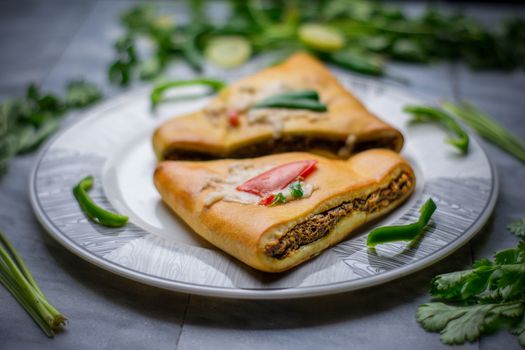
Photo: Qamar Rehman / Pexels
The diets react (see scores below)
Common Ingredients
- baladi bread
- ground beef
- onion
- green pepper
- chili
- parsley
- cumin
- black pepper
Specific recipes may vary.
Incompatible with 8 of 11 diets
Diet Ratings
Hawawshi is an Egyptian stuffed bread dish where spiced ground beef is baked inside baladi bread (a traditional Egyptian flatbread similar to pita). The baladi bread is the dominant structural component and is made from wheat flour, making it extremely high in net carbs — a single serving would deliver 40-60g of net carbs or more, far exceeding the ketogenic daily limit of 20-50g in one meal alone. While the spiced ground beef filling is inherently keto-friendly (high protein, moderate fat, low carb seasonings), the bread encasing it makes the dish as traditionally prepared entirely incompatible with ketosis. The only way to adapt this dish would be to discard the bread entirely and eat just the filling, which would fundamentally change what the dish is.
Hawawshi is an Egyptian meat-stuffed bread that contains ground beef as its primary protein. Beef is an animal product and is unambiguously excluded from a vegan diet. There are no hidden or borderline ingredients here — the dish's defining characteristic is the spiced ground beef filling, making it clearly incompatible with veganism.
Hawawshi is fundamentally a bread-based dish — ground beef and spices stuffed inside baladi bread, which is a traditional Egyptian flatbread made from wheat flour. While the filling ingredients (ground beef, onion, green pepper, chili, parsley, cumin, black pepper) are entirely paleo-compliant, the baladi bread is a grain-based product and a core, non-optional component of the dish. Grains are among the most clearly excluded food groups in the paleo framework, rejected by virtually all paleo authorities including Loren Cordain, Mark Sisson, and Robb Wolf. The dish cannot be considered paleo in its traditional form.
Hawawshi is a ground beef-stuffed bread dish that conflicts with core Mediterranean diet principles on two fronts. First, red meat (ground beef) is the primary protein and should be limited to only a few times per month in a Mediterranean dietary pattern. Second, the bread used is baladi bread, a refined white flatbread that falls into the refined grains category, which the Mediterranean diet discourages in favor of whole grains. While the aromatics and vegetables (onion, green pepper, parsley, chili) and spices (cumin, black pepper) are Mediterranean-friendly additions, they cannot offset the combined impact of red meat and refined bread as the dish's core components. There is no olive oil as the fat source, and the dish is essentially a red meat sandwich on refined bread — a combination that runs counter to the diet's foundational principles.
Hawawshi is fundamentally incompatible with the carnivore diet. While it contains ground beef as its protein base, the dish is built around baladi bread (a plant-based grain product) and includes multiple plant-derived ingredients: onion, green pepper, chili, parsley, cumin, and black pepper. The bread alone disqualifies it entirely — it is a grain-based carbohydrate that violates the core carnivore principle of eating exclusively animal products. The vegetable and spice additions further compound the incompatibility. The only carnivore-compliant component is the ground beef itself. This is essentially a meat-stuffed bread sandwich, which is a classic plant-food-dominant dish from a carnivore perspective.
Hawawshi is an Egyptian street food consisting of spiced ground beef stuffed inside baladi bread (a traditional Egyptian flatbread made from wheat flour). While the meat filling itself — ground beef with onion, green pepper, chili, parsley, cumin, and black pepper — is entirely Whole30 compliant, the baladi bread is a grain-based bread product and is explicitly excluded on Whole30. Grains (including wheat) are one of the core eliminated food groups. Furthermore, even if someone attempted to reconstruct this dish with compliant ingredients, bread is explicitly listed among the 'no recreating baked goods/junk food' items (wraps, tortillas, and similar bread-based vehicles are all prohibited). The dish cannot be made Whole30 compliant without fundamentally changing its identity.
Hawawshi is a high-FODMAP dish with multiple problematic ingredients during the elimination phase. The primary issue is baladi bread, a traditional Egyptian flatbread made from wheat flour, which is high in fructans — a major FODMAP category. Onion is one of the highest-FODMAP foods tested by Monash University, containing significant fructans even in small quantities. Together, wheat bread and onion make this dish clearly incompatible with the low-FODMAP elimination phase at any standard serving size. Green pepper is low-FODMAP and ground beef is low-FODMAP (plain), but these safe ingredients cannot offset the high-FODMAP load from bread and onion. Chili (fresh red chili) is low-FODMAP at small amounts per Monash. Parsley, cumin, and black pepper are low-FODMAP spices. The dish is fundamentally built on a wheat bread vessel with onion-heavy filling, making it unavoidable in terms of FODMAP load.
Hawawshi is an Egyptian stuffed bread dish made with baladi (whole wheat flatbread) filled with spiced ground beef. From a DASH perspective, it presents a mixed profile. The baladi bread is a positive element as it is typically a whole grain flatbread, aligning with DASH whole grain recommendations. The vegetables (onion, green pepper, parsley) and spices (cumin, black pepper, chili) are DASH-friendly and contribute fiber, potassium, and flavor without sodium reliance. However, ground beef is a red meat, which DASH explicitly limits due to its saturated fat content. The fat content depends heavily on the leanness of the beef used — typical ground beef in Egyptian street food preparation is often higher-fat cuts. Additionally, this is commonly prepared by baking or frying the stuffed bread, which can add further fat. There is no explicit high-sodium ingredient listed, but preparation and portion size matter. This dish is not a core DASH food but can be consumed occasionally if prepared with lean ground beef (90%+ lean), minimal added fat, and portion-controlled. Substituting with lean ground turkey or chicken would improve the DASH score significantly.
NIH DASH guidelines categorically limit red meat and recommend lean poultry and fish as primary proteins, placing ground beef dishes in the 'limit' category. However, updated clinical interpretations note that lean ground beef (>90% lean) in moderate portions can fit within overall DASH dietary patterns, particularly when paired with vegetables and whole grains as in this dish, provided saturated fat intake remains within the 6% of total calories threshold.
Hawawshi is an Egyptian spiced ground beef sandwich served in baladi bread (a traditional Egyptian flatbread similar to pita, made from whole or semi-whole wheat flour). From a Zone perspective, several issues arise. The baladi bread is a moderately high-glycemic carbohydrate source — while it is less refined than white bread, it still scores as an 'unfavorable' Zone carb due to its relatively high glycemic load and the fact that bread in general is discouraged in the Zone framework (0-1 grain servings/day). Ground beef, depending on fat content, may contain significant saturated fat, making it less ideal than skinless chicken or fish; however, leaner ground beef (90%+ lean) can be incorporated into Zone meals. The spices (cumin, black pepper, parsley, chili) are Zone-friendly and even anti-inflammatory, adding polyphenol value. The onion and green pepper contribute small amounts of favorable low-glycemic carbohydrates. The structural problem is that the dish is carbohydrate-heavy relative to protein and fat, with the bread dominating the macro ratio and pushing it well out of the 40/30/30 Zone balance. Additionally, there is typically no deliberate monounsaturated fat source (e.g., olive oil) to satisfy the Zone fat block. With significant portioning adjustments — using a smaller amount of bread, leaner beef, and adding a side of vegetables — this dish could be brought closer to Zone compliance, but as traditionally prepared it represents an unfavorable Zone meal.
Some Zone practitioners note that baladi bread made from whole wheat flour has a lower glycemic index than white pita or white bread, and that the protein density of the spiced beef filling can partially offset the carbohydrate load. Dr. Sears' later work (Toxic Fat, The Mediterranean Zone) increasingly emphasized food quality and anti-inflammatory polyphenols over strict block counting, and the herbs and spices in hawawshi (parsley, cumin, chili) align well with this anti-inflammatory philosophy. A practitioner following the later, more flexible Mediterranean Zone interpretation might rate this more favorably if lean beef is used and portion size is moderated.
Hawawshi is a spiced ground beef sandwich served in baladi (Egyptian flatbread). The dish has a mixed anti-inflammatory profile. On the positive side, it contains meaningful amounts of anti-inflammatory spices — cumin, black pepper, chili, and parsley — along with onion and green pepper, which provide quercetin, vitamin C, and other polyphenols. These ingredients partially offset inflammatory concerns. However, the primary protein is ground beef, which is red meat high in saturated fat and arachidonic acid, both of which are associated with elevated inflammatory markers (CRP, IL-6) when consumed regularly. The baladi bread, while a traditional whole-grain flatbread, is still a refined or semi-refined carbohydrate that provides limited anti-inflammatory benefit. Ground beef as the centerpiece — likely a moderate-to-high fat variety given the dish's richness — places this firmly in the 'limit' category per anti-inflammatory guidelines. The dish is not inherently harmful and its spice profile provides real benefit, but red meat as the dominant component with a refined bread base makes this a food to consume only occasionally rather than regularly on an anti-inflammatory diet.
Hawawshi is a traditional Egyptian spiced ground beef sandwich baked or fried inside baladi (Egyptian flatbread). While it does contain meaningful protein from the ground beef and some beneficial spices, it presents several significant concerns for GLP-1 patients. Ground beef is typically higher in saturated fat than lean proteins like chicken breast or fish, and hawawshi is traditionally prepared with fatty cuts that worsen GLP-1 side effects like nausea, bloating, and reflux. The chili and spice blend — especially when generous — can aggravate GI discomfort and reflux, which are already common on GLP-1 medications. Baladi bread is a refined grain with limited fiber and nutritional density, contributing mostly empty carbohydrate calories. The dish is also portion-heavy by design — a full stuffed bread pocket is not small-portion-friendly. When baked at home with very lean ground beef and moderate spicing, the profile improves, but the standard preparation does not align well with GLP-1 dietary priorities.
Some GLP-1-focused dietitians may rate a home-prepared, oven-baked version made with extra-lean ground beef and moderate chili more favorably, arguing the protein content is meaningful and the dish can be portion-controlled. The primary disagreement centers on fat content and spice tolerance, both of which vary significantly among individual GLP-1 patients.
*See how scores were generated at our methodology page.
Nutritional profile
Six traits that cut across every diet.
Fiber & Plants
How much whole-plant food and fiber it delivers.
Healthy Fats
The quality of its fats (unsaturated, omega-3).
Whole / Unprocessed
How close it is to its natural, unprocessed form.
Gut Gentle
How easy it is on digestion (low FODMAP, few irritants).
Low Glycemic
How little it spikes your blood sugar.
Protein Density
How much protein it packs per calorie.
Controversy Index
Higher controversy = more disagreement between diets.
Diet-Specific Tips
 DASH — 4/10
View tips
- Ground beef is a red meat, which DASH limits due to saturated fat content
- Baladi bread is typically whole grain, a DASH-positive element
- Vegetables and spices (onion, green pepper, parsley, cumin) contribute DASH-beneficial nutrients
- No explicitly high-sodium ingredients listed, but preparation method and added salt during cooking are unknown
- Fat content highly dependent on beef leanness and cooking method (baked vs. fried)
- Portion control is essential — as a snack, a smaller serving mitigates red meat and saturated fat concerns
- Substituting lean ground turkey or chicken would significantly improve DASH compatibility
 Zone — 4/10
View tips
- Baladi bread is an 'unfavorable' Zone carbohydrate — moderately high glycemic index, pushing the meal out of Zone ratio balance
- Ground beef fat content is variable; higher-fat ground beef increases saturated fat beyond Zone recommendations
- Onion and green pepper are favorable low-glycemic Zone carbohydrates that add polyphenol value
- Spices (cumin, parsley, chili) are anti-inflammatory and align with Dr. Sears' polyphenol emphasis
- No deliberate monounsaturated fat source present (e.g., olive oil drizzle or avocado)
- As traditionally portioned, the carbohydrate-to-protein ratio skews unfavorably away from 40/30/30
- Could be partially rebalanced by reducing bread quantity, using lean ground beef, and adding a vegetable side
 Anti-Inflammatory — 4/10
View tips
- Ground beef (red meat) is pro-inflammatory due to saturated fat and arachidonic acid — anti-inflammatory guidelines recommend limiting red meat
- Cumin, black pepper, chili, and parsley contribute meaningful anti-inflammatory polyphenols and antioxidants
- Onion and green pepper provide quercetin, vitamin C, and flavonoids with anti-inflammatory properties
- Baladi bread is a refined/semi-refined carbohydrate with limited anti-inflammatory benefit
- Overall dish is acceptable occasionally but not recommended as a regular feature of an anti-inflammatory diet