Photo: Mohamed Olwy / Pexels
The diets react (see scores below)
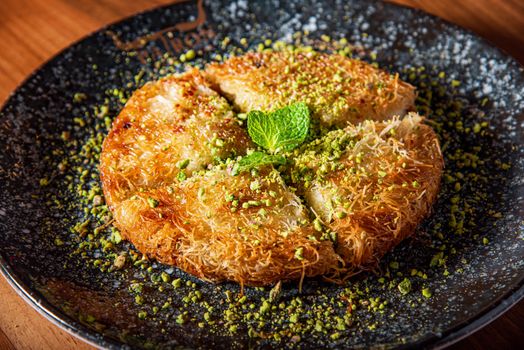
Common Ingredients
- kunafa pastry
- cheese
- sugar syrup
- butter
- pistachios
- rose water
Specific recipes may vary.
Incompatible with 11 of 11 diets
Diet Ratings
Kunafa is fundamentally incompatible with a ketogenic diet. The dish is built on kunafa pastry (shredded phyllo/kataifi dough made from wheat flour), which is a refined grain product loaded with carbohydrates. This is then drenched in sugar syrup, adding massive amounts of simple sugars. A single serving of kunafa can easily contain 60-80g or more of net carbs — far exceeding the entire daily keto limit in one snack. While the cheese and butter components are keto-friendly, they are entirely overwhelmed by the pastry and syrup. There is no realistic portion size that makes this dish compatible with ketosis.
Kunafa as listed contains two animal-derived ingredients that disqualify it from a vegan diet: cheese (a dairy product) and butter (also dairy). The traditional Egyptian preparation of kunafa is built around a melted, stretchy cheese filling — typically akkawi or mozzarella — and is soaked in a butter-enriched syrup base. Both are clear violations of vegan dietary rules. The remaining ingredients (kunafa pastry/kataifi, sugar syrup, pistachios, rose water) are plant-based, but the dish as described is not vegan. A vegan version could theoretically be made by substituting the cheese with a plant-based alternative and using vegan margarine or coconut oil, but that would be a significant reformulation, not the standard dish.
Kunafa is fundamentally incompatible with the Paleo diet. The dish contains multiple non-Paleo ingredients: kunafa pastry is made from shredded wheat/semolina dough (a grain), cheese is a dairy product excluded from Paleo, and sugar syrup is refined sugar. While pistachios and rose water are Paleo-friendly, and butter occupies a gray area, the core structural components of this dish are clear violations. This is not a borderline case — the primary ingredients (grain-based pastry, dairy cheese, refined sugar syrup) are all on the strict exclusion list with high consensus across all major Paleo authorities.
Kunafa is a Middle Eastern/North African dessert that fundamentally contradicts Mediterranean diet principles. It combines refined shredded wheat pastry (kunafa dough) with significant amounts of added sugar (via sugar syrup), butter as the primary fat instead of olive oil, and sweetened cheese. The dish is high in refined carbohydrates, added sugars, and saturated fat from both butter and cheese. While pistachios and rose water are benign or beneficial ingredients, they are minor components that do not offset the overall nutritional profile. This is an occasional indulgence at best, not compatible with regular Mediterranean diet consumption.
Kunafa is almost entirely incompatible with the carnivore diet. The dish is built on kunafa pastry (shredded wheat/semolina dough — a grain-based plant food), sugar syrup (pure sugar, explicitly excluded), pistachios (nuts, plant-derived), and rose water (plant-derived flavoring). While butter and cheese are animal-derived dairy products that some carnivore practitioners include, they are minor components here and cannot redeem a dish whose foundation is wheat dough, sugar, and nuts. This is a dessert/pastry with virtually no carnivore-compatible structure — the overwhelming majority of ingredients are exactly what the carnivore diet excludes.
Kunafa contains multiple excluded ingredients that make it entirely incompatible with Whole30. First, kunafa pastry (kataifi/shredded phyllo) is made from wheat flour, a grain that is explicitly excluded. Second, sugar syrup is added sugar, which is prohibited. Third, regular butter is excluded (only ghee/clarified butter is allowed). Fourth, cheese is a dairy product, which is excluded. Even setting aside the spirit-of-the-program concern about recreating a dessert/sweet baked good, the core ingredients themselves are fundamentally non-compliant on multiple fronts.
Kunafa contains multiple high-FODMAP ingredients that make it unsuitable during the elimination phase. The kunafa pastry (kataifi) is made from wheat flour, which is high in fructans — a major FODMAP category. The cheese filling is typically made with soft, fresh cheeses such as akkawi, ricotta, or mozzarella; soft and fresh cheeses are high in lactose compared to aged hard cheeses, posing a lactose concern. The sugar syrup in large quantities may contribute to excess fructose depending on the sweetener used, and pistachios are high-FODMAP at standard serving sizes (Monash rates pistachios as high-FODMAP even at 1 tablespoon/10g portions due to fructans and GOS). Rose water and butter are generally low-FODMAP. However, the combination of wheat pastry, lactose-containing cheese, and pistachios creates compounding FODMAP loads that make this dish inappropriate for the elimination phase at any reasonable serving size.
Monash University has not specifically tested kunafa as a dish, so the verdict relies on component-level analysis. Some clinical FODMAP practitioners note that if a lactose-free cheese substitute were used and pistachios omitted, the primary remaining concern would be the wheat-based pastry — which remains high-FODMAP due to fructans regardless of portion size modifications.
Kunafa is a Middle Eastern/Egyptian dessert that conflicts with DASH diet principles on multiple fronts. It is made with refined white pastry (shredded phyllo/kataifi dough), full-fat cheese (typically akkawi, ricotta, or similar), generous amounts of butter, and heavy sugar syrup — all of which are explicitly limited or discouraged by DASH guidelines. The dish is high in added sugars (from sugar syrup), saturated fat (from butter and full-fat cheese), refined carbohydrates (from the white pastry), and likely significant sodium (from the cheese). While pistachios and rose water are innocuous or mildly beneficial, they do not meaningfully offset the other components. DASH guidelines explicitly limit sweets, added sugars, full-fat dairy, saturated fat, and refined grains. Kunafa is essentially a dessert built on the foods DASH most restricts.
Kunafa is a Middle Eastern/Egyptian dessert built almost entirely from Zone-unfavorable ingredients. The kunafa pastry (shredded phyllo/kataifi) is a refined, high-glycemic carbohydrate with minimal fiber, spiking blood sugar rapidly. The sugar syrup that saturates the dish is pure sucrose — one of the most Zone-incompatible ingredients possible, contributing heavily to glycemic load with zero nutritional value. Butter adds saturated fat rather than the monounsaturated fats the Zone prefers. While the cheese provides some protein and the pistachios offer monounsaturated fat (a Zone positive), these favorable elements are completely overwhelmed by the sugar syrup and refined pastry base. The macronutrient ratio skews dramatically toward high-glycemic carbohydrates and saturated fat, with far too little lean protein — essentially the inverse of the 40/30/30 Zone target. There is no practical way to portion this food into a Zone-compliant block structure; even a very small serving delivers a disproportionate sugar and refined-carb load that would disrupt eicosanoid balance — the core metabolic concern of the Zone Diet.
Kunafa is a traditional Middle Eastern/Egyptian dessert that is heavily pro-inflammatory from an anti-inflammatory diet perspective. The dish is dominated by refined carbohydrates (kunafa shredded wheat pastry), substantial added sugar in the form of a heavy sugar syrup, butter (saturated fat), and full-fat cheese — all of which are in the 'limit' or 'avoid' categories. The sugar syrup alone represents a significant glycemic load, which drives inflammatory markers like CRP and IL-6. Butter contributes saturated fat. Full-fat cheese is in the 'limit' category. The only redeeming elements are pistachios, which contain healthy fats, polyphenols, and some anti-inflammatory properties, and rose water, which has minor antioxidant content — but these are present in small quantities and do not meaningfully offset the inflammatory burden of the dish's primary components. Kunafa is essentially a confection of refined starch, sugar, saturated fat, and dairy — a combination that represents nearly the opposite of anti-inflammatory eating principles.
Kunafa is a poor fit for GLP-1 patients across nearly every dietary criterion. It is dominated by refined pastry dough (shredded phyllo/kadaif), butter, and sugar syrup — a combination that is high in refined carbohydrates, saturated fat, and added sugar while being extremely low in protein and fiber relative to its calorie density. The cheese provides a small amount of protein, but it is typically a high-fat, mild-stretching cheese (such as akkawi or mozzarella) used in modest proportion relative to the pastry and syrup volume. The heavy sugar syrup loading makes this a high-glycemic, high-sugar food that directly conflicts with blood sugar stabilization goals. Butter contributes significant saturated fat, worsening potential nausea, bloating, and reflux — known GLP-1 side effects. Pistachios add a small positive (healthy fats, some protein), but their contribution is minimal at typical garnish quantities. The dish is calorie-dense per small serving with negligible fiber and very low protein density per calorie, making it a poor use of reduced appetite capacity. It qualifies as an empty-calorie, high-sugar, high-saturated-fat food that should be avoided on a GLP-1 dietary plan.
*See how scores were generated at our methodology page.
Nutritional profile
Six traits that cut across every diet.
Fiber & Plants
How much whole-plant food and fiber it delivers.
Healthy Fats
The quality of its fats (unsaturated, omega-3).
Whole / Unprocessed
How close it is to its natural, unprocessed form.
Gut Gentle
How easy it is on digestion (low FODMAP, few irritants).
Low Glycemic
How little it spikes your blood sugar.
Protein Density
How much protein it packs per calorie.
Controversy Index
Higher controversy = more disagreement between diets.