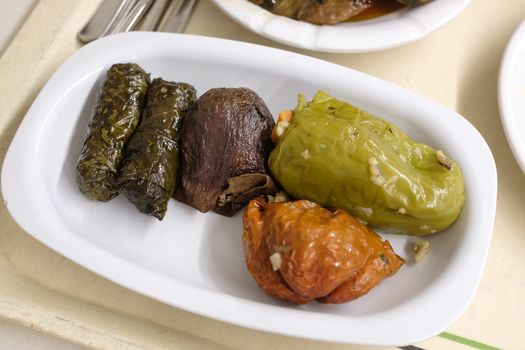
Photo: Markus Winkler / Pexels
The diets react (see scores below)
Common Ingredients
- zucchini
- bell peppers
- vine leaves
- rice
- tomato
- parsley
- dill
- onion
- mint
Specific recipes may vary.
Incompatible with 5 of 11 diets
Diet Ratings
Mahshi is an Egyptian stuffed vegetable dish where zucchini, bell peppers, and vine leaves are filled with a rice-based mixture. Rice is the primary filling ingredient and is a high-carb grain that is fundamentally incompatible with ketosis — a single serving can contain 30-50g of net carbs from rice alone, far exceeding the daily keto limit. The dish has no significant fat content and lacks protein, making it fail keto criteria on virtually every dimension. There is no realistic portion size that makes this dish keto-compatible given rice is the core structural ingredient, not a minor addition.
Mahshi as described here consists entirely of whole plant foods: zucchini, bell peppers, and vine leaves stuffed with a filling of rice, tomato, parsley, dill, onion, and mint. All ingredients are unambiguously plant-based. This is a traditional Egyptian dish that, in its vegetarian form, is naturally vegan. The only note is that some traditional recipes include minced meat in the stuffing, but the listed ingredients contain no animal products whatsoever. The dish is nutritionally balanced, featuring complex carbohydrates from rice, fiber and micronutrients from the vegetables and herbs, making it a wholesome whole-food plant-based meal.
Mahshi is an Egyptian stuffed vegetable dish where zucchini, bell peppers, and vine leaves are filled with a rice-based mixture. Rice is a grain and is explicitly excluded from the paleo diet. While the vegetable wrappers (zucchini, bell peppers, vine leaves) and aromatics (tomato, parsley, dill, onion, mint) are all paleo-approved, rice is the central, defining ingredient of this dish — it forms the bulk of the filling and cannot be removed without fundamentally changing the dish. The dish as traditionally prepared is not paleo-compatible due to this core grain component.
Mahshi is a traditional Egyptian dish of vegetables (zucchini, bell peppers, vine leaves) stuffed with a rice-herb mixture — largely plant-forward and aligned with Mediterranean principles. The vegetables, fresh herbs (parsley, dill, mint), tomato, and onion are all Mediterranean staples eaten daily. However, the filling is based on white rice, a refined grain, rather than a whole grain. White rice is not a core Mediterranean food per modern guidelines, though it appears in traditional Eastern Mediterranean cuisines (Egyptian, Lebanese, Greek) regularly. The dish contains no red meat, no added sugars, and no highly processed ingredients, making it a relatively healthy choice, but the refined grain base prevents a full 'approve' rating under stricter interpretations.
Traditional Eastern Mediterranean culinary practice — including Egyptian, Lebanese, and Greek cuisines — has long incorporated white rice in stuffed vegetable dishes as a staple ingredient, and some Mediterranean diet authorities acknowledge regional grain traditions as compatible. Strict modern clinical guidelines (e.g., Oldways Preservation Trust) favor whole grains, which would lower this dish's rating.
Mahshi is an Egyptian stuffed vegetable dish consisting entirely of plant-based ingredients. The dish features zucchini, bell peppers, and vine leaves stuffed with a rice filling seasoned with tomato, parsley, dill, onion, and mint. Every single ingredient is plant-derived — there is no animal product whatsoever in this dish. Rice is a grain, all the vegetables are excluded on carnivore, and the herbs and aromatics are plant-based spices. This dish is completely incompatible with the carnivore diet at every level.
Mahshi is an Egyptian stuffed vegetable dish where hollowed-out zucchini, bell peppers, and vine leaves are filled with a rice-based mixture. Rice is explicitly excluded on the Whole30 as a grain. There is no compliant substitute listed in this recipe — the rice filling is the core component of the dish. All other ingredients (zucchini, bell peppers, vine leaves, tomato, parsley, dill, onion, mint) are Whole30-compliant vegetables and herbs, but the presence of rice makes the entire dish non-compliant.
Mahshi contains two significant high-FODMAP ingredients that make it unsuitable during the elimination phase. Onion is one of the highest-FODMAP foods tested by Monash University, containing high levels of fructans at any cooking quantity — and in stuffed vegetable dishes, onion is typically a core filling ingredient used in meaningful amounts. Vine leaves (grape leaves) are also high-FODMAP, as Monash has tested them and found they contain significant fructans, particularly when used in multiple-leaf servings as required by this dish. The remaining ingredients are generally favorable: zucchini is low-FODMAP at standard servings (up to 65g), bell peppers are low-FODMAP, white rice is low-FODMAP, tomato is low-FODMAP at moderate portions, and fresh herbs (parsley, dill, mint) are low-FODMAP. However, the combination of onion and vine leaves — both unavoidable structural components of traditional Mahshi — makes this dish high-FODMAP regardless of portion size. Onion cannot simply be reduced to a safe amount in a stuffed vegetable recipe without fundamentally altering the dish.
Mahshi is a traditional Egyptian stuffed vegetable dish featuring zucchini, bell peppers, and vine leaves filled with rice, tomatoes, herbs (parsley, dill, mint), and onion. The ingredient profile is highly compatible with DASH principles: vegetables dominate the dish, the herbs are rich in micronutrients, and there is no red meat, saturated fat, or added sugar. The filling is primarily rice and vegetables with aromatic herbs, all of which align with DASH emphasis on plant-based foods, fiber, potassium, and magnesium. The dish has no inherently high-sodium ingredients in its base form, though preparation method matters — if olive oil is used (as is traditional), that is a heart-healthy fat consistent with DASH. The white rice used in traditional mahshi is a refined grain rather than a whole grain, which is the one notable deviation from DASH ideals (DASH recommends whole grains). Sodium can also accumulate if salted cooking water or canned tomatoes are used heavily. Overall, this is a nutrient-dense, plant-forward dish well suited to DASH eating.
NIH DASH guidelines emphasize whole grains over refined grains; traditional mahshi uses white rice, which some DASH clinicians would flag as a moderate concern. However, updated clinical interpretations note that when white rice is embedded in a high-fiber, vegetable-rich dish like mahshi, its glycemic impact is attenuated, and many practitioners consider it acceptable in this context.
Mahshi is a traditional Egyptian stuffed vegetable dish where the primary filling is rice mixed with tomato, herbs (parsley, dill, mint), and onion, stuffed into zucchini, bell peppers, and vine leaves. The vegetable vessels (zucchini, bell peppers, vine leaves) are excellent Zone-favorable, low-glycemic carbohydrates rich in polyphenols and fiber. However, white rice is the dominant filling ingredient and is classified as an 'unfavorable' carbohydrate in Zone terminology due to its high glycemic index and lack of fiber. The dish also lacks any meaningful protein source (listed as 'none'), making it structurally impossible to hit the 30% protein target without significant additions. The fat content is minimal and likely negligible without added oil. As presented, Mahshi is essentially a carbohydrate-heavy dish dominated by high-GI rice with no protein block to balance the meal. While the vegetable wrappers are Zone-friendly, the rice filling and absent protein make this very difficult to incorporate into a Zone meal as-is. It could be salvaged by dramatically reducing rice, adding lean protein (ground turkey, chicken, or tofu) to the filling, and adding a side of olive oil or avocado.
Mahshi is a traditional Egyptian stuffed vegetable dish featuring a remarkably anti-inflammatory ingredient profile. The vegetable base — zucchini, bell peppers, vine/grape leaves, and tomato — delivers a broad spectrum of antioxidants, carotenoids (lycopene from tomato, beta-carotene from bell peppers), and polyphenols. Grape/vine leaves in particular are notably high in anti-inflammatory flavonoids and resveratrol. The fresh herbs — parsley, dill, and mint — contribute additional anti-inflammatory phytonutrients, including apigenin (parsley) and menthol compounds (mint). Onion provides quercetin, a well-studied anti-inflammatory flavonoid. Rice is the one ingredient worth noting: as a refined/white grain it offers little fiber and has a moderate glycemic index, making it less ideal than whole grains in an anti-inflammatory framework. However, in this context it is present as a stuffing element alongside multiple highly beneficial vegetables and herbs, and its overall proportion in the dish is moderated by the surrounding vegetables. The dish contains no processed ingredients, no added sugars, no trans fats, and no significant saturated fat, which further supports its anti-inflammatory profile. It scores well as a plant-forward, herb-rich main.
White rice as the primary stuffing grain is a point of contention: mainstream anti-inflammatory guidance (Dr. Weil's pyramid, IF Rating system) emphasizes whole grains and cautions against refined carbohydrates for their glycemic impact and lack of fiber. Some anti-inflammatory practitioners would lower the rating on any dish where white rice is a central component, particularly for individuals with metabolic concerns or insulin resistance. Substituting brown rice or cauliflower rice would meaningfully improve the dish's anti-inflammatory score.
Mahshi is a traditional Egyptian dish of vegetables (zucchini, bell peppers, vine leaves) stuffed with a rice-herb mixture. The vegetable wrappers provide meaningful fiber and micronutrients, and the herbs (parsley, dill, mint) and tomato add antioxidants and water content — all positives for GLP-1 patients. However, the dish has no primary protein source, which is a significant drawback given that protein is the #1 priority for GLP-1 patients. The base is primarily white rice, a refined carbohydrate with low protein density and moderate glycemic impact. A standard serving is likely to be filling due to the rice volume, but will not contribute meaningfully to the 100-120g daily protein target. Fat content is generally low, which is a positive, and the dish is easy to digest. It is not inherently harmful, but as a standalone main course it fails to meet the protein and nutrient-density standards expected from a GLP-1-friendly primary meal. Best consumed as a side dish alongside a high-protein main, or modified with the addition of lean ground meat or legumes to the rice stuffing, which is common in some regional variations.
Some GLP-1-focused dietitians may be more permissive with Mahshi if the patient is meeting protein targets across the full day through other meals, viewing it as an acceptable fiber-rich, low-fat, portion-friendly option. Others would flag the white rice filling as a concern for blood sugar management, particularly relevant in GLP-1 patients who often have comorbid insulin resistance or type 2 diabetes, recommending it only occasionally or in small portions.
*See how scores were generated at our methodology page.
Nutritional profile
Six traits that cut across every diet.
Fiber & Plants
How much whole-plant food and fiber it delivers.
Healthy Fats
The quality of its fats (unsaturated, omega-3).
Whole / Unprocessed
How close it is to its natural, unprocessed form.
Gut Gentle
How easy it is on digestion (low FODMAP, few irritants).
Low Glycemic
How little it spikes your blood sugar.
Protein Density
How much protein it packs per calorie.
Controversy Index
Higher controversy = more disagreement between diets.
Diet-Specific Tips
 Vegan — 9/10
View tips
- All listed ingredients are whole plant foods
- No animal products or animal-derived ingredients present
- Traditional version of this dish can include meat, but the submitted version does not
- Nutrient-dense combination of vegetables, grains, and fresh herbs
- No processed or ethically contested ingredients
 Mediterranean — 6/10
View tips
- Vegetables as the primary vessel: zucchini, bell peppers, vine leaves — all Mediterranean staples
- Rich in fresh herbs (parsley, dill, mint) and aromatics (onion, tomato)
- White rice filling is a refined grain, not aligned with whole-grain preference in modern Mediterranean guidelines
- No red meat, processed foods, added sugars, or unhealthy fats
- Dish is plant-based in its entirety — no animal protein
- Traditional Eastern Mediterranean recipe with deep regional roots
 DASH — 8/10
View tips
- High vegetable content (zucchini, bell peppers, vine leaves, tomato, onion) — strongly DASH-aligned
- Rich in potassium and magnesium from vegetables and herbs
- Fresh herbs (parsley, dill, mint) add micronutrients with negligible sodium
- White rice rather than whole grain is a mild DASH deviation
- No red meat, saturated fat, or added sugar
- Sodium level depends on preparation — home-cooked with minimal added salt is low-sodium
- Traditional use of olive oil aligns with DASH-recommended healthy fats
- Portion control of rice filling important to manage refined carbohydrate intake
 Zone — 4/10
View tips
- White rice is the dominant filling — classified as 'unfavorable' high-glycemic carbohydrate in Zone methodology
- No protein source present — impossible to achieve 30% protein target without significant additions
- Vegetable vessels (zucchini, bell peppers, vine leaves) are Zone-favorable, low-glycemic, and polyphenol-rich
- Herbs (parsley, dill, mint) are excellent Zone additions with anti-inflammatory properties
- Dish is structurally carbohydrate-only, violating the fundamental 40/30/30 Zone block balance
- Minimal fat content — no monounsaturated fat source present
- Could be modified into a Zone meal by substituting cauliflower rice and adding lean ground protein to filling
 Anti-Inflammatory — 7/10
View tips
- Vine/grape leaves are rich in resveratrol and anti-inflammatory flavonoids
- Bell peppers and tomato provide lycopene, beta-carotene, and vitamin C
- Parsley, dill, and mint contribute anti-inflammatory phytonutrients (apigenin, flavonoids)
- Onion provides quercetin, a well-researched anti-inflammatory flavonoid
- White rice is a refined carbohydrate — less ideal than whole grains but mitigated by its supporting role in the dish
- No processed ingredients, trans fats, added sugars, or significant saturated fat
- Entirely plant-based with high vegetable and herb density
 GLP-1 Friendly — 4/10
View tips
- No protein source — fails the #1 GLP-1 dietary priority
- White rice filling is a refined carbohydrate with low protein density
- Vegetable wrappers (zucchini, bell peppers, vine leaves) provide meaningful fiber
- Low fat content — positive for GLP-1 GI side effect management
- Herbs and tomato add micronutrients and hydration support
- Should be paired with a high-protein side or modified with lean meat or legumes
- Portion-sensitive: rice expands in stomach, which matters given slowed gastric emptying on GLP-1s