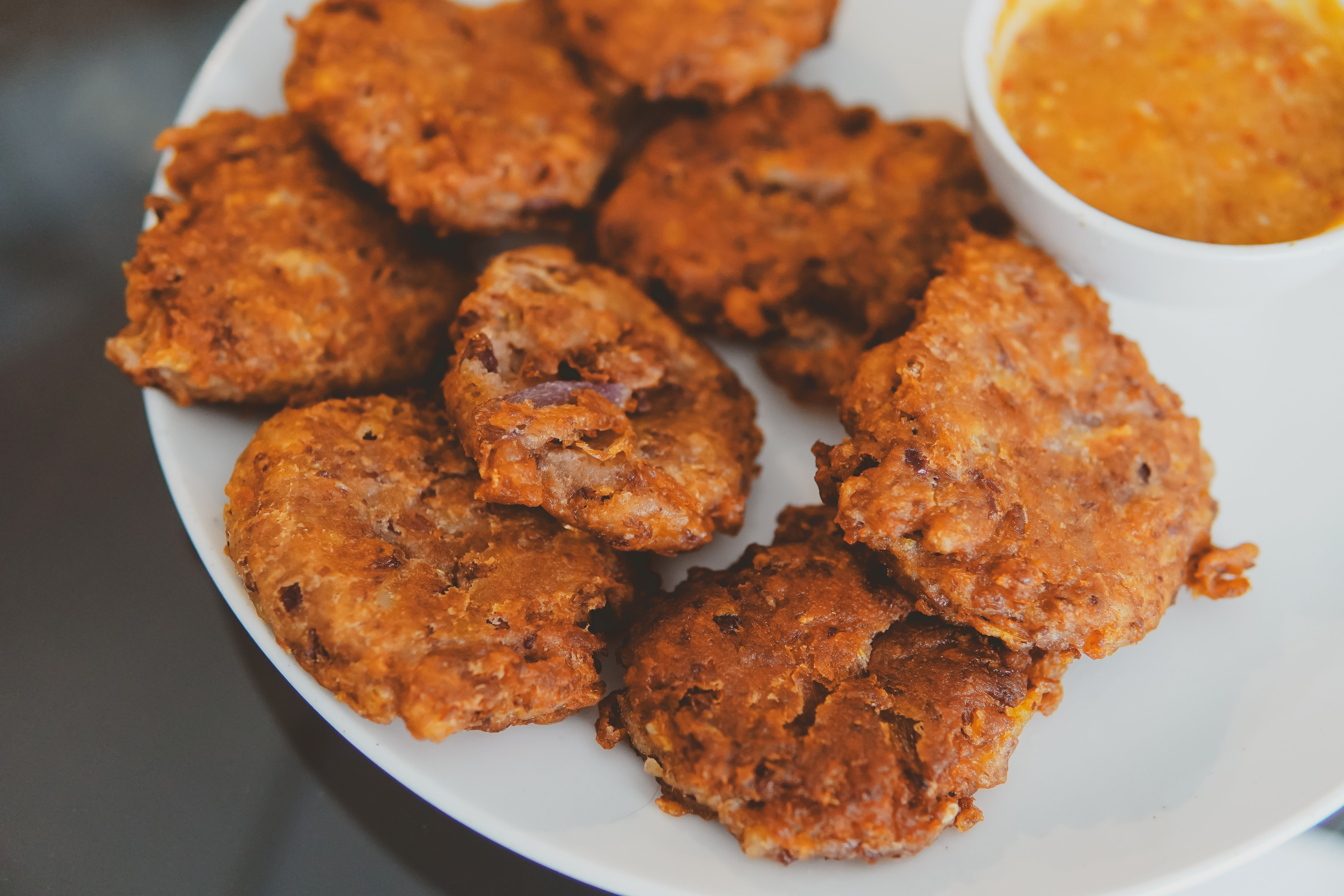
Photo: Su La Pyae / Pexels
Egyptian
Ta'ameya
The diets react (see scores below)
Common Ingredients
- fava beans
- parsley
- cilantro
- dill
- garlic
- onion
- cumin
- sesame seeds
Specific recipes may vary.
Incompatible with 5 of 11 diets
Diet Ratings
Ta'ameya is an Egyptian falafel made primarily from fava beans, which are a high-carbohydrate legume. A standard serving (3-4 pieces, ~100g) contains approximately 25-30g net carbs from the fava beans alone, easily pushing or exceeding the daily keto limit in a single snack. Fava beans are starchy legumes that are fundamentally incompatible with ketogenic eating. While the herbs, garlic, onion, and spices add minimal carbs, the base ingredient is the problem. The dish is also fried in oil (typically vegetable oil), but the high carb load from fava beans makes this a clear avoid regardless of fat content.
Ta'ameya is the Egyptian version of falafel, made entirely from whole plant-based ingredients. Fava beans serve as the protein base, while parsley, cilantro, and dill provide fresh herbal flavor. Garlic, onion, and cumin are classic aromatic seasonings, and sesame seeds add healthy fats and a coating. Every single ingredient is unambiguously plant-derived with no animal products or animal-derived additives. The dish is also minimally processed — the beans are soaked and ground, not industrially manufactured — which earns it a high whole-food score. It is a nutritionally dense, protein-rich snack fully aligned with vegan dietary principles.
Ta'ameya is an Egyptian falafel made primarily from fava beans, which are legumes — explicitly excluded from the paleo diet due to their high lectin and phytate content, anti-nutrient profile, and classification as a non-Paleolithic food source. Fava beans are the foundational and defining ingredient of this dish; without them, the dish does not exist. While the supporting ingredients (parsley, cilantro, dill, garlic, onion, cumin) are all paleo-approved herbs and aromatics, and sesame seeds occupy a minor caution-area role, the primary protein and structural base of ta'ameya is entirely legume-derived. The dish is also typically deep-fried in seed oils (sunflower or vegetable oil), adding another layer of non-compliance. There is strong consensus across all major paleo authorities — Cordain, Sisson, Wolf — that legumes including fava beans must be avoided.
Ta'ameya is an exemplary Mediterranean-compatible dish. Fava beans are a traditional legume staple across the Mediterranean basin, providing plant-based protein, fiber, and complex carbohydrates. The generous use of fresh herbs (parsley, cilantro, dill) adds phytonutrients and antioxidants. Garlic, onion, and cumin are foundational Mediterranean aromatics with well-documented health benefits. Sesame seeds contribute healthy fats and minerals. The dish is wholly plant-based, minimally processed, and free from refined grains, added sugars, or saturated fats. Fava beans in particular have deep roots in Egyptian and broader Eastern Mediterranean culinary traditions, making this a genuine regional staple that aligns perfectly with Mediterranean diet principles.
Ta'ameya is an Egyptian falafel made entirely from plant-based ingredients. Every single component — fava beans, parsley, cilantro, dill, garlic, onion, cumin, and sesame seeds — is plant-derived and explicitly excluded from the carnivore diet. Fava beans are legumes, a category universally rejected by all carnivore frameworks due to their antinutrients, lectins, and phytates. The herbs and spices are plant compounds. There is not a single animal-derived ingredient in this dish. This is one of the clearest possible 'avoid' cases on a carnivore diet.
Ta'ameya is the Egyptian version of falafel, made primarily from fava beans, which are legumes. Legumes are explicitly excluded on the Whole30 program. While the specific exceptions for legumes include green beans, sugar snap peas, and snow peas, fava beans are not among them. All other ingredients — parsley, cilantro, dill, garlic, onion, cumin, and sesame seeds — are fully Whole30-compliant, but the fava bean base disqualifies the dish entirely. Additionally, ta'ameya is typically formed into patties or balls and deep-fried, which could also raise 'food with no brakes' concerns, but the primary disqualifier is the legume content.
Ta'ameya is an Egyptian falafel made primarily from fava beans (broad beans), which are high in GOS (galacto-oligosaccharides) and fructans — major FODMAP triggers. Unlike chickpea-based falafel, ta'ameya uses whole fava beans as its primary ingredient, making it inherently high-FODMAP at any standard serving size. Compounding the problem, the recipe includes two of the most potent FODMAP ingredients: garlic (high fructans, avoid entirely during elimination) and onion (high fructans, one of the highest-FODMAP foods tested by Monash). The combination of fava beans + garlic + onion creates a triple FODMAP load that makes this dish unsuitable during the elimination phase. Parsley, cilantro, dill, cumin, and sesame seeds are low-FODMAP and not a concern, but they cannot offset the core high-FODMAP ingredients.
Ta'ameya is the Egyptian version of falafel made with fava beans rather than chickpeas, combined with fresh herbs and spices. The base ingredients are excellent from a DASH perspective: fava beans are rich in potassium, magnesium, fiber, and plant protein — all DASH-priority nutrients. Fresh herbs (parsley, cilantro, dill), garlic, and onion add micronutrients with negligible sodium. Cumin and sesame seeds contribute healthy fats and minerals. However, ta'ameya is almost universally deep-fried in oil, which significantly increases total fat content and caloric density. While the frying oil is typically vegetable oil (not a tropical oil), the frying process adds considerable fat that DASH guidelines would flag. Sodium content depends heavily on preparation — home versions can be low-sodium, but restaurant or commercial versions may add notable salt. The dish earns a 'caution' rather than 'approve' primarily due to the deep-frying method. If baked or air-fried with minimal added salt, ta'ameya would score much higher (8-9) as a DASH-friendly snack given its exceptional legume and herb base.
NIH DASH guidelines emphasize beans and legumes as core foods and would view the fava bean base favorably; some DASH-oriented clinicians and updated clinical interpretations argue that occasional consumption of plant-protein-rich fried foods like ta'ameya is acceptable within an overall DASH pattern, especially when compared to animal-protein snack alternatives, and would approve baked versions without reservation.
Ta'ameya (Egyptian falafel made from fava beans) is a plant-based snack with a reasonably favorable nutrient profile for Zone purposes, but it requires careful portioning and pairing. Fava beans provide both protein and carbohydrates — in Zone terms, they count primarily as a carbohydrate block with some incomplete protein contribution. The herbs (parsley, cilantro, dill), garlic, and onion are excellent Zone-friendly additions, delivering polyphenols and anti-inflammatory compounds Sears strongly endorses. Sesame seeds contribute monounsaturated and polyunsaturated fats, though sesame is higher in omega-6 than ideal. The main challenge is Zone block balancing: fava beans are moderate-glycemic and carbohydrate-dense, so they serve better as the carb block than the protein block. To achieve 40/30/30, ta'ameya should be paired with a lean protein source (e.g., egg whites, low-fat yogurt dip) since the bean protein alone is insufficient for a full Zone protein block. Typically fried, the cooking method adds omega-6-heavy seed oils, which conflicts with Zone's anti-inflammatory principles — though baking or air-frying resolves this. As a snack, a 2-3 piece portion is manageable within Zone ratios if paired appropriately.
Some Zone practitioners treat legumes like fava beans as an 'unfavorable' carbohydrate due to their higher glycemic load compared to non-starchy vegetables, and would limit ta'ameya to very small portions. Others following Sears' later anti-inflammatory writing note that legumes' high fiber content (which reduces net carbs for block counting) and polyphenol content actually make them more Zone-compatible than their raw carb numbers suggest, potentially rating this food more favorably.
Ta'ameya is an Egyptian falafel made primarily from fava beans rather than chickpeas, and its ingredient profile is exceptionally well-aligned with anti-inflammatory principles. Fava beans are a rich source of plant-based protein, dietary fiber, folate, and phytonutrients — legumes are explicitly emphasized in anti-inflammatory frameworks. The heavy use of fresh herbs (parsley, cilantro, dill) provides a dense array of polyphenols, flavonoids, and chlorophyll-derived antioxidants. Garlic contains allicin and organo-sulfur compounds with well-documented anti-inflammatory and immunomodulatory effects. Onion contributes quercetin, a potent flavonoid. Cumin offers antioxidant phytochemicals and has shown anti-inflammatory activity in research. Sesame seeds supply lignans (sesamin, sesamolin), calcium, and a moderate source of healthy fats. The dish is inherently plant-based, minimally processed, free of refined carbohydrates, added sugars, trans fats, and problematic seed oils (assuming shallow-frying in olive oil or baking, as is common). Deep-frying in refined seed oils would lower the score, but the base formulation is outstanding. This dish exemplifies the legume-plus-herbs-plus-spices combination that anti-inflammatory protocols consistently emphasize.
Ta'ameya (Egyptian falafel) is made from whole fava beans rather than chickpeas, giving it a slightly better protein and fiber profile than its chickpea counterpart. The ingredient list itself — fava beans, fresh herbs, garlic, onion, cumin, sesame seeds — is nutritionally solid: fava beans provide meaningful plant protein (~13g per 100g cooked) and good fiber (~5-6g per 100g), and the herbs add micronutrients with virtually no caloric cost. However, ta'ameya is traditionally deep-fried, which is the critical issue for GLP-1 patients. Deep frying significantly increases fat content per serving (from negligible in the raw mix to 10-15g+ of fat per serving depending on portion), worsens nausea, bloating, and reflux — key GLP-1 side effects — and slows gastric emptying further on top of the medication's already significant delay. The sesame seeds add healthy unsaturated fats in small amounts but also contribute to fat load. The dish is also relatively low in calories per piece when fried in small patties, which makes portion control easier. As a snack, 2-3 pieces is a reasonable serving. Baked or air-fried versions would score 7-8, qualifying for approve, as the underlying ingredient profile is genuinely GLP-1-friendly. The standard fried preparation holds this to a caution rating.
Some GLP-1-focused dietitians are more permissive with ta'ameya than with other fried foods because the fava bean base provides meaningful protein and fiber that most fried snacks lack entirely — arguing that 2-3 pieces alongside a fiber-rich vegetable side represents an acceptable trade-off. Others apply a stricter no-fried-foods standard regardless of the underlying ingredients, citing the consistent clinical pattern of fried foods worsening GI side effects in GLP-1 patients across food categories.
*See how scores were generated at our methodology page.
Nutritional profile
Six traits that cut across every diet.
Fiber & Plants
How much whole-plant food and fiber it delivers.
Healthy Fats
The quality of its fats (unsaturated, omega-3).
Whole / Unprocessed
How close it is to its natural, unprocessed form.
Gut Gentle
How easy it is on digestion (low FODMAP, few irritants).
Low Glycemic
How little it spikes your blood sugar.
Protein Density
How much protein it packs per calorie.
Controversy Index
Higher controversy = more disagreement between diets.
Diet-Specific Tips
 Vegan — 9/10
View tips
- Fava beans are a whole-food plant protein with no animal involvement
- All herbs and spices (parsley, cilantro, dill, cumin) are fully plant-based
- Sesame seeds provide healthy fats and are entirely vegan
- No dairy, eggs, or other animal-derived binders used
- Minimal processing — soaked and ground whole legumes, not industrially manufactured
- Traditional preparation is inherently vegan with no animal-product variants to note
 Mediterranean — 9/10
View tips
- Fava beans are a core Mediterranean legume, high in plant protein and fiber
- All ingredients are whole, unprocessed plant foods
- Fresh herbs used abundantly, adding antioxidants and phytonutrients
- Sesame seeds provide healthy unsaturated fats
- No refined grains, added sugars, or animal products
- Traditional Eastern Mediterranean dish with centuries of regional use
- Typically prepared with olive oil for frying, which remains the preferred fat source
 DASH — 6/10
View tips
- Fava beans are DASH-core: high in potassium, magnesium, fiber, and plant protein
- Fresh herbs (parsley, cilantro, dill) add micronutrients with near-zero sodium
- Deep-frying significantly increases total fat content — primary DASH concern
- No saturated fat sources, no added sugar, no cholesterol-heavy ingredients
- Sodium level varies by preparation; home versions can be very low-sodium
- Baked or air-fried preparation would elevate score to 8-9 range
- Sesame seeds contribute healthy unsaturated fats and calcium
 Zone — 6/10
View tips
- Fava beans count primarily as a carbohydrate block in Zone, not a full protein block — incomplete protein source
- Moderate glycemic index of fava beans requires portion control; net carbs after fiber deduction are more favorable
- Rich in polyphenols and anti-inflammatory herbs (parsley, cilantro, dill) — strongly aligned with Sears' anti-inflammatory focus
- Traditional frying introduces omega-6-heavy oils, conflicting with Zone anti-inflammatory principles; baking improves Zone compatibility
- Sesame seeds provide fat blocks but are higher in omega-6 than Zone-preferred monounsaturated fats (olive oil, avocado, almonds)
- Must be paired with lean protein to achieve 40/30/30 balance as a Zone snack
- Garlic, onion, and cumin add negligible macros but strong polyphenol and anti-inflammatory value
 Anti-Inflammatory — 9/10
View tips
- Fava beans: high-fiber legume with anti-inflammatory polyphenols, explicitly favored in anti-inflammatory diets
- Parsley, cilantro, and dill: dense in flavonoids, antioxidants, and chlorophyll
- Garlic: allicin and organo-sulfur compounds with strong anti-inflammatory evidence
- Onion: quercetin content reduces inflammatory markers in research
- Cumin: antioxidant phytochemicals with anti-inflammatory properties
- Sesame seeds: lignans and healthy fats with anti-inflammatory activity
- Entirely plant-based, no refined sugars, no trans fats, no artificial additives
- Cooking method matters: score assumes baking or olive-oil frying; deep-frying in refined seed oils would reduce anti-inflammatory value
 GLP-1 Friendly — 5/10
View tips
- Deep-fried preparation is the primary concern — significantly increases fat content and worsens GLP-1 GI side effects
- Fava bean base provides good plant protein (~13g/100g cooked) and fiber (~5-6g/100g) — strong underlying nutritional profile
- Fresh herbs (parsley, cilantro, dill) add micronutrient density with minimal calories
- Sesame seeds contribute healthy unsaturated fats but add to total fat load
- Baked or air-fried preparation would elevate score to 7-8 (approve)
- Small patty format supports portion control — 2-3 pieces is a manageable snack serving
- Cumin and garlic are well-tolerated at typical cooking quantities; not a significant GI irritant risk
- No added sugar, no refined grains, no ultra-processed ingredients in the base recipe