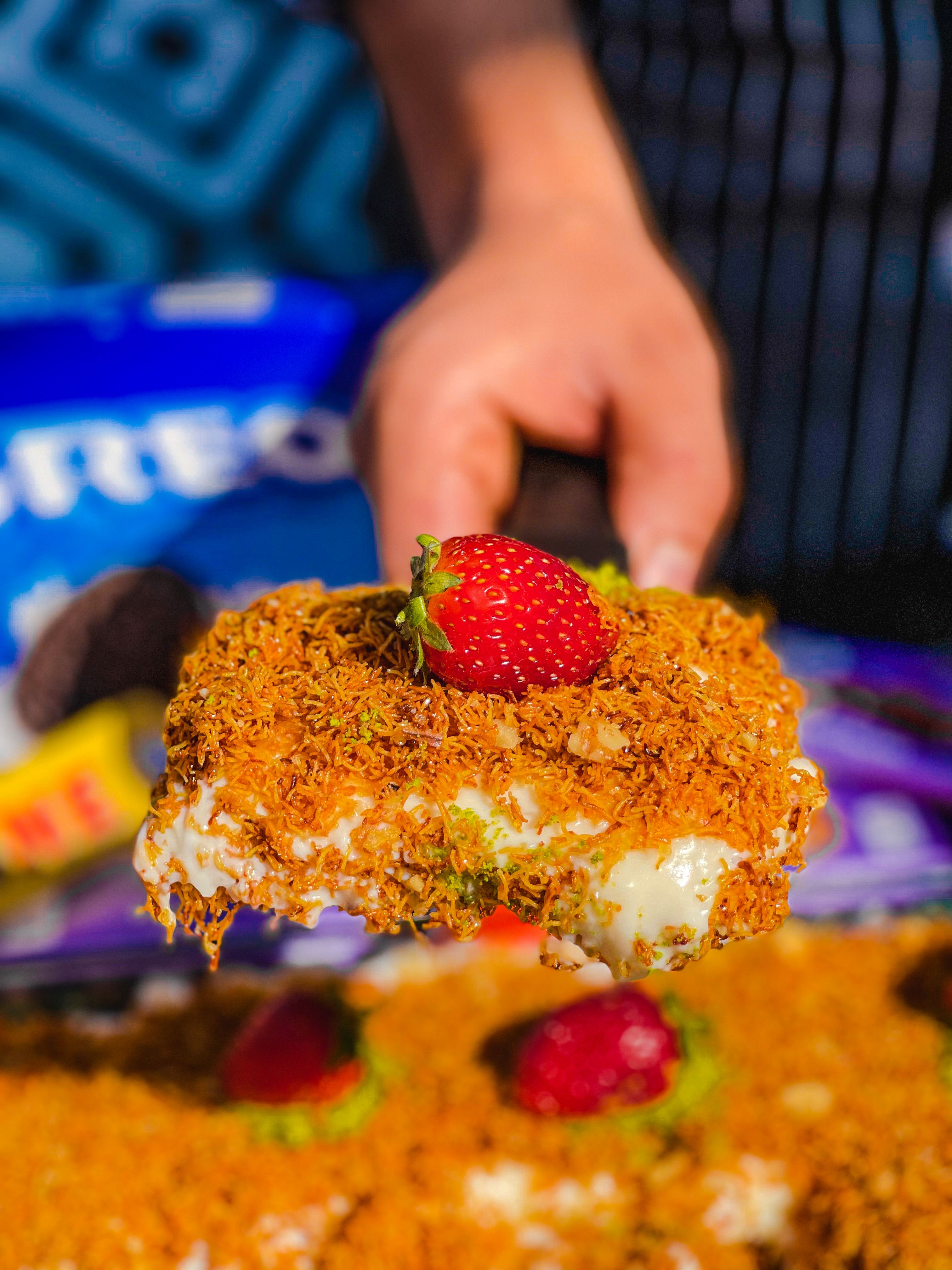
Greek
Ekmek Kadayifi
The diets react (see scores below)
Common Ingredients
- phyllo pastry
- butter
- sugar
- water
- honey
- whipped cream
- pistachios
- cinnamon
Specific recipes may vary.
Incompatible with 11 of 11 diets
Diet Ratings
Ekmek Kadayifi is fundamentally incompatible with a ketogenic diet. The dish is built on phyllo pastry (a grain-based, high-carb dough), drenched in a sugar-water-honey syrup, and topped with sweetened whipped cream and pistachios. The combined net carbs from phyllo, sugar, honey, and pistachios would far exceed the entire daily keto carb budget (20-50g) in a single serving. There is no meaningful way to consume this dish within ketogenic parameters — it is essentially a concentrated carbohydrate and sugar delivery vehicle with minimal fat-to-carb ratio benefit.
Ekmek Kadayifi contains multiple clear animal-derived ingredients that place it firmly outside vegan dietary guidelines. Butter is a dairy product, whipped cream is a dairy product, and honey is excluded by the vast majority of vegan organizations including the Vegan Society and PETA. With three distinct non-vegan ingredients, this dish is unambiguously incompatible with a vegan diet. The phyllo pastry itself often contains butter, compounding the issue. The remaining ingredients — sugar, water, pistachios, and cinnamon — are plant-based, but they cannot offset the multiple animal-derived components.
Ekmek Kadayifi is fundamentally incompatible with the Paleolithic diet. Phyllo pastry is made from refined wheat flour, a grain that is strictly excluded from paleo. Butter is a dairy product (excluded), refined sugar is a processed sweetener (excluded), and whipped cream is dairy (excluded). Nearly every core ingredient violates paleo principles. The only paleo-friendly components are honey (a caution-level natural sweetener), pistachios (approved), and cinnamon (approved) — but these minor ingredients cannot redeem a dish built on multiple foundational paleo violations.
Ekmek Kadayifi is a traditional Greek/Turkish dessert that fundamentally conflicts with Mediterranean diet principles. It is built on refined phyllo pastry (refined grain), large amounts of added sugar, butter (saturated fat replacing olive oil), and whipped cream — all of which are discouraged or minimized in Mediterranean dietary guidelines. The dish is high in added sugars, saturated fats, and refined carbohydrates with little nutritional benefit. While pistachios and honey have some Mediterranean legitimacy, they are overwhelmed by the problematic ingredients. This is an occasional celebratory treat at best, not a regular part of the dietary pattern.
Some Mediterranean diet scholars note that traditional sweets using honey and nuts — core Mediterranean ingredients — have a place in the cultural food heritage of the region, and that moderate, infrequent consumption of such pastries is consistent with how the diet is actually practiced in Greece and Turkey. The Oldways Mediterranean Diet pyramid acknowledges sweets as an occasional cultural food rather than a strict exclusion.
Ekmek Kadayifi is a Greek/Turkish dessert that is entirely incompatible with the carnivore diet. It consists almost entirely of plant-derived and processed ingredients: phyllo pastry (wheat flour), sugar, water, honey, pistachios (nuts), and cinnamon (plant spice). Butter and whipped cream are the only animal-derived components, but they are minor elements in a dish dominated by grains, sugar, and nuts. This is a high-carbohydrate, plant-heavy dessert with no meaningful animal protein or fat profile. Every core carnivore principle is violated here.
Ekmek Kadayifi contains multiple excluded ingredients that make it incompatible with Whole30. First, phyllo pastry is a grain-based product (wheat flour), which is explicitly excluded. Second, butter (regular, not clarified/ghee) is a dairy product and excluded. Third, sugar is an added sweetener and excluded. Fourth, honey is an added sugar and excluded on Whole30. Fifth, whipped cream is a dairy product and excluded. Beyond individual ingredients, this dish is a classic Greek dessert/sweet pastry — even if somehow reformulated with compliant ingredients, it would fall under the 'no recreating baked goods/junk food' rule. This is an unambiguous avoid with no pathway to compliance in its traditional form.
Ekmek Kadayifi contains multiple high-FODMAP ingredients that make it unsuitable during the elimination phase. Phyllo pastry is made from wheat flour, which is high in fructans — a key FODMAP to avoid. Honey is high in excess fructose and is explicitly listed as a high-FODMAP sweetener by Monash University. Whipped cream, while lower in lactose than milk, is typically consumed in significant quantities in this dessert and can accumulate FODMAP load. Pistachios are high in GOS (galacto-oligosaccharides) and fructans at standard serving sizes (Monash rates them as high-FODMAP). The combination of wheat-based phyllo, honey, and pistachios alone would make this dish clearly high-FODMAP at any realistic serving size.
Ekmek Kadayifi is a Greek/Turkish dessert made primarily of phyllo pastry soaked in a sugar-honey syrup and topped with whipped cream (full-fat dairy) and pistachios. This dish is fundamentally incompatible with DASH diet principles. It is heavily loaded with added sugars from both sugar syrup and honey, contains significant saturated fat from butter (used to layer phyllo) and full-fat whipped cream, and provides virtually no fiber, potassium, magnesium, or calcium in meaningful amounts relative to its caloric density. DASH explicitly limits sweets, added sugars, saturated fats, and full-fat dairy — all of which are central ingredients here. Pistachios and cinnamon are DASH-friendly in isolation, but they do not offset the overwhelmingly problematic nutritional profile of the dish as a whole. This is a treat/dessert that should be avoided or consumed only on very rare occasions on a DASH eating plan.
Ekmek Kadayifi is a traditional Greek/Turkish dessert that is fundamentally incompatible with Zone Diet principles. The dish is dominated by high-glycemic, nutritionally empty carbohydrates: phyllo pastry (refined white flour), sugar syrup, honey, and water — all of which spike blood glucose rapidly and provide minimal fiber or micronutrients. The fat profile is heavily saturated (butter, whipped cream), directly conflicting with the Zone's emphasis on monounsaturated fats. The whipped cream provides negligible lean protein value. The macro ratio of this dessert is overwhelmingly skewed toward high-GI carbohydrates and saturated fat, with virtually no lean protein — the polar opposite of the 40/30/30 Zone target. Pistachios offer some monounsaturated fat and minor protein, and cinnamon has polyphenol benefits, but these components are minor and do not meaningfully rehabilitate the dish. There is no practical portioning strategy that would bring a serving of Ekmek Kadayifi into Zone balance without reducing it to a few bites with no satiety value.
Ekmek Kadayifi is a Greek dessert built almost entirely around pro-inflammatory ingredients. Butter and whipped cream are high in saturated fat, which is explicitly limited in anti-inflammatory frameworks. Refined sugar and honey in substantial quantities drive glycemic spikes and promote inflammatory signaling (elevated IL-6, CRP). Phyllo pastry is a refined carbohydrate with minimal fiber or nutritional density. The syrup component (sugar + water + honey) adds yet another layer of concentrated simple sugars. The only meaningfully anti-inflammatory elements are pistachios (healthy fats, polyphenols) and cinnamon (anti-inflammatory spice), but these are minor components that cannot offset the dominant pro-inflammatory load of the dish. This is an indulgent dessert that conflicts with nearly every core anti-inflammatory dietary principle: it is high in saturated fat, refined carbohydrates, and added sugars, while being low in fiber, omega-3s, and antioxidants.
Ekmek Kadayifi is a Greek/Turkish dessert built almost entirely on ingredients that conflict with GLP-1 dietary priorities. The base is phyllo pastry soaked in a sugar-honey syrup, topped with whipped cream and pistachios — meaning nearly every calorie comes from refined carbohydrates, saturated fat, and added sugar, with negligible protein and fiber. Butter and whipped cream contribute high saturated fat that worsens nausea, bloating, and reflux — the most common GLP-1 side effects. The sugar-syrup soaking creates a high-glycemic load with no blood sugar stabilization. Whipped cream is high in fat with almost no protein despite being listed as the primary protein source, which is a red flag — this dish essentially offers no meaningful protein. Pistachios provide a small amount of protein and healthy fat but in the quantities used as a garnish, the contribution is negligible. This is a calorie-dense, nutrient-poor dessert that delivers empty calories, worsens GI side effects, and does nothing to meet the 15-30g protein per meal or 25-30g daily fiber targets GLP-1 patients require.
*See how scores were generated at our methodology page.
Nutritional profile
Six traits that cut across every diet.
Fiber & Plants
How much whole-plant food and fiber it delivers.
Healthy Fats
The quality of its fats (unsaturated, omega-3).
Whole / Unprocessed
How close it is to its natural, unprocessed form.
Gut Gentle
How easy it is on digestion (low FODMAP, few irritants).
Low Glycemic
How little it spikes your blood sugar.
Protein Density
How much protein it packs per calorie.
Controversy Index
Higher controversy = more disagreement between diets.