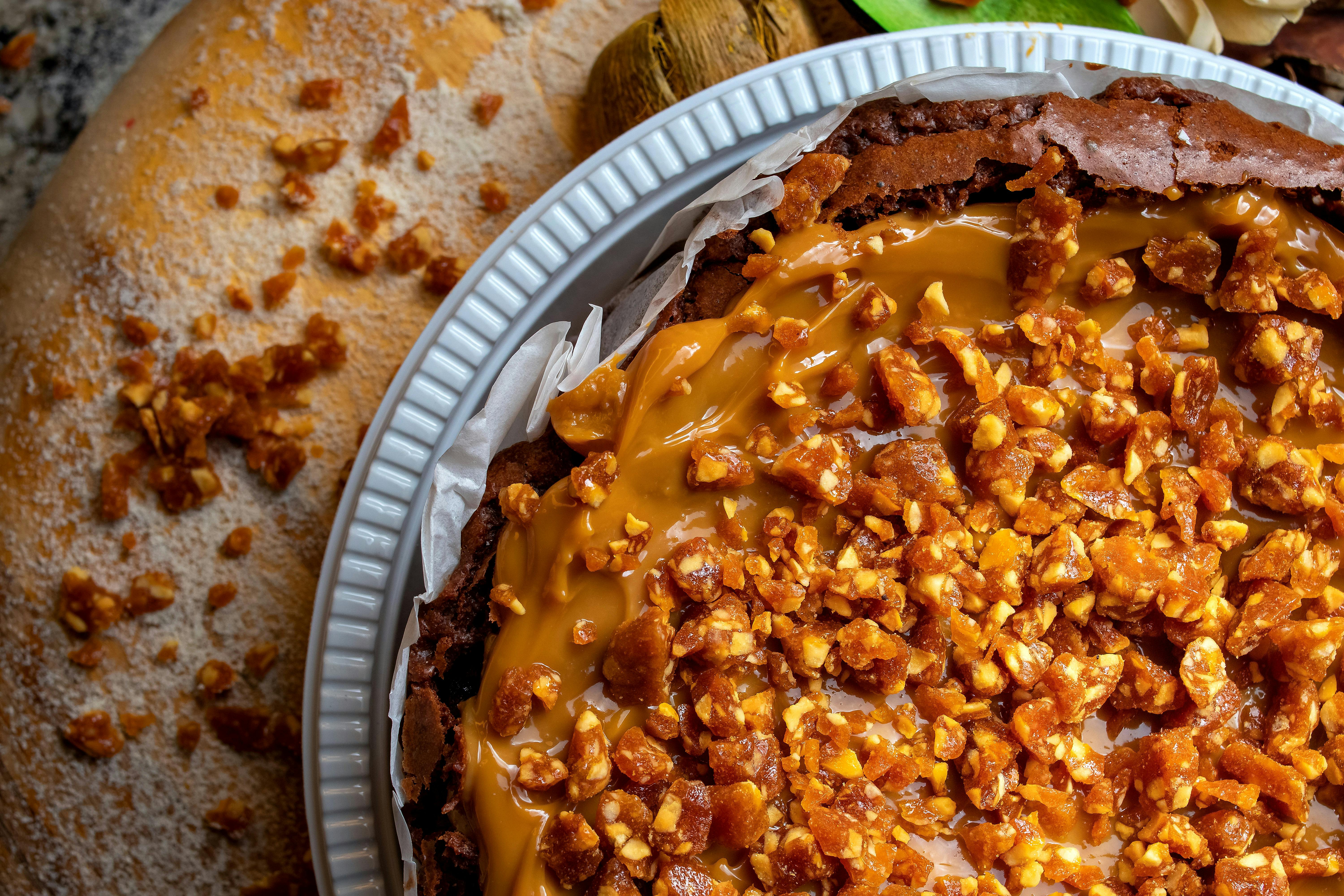
Photo: Hiure Gomes Fernandes / Pexels
American
English Toffee
The diets react (see scores below)
Common Ingredients
- butter
- sugar
- chocolate
- almonds
- salt
- vanilla
Specific recipes may vary.
Incompatible with 11 of 11 diets
Diet Ratings
English Toffee is fundamentally built on sugar as its primary structural ingredient, making it completely incompatible with ketogenic diets. The candy-making process requires large quantities of sugar to achieve the toffee texture, and a standard serving (1 oz / ~28g) contains approximately 20-25g of net carbs from sugar alone — easily exceeding the lower end of a full day's keto carb budget in a single piece. While butter and almonds are keto-friendly and chocolate can be acceptable in dark/unsweetened form, the dominant ingredient is pure sucrose, which immediately kicks the body out of ketosis. There is no meaningful portion size at which English Toffee becomes compatible with ketosis; even a small piece delivers a significant sugar load.
English Toffee contains butter as a primary ingredient, which is a dairy product and therefore a clear animal-derived ingredient. This makes it incompatible with a vegan diet. The chocolate coating may also contain dairy (milk chocolate is the most common variety used). Almonds, sugar, salt, and vanilla are plant-based, but the presence of butter alone is sufficient to classify this dish as non-vegan. Vegan versions of toffee exist using plant-based butter substitutes and dairy-free dark chocolate, but the traditional recipe as listed is not vegan.
English Toffee is fundamentally incompatible with the paleo diet. The dish is built on refined sugar as its primary structural ingredient — a clear paleo exclusion. Butter is a dairy product excluded under strict paleo guidelines. Added salt is also discouraged. Chocolate, unless specified as very high-cacao dark chocolate with no added sugar, typically contains dairy and refined sugar. While almonds are paleo-approved, they cannot redeem a recipe whose core identity depends on refined sugar and dairy. This is a processed confection that violates multiple foundational paleo principles simultaneously.
English Toffee is a confection built around butter and sugar as primary ingredients, making it fundamentally incompatible with Mediterranean diet principles. It is a highly processed sweet treat dominated by saturated fat (butter) and added sugar, both of which the Mediterranean diet explicitly minimizes. While almonds and dark chocolate have some nutritional merit individually, they are minor components overwhelmed by the candy's sugar and saturated fat content. This dish falls squarely into the category of added sugars and highly processed sweets that the Mediterranean diet discourages strongly.
English Toffee is fundamentally incompatible with the carnivore diet. While butter is an animal-derived ingredient, it is completely overwhelmed by multiple disqualifying plant-based and processed components. Sugar is a processed plant-derived sweetener explicitly excluded from carnivore. Chocolate contains cacao, a plant product. Almonds are nuts — a plant food. Vanilla is a plant-derived flavoring. Salt is the only neutral ingredient. This dish is essentially a confection built around sugar and plant foods with trace animal fat, making it a clear avoid with no ambiguity in the carnivore community.
English Toffee contains multiple excluded ingredients. Sugar is an added sweetener explicitly banned on Whole30. Butter (not ghee or clarified butter) is a dairy product and excluded. Chocolate typically contains added sugar and often dairy. Additionally, even if all ingredients could be made compliant, English Toffee is a confection/candy that falls squarely into the 'no recreating junk food' rule — it is precisely the type of treat the Whole30 program is designed to help participants step away from.
English toffee is made from butter, sugar, chocolate, almonds, salt, and vanilla — none of which are inherently high-FODMAP ingredients at small servings. Butter is low-FODMAP (fat-based, negligible lactose). Plain sugar (sucrose) is low-FODMAP. Dark chocolate is low-FODMAP at around 30g per Monash; milk chocolate is moderate-FODMAP due to lactose. Almonds are low-FODMAP at 10 nuts (approximately 12g) but become high-FODMAP at larger amounts (≥20 nuts) due to GOS and excess fructose. Vanilla extract is low-FODMAP. Salt is fine. The main risks are: (1) the type of chocolate used — if milk chocolate, lactose becomes a concern; (2) almond quantity per serving — toffee often contains a generous almond coating that may push portions into high-FODMAP territory; (3) serving size — toffee is energy-dense and easy to overeat. A small piece (1-2 pieces) with dark chocolate and moderate almonds is likely safe, but standard snacking portions could tip into high-FODMAP range due to almonds accumulating.
Monash University rates almonds as low-FODMAP at 10 nuts per serving, but many FODMAP practitioners caution that almond-heavy confections make portion control difficult in practice. The chocolate type is also rarely specified in commercial English toffee, and milk chocolate versions would add a lactose burden that clinical dietitians typically advise avoiding during the elimination phase.
English Toffee is fundamentally incompatible with DASH diet principles. It is a confection built almost entirely from butter (high saturated fat) and sugar (high added sugar) — two categories DASH explicitly limits. Chocolate adds further saturated fat and sugar, and salt contributes sodium. While almonds are a DASH-approved food and provide some positive nutritional value, they represent a minor component in this candy. The dish is a classic 'sweet' that DASH guidelines specifically call out as a category to limit. There is no meaningful source of potassium, magnesium, calcium, or dietary fiber, and the saturated fat and added sugar content far exceed DASH targets for these nutrients.
English toffee is a confection built almost entirely around sugar and butter — two of the most problematic ingredients in Zone Diet terms. Sugar is a pure high-glycemic carbohydrate that spikes insulin rapidly, which is the central mechanism the Zone seeks to avoid. Butter contributes saturated fat rather than the preferred monounsaturated fats. Together, the macro profile is dominated by high-GI carbs and saturated fat, with virtually zero protein — the opposite of the 40/30/30 Zone ratio. Chocolate (unless very dark, very small quantities) adds more sugar. Almonds and vanilla are the only Zone-friendly ingredients, but they are minor players in a sugar-and-butter matrix. There is no reasonable portioning strategy that makes English toffee a Zone-compatible snack, because the food itself has no protein block anchor and the carbohydrate load is pure glucose-spiking sugar. A Zone snack requires at least 1 protein block (~7g protein) to moderate the insulin response — English toffee provides none.
English Toffee is a confection built almost entirely on pro-inflammatory ingredients. Butter is a significant source of saturated fat, which is explicitly limited in anti-inflammatory frameworks. Sugar — the second major ingredient — is a primary driver of inflammation, spiking blood glucose and elevating inflammatory markers like CRP and IL-6. The combination of high saturated fat and high added sugar in large quantities places this firmly in the 'avoid' category. The chocolate coating offers some partial mitigation if it is dark chocolate (polyphenols, flavanoids), and almonds provide vitamin E, healthy monounsaturated fats, and some anti-inflammatory benefit. However, these positive elements are minor in proportion to the dominant pro-inflammatory base of butter and sugar. Salt and vanilla are nutritionally neutral in these quantities. This is an occasional indulgence treat, not a food compatible with anti-inflammatory eating patterns.
English toffee is a high-sugar, high-saturated-fat confection with negligible protein, no fiber, and virtually no micronutrient value. The primary ingredients — butter and sugar — represent exactly the categories GLP-1 patients must avoid: saturated fat worsens nausea and GI side effects, and concentrated sugar delivers empty calories. Chocolate adds additional saturated fat and sugar. While almonds contribute a small amount of protein and healthy fat, their nutritional benefit is minimal at the quantities present in toffee. Slowed gastric emptying means high-fat, high-sugar foods linger longer in the stomach, significantly increasing the risk of nausea, reflux, and bloating. As a snack with no redeeming protein or fiber content, it offers nothing that supports satiety, muscle preservation, or digestive health — and actively works against all top GLP-1 dietary priorities.
*See how scores were generated at our methodology page.
Nutritional profile
Six traits that cut across every diet.
Fiber & Plants
How much whole-plant food and fiber it delivers.
Healthy Fats
The quality of its fats (unsaturated, omega-3).
Whole / Unprocessed
How close it is to its natural, unprocessed form.
Gut Gentle
How easy it is on digestion (low FODMAP, few irritants).
Low Glycemic
How little it spikes your blood sugar.
Protein Density
How much protein it packs per calorie.
Controversy Index
Higher controversy = more disagreement between diets.