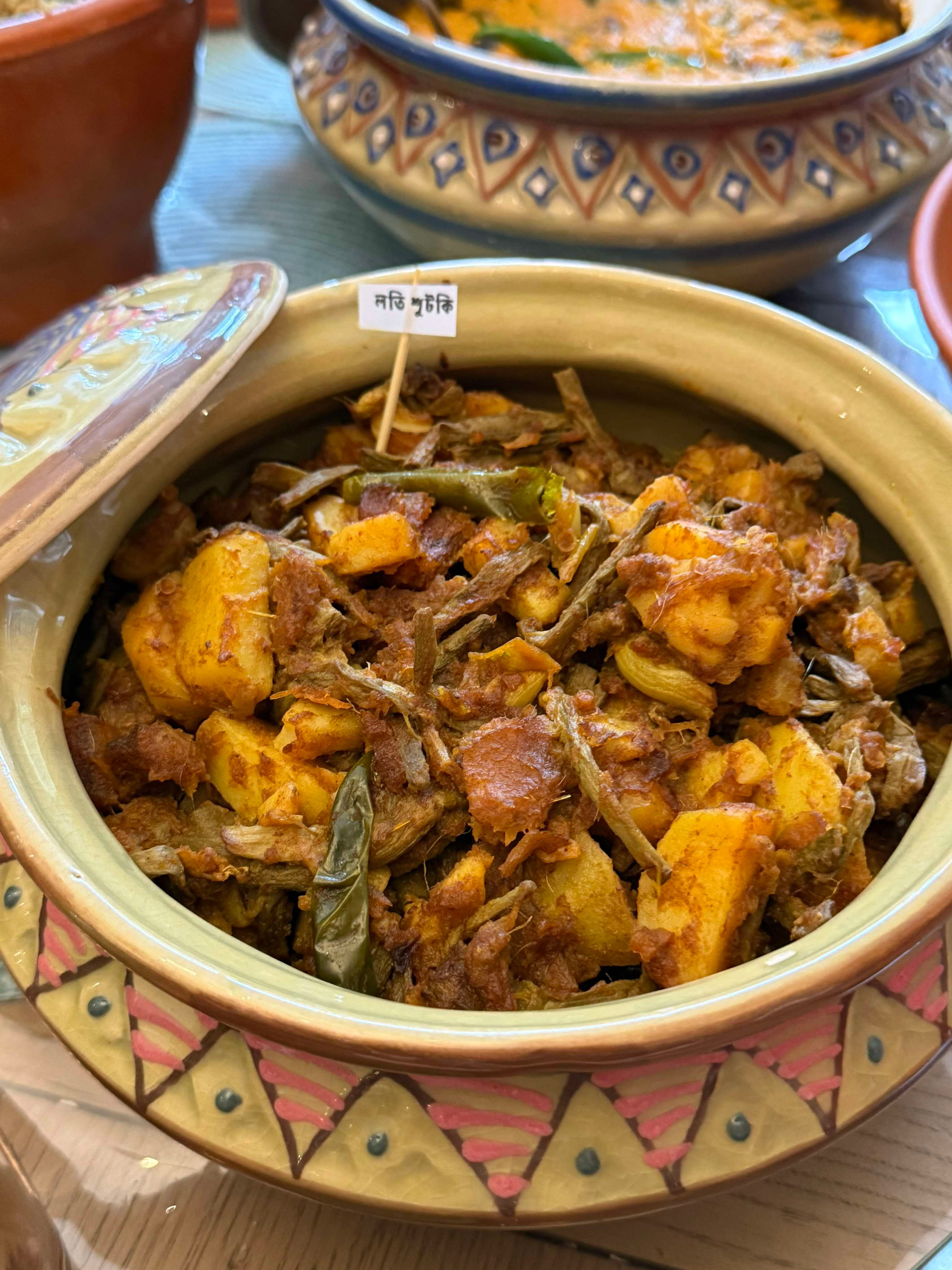
Ethiopian
Atkilt Wat
The diets react (see scores below)
Common Ingredients
- cabbage
- carrots
- potatoes
- onion
- garlic
- ginger
- turmeric
- vegetable oil
Specific recipes may vary.
Incompatible with 4 of 11 diets
Diet Ratings
Atkilt Wat is fundamentally incompatible with ketogenic eating due to its inclusion of potatoes and carrots as primary ingredients. Potatoes are extremely high in net carbs (roughly 15-17g net carbs per 100g), making even a small serving capable of exceeding the entire daily keto carb limit. Carrots add additional net carbs (~7g per 100g). While cabbage, garlic, ginger, turmeric, and vegetable oil are keto-friendly, they are secondary to the high-carb starchy vegetables that define this dish. The onion also contributes moderate carbs. There is no realistic portion size of traditional Atkilt Wat that keeps net carbs within keto thresholds without fundamentally altering the dish's character.
Atkilt Wat is a traditional Ethiopian spiced vegetable stew consisting entirely of whole plant foods. Every ingredient — cabbage, carrots, potatoes, onion, garlic, ginger, turmeric, and vegetable oil — is fully plant-based with no animal products or animal-derived ingredients. This is a naturally vegan dish requiring no substitutions. The predominance of whole vegetables and aromatics places it at the high end of the approval scale, with only the use of refined vegetable oil (rather than a whole-food fat source) preventing a perfect 10.
Atkilt Wat contains several problematic ingredients from a paleo perspective. The most significant issue is the 'vegetable oil,' which almost certainly refers to a seed oil (canola, soybean, sunflower, or similar) — a clear paleo violation. White potatoes are themselves a debated ingredient, discouraged by strict Cordain-school paleo. The remaining ingredients (cabbage, carrots, onion, garlic, ginger, turmeric) are all paleo-approved vegetables and spices. However, the seed oil alone is enough to push this dish into 'avoid' territory, as it is a non-negotiable exclusion in virtually all paleo frameworks. If the vegetable oil were replaced with olive oil, coconut oil, or avocado oil, the dish would move into caution territory due to the white potatoes.
If 'vegetable oil' is interpreted loosely and substituted with a paleo-approved fat, some modern paleo practitioners (following Mark Sisson or Whole30 guidelines) would accept white potatoes as a starch source, potentially rating the dish as caution. Strict Cordain-school paleo, however, would still flag white potatoes regardless of the oil used.
Atkilt Wat is a vegetable-forward Ethiopian stew made entirely of whole plant foods — cabbage, carrots, potatoes, onion, garlic, and ginger — which aligns excellently with Mediterranean diet principles emphasizing abundant vegetables and plant-based eating. The spices (turmeric, ginger, garlic) are not only compatible but actively encouraged for their anti-inflammatory properties. The one note of caution is the use of generic 'vegetable oil' rather than extra virgin olive oil, which is the canonical fat of the Mediterranean diet. Depending on the oil used (e.g., sunflower, canola), this could be acceptable or less ideal, but it does not significantly undermine the dish's overall plant-based excellence.
Some strict Mediterranean diet frameworks would flag the use of unspecified vegetable oil rather than extra virgin olive oil as a meaningful deviation, since olive oil is not just a fat source but a nutritional cornerstone. Substituting with EVOO would elevate this dish to a near-perfect score.
Atkilt Wat is a fully plant-based Ethiopian vegetable stew containing cabbage, carrots, potatoes, onion, garlic, ginger, turmeric, and vegetable oil. Every single ingredient is either plant-derived or a plant-based oil — there are zero animal products present. This dish is completely incompatible with the carnivore diet at every level, including the most lenient interpretations. Vegetables, root vegetables, alliums, spices, and seed/vegetable oils are all explicitly excluded from carnivore eating.
Atkilt Wat is an Ethiopian spiced vegetable stew made entirely from Whole30-compliant ingredients. Cabbage, carrots, potatoes, onion, garlic, and ginger are all whole vegetables explicitly allowed on the program. Turmeric is a compliant spice, and vegetable oil (such as olive or coconut oil) is an allowed natural fat. There are no grains, legumes, dairy, added sugars, or other excluded ingredients present. This is a straightforward, whole-food vegetable dish that aligns well with the spirit of Whole30.
Atkilt Wat contains two major high-FODMAP ingredients — onion and garlic — that make this dish problematic during the elimination phase. Both onion and garlic are among the highest-fructan foods tested by Monash University, and because they are cooked into the dish (typically as a base), their FODMAPs infuse throughout the entire preparation. There is no practical way to remove these FODMAPs once incorporated. The remaining ingredients (cabbage, carrots, potatoes, ginger, turmeric, vegetable oil) are individually low-FODMAP at standard servings, so the dish would be salvageable if onion and garlic were omitted or replaced with garlic-infused oil and the green tops of spring onions. As traditionally prepared, however, this dish must be avoided during the elimination phase.
Atkilt Wat is an Ethiopian spiced vegetable stew featuring cabbage, carrots, potatoes, onion, garlic, and ginger — all vegetables that align strongly with DASH diet principles. The dish is naturally low in sodium, contains no saturated fat (using vegetable oil), and delivers meaningful amounts of potassium, fiber, magnesium, and vitamins from its vegetable base. Turmeric adds anti-inflammatory compounds without any DASH concerns. The vegetable oil (presumably canola or a neutral oil) is consistent with DASH guidelines favoring unsaturated fats. Potatoes, while starchy, are a good source of potassium, a key DASH mineral. The dish has no meat, no added sugar, no processed ingredients, and no tropical oils. The main consideration is portion control for the oil used in cooking and the starchy potato content, but as a side dish this is an excellent DASH-compatible choice.
Atkilt Wat is an Ethiopian spiced vegetable stew with a mixed Zone profile. The cabbage and carrots are Zone-favorable low-glycemic vegetables that Sears actively encourages. Garlic, ginger, and turmeric are excellent anti-inflammatory polyphenol sources that align with Zone's inflammation-control philosophy. However, potatoes are explicitly categorized as 'unfavorable' carbohydrates in Zone methodology due to their high glycemic index and dense starch content — Sears lists them among carbs to avoid or minimize. The vegetable oil is unspecified; if it is a seed oil high in omega-6 (canola, sunflower, soybean), it conflicts with Zone's anti-inflammatory fat emphasis. The dish also lacks protein entirely, meaning it cannot stand alone as a Zone meal — it must be paired with a lean protein source. As a side dish used in controlled portions alongside lean protein and a monounsaturated fat source, it is workable, but the potato content is a meaningful Zone concern that cannot be ignored even with portion control, as potatoes shift the glycemic load considerably relative to the net carb block math.
Some Zone practitioners treat potatoes permissibly in very small portions (half-block quantities) when combined with high-fiber vegetables like cabbage that blunt glycemic response. The overall vegetable density of the dish — particularly cabbage and carrots — partially offsets the potato's glycemic impact. Sears' later anti-inflammatory writings emphasize polyphenol-rich foods, and turmeric, garlic, and ginger make this dish noteworthy from that lens, potentially elevating its practical Zone value beyond a strict glycemic-index reading.
Atkilt Wat is a plant-based Ethiopian vegetable stew built on a strongly anti-inflammatory foundation. Cabbage and carrots deliver fiber, vitamin C, beta-carotene, and antioxidant polyphenols. Garlic and ginger are well-established anti-inflammatory spices with documented effects on inflammatory markers like CRP and NF-κB pathways. Turmeric contains curcumin, one of the most researched anti-inflammatory compounds in food. Onions provide quercetin, a potent flavonoid. Potatoes, while starchy, are whole-food carbohydrates with meaningful potassium and vitamin C content; their glycemic impact is moderated in the context of a mixed vegetable dish with fiber from the other ingredients. The main uncertainty is 'vegetable oil' — Ethiopian cooking traditionally uses niter kibbeh (spiced butter) or, in vegan versions, commonly canola, sunflower, or corn oil. If a high-omega-6 refined seed oil is used, that partially offsets the otherwise excellent anti-inflammatory profile. If canola or olive oil is used, the dish remains solidly approvable. Assuming a reasonable quantity of a common cooking oil in a vegetable-forward dish, the overall profile is strongly anti-inflammatory.
The 'vegetable oil' ingredient introduces ambiguity: if sunflower, corn, or safflower oil is used (common in some Ethiopian household cooking), mainstream anti-inflammatory protocols including Dr. Weil's framework advise limiting these due to high omega-6 content and oxidation risk at heat. The AHA considers these oils heart-healthy, but anti-inflammatory nutritionists distinguish refined seed oils from cold-pressed or low-omega-6 options. Potatoes also draw mild criticism in AIP and some autoimmune-focused frameworks as nightshade vegetables, though mainstream anti-inflammatory nutrition (Dr. Weil) views them as acceptable whole-food carbohydrates.
Atkilt Wat is a fiber-rich vegetable stew with meaningful nutritional value from cabbage, carrots, and potatoes, but it falls short as a GLP-1 companion dish primarily because it contains no significant protein source. The vegetables provide good fiber and micronutrients, and the anti-inflammatory spices (turmeric, ginger, garlic) are well-tolerated and digestively supportive. Vegetable oil is used in cooking, which adds fat but in a typical Ethiopian preparation the quantity is moderate and the oil is unsaturated — less concerning than saturated fats. Potatoes are starchy and moderately high glycemic, which is a consideration for blood sugar stability, but their fiber and water content partially offset this. The dish is easy to digest, low in fat per serving, and hydration-supportive due to high water content in the vegetables. The critical drawback is the absence of protein, which is the top priority for GLP-1 patients. As a side dish consumed alongside a protein source (lentils, eggs, fish, chicken), it rates higher in practice. Standalone, it fails to meet the protein requirement per meal (15–30g target) and risks filling limited stomach capacity with low-protein calories.
Some GLP-1-focused dietitians would rate this more favorably as a side dish, arguing that its fiber content, anti-inflammatory spices, and easy digestibility make it an excellent complement to a protein-forward main — the concern is primarily about portion displacement of protein-rich foods rather than any direct harm from the dish itself.
*See how scores were generated at our methodology page.
Nutritional profile
Six traits that cut across every diet.
Fiber & Plants
How much whole-plant food and fiber it delivers.
Healthy Fats
The quality of its fats (unsaturated, omega-3).
Whole / Unprocessed
How close it is to its natural, unprocessed form.
Gut Gentle
How easy it is on digestion (low FODMAP, few irritants).
Low Glycemic
How little it spikes your blood sugar.
Protein Density
How much protein it packs per calorie.
Controversy Index
Higher controversy = more disagreement between diets.
Diet-Specific Tips
 Vegan — 9/10
View tips
- All ingredients are 100% plant-based
- Composed primarily of whole vegetables — cabbage, carrots, potatoes
- Aromatics (onion, garlic, ginger) and turmeric are vegan staples
- Vegetable oil is the only processed ingredient, mildly reducing the whole-food score
- Traditional preparation contains no dairy, eggs, or meat
- No hidden animal-derived additives in the listed ingredients
 Mediterranean — 8/10
View tips
- All ingredients are whole, minimally processed plant foods
- Abundant non-starchy vegetables (cabbage, carrots, onion, garlic)
- No added sugar, refined grains, or animal products
- Potatoes are a moderate-glycemic whole food, acceptable in context
- Vegetable oil instead of extra virgin olive oil is the primary concern
- Spices like turmeric and ginger align with anti-inflammatory Mediterranean principles
 Whole30 — 9/10
View tips
- All ingredients are whole vegetables, spices, or natural fats — fully compliant
- No grains, legumes, dairy, or added sugars
- Turmeric is an approved spice
- Vegetable oil is compliant (assuming a standard compliant oil like olive or coconut)
- Simple, unprocessed preparation consistent with Whole30 philosophy
 DASH — 8/10
View tips
- All ingredients are whole vegetables — strongly emphasized in DASH
- Naturally low in sodium with no processed or cured ingredients
- Vegetable oil is DASH-preferred over saturated fats
- Rich in potassium (potatoes, cabbage, carrots) and fiber — key DASH nutrients
- Anti-inflammatory spices (turmeric, ginger, garlic) align with DASH principles
- Portion control for oil quantity in preparation is advisable
- Potatoes are starchy but potassium-rich — acceptable in DASH servings
 Zone — 5/10
View tips
- Potatoes are explicitly 'unfavorable' Zone carbohydrates due to high glycemic index
- Cabbage and carrots are Zone-favorable low-glycemic vegetables
- Garlic, ginger, and turmeric are excellent Zone anti-inflammatory polyphenols
- Unspecified vegetable oil may be omega-6-heavy seed oil, conflicting with Zone fat guidelines
- No protein source — must be paired to complete any Zone meal
- Portion size of potatoes relative to total carb block allotment is critical
- Works better as a small side component than a primary dish
 Anti-Inflammatory — 8/10
View tips
- Turmeric (curcumin) — well-researched anti-inflammatory compound
- Garlic and ginger — potent anti-inflammatory spices with CRP-reducing evidence
- Cabbage and carrots — high in fiber, antioxidants, and beta-carotene
- Onion — rich in quercetin, an anti-inflammatory flavonoid
- Entirely plant-based, no processed or pro-inflammatory animal fats
- Vegetable oil type unspecified — potential omega-6 concern if refined seed oil
- Potatoes are a nightshade — benign for most, flagged in AIP protocols
 GLP-1 Friendly — 5/10
View tips
- No meaningful protein content — fails the #1 GLP-1 dietary priority
- Good fiber from cabbage, carrots, and vegetables supports digestion and constipation prevention
- Potatoes add starchy carbohydrates with moderate glycemic impact — portion size matters
- Anti-inflammatory spices (turmeric, ginger, garlic) are well-tolerated and GI-supportive
- Vegetable oil adds unsaturated fat in moderate amounts — acceptable but worth noting
- High water content from vegetables supports hydration
- Easy to digest — consistent with slowed gastric emptying needs
- Best used as a side alongside a high-protein main; should not fill the plate at the expense of protein