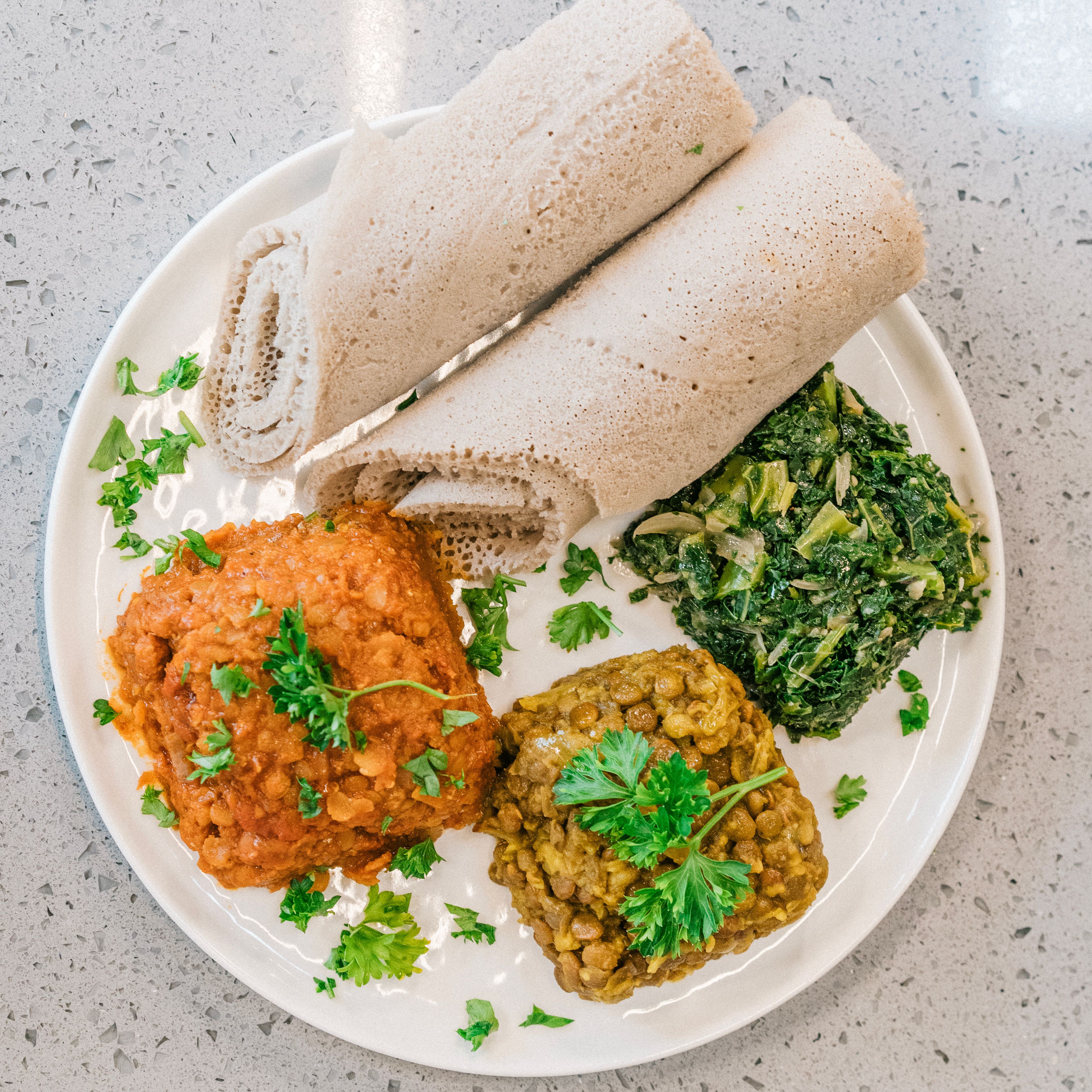
Photo: Deane Bayas / Pexels
The diets react (see scores below)
Common Ingredients
- injera
- red lentils
- chickpeas
- collard greens
- cabbage
- potatoes
- berbere
- niter kibbeh
Specific recipes may vary.
Incompatible with 6 of 11 diets
Diet Ratings
Beyainatu is fundamentally incompatible with ketogenic eating. The dish is built around multiple high-carb ingredients that together make it impossible to fit within keto macros. Injera alone — a fermented teff flatbread used as both plate and utensil — contains roughly 20-25g net carbs per piece and is grain-based, making it an immediate disqualifier. Beyond the injera, the dish stacks carb sources: red lentils (~20g net carbs per half cup), chickpeas (~22g net carbs per half cup), and potatoes (~15-20g net carbs per medium potato) collectively push net carbs far beyond the 20-50g daily keto ceiling in a single serving. While collard greens and cabbage are keto-friendly, and niter kibbeh (spiced clarified butter) is an excellent keto fat source, these positives are entirely overwhelmed by the carbohydrate load of the other ingredients. Berbere spice is also fine in small amounts. However, no reasonable portion of this dish as traditionally prepared can fit within ketogenic parameters.
Beyainatu is a traditional Ethiopian platter of assorted vegetarian dishes served on injera, and the plant-based components — lentils, chickpeas, collard greens, cabbage, potatoes, berbere spice blend, and injera itself — are all fully vegan. However, this dish as listed includes niter kibbeh, a spiced clarified butter (ghee) that is a foundational cooking fat in Ethiopian cuisine. Niter kibbeh is an animal-derived dairy product, which definitively places this dish outside vegan compliance. Without niter kibbeh, and substituting a plant-based oil (such as coconut oil or vegan niter kibbeh made with vegetable shortening), the dish would score 8–9 and be fully approvable. As described with the traditional ingredient, it must be rated avoid.
Beyainatu is a traditional Ethiopian fasting platter that is fundamentally incompatible with the paleo diet. It contains multiple hard-excluded ingredients: injera (made from teff, a grain), red lentils (legume), and chickpeas (legume). Niter kibbeh is a spiced clarified butter, which is a dairy derivative and discouraged under strict paleo guidelines. Potatoes are debated but would be the least problematic ingredient here. The dish's identity is built around legumes and grain-based bread — both of which are categorically excluded from paleo with high consensus. The approved components (collard greens, cabbage, berbere spice blend) are paleo-friendly, but they represent a small fraction of the dish and cannot offset the core violations.
Beyainatu is a plant-forward Ethiopian combination platter featuring legumes (red lentils, chickpeas), cruciferous vegetables (collard greens, cabbage), and potatoes — all strongly aligned with Mediterranean diet principles. The berbere spice blend is a flavorful, whole-ingredient seasoning with no issues. However, two factors introduce complexity: (1) Injera is made from teff, a whole grain, which is nutritious, but the fermented flatbread is typically made in large quantities and acts as a significant refined-carbohydrate-adjacent base — teff is not a traditional Mediterranean grain, though it is whole. (2) Niter kibbeh is a spiced clarified butter (ghee-like), which is a saturated animal fat rather than olive oil, directly substituting the Mediterranean diet's primary fat source. The dish is excellent in terms of plant diversity and legume content, but the butter-based fat and non-traditional grain base temper a full approval.
Some Mediterranean diet interpreters would rate this more favorably, noting that teff-based injera is a whole grain with a low-to-moderate glycemic impact due to fermentation, and that small amounts of clarified butter appear in some regional Mediterranean traditions (e.g., North African cooking). The overwhelming plant diversity and legume density could justify a higher score under a more flexible interpretation.
Beyainatu is a traditional Ethiopian vegan platter that is entirely plant-based, making it completely incompatible with the carnivore diet. Every single ingredient violates carnivore principles: injera is a fermented grain flatbread (teff), red lentils and chickpeas are legumes, collard greens and cabbage are vegetables, potatoes are starchy tubers, and berbere is a plant-based spice blend. The only ingredient with any animal connection is niter kibbeh (a spiced Ethiopian clarified butter), but even that is a dairy derivative infused with plant spices, making it debated even within carnivore. There is no animal protein whatsoever — the primary protein source is lentils. This dish represents essentially everything the carnivore diet excludes.
Beyainatu contains multiple Whole30-excluded ingredients that make it firmly non-compliant. First, injera is a fermented flatbread made from teff (a grain), which is excluded as both a grain and a bread/baked good. Second, lentils are explicitly excluded legumes. Third, chickpeas are also excluded legumes. Niter kibbeh is a spiced clarified butter, which is similar to ghee and potentially compliant on its own, but the dish as a whole is disqualified by the injera, lentils, and chickpeas alone. The collard greens, cabbage, potatoes, and berbere spice blend are all compliant, but they cannot redeem a dish with three major excluded components.
Beyainatu is a traditional Ethiopian platter featuring multiple high-FODMAP ingredients that make it unsuitable during the elimination phase. The dish contains several major FODMAP offenders: (1) Injera is made from teff flour but is typically fermented and may also contain wheat or barley, and a full serving-sized piece represents a large carbohydrate load — teff itself is low-FODMAP, but standard injera portions and mixed-grain recipes are problematic. (2) Chickpeas are high in GOS and are high-FODMAP at any typical serving size (safe only at a very restricted 42g canned/drained portion, which is far less than a full dish serving). (3) Red lentils contain GOS and are high-FODMAP unless consumed in very small amounts (under ~23g dried or ~46g cooked). (4) Berbere spice blend almost universally contains garlic and onion, both of which are among the highest-FODMAP foods due to fructans — even small amounts can trigger symptoms. (5) Niter kibbeh (spiced clarified butter) is typically infused with onion and garlic during preparation; unlike garlic-infused oil where FODMAPs stay behind, niter kibbeh involves straining solids but FODMAP fructans may partially transfer. With multiple high-FODMAP ingredients — particularly chickpeas, lentils in full serving sizes, and garlic/onion in berbere and niter kibbeh — this dish is essentially unavoidable as a FODMAP trigger in its traditional form.
Beyainatu is a Ethiopian vegetarian platter featuring multiple DASH-friendly components: red lentils and chickpeas provide excellent plant-based protein, fiber, potassium, and magnesium; collard greens and cabbage are core DASH vegetables rich in calcium, potassium, and fiber; potatoes contribute potassium. These elements strongly align with DASH principles. However, two ingredients introduce concern: (1) Niter kibbeh is a spiced clarified butter (similar to ghee) that is high in saturated fat — DASH explicitly limits saturated fat and recommends low-fat over full-fat dairy-derived fats. (2) Injera, while made from teff (a whole grain with good nutritional profile), is fermented and can have moderate sodium content depending on preparation. Berbere spice blend is generally low-sodium when homemade but commercial versions can add sodium. The dish is not as problematic as meat-based Ethiopian dishes, but the niter kibbeh component is a meaningful saturated fat concern that prevents a full 'approve' verdict. In typical restaurant portions, niter kibbeh is used generously, which compounds the saturated fat load.
NIH DASH guidelines categorically limit saturated fat and full-fat dairy-derived fats like clarified butter, which would keep this dish at 'caution.' However, updated clinical interpretations and emerging research (including some meta-analyses) suggest that dairy-derived fats like ghee/clarified butter may have a more neutral cardiovascular effect than previously thought, and some DASH-oriented dietitians now focus more on overall dietary pattern quality — in which case this largely plant-based, high-fiber, high-potassium dish could be viewed more favorably.
Beyainatu is a traditional Ethiopian platter featuring multiple vegetable and legume stews served on injera. From a Zone perspective, it presents a mixed picture. On the positive side, it includes several Zone-favorable ingredients: collard greens and cabbage are excellent low-glycemic vegetables, red lentils and chickpeas provide vegetarian protein along with fiber-rich carbs, and berbere spices are anti-inflammatory and polyphenol-rich. However, the dish has significant Zone challenges. Injera, made from teff, is a high-glycemic fermented flatbread that dominates the carbohydrate load and is classified as an 'unfavorable' Zone carb — it spikes blood sugar rapidly despite some fermentation benefits. Potatoes are explicitly unfavorable in Zone due to high glycemic impact. Niter kibbeh (spiced clarified butter) is a saturated fat source that Zone traditionally limits, though Dr. Sears' later writings are more permissive of dairy-derived saturated fats in context. As a vegetarian meal, the protein sources (lentils, chickpeas) come packaged with substantial carbohydrates, making it very difficult to hit 30% protein calories without the ratio being overwhelmed by carbs — especially with injera and potatoes adding to the carb load. The fat profile is also saturated rather than monounsaturated. A Zone practitioner could partially adapt this dish by eating a smaller portion of injera, skipping potatoes, and emphasizing the legume and greens stews, but as traditionally served, the macronutrient ratio skews heavily carbohydrate-forward with unfavorable glycemic sources.
Some Zone practitioners following Dr. Sears' later anti-inflammatory framework (Toxic Fat, The Mediterranean Zone) might rate this slightly more favorably, noting that teff injera contains more fiber and nutrients than white bread, lentils and chickpeas are among the most Zone-compatible carb-protein dual sources, and niter kibbeh in small amounts is not categorically excluded in updated Zone thinking. The polyphenol richness of berbere and the abundance of vegetables could also elevate its anti-inflammatory score in Sears' OmegaRx Zone framework. However, the potato inclusion and the sheer injera volume remain hard to reconcile with classic Zone block ratios.
Beyainatu is a traditional Ethiopian mixed vegetarian platter with a strong anti-inflammatory foundation. Red lentils and chickpeas are excellent sources of plant protein, fiber, and polyphenols that reduce inflammatory markers. Collard greens and cabbage are cruciferous vegetables rich in antioxidants, vitamin K, and glucosinolates. Berbere spice blend typically contains chili pepper, turmeric, ginger, fenugreek, garlic, and coriander — all well-established anti-inflammatory agents. Potatoes are a neutral whole food with some antioxidants (vitamin C, carotenoids in colored varieties). The primary concern is niter kibbeh, a spiced clarified butter that is a source of saturated fat, which is on the 'limit' list in anti-inflammatory frameworks. However, niter kibbeh is used as a cooking fat rather than a main ingredient, and is infused with anti-inflammatory spices (turmeric, ginger, onion, garlic), which partially offsets concerns. Injera (fermented teff flatbread) is a whole grain with a low glycemic index and beneficial fermentation byproducts, though it is a processed grain product. Overall, the dish is predominantly plant-based, fiber-rich, legume-forward, and spice-heavy — well aligned with anti-inflammatory principles despite the modest saturated fat contribution from niter kibbeh.
The niter kibbeh (spiced clarified butter) contributes saturated fat, which mainstream anti-inflammatory guidance recommends limiting. Some stricter anti-inflammatory practitioners would lower the rating due to butter-based fats, while others note that clarified butter in small culinary quantities, especially spice-infused, is far less concerning than processed fats and may even carry fat-soluble beneficial compounds from the spices.
Beyainatu is a traditional Ethiopian vegetarian feast plate featuring multiple plant-based components. The combination of red lentils and chickpeas provides a meaningful plant-based protein contribution and excellent fiber, and the collard greens, cabbage, and other vegetables add micronutrient density. However, this dish presents several GLP-1-specific concerns. First, protein density is moderate at best — lentils and chickpeas are good plant proteins but require substantial volume to reach the 15-30g per meal target, which is challenging on a reduced appetite. Second, niter kibbeh (Ethiopian spiced clarified butter) is a saturated fat that can worsen nausea and GI side effects; the amount used matters greatly but it is integral to the dish. Third, injera is a fermented teff flatbread — while teff has decent fiber and some protein, injera is a refined-carbohydrate-forward base and is typically consumed in large portions as a vehicle for the stews; on a GLP-1-reduced appetite, it may crowd out more nutritionally dense bites. Fourth, berbere spice blend contains chili peppers and can be quite spicy, which may worsen reflux or nausea in sensitive GLP-1 patients. The potatoes add bulk with limited protein payoff. As a shared or sampler-style meal, portion control is difficult. The dish is not fried and is largely whole-food-based, which keeps it out of the avoid category, but the fat from niter kibbeh, the spice load, the injera volume, and the moderate protein density collectively warrant caution.
Some GLP-1-focused dietitians view legume-heavy plant-based plates like beyainatu positively, emphasizing that lentils and chickpeas together can approach adequate protein with high fiber and low glycemic impact — and that the fermented injera may support gut microbiome health. Others flag the saturated fat in niter kibbeh and the spice intensity of berbere as meaningful GI risk factors for GLP-1 patients, particularly in the early weeks of treatment when nausea and reflux are most prominent.
*See how scores were generated at our methodology page.
Nutritional profile
Six traits that cut across every diet.
Fiber & Plants
How much whole-plant food and fiber it delivers.
Healthy Fats
The quality of its fats (unsaturated, omega-3).
Whole / Unprocessed
How close it is to its natural, unprocessed form.
Gut Gentle
How easy it is on digestion (low FODMAP, few irritants).
Low Glycemic
How little it spikes your blood sugar.
Protein Density
How much protein it packs per calorie.
Controversy Index
Higher controversy = more disagreement between diets.
Diet-Specific Tips
 Mediterranean — 6/10
View tips
- High legume content (red lentils, chickpeas) — strongly Mediterranean-aligned
- Abundant vegetables (collard greens, cabbage, potatoes) — plant-forward
- Berbere spice blend is whole-ingredient and diet-compatible
- Niter kibbeh (spiced clarified butter) replaces olive oil as the primary fat — not Mediterranean-canonical
- Injera (teff-based fermented flatbread) is a whole grain but non-traditional to Mediterranean cuisine
- No red meat, processed ingredients, or added sugars
- Overall dish is plant-dominant and nutrient-dense despite fat source concern
 DASH — 6/10
View tips
- Lentils and chickpeas are ideal DASH plant proteins — high in fiber, potassium, and magnesium
- Collard greens and cabbage are core DASH vegetables with excellent micronutrient profiles
- Niter kibbeh (spiced clarified butter) is high in saturated fat, which DASH explicitly limits
- Teff-based injera is a whole grain but fermentation may introduce moderate sodium
- Berbere spice blend is low-sodium when homemade; commercial versions may add sodium
- Overall dish is plant-forward and vegetarian, strongly aligning with DASH's dietary pattern emphasis
- Saturated fat content from niter kibbeh is the primary limiting factor for a higher score
 Zone — 4/10
View tips
- Injera is a high-glycemic 'unfavorable' Zone carbohydrate that dominates the carb load
- Potatoes are explicitly unfavorable in Zone due to high glycemic index
- Red lentils and chickpeas are vegetarian protein sources but carry significant carb load, making Zone ratios difficult
- Collard greens and cabbage are excellent Zone-favorable low-glycemic vegetables
- Niter kibbeh is a saturated fat source, not the preferred monounsaturated fat in Zone
- As a vegetarian meal, fat blocks should be counted at 3g fat per block, but saturated fat is not the ideal type
- Berbere spices provide anti-inflammatory polyphenols, a positive in Sears' framework
- Dish as traditionally served is heavily carbohydrate-dominant, difficult to balance to 40/30/30 without major modification
 Anti-Inflammatory — 7/10
View tips
- Red lentils and chickpeas provide plant protein, fiber, and anti-inflammatory polyphenols
- Collard greens and cabbage are antioxidant-rich cruciferous vegetables
- Berbere spice blend contains turmeric, ginger, chili, and garlic — potent anti-inflammatory agents
- Niter kibbeh (spiced clarified butter) adds saturated fat, a moderate concern in anti-inflammatory diet
- Injera made from teff is a whole grain with fermentation benefits and low glycemic load
- Potatoes are a neutral starchy vegetable — anti-inflammatory when unprocessed
- Dish is entirely plant-based protein with no red meat or processed ingredients
 GLP-1 Friendly — 5/10
View tips
- Lentils and chickpeas provide plant-based protein and high fiber, supporting two top GLP-1 priorities
- Niter kibbeh (spiced clarified butter) adds saturated fat that may worsen nausea and GI side effects
- Berbere spice blend may trigger or worsen reflux and nausea in GLP-1 patients
- Injera is carbohydrate-dense and typically consumed in large volume, reducing per-calorie nutrient density
- Protein per serving is moderate — reaching 15-30g target requires large portions, difficult with GLP-1-reduced appetite
- Potatoes add caloric bulk with limited protein contribution
- Dish is whole-food-based and not fried, which is a meaningful positive
- Portion control is inherently difficult with a shared communal plate format