Photo: Keesha's Kitchen / Pexels
The diets react (see scores below)
Common Ingredients
- tripe
- liver
- beef
- niter kibbeh
- berbere
- onion
- garlic
- green chili
Specific recipes may vary.
Incompatible with 6 of 11 diets
Diet Ratings
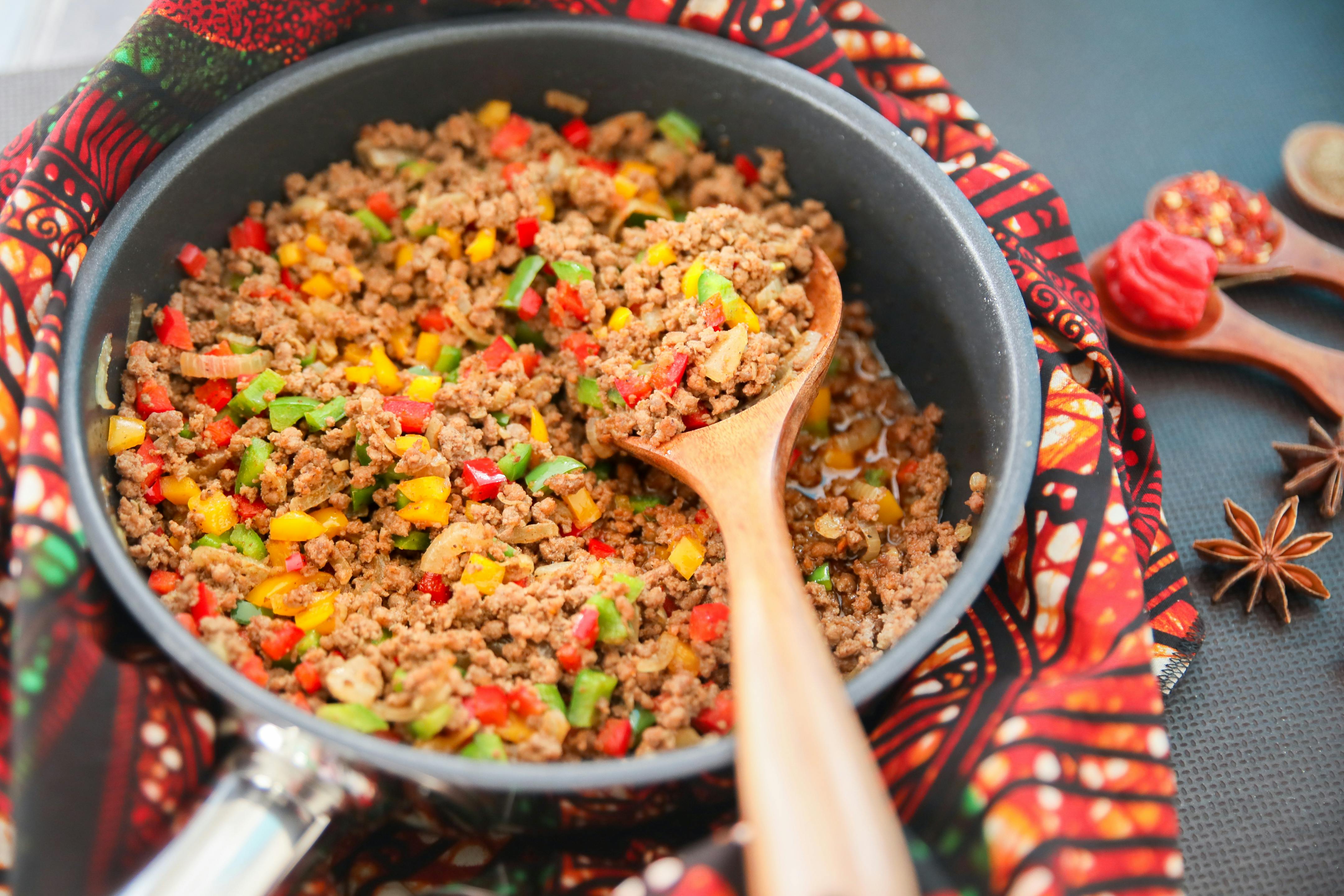
Dulet is an Ethiopian minced offal dish combining tripe, liver, and beef cooked in niter kibbeh (spiced clarified butter) with berbere spice blend, onion, garlic, and green chili. The core ingredients are highly keto-compatible: beef and tripe are high-fat, zero-carb meats, and niter kibbeh adds healthy saturated fats. The main carb concern is liver, which contains roughly 3-4g net carbs per 3oz serving, and onion/garlic add a small amount. Berbere spice blend typically contains small amounts of fenugreek and other spices that add minimal carbs at culinary quantities. In a standard serving, total net carbs likely fall in the 5-8g range, well within keto limits. The high fat content from niter kibbeh and the protein-rich organ meats make this a nutrient-dense keto-friendly dish.
Some strict keto practitioners flag liver due to its glycogen content and moderate carb load, arguing that organ meats should be limited to small portions to avoid inadvertently spiking blood sugar, especially when combined with onion and berbere spice blends that may contain hidden sugars or starches.
Dulet is an Ethiopian dish composed almost entirely of animal products. Tripe (beef stomach), liver, and beef are all meat/organ meats, making this dish fundamentally incompatible with a vegan diet. Niter kibbeh, the spiced clarified butter central to Ethiopian cuisine, is a dairy-derived fat. Every primary ingredient — tripe, liver, beef, and niter kibbeh — is animal-derived. The only vegan components are the seasonings and aromatics (berbere, onion, garlic, green chili).
Dulet is a traditional Ethiopian minced offal dish featuring tripe, liver, and beef — all of which are highly paleo-approved organ meats and muscle meat. The aromatics (onion, garlic, green chili, berbere spice blend) are paleo-compliant vegetables and spices. The primary concern is niter kibbeh, the spiced Ethiopian clarified butter used as the cooking fat. Like ghee, niter kibbeh is a clarified butter with milk solids removed during the infusion process, placing it in the same contested dairy-derivative category. Strict Cordain-school paleo excludes all dairy derivatives including clarified butters, while most modern paleo practitioners accept ghee and by extension niter kibbeh. Berbere spice blends are generally paleo-friendly (chili, fenugreek, coriander, etc.), though some commercial blends may contain added salt — homemade or pure versions are preferred. The dish itself is an excellent example of nose-to-tail eating that aligns well with ancestral diet philosophy.
Strict Cordain-school paleo (The Paleo Diet) discourages all dairy derivatives including clarified butters like niter kibbeh and ghee, arguing that any butter-derived fat falls outside true Paleolithic eating. Replacing niter kibbeh with coconut oil or avocado oil would make this dish fully approved under the strictest interpretation.
Dulet is an Ethiopian dish made primarily from organ meats (tripe and liver) and beef, cooked in niter kibbeh (a spiced clarified butter). From a Mediterranean diet perspective, this dish presents multiple conflicts: it centers on red meat and organ meats, which are limited to a few times per month; the primary fat is niter kibbeh (butter-based), not olive oil; and while organ meats are nutrient-dense, they are high in saturated fat and cholesterol. The aromatics (onion, garlic, chili, berbere spices) are Mediterranean-friendly, but they are not sufficient to offset the core issues. The dish is heavily animal-protein-centric with no plant-based staples as the foundation.
Some Mediterranean diet interpreters note that organ meats like liver are extremely nutrient-dense (rich in B12, iron, and folate) and were historically consumed in traditional Mediterranean and Middle Eastern cuisines in small quantities. A small portion of liver occasionally could be tolerated within a broader plant-forward dietary pattern, nudging the score slightly upward in that framing.
Dulet contains excellent carnivore-friendly animal ingredients — tripe, liver, and beef are organ and muscle meats that would score a 10 on their own, and niter kibbeh (spiced clarified butter) is dairy-derived but largely accepted. However, the dish is heavily laden with plant-based ingredients that disqualify it from carnivore compliance: berbere spice blend (a complex mix of plant spices and chili peppers), onion, garlic, and green chili are all plant foods explicitly excluded from the carnivore diet. These are not trace additives — they are core, structural components of the dish that cannot be removed without fundamentally changing the recipe. The dish as prepared must be rated avoid.
Dulet is an Ethiopian minced offal dish combining tripe, liver, and beef with niter kibbeh (Ethiopian spiced clarified butter), berbere spice blend, onion, garlic, and green chili. The core ingredients are Whole30-compliant: organ meats and beef are allowed, and niter kibbeh — being a clarified butter — falls under the explicit dairy exception for ghee and clarified butter. Onion, garlic, and green chili are all permitted vegetables. Berbere spice blends, however, are where caution is warranted: store-bought or restaurant versions frequently include fillers, added sugars, or non-compliant additives, so the spice blend must be verified or made from scratch. When prepared with a clean berbere (dried chilies, fenugreek, coriander, black pepper, etc.) and verified compliant niter kibbeh, the dish is technically Whole30-compliant. The caution rating reflects the real-world likelihood that restaurant or packaged versions of berbere or niter kibbeh contain non-compliant ingredients.
Official Whole30 guidelines endorse organ meats and clarified butter as compliant; however, the community flags that restaurant preparations of Ethiopian dishes often use spice blends or spiced butters with unknown additives or trace sugars, making home preparation with verified ingredients the only reliable compliant option.
Dulet contains two major high-FODMAP ingredients that make it incompatible with the elimination phase: garlic and onion. Both are among the highest-fructan foods in the Monash system and are consistently rated as 'avoid' at any culinary amount. Garlic in particular is one of the most concentrated sources of fructans and is problematic even in trace amounts when used as an ingredient (as opposed to garlic-infused oil). Onion is similarly high-fructan at any serving size. The berbere spice blend traditionally contains both garlic and onion powder, compounding the fructan load further. The remaining ingredients — tripe, liver, beef, niter kibbeh (clarified butter spiced with aromatics including onion and garlic), and green chili — present additional concerns. Niter kibbeh is infused with onion and garlic during preparation, and while clarified fats don't carry water-soluble FODMAPs in the same way garlic-infused oil does, the preparation method for niter kibbeh typically leaves onion and garlic solids or residue. The combination of multiple high-FODMAP sources makes this dish clearly unsuitable during the elimination phase.
Dulet is an Ethiopian dish made from minced tripe, liver, and beef cooked in niter kibbeh (a spiced clarified butter) with berbere spice blend. Several components conflict with DASH principles. Niter kibbeh is a saturated fat-dense clarified butter, directly violating DASH's limit on saturated fats and its preference for vegetable oils over animal fats. Organ meats like tripe and liver are high in cholesterol and saturated fat. Berbere spice blends typically contain significant sodium, and the combination of multiple processed/spiced ingredients can push sodium content well above DASH thresholds. While the dish does include onion, garlic, and green chili (DASH-friendly aromatics), and liver provides iron and some B vitamins, these benefits are outweighed by the high saturated fat load from niter kibbeh and organ meats. Red meat (beef) is already a DASH-limited food, and pairing it with organ meats and clarified butter compounds the concern.
NIH DASH guidelines broadly restrict saturated fat and organ meats, but some updated clinical interpretations note that liver is extraordinarily nutrient-dense (rich in iron, B12, folate, and potassium — all DASH-aligned nutrients), and that moderate organ meat consumption may not be categorically harmful for non-hypertensive individuals. A DASH-conscious preparation substituting niter kibbeh with a small amount of olive or canola oil and using low-sodium berbere could improve the profile meaningfully.
Dulet is an Ethiopian minced offal dish combining tripe, liver, and beef with niter kibbeh (a spiced clarified butter), berbere spice blend, onion, garlic, and green chili. From a Zone perspective, the protein sources are mixed quality: liver is actually excellent nutritionally (very lean, dense in micronutrients) and fits Zone protein blocks well; tripe is moderately lean; and lean beef is acceptable. These organ meats provide solid protein blocks. However, the fat profile is the primary concern — niter kibbeh is essentially spiced clarified butter (ghee), which is predominantly saturated fat rather than the preferred monounsaturated fats Zone favors. The dish is also protein-and-fat heavy with minimal carbohydrates, making it difficult to achieve the 40/30/30 ratio without significant additions of low-glycemic vegetables. The berbere spice blend, onions, garlic, and green chilies are Zone-favorable and add polyphenols and anti-inflammatory compounds. To bring this into Zone balance, one would need to reduce the niter kibbeh significantly, pair the dish with a large serving of low-glycemic vegetables, and portion the meat carefully to ~3 oz. The dish is not inherently 'avoid,' but requires substantial modification and pairing to fit Zone ratios.
In Sears' later anti-inflammatory writings (The OmegaRx Zone, The Anti-Inflammation Zone), he somewhat softened his stance on saturated fat, acknowledging that not all saturated fat is equally problematic. Some Zone practitioners would argue that organ meats like liver are among the most nutrient-dense proteins available and that a small amount of clarified butter in a largely protein-rich dish is manageable within Zone blocks, especially given berbere's strong polyphenol content. Others would flag that without a carbohydrate component, this dish structurally cannot form a complete Zone meal on its own.
Dulet is a traditional Ethiopian minced offal dish combining tripe, liver, and beef with niter kibbeh (spiced clarified butter), berbere spice blend, onion, garlic, and green chili. The profile is genuinely mixed. On the pro side: liver is extraordinarily nutrient-dense, rich in B vitamins, iron, zinc, and selenium — nutrients that support antioxidant enzyme function (glutathione peroxidase). Berbere is a powerhouse anti-inflammatory spice blend containing turmeric, fenugreek, ginger, garlic, chili peppers, and black pepper — all well-supported anti-inflammatory ingredients. Garlic and onion contribute quercetin, allicin, and organosulfur compounds with documented anti-inflammatory effects. Green chili provides capsaicin. On the cautionary side: niter kibbeh is a clarified butter, meaning significant saturated fat — a LIMIT ingredient under anti-inflammatory guidelines. Organ meats (tripe, liver) are also high in arachidonic acid, a precursor to pro-inflammatory eicosanoids, which is a meaningful concern especially in quantity. Red meat (beef) is a LIMIT food. The dish contains no omega-3 sources, no fiber-rich vegetables beyond aromatics, and no antioxidant-rich produce. The combination of saturated fat from niter kibbeh plus arachidonic acid-rich organ meats offsets the genuine benefits of the spice blend. This is an occasional food rather than a regular choice on an anti-inflammatory diet.
Some functional medicine and ancestral diet proponents (including Weston A. Price Foundation adherents) would rate organ meats significantly higher, arguing that their dense nutrient profile — particularly CoQ10, vitamin A, and choline in liver — supports cellular anti-inflammatory processes, and that arachidonic acid from whole-food sources is not automatically pro-inflammatory in the context of a balanced diet. Conversely, strict anti-inflammatory protocols following Dr. Weil's pyramid would emphasize that organ meats, clarified butter, and red meat together constitute multiple LIMIT/AVOID categories simultaneously, pushing this toward a lower score.
Dulet is a traditional Ethiopian dish made from minced raw or lightly cooked offal (tripe, liver) combined with lean beef, but prepared with niter kibbeh (a spiced clarified butter used generously) and berbere (a fiery spice blend). While the organ meats and beef provide meaningful protein, the dish poses multiple serious concerns for GLP-1 patients. Niter kibbeh is a saturated-fat-heavy cooking fat used in substantial quantities, driving up fat per serving significantly and increasing risk of nausea, bloating, and reflux — the exact side effects GLP-1 medications exacerbate. Berbere and green chili create a high spice load that can worsen GI discomfort and reflux in patients with slowed gastric emptying. Organ meats like tripe and liver are also harder to digest and can sit heavily in a stomach that empties slowly on GLP-1 therapy. The combination of high saturated fat, intense spice, and difficult digestibility makes this a poor choice for GLP-1 patients regardless of its protein content.
Some GLP-1-informed dietitians may note that liver is exceptionally nutrient-dense — rich in B12, iron, and zinc, nutrients that become depleted during rapid weight loss on GLP-1s — and that small portions of organ meat could theoretically be tolerated by patients with low spice and fat sensitivity. However, the specific preparation of Dulet (niter kibbeh fat load plus berbere heat) makes a favorable rating difficult to justify for most patients.
*See how scores were generated at our methodology page.
Nutritional profile
Six traits that cut across every diet.
Fiber & Plants
How much whole-plant food and fiber it delivers.
Healthy Fats
The quality of its fats (unsaturated, omega-3).
Whole / Unprocessed
How close it is to its natural, unprocessed form.
Gut Gentle
How easy it is on digestion (low FODMAP, few irritants).
Low Glycemic
How little it spikes your blood sugar.
Protein Density
How much protein it packs per calorie.
Controversy Index
Higher controversy = more disagreement between diets.
Diet-Specific Tips
 Keto — 8/10
View tips
- Beef and tripe are zero-carb, high-fat keto staples
- Niter kibbeh (spiced clarified butter) adds substantial healthy fat
- Liver contributes ~3-4g net carbs per serving — manageable but notable
- Onion, garlic, and berbere add minor carbs at typical culinary amounts
- No grains, starchy vegetables, or added sugars
- Overall net carb estimate per serving: 5-8g, within keto limits
 Paleo — 6/10
View tips
- Tripe, liver, and beef are all paleo-approved organ and muscle meats
- Niter kibbeh (spiced clarified butter) is a dairy derivative — debated in paleo, similar to ghee
- Onion, garlic, and green chili are paleo-approved vegetables
- Berbere spice blend is generally paleo-compliant; caution with commercial versions containing added salt
- Excellent nose-to-tail eating philosophy aligns with ancestral diet principles
- No grains, legumes, or seed oils present
 Whole30 — 6/10
View tips
- Niter kibbeh is clarified/spiced butter — falls under the explicit ghee/clarified butter exception
- Berbere spice blends must be label-checked or homemade — commercial blends may contain sugar or non-compliant additives
- Tripe, liver, and beef are fully allowed as organ meats and whole cuts
- Onion, garlic, and green chili are compliant vegetables
- Restaurant versions present high risk of non-compliant ingredient exposure
 Zone — 5/10
View tips
- Niter kibbeh (spiced clarified butter) is high in saturated fat, conflicting with Zone's preference for monounsaturated fats
- Liver and tripe are lean, micronutrient-dense protein sources that fit Zone protein blocks reasonably well
- Dish is protein-and-fat dominant with very low carbohydrates — cannot achieve 40/30/30 ratio without significant vegetable additions
- Berbere, garlic, onion, and green chili are Zone-favorable ingredients with anti-inflammatory polyphenols
- Organ meats (particularly liver) are not highlighted as favorable Zone proteins in Sears' core writings despite being lean
- Would require pairing with substantial low-glycemic vegetables and portion control on the kibbeh to approach Zone compliance
 Anti-Inflammatory — 4/10
View tips
- Niter kibbeh (clarified butter) contributes significant saturated fat — a LIMIT ingredient
- Organ meats (liver, tripe) are high in arachidonic acid, a pro-inflammatory precursor
- Berbere spice blend is rich in anti-inflammatory compounds (turmeric, ginger, chili, garlic, fenugreek)
- Garlic and onion provide quercetin and organosulfur anti-inflammatory compounds
- Green chili contributes capsaicin with anti-inflammatory properties
- Liver is nutrient-dense with selenium and B vitamins supporting antioxidant function
- No omega-3 fatty acid sources present
- Limited dietary fiber and antioxidant-rich vegetables beyond aromatics
- Red meat (beef) is a LIMIT food under anti-inflammatory guidelines
- Best consumed occasionally rather than regularly