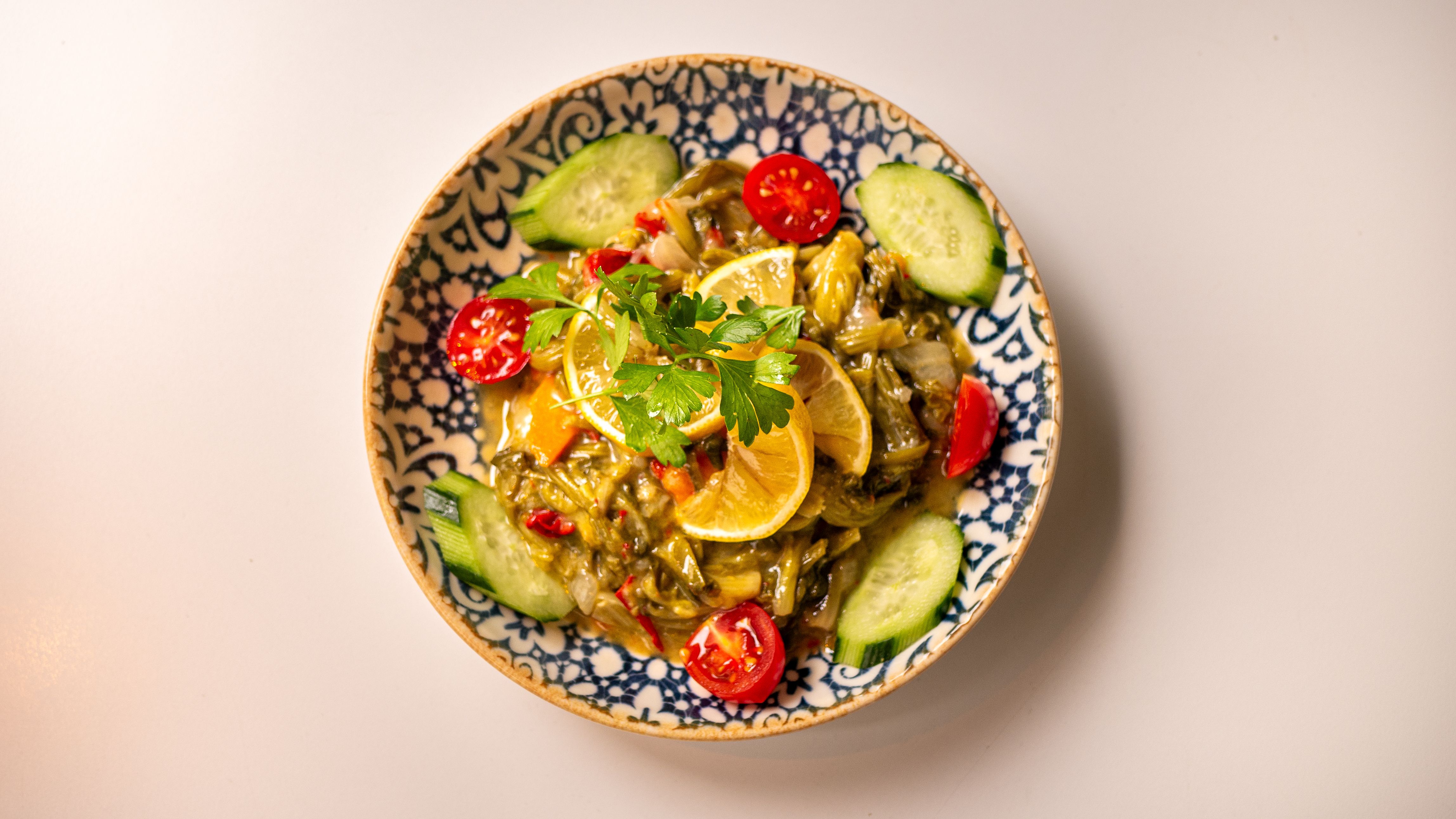
Photo: Nurefşan Çalışkan / Pexels
The diets react (see scores below)
Common Ingredients
- collard greens
- onion
- garlic
- ginger
- green chili
- niter kibbeh
- salt
Specific recipes may vary.
Incompatible with 3 of 11 diets
Diet Ratings
Gomen is an Ethiopian collard greens dish cooked in niter kibbeh (spiced clarified butter), which is an excellent keto fat source. Collard greens are a low-carb, fiber-rich leafy green with roughly 2-3g net carbs per cooked cup. Onion, garlic, and ginger add modest carbs but in typical cooking quantities remain within keto limits for a side dish. Green chili contributes negligible carbs. The niter kibbeh provides healthy saturated fat, making the macros highly favorable for ketosis. The dish is whole and unprocessed with no grains, added sugars, or starchy vegetables. Overall net carbs for a standard serving are likely 4-6g, well within daily limits.
Some stricter keto practitioners flag onion and garlic as moderate-carb aromatics that can accumulate across a full day's meals, and may caution that ginger adds small but non-trivial carbs; those following clinical or very strict (<20g) keto protocols might limit portion size or use these ingredients more sparingly.
Gomen is an Ethiopian braised collard greens dish that would otherwise be fully vegan, but this recipe explicitly lists niter kibbeh as an ingredient. Niter kibbeh is a traditional Ethiopian spiced clarified butter — an animal-derived dairy product — making this dish non-vegan. The base vegetables (collard greens, onion, garlic, ginger, green chili) are all plant-based, but the niter kibbeh is a core cooking fat that permeates the entire dish and cannot be considered incidental. A vegan version is achievable by substituting niter kibbeh with a spiced plant-based oil (e.g., coconut oil or vegan butter infused with the same spices), which is a common adaptation.
Gomen is an Ethiopian braised collard greens dish. Most of its ingredients are solidly paleo — collard greens, onion, garlic, ginger, and green chili are all whole vegetables approved under any paleo framework. However, two ingredients create friction: (1) Niter kibbeh is an Ethiopian spiced clarified butter (similar to ghee), which removes casein and lactose but remains a dairy derivative — its paleo status is debated, with strict Cordain-school paleo excluding all dairy, while most modern practitioners accept clarified butter; (2) Salt is explicitly discouraged under strict paleo guidelines (added salt was not available to Paleolithic humans in refined form), though it is widely tolerated in practice. These two debated ingredients prevent a clean approval, landing the dish in caution territory rather than avoid, since the base is otherwise exemplary whole-food paleo eating.
Strict followers of Loren Cordain's original framework would flag niter kibbeh as a dairy derivative and exclude it entirely, and would also object to added salt. However, Mark Sisson, Robb Wolf, and most contemporary paleo practitioners accept clarified butter (ghee-equivalents) given the removal of problematic dairy proteins, making niter kibbeh broadly tolerated in the modern paleo community.
Gomen is primarily a vegetable dish built on collard greens, onion, garlic, ginger, and green chili — all strongly aligned with Mediterranean diet principles. The problematic element is niter kibbeh, an Ethiopian spiced clarified butter. Butter is a saturated animal fat not traditionally part of the Mediterranean diet, where extra virgin olive oil is the canonical cooking fat. The vegetable base is excellent, but the cooking fat pulls this dish away from a full 'approve' rating. Used occasionally as a side dish with olive oil substituted, this would be ideal; as prepared with niter kibbeh, moderation is advised.
Some Mediterranean diet practitioners and researchers, particularly those focused on traditional regional practices, note that butter and clarified fats appear in certain Mediterranean-adjacent cuisines (e.g., North African and Middle Eastern traditions), and argue that spiced clarified butter in modest quantities as a cooking medium is acceptable. Modern clinical interpretations, however, consistently recommend minimizing saturated animal fats in favor of olive oil.
Gomen is an Ethiopian collard greens dish that is overwhelmingly plant-based. The primary ingredient is collard greens, a leafy vegetable, accompanied by onion, garlic, ginger, and green chili — all plant-derived and strictly excluded from the carnivore diet. While niter kibbeh (Ethiopian spiced clarified butter) is an animal-derived fat, it is merely a cooking medium here and contains plant spices. The dish has no primary animal protein and is fundamentally a vegetable preparation. No meaningful carnivore criteria are met by this dish.
Gomen (Ethiopian braised collard greens) is largely Whole30-compliant. Collard greens, onion, garlic, ginger, green chili, and salt are all approved whole foods. The key ingredient requiring attention is niter kibbeh — Ethiopian spiced clarified butter. Clarified butter (like ghee) is explicitly allowed on Whole30, so niter kibbeh made from clarified butter with compliant spices (onion, garlic, ginger, turmeric, etc.) is technically compliant. However, niter kibbeh is a complex spiced butter that could contain non-compliant additions depending on the recipe or commercial preparation. If made homemade from clarified butter and whole spices, it is fully compliant. If purchased commercially, label-reading is required to ensure no added sugars, non-compliant oils, or other excluded ingredients are present.
Some Whole30 practitioners may question whether traditional niter kibbeh preparations always use fully clarified butter (with all milk solids removed) versus regular spiced butter, which would make it non-compliant. Official Whole30 guidelines permit only ghee/clarified butter as the dairy exception, so any version retaining milk solids would violate the rules.
Gomen contains two high-FODMAP ingredients that make it unsuitable during the elimination phase: onion and garlic. Both are among the highest-fructan foods in the FODMAP system and are rated 'avoid' by Monash University at any culinary serving size. There is no realistic portion of this dish that would exclude a meaningful amount of these aromatics, as they are foundational to the recipe. Collard greens are low-FODMAP at standard servings (Monash rates them as green light). Ginger is low-FODMAP at typical culinary amounts. Green chili is low-FODMAP at small servings. Niter kibbeh (Ethiopian spiced clarified butter) is made by infusing butter with onion, garlic, and other spices — clarified butter itself is low-FODMAP, but the traditional preparation involves cooking alliums directly into the fat. Since FODMAPs are water-soluble and not fat-soluble, garlic- and onion-infused oils/fats are technically low-FODMAP if the solids are removed, but niter kibbeh often retains spice particles and is not strictly an infused oil in the garlic-infused oil sense. The dominant disqualifying factors are the whole onion and garlic cloves used as primary aromatics in the dish itself.
Gomen is an Ethiopian collard greens dish that features several DASH-friendly ingredients: collard greens are an excellent source of potassium, calcium, magnesium, and fiber; onion, garlic, ginger, and green chili add flavor without sodium concerns. However, the defining issue is niter kibbeh — a spiced clarified butter that is a staple Ethiopian cooking fat. Clarified butter is high in saturated fat, which DASH explicitly limits. The amount of niter kibbeh used in traditional gomen can be substantial (2–4 tablespoons per serving), potentially adding 5–10g of saturated fat per serving, pushing it into 'caution' territory. Salt added during cooking is also a concern, as home preparation varies widely. The underlying vegetable base is strongly DASH-aligned, making this a conditionally acceptable dish if niter kibbeh is used sparingly or substituted with a DASH-approved oil (e.g., olive or canola oil), and salt is minimized.
NIH DASH guidelines clearly limit saturated fat and specify vegetable oils over butter/clarified butter. However, some DASH-informed dietitians note that when niter kibbeh is used in modest amounts as a flavor enhancer rather than a primary cooking fat, and the dish is otherwise rich in vegetables, the overall nutritional profile may still be compatible with DASH goals — particularly given collard greens' exceptional micronutrient density.
Gomen is an Ethiopian braised collard greens dish that is largely Zone-friendly in its vegetable base but is complicated by the use of niter kibbeh (Ethiopian spiced clarified butter), which is a saturated fat source rather than the monounsaturated fats Dr. Sears prefers. The collard greens, onion, garlic, ginger, and green chili are excellent Zone carbohydrate choices — all low-glycemic, high in fiber, and rich in polyphenols, fitting the 'favorable' carbohydrate category well. However, niter kibbeh contributes saturated fat rather than the preferred monounsaturated fat (olive oil, avocado, almonds). The Zone does not categorically exclude saturated fat, but it does favor limiting it. As a side dish with no protein, Gomen would need to be paired with a lean protein source to complete a Zone block meal. The fat from niter kibbeh can count toward the fat block, but the saturated fat profile is less ideal. Used in modest portions as a vegetable side alongside lean protein, this dish is quite workable in the Zone framework.
In Dr. Sears' earlier works (Enter the Zone, 1995), saturated fat was more strictly discouraged. However, in his later anti-inflammatory writings, Sears acknowledged that not all saturated fats are equally problematic, and traditional whole-food fat sources like clarified butter are arguably preferable to processed seed oils high in omega-6. Some Zone practitioners would rate Gomen more favorably given its exceptional vegetable base and the relatively small amount of niter kibbeh used per serving. Others would maintain the caution rating due to the saturated fat content.
Gomen is an Ethiopian braised collard greens dish with a strongly anti-inflammatory base: collard greens are rich in vitamins K, C, and beta-carotene, with proven antioxidant and anti-inflammatory properties. Garlic, ginger, and green chili are all well-regarded anti-inflammatory spices supported by research on allicin, gingerols, and capsaicin respectively. Onion adds quercetin, a potent flavonoid. The significant limiting factor is niter kibbeh — Ethiopian spiced clarified butter — which is a saturated fat source that the anti-inflammatory framework places in the 'limit' category. Clarified butter (ghee/niter kibbeh) lacks the trans fats of margarine, but its high saturated fat content is a concern under most anti-inflammatory protocols. However, the amount used as a cooking medium for vegetables is typically moderate, and the dish is otherwise highly plant-forward. The overall profile is mixed: excellent vegetable-forward ingredients undermined somewhat by saturated fat from the niter kibbeh. A version using extra virgin olive oil instead would score 8-9.
Some anti-inflammatory practitioners, particularly those informed by Ayurvedic and ancestral nutrition traditions, consider ghee and clarified butter to be neutral or even beneficial due to butyrate content and the absence of milk solids; Dr. Weil's framework does not explicitly condemn small amounts of butter or ghee. Conversely, stricter anti-inflammatory protocols flag saturated fat from dairy as pro-inflammatory and would penalize niter kibbeh more heavily regardless of amount.
Gomen is a traditional Ethiopian braised collard greens dish with strong nutritional merits — collard greens are high in fiber, rich in vitamins K, A, and C, and easy to digest when well-cooked. The aromatics (onion, garlic, ginger) are gut-supportive and nutrient-dense. However, the key concern is niter kibbeh, an Ethiopian spiced clarified butter that is high in saturated fat. Even modest amounts meaningfully raise the fat content of the dish, which can worsen GLP-1 side effects like nausea, bloating, and reflux. Green chili may also irritate some GLP-1 patients prone to reflux, though the quantity is typically small. As a side dish with no primary protein, it contributes fiber and micronutrients but does nothing to meet the critical protein targets for GLP-1 patients. It works best as a small accompaniment to a lean protein source, not as a standalone dish.
Some GLP-1-focused dietitians may rate this more favorably, noting that niter kibbeh is used in small quantities and the dish is otherwise an excellent source of fiber and micronutrients; they may view it as an acceptable high-fiber vegetable side. Others will flag the saturated fat content of clarified butter as a consistent trigger for GI side effects and recommend avoiding it or substituting olive oil.
*See how scores were generated at our methodology page.
Nutritional profile
Six traits that cut across every diet.
Fiber & Plants
How much whole-plant food and fiber it delivers.
Healthy Fats
The quality of its fats (unsaturated, omega-3).
Whole / Unprocessed
How close it is to its natural, unprocessed form.
Gut Gentle
How easy it is on digestion (low FODMAP, few irritants).
Low Glycemic
How little it spikes your blood sugar.
Protein Density
How much protein it packs per calorie.
Controversy Index
Higher controversy = more disagreement between diets.
Diet-Specific Tips
 Keto — 8/10
View tips
- Collard greens are a low net-carb leafy green, ideal for keto
- Niter kibbeh (spiced clarified butter) is a high-quality fat source that aligns well with keto macros
- Onion, garlic, and ginger contribute modest carbs but remain keto-compatible in typical cooking portions
- No grains, added sugars, or starchy vegetables present
- Whole, minimally processed ingredients
- Standard serving likely 4-6g net carbs
 Paleo — 5/10
View tips
- Collard greens, onion, garlic, ginger, and green chili are fully paleo-approved whole foods
- Niter kibbeh is a spiced clarified butter — dairy derivative with casein/lactose removed, status debated in paleo
- Salt is discouraged under strict paleo rules as a refined/added ingredient
- No grains, legumes, seed oils, or processed foods present
- Dish is otherwise a clean whole-food preparation consistent with paleo philosophy
 Mediterranean — 6/10
View tips
- Collard greens are a nutrient-dense leafy vegetable, strongly encouraged in Mediterranean eating
- Aromatics (onion, garlic, ginger, green chili) are all plant-based and diet-compatible
- Niter kibbeh (spiced clarified butter) is a saturated animal fat, not aligned with olive oil as primary fat
- No red meat, refined grains, or added sugars present
- Plant-forward dish overall with one significant deviation in cooking fat
- Easy adaptation: substituting olive oil for niter kibbeh would make this fully approvable
 Whole30 — 6/10
View tips
- Collard greens, onion, garlic, ginger, and green chili are all Whole30-approved vegetables
- Salt is explicitly permitted on Whole30
- Niter kibbeh is Ethiopian spiced clarified butter — clarified butter/ghee is the only dairy exception allowed on Whole30
- Homemade niter kibbeh from clarified butter and compliant spices is fully approved
- Commercial or restaurant niter kibbeh may use regular butter (not fully clarified) or contain non-compliant additives, requiring label/recipe verification
- Dish is otherwise a clean, whole-food preparation with no grains, legumes, or added sugars
 DASH — 5/10
View tips
- Collard greens are a DASH-approved vegetable rich in potassium, calcium, magnesium, and fiber
- Niter kibbeh (spiced clarified butter) is high in saturated fat, which DASH explicitly limits
- Salt quantity during preparation is variable and can significantly affect sodium content
- Aromatics (garlic, onion, ginger, chili) are DASH-friendly and reduce need for salt
- Dish can be made more DASH-compatible by substituting olive or canola oil for niter kibbeh
- No added sugar, processed ingredients, or red meat — vegetable-forward profile is a positive
 Zone — 6/10
View tips
- Collard greens are an excellent Zone 'favorable' carbohydrate — very low glycemic, high fiber, nutrient-dense
- Onion, garlic, ginger, and green chili are all favorable Zone carb additions with strong polyphenol profiles
- Niter kibbeh (spiced clarified butter) provides saturated fat rather than Zone-preferred monounsaturated fat
- No protein component — must be paired with lean protein to form a complete Zone meal
- Small amounts of niter kibbeh per serving keep saturated fat manageable and portion can be controlled
- Anti-inflammatory vegetable base aligns well with Sears' omega-3/polyphenol emphasis
- As a side dish, the fat block from niter kibbeh counts but saturated fat sourcing is suboptimal
 Anti-Inflammatory — 6/10
View tips
- Collard greens: rich in antioxidants, vitamin K, carotenoids — strongly anti-inflammatory
- Garlic, ginger, green chili: well-evidenced anti-inflammatory spices (allicin, gingerols, capsaicin)
- Onion: source of quercetin, an anti-inflammatory flavonoid
- Niter kibbeh (spiced clarified butter): saturated fat — flagged as 'limit' in anti-inflammatory frameworks
- No refined carbohydrates, sugars, trans fats, or processed additives
- Dish is plant-dominant; butter serves as cooking fat rather than primary ingredient
 GLP-1 Friendly — 5/10
View tips
- High fiber from collard greens supports GLP-1 digestion goals and helps prevent constipation
- Niter kibbeh (spiced clarified butter) adds saturated fat that can worsen nausea, bloating, and reflux on GLP-1 medications
- No protein contribution — must be paired with a lean protein source to meet GLP-1 dietary priorities
- Green chili may irritate patients with GLP-1-related reflux or nausea, though quantity is typically small
- Well-cooked collard greens are easy to digest, which is beneficial given slowed gastric emptying
- Excellent micronutrient density per calorie — vitamins K, A, C, and calcium
- Small portion friendly as a side dish; portion size of niter kibbeh matters significantly