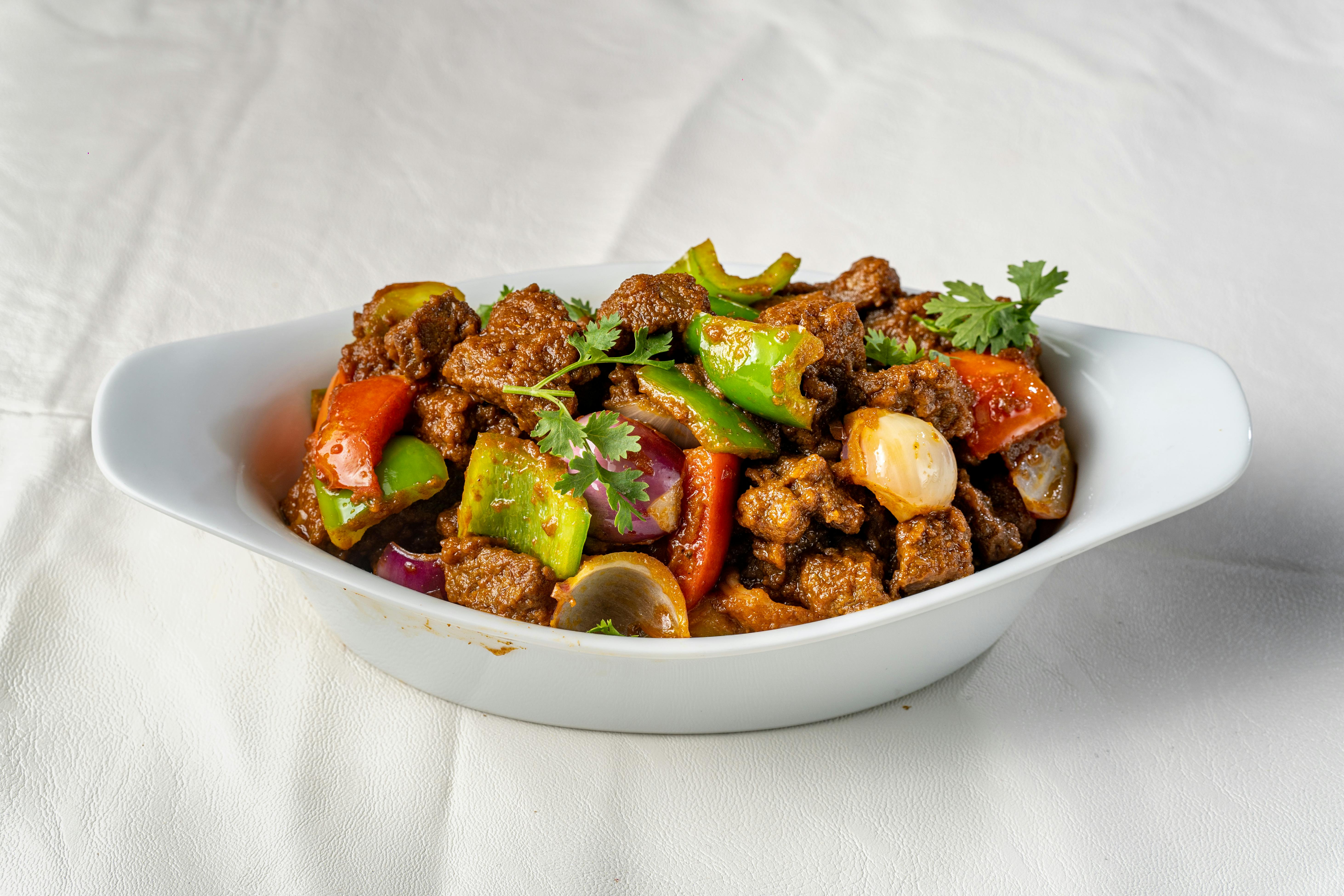
Photo: Shardar Tarikul Islam / Pexels
Ethiopian
Gored Gored
The diets react (see scores below)
Common Ingredients
- beef
- niter kibbeh
- berbere
- mitmita
- cardamom
- salt
Specific recipes may vary.
Incompatible with 6 of 11 diets
Diet Ratings
Gored Gored is a raw beef dish from Ethiopia that is an excellent fit for ketogenic eating. The primary ingredients are raw cubed beef (high protein, moderate fat), niter kibbeh (a spiced clarified butter that is essentially pure fat), and spices (berbere, mitmita, cardamom, salt). The net carbs are minimal — the spice blend berbere does contain some carbs, but in the small quantities used as a seasoning, the contribution is negligible (likely under 2-3g net carbs per serving). Niter kibbeh adds healthy saturated fat, reinforcing the high-fat profile. There are no grains, sugars, or starchy vegetables. This dish is naturally very low-carb and high in quality fats and protein, making it a strong keto choice.
Some strict keto practitioners flag berbere spice blends due to their inclusion of dried chili peppers, fenugreek, and other spices that can carry small but non-trivial carb loads; those following very precise clinical or therapeutic keto protocols may want to verify the exact quantity of berbere used and track accordingly.
Gored Gored is an Ethiopian dish consisting of raw cubed beef cooked or marinated in niter kibbeh (a spiced clarified butter made from dairy) and seasoned with berbere and mitmita spice blends. It contains two distinct animal-derived ingredients: beef (red meat) and niter kibbeh (clarified butter, a dairy product). Both are unambiguously non-vegan. There is no plant-based version of this dish in its traditional form.
Gored Gored is a raw cubed beef dish from Ethiopian cuisine, which is fundamentally paleo-friendly in concept. The beef itself is excellent — unprocessed, high-quality protein. Berbere and mitmita are spice blends (chili, fenugreek, coriander, ginger, etc.) that are generally paleo-acceptable, though commercial blends may contain added salt or anti-caking agents. The primary concerns are: (1) Niter kibbeh is a spiced clarified butter — like ghee, it has milk solids removed, but strict Cordain-school paleo excludes all dairy derivatives including clarified butter; most modern paleo practitioners accept it similarly to ghee. (2) Salt is listed as an ingredient — added salt is generally discouraged in strict paleo interpretations. These two factors push the dish into caution territory despite its strong paleo foundation of raw beef and spices.
Strict Cordain-school paleo (The Paleo Diet) excludes all dairy derivatives including clarified butter like niter kibbeh, and discourages added salt. Under this interpretation, the dish would lean toward avoid. Conversely, more permissive paleo frameworks (Mark Sisson's Primal Blueprint, Whole30) would accept clarified butter and minimal salt, potentially rating this dish as an approve.
Gored Gored is a traditional Ethiopian dish of raw cubed beef seasoned with niter kibbeh (spiced clarified butter) and hot spices. It presents multiple conflicts with Mediterranean diet principles: beef is the primary protein, which the Mediterranean diet limits to a few times per month; the dish is composed almost entirely of red meat with no vegetables, legumes, whole grains, or other plant-based components; and niter kibbeh is a saturated fat-heavy butter base, directly contradicting the Mediterranean diet's emphasis on extra virgin olive oil as the primary fat. The absence of plant-forward elements and the reliance on red meat and saturated animal fat make this dish fundamentally misaligned with Mediterranean dietary patterns.
Gored Gored is a raw beef dish from Ethiopian cuisine, and the beef itself would be ideal on a carnivore diet. However, the dish is heavily spiced with berbere (a complex spice blend containing chili peppers, fenugreek, coriander, and other plant-based spices), mitmita (another Ethiopian spice blend with bird's eye chili, cardamom, and cloves), and additional cardamom. These are all plant-derived ingredients explicitly excluded from the carnivore diet. Niter kibbeh, a spiced clarified butter, also contains numerous plant spices. While the raw beef and the clarified butter base are carnivore-compliant, the dominant seasoning profile of this dish is entirely plant-based spice blends, making the dish as traditionally prepared incompatible with carnivore principles.
Gored Gored is a traditional Ethiopian dish of raw or lightly cooked beef cubed and tossed with niter kibbeh (Ethiopian spiced clarified butter), berbere spice blend, mitmita spice blend, cardamom, and salt. All core ingredients are Whole30 compliant: beef is an approved protein, niter kibbeh is a clarified butter (analogous to ghee, which is the explicitly allowed dairy exception on Whole30), and berbere, mitmita, cardamom, and salt are all spices/seasonings. However, confidence is medium rather than high because niter kibbeh, while functionally clarified butter, is a spiced infused version that may include onion, garlic, ginger, turmeric, and other aromatics — none of which are excluded, but the commercial or restaurant preparation should be verified to ensure no non-compliant additives (e.g., added sugar, non-compliant oils) are present. Similarly, commercial berbere and mitmita blends should be label-checked for added sugar or non-compliant fillers. When made from whole, clean ingredients, this dish is a strong Whole30 choice.
Official Whole30 guidelines treat clarified butter/ghee as the sole dairy exception; niter kibbeh qualifies if fully clarified, but some community members flag that spiced infused butters — especially commercial versions — may not be fully clarified or may contain non-compliant additives, warranting extra scrutiny beyond standard ghee.
Gored Gored is a raw beef dish seasoned with spiced clarified butter (niter kibbeh) and spice blends (berbere and mitmita). The base protein — raw or lightly cooked beef — is inherently low-FODMAP. Niter kibbeh is a clarified butter infused with onion, garlic, and spices; critically, because FODMAPs (fructans) are water-soluble and not fat-soluble, a properly made clarified butter where solids are strained out should retain minimal FODMAP content, similar to garlic-infused oil. However, the key concern is berbere spice blend, which traditionally contains garlic and onion powder — both high-FODMAP ingredients even in small quantities (onion and garlic powder are among the most concentrated sources of fructans). Mitmita similarly can contain garlic. Cardamom and salt are low-FODMAP. The FODMAP load depends heavily on how much berbere and mitmita are used and their exact formulations. At typical restaurant or home serving quantities, the garlic and onion powder in these spice blends are likely to push the dish into moderate-FODMAP territory, warranting caution rather than a clear approval.
Monash University has not specifically tested berbere spice blend, and clinical FODMAP practitioners generally advise avoiding any spice blend containing garlic or onion powder during the elimination phase, as even small amounts can trigger symptoms. If niter kibbeh is made as a true clarified butter with solids fully removed and the berbere quantity is very small, some practitioners may consider this low-FODMAP, but standardization is difficult in practice.
Gored Gored is a raw beef dish from Ethiopian cuisine that presents multiple concerns for DASH diet adherence. The primary protein is beef (typically a fattier cut served raw), which falls under the 'red meat' category that DASH explicitly limits. More significantly, the dish is prepared with niter kibbeh — a spiced clarified butter — which is high in saturated fat, a nutrient DASH strictly limits. The combination of red meat and a saturated fat-rich cooking fat stacks two DASH negatives together. Berbere and mitmita spice blends often contain significant added salt, and additional salt is listed as an ingredient, raising sodium concerns. The dish lacks the vegetables, whole grains, fiber, potassium, calcium, or magnesium that DASH emphasizes. As a raw preparation, it also carries food safety risks relevant to vulnerable populations (e.g., hypertensive patients who may be elderly or immunocompromised). While the spices themselves (cardamom, berbere) offer phytonutrients, they do not offset the core nutritional concerns.
NIH DASH guidelines clearly limit red meat and saturated fat, placing this dish in the 'avoid' category. Some DASH-oriented clinicians note that lean beef in small portions is technically permissible on DASH; however, the niter kibbeh (clarified spiced butter) makes it difficult to consume this dish in a DASH-compliant form without fundamentally altering its preparation.
Gored Gored is a traditional Ethiopian raw beef dish cubed and seasoned with niter kibbeh (spiced clarified butter), berbere spice blend, mitmita, cardamom, and salt. From a Zone perspective, the dish provides a solid lean protein foundation in the beef itself, but the niter kibbeh introduces notable saturated fat concerns. The beef is a usable protein source — lean cuts would be favorable, but the cut used in Gored Gored is often a fattier cut to complement the raw preparation, increasing total saturated fat load. The niter kibbeh is essentially clarified butter infused with spices, which is a saturated fat source that the Zone Diet — especially Dr. Sears' early work — discourages in favor of monounsaturated fats like olive oil and avocado. The spice blend (berbere, mitmita, cardamom) is Zone-neutral and actually anti-inflammatory in Sears' framework given its polyphenol content. Critically, Gored Gored as served contains zero carbohydrates and no fat from monounsaturated sources, meaning it cannot stand alone as a Zone-balanced meal without adding a substantial carbohydrate source (e.g., a salad or low-GI vegetables) and replacing or reducing the niter kibbeh. As a meal component requiring significant balancing, it falls squarely in 'caution' territory.
Some Zone practitioners following Dr. Sears' later anti-inflammatory writings (notably 'The OmegaRx Zone' and 'Toxic Fat') take a more permissive view of saturated fat from whole animal sources, arguing that the inflammatory concern is primarily with industrial seed oils and processed foods. Under this interpretation, niter kibbeh from grass-fed butter could be viewed as acceptable in controlled portions, elevating the dish to a moderate Zone component — particularly if the beef is a lean cut. The polyphenol-rich spices (berbere contains chili, fenugreek, and other anti-inflammatory compounds) further support a slightly more favorable reading.
Gored Gored is a traditional Ethiopian dish of raw cubed beef seasoned with niter kibbeh (spiced clarified butter), berbere, mitmita, cardamom, and salt. The ingredient profile is genuinely mixed from an anti-inflammatory standpoint. On the pro-inflammatory side: beef is a red meat high in saturated fat and arachidonic acid, both associated with increased inflammatory markers when consumed regularly. Niter kibbeh is a clarified butter (ghee-like), meaning it is high in saturated fat — a category explicitly limited in anti-inflammatory frameworks. On the anti-inflammatory side: berbere is a complex spice blend featuring turmeric, ginger, garlic, fenugreek, chili pepper, coriander, and black pepper — all well-documented anti-inflammatory agents with meaningful polyphenol and curcuminoid content. Mitmita similarly contributes cardamom and chili (capsaicin). These spice combinations are genuinely powerful and may partially offset the inflammatory potential of the red meat and butter base. The dish is also raw, meaning no high-heat oxidation of the fat, which is a modest advantage. Overall, the red meat + clarified butter combination places this firmly in 'limit' territory per anti-inflammatory guidelines, but the extraordinary spice profile and cultural context of moderate, whole-food consumption push it toward the better end of 'caution' rather than 'avoid.'
Some anti-inflammatory researchers and practitioners (particularly those aligned with ancestral or carnivore-adjacent frameworks) argue that grass-fed beef and clarified butter like ghee have a more favorable fatty acid profile and fat-soluble vitamin content than conventionally raised equivalents, and should not be treated equivalently to processed red meat. Dr. Weil's framework, however, consistently places red meat and full-fat dairy in the 'limit' category regardless of sourcing, keeping this dish from a higher score under mainstream anti-inflammatory guidance.
Gored Gored is a traditional Ethiopian dish of raw, cubed beef dressed generously in niter kibbeh (a spiced clarified butter), berbere, and mitmita spice blends. It presents multiple significant concerns for GLP-1 patients. First, niter kibbeh is a high-saturated-fat cooking fat used in substantial quantities — fat content per serving is high and will worsen the nausea, bloating, and reflux that GLP-1 medications already promote. Second, both berbere and mitmita are intensely spicy spice blends; mitmita in particular is among the hottest Ethiopian spices and is a meaningful reflux and nausea trigger on a stomach that empties slowly. Third, the beef itself is typically a fatty cut used in this preparation, not a lean protein source. Fourth, raw beef carries food safety risk — immunocompromised patients or those with GI sensitivity (already elevated on GLP-1s) face heightened concern. The dish has no fiber, no hydration support, and poor nutrient density relative to its fat load. The protein content from beef is a genuine positive, but it is substantially offset by every other factor.
Some GLP-1-focused dietitians would note that if a patient tolerates spice well and the beef portion is lean and small, the protein contribution is real and worth acknowledging. However, the combination of high saturated fat from niter kibbeh and intense spice from mitmita makes individual tolerance highly variable, and most clinicians working with GLP-1 patients would flag this dish as high-risk for triggering GI side effects regardless of spice tolerance history, since GLP-1 medications can alter that tolerance unpredictably.
*See how scores were generated at our methodology page.
Nutritional profile
Six traits that cut across every diet.
Fiber & Plants
How much whole-plant food and fiber it delivers.
Healthy Fats
The quality of its fats (unsaturated, omega-3).
Whole / Unprocessed
How close it is to its natural, unprocessed form.
Gut Gentle
How easy it is on digestion (low FODMAP, few irritants).
Low Glycemic
How little it spikes your blood sugar.
Protein Density
How much protein it packs per calorie.
Controversy Index
Higher controversy = more disagreement between diets.
Diet-Specific Tips
 Keto — 9/10
View tips
- Raw beef is zero-carb and provides quality protein and fat
- Niter kibbeh (spiced clarified butter) is a pure fat source, highly keto-friendly
- Berbere spice blend contains trace carbs but amounts used as seasoning are negligible
- No grains, sugars, starchy vegetables, or high-carb ingredients
- Minimally processed, whole-food ingredients align with keto principles
- Net carbs per serving estimated well under 5g
 Paleo — 5/10
View tips
- Raw beef is an ideal paleo protein — unprocessed and nutrient-dense
- Niter kibbeh (spiced clarified butter) is debated: accepted by most modern paleo practitioners but excluded by strict Cordain-school paleo
- Added salt is discouraged in strict paleo interpretations
- Berbere and mitmita spice blends are generally paleo-compliant but commercial versions may contain additives
- Cardamom is a paleo-approved spice
- Overall dish concept aligns with ancestral eating patterns despite the two flagged ingredients
 Whole30 — 8/10
View tips
- Beef is a fully approved Whole30 protein
- Niter kibbeh is spiced clarified butter, analogous to the explicitly allowed ghee exception
- Berbere and mitmita are spice blends — compliant when free of added sugar or non-compliant fillers
- Cardamom and salt are compliant seasonings
- Label-checking commercial spice blends and niter kibbeh for hidden non-compliant ingredients is advised
- Home preparation with whole, clean ingredients makes this dish straightforwardly compliant
 Zone — 5/10
View tips
- Beef provides solid protein block foundation but cut leanness is uncertain in traditional preparation
- Niter kibbeh (spiced clarified butter) is primarily saturated fat — unfavorable in classic Zone methodology
- No carbohydrate component — dish is protein/fat only and requires pairing with low-GI vegetables to form a Zone meal
- No monounsaturated fat source present — Zone ideal fat profile is not met
- Berbere and mitmita spice blends are polyphenol-rich, supporting anti-inflammatory Zone goals
- Dish would need significant macro restructuring (added carbs, reduced or replaced fat) to achieve 40/30/30 balance
 Anti-Inflammatory — 4/10
View tips
- Red meat (beef) is pro-inflammatory at regular consumption — high in saturated fat and arachidonic acid
- Niter kibbeh (spiced clarified butter) is high in saturated fat, a category to limit on anti-inflammatory diets
- Berbere spice blend contains turmeric, ginger, garlic, and chili — all well-documented anti-inflammatory agents
- Mitmita and cardamom add additional anti-inflammatory spice compounds including capsaicin and cineole
- Raw preparation avoids high-heat fat oxidation, a modest advantage over cooked red meat preparations
- Spice diversity and concentration is unusually high, providing meaningful polyphenol and bioactive offset