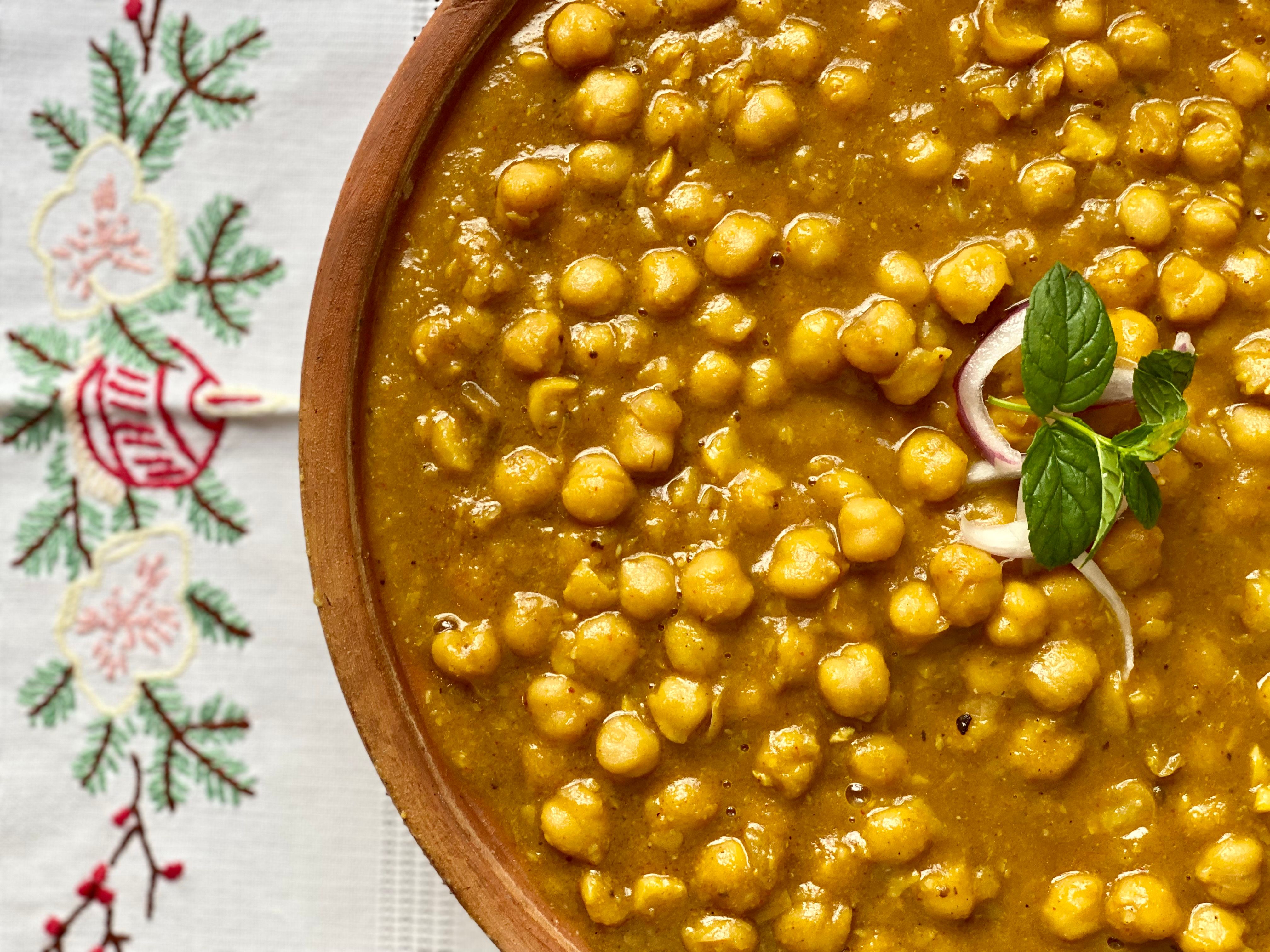
Photo: Muhammad Khawar Nazir / Pexels
Ethiopian
Kik Alicha
The diets react (see scores below)
Common Ingredients
- yellow split peas
- onion
- garlic
- ginger
- turmeric
- niter kibbeh
- green chili
- salt
Specific recipes may vary.
Incompatible with 6 of 11 diets
Diet Ratings
Kik Alicha is built on yellow split peas, which are legumes with a very high net carb content — approximately 25-30g net carbs per half-cup cooked serving. This alone can exceed or max out an entire day's keto carb budget in a single side dish portion. While the other ingredients (niter kibbeh, garlic, ginger, turmeric, onion) are keto-friendly or low-impact in typical amounts, they cannot offset the fundamental incompatibility of split peas with ketogenic macros. Legumes are broadly excluded from standard keto protocols due to their dense starch content.
Kik Alicha is a traditional Ethiopian yellow split pea stew that is fundamentally plant-based in its core ingredients — split peas, onion, garlic, ginger, turmeric, and chili. However, this recipe explicitly lists niter kibbeh as an ingredient. Niter kibbeh is a spiced clarified butter (ghee) that is central to Ethiopian cooking and is unambiguously an animal-derived dairy product. This disqualifies the dish in its listed form from vegan compliance. A vegan version of Kik Alicha absolutely exists and is common — substituting niter kibbeh with a spiced coconut oil or vegan margarine blend — but the dish as described here cannot be approved.
Kik Alicha is a traditional Ethiopian yellow split pea stew that is fundamentally incompatible with the paleo diet. Yellow split peas are legumes — one of the most clearly excluded food groups in paleo due to their lectin and phytate content. Niter kibbeh (Ethiopian spiced clarified butter) is a dairy derivative, which is also excluded, though similar in concept to ghee. Added salt is likewise discouraged. While several ingredients — onion, garlic, ginger, turmeric, and green chili — are fully paleo-approved, the foundational protein source (yellow split peas) is a hard disqualifier. No amount of paleo-friendly spicing can rehabilitate a legume-based dish.
Kik Alicha is a wholesome legume-based dish featuring yellow split peas with anti-inflammatory spices like turmeric, garlic, and ginger — all strongly aligned with Mediterranean principles. The core ingredients are plant-forward and nutrient-dense. However, the traditional fat used is niter kibbeh, a spiced clarified butter (ghee), which is an animal-derived saturated fat rather than extra virgin olive oil. This is the primary factor preventing a full 'approve' rating. If olive oil were substituted, this dish would score 8-9. As prepared, it occupies the moderate zone — excellent nutritional profile undermined by a non-canonical fat source.
Some Mediterranean diet practitioners, particularly those following traditional North African or Eastern Mediterranean regional variants, would accept clarified butter in modest amounts as analogous to other regional dairy fats used sparingly. Modern clinical interpretations (e.g., Willett/Harvard guidelines) would more strictly flag saturated animal fats as incompatible with the diet's core fat principle.
Kik Alicha is an Ethiopian yellow split pea stew that is fundamentally plant-based. The primary protein is lentils (yellow split peas), which are legumes — entirely excluded on the carnivore diet. Nearly every ingredient is plant-derived: yellow split peas, onion, garlic, ginger, turmeric, and green chili are all forbidden plant foods. Niter kibbeh (a spiced Ethiopian clarified butter) is the only animal-derived ingredient, but it is itself a minor component and contains plant spices. There is no scenario under any carnivore framework — strict Lion Diet, standard carnivore, or even the more liberal animal-based approach — where a legume-and-vegetable stew would be acceptable.
Kik Alicha is a traditional Ethiopian yellow split pea stew. The primary protein — yellow split peas — are legumes, and legumes are explicitly excluded on the Whole30 program. Unlike green beans, sugar snap peas, and snow peas (which are explicitly excepted despite being botanical legumes), split peas have no such exception and fall squarely in the excluded category. The remaining ingredients (onion, garlic, ginger, turmeric, niter kibbeh, green chili, salt) are all individually compliant, but the foundational ingredient renders the entire dish non-compliant. There is no compliant substitution that would preserve the identity of this dish.
Kik Alicha contains multiple high-FODMAP ingredients that make it unsuitable during the elimination phase. Yellow split peas are high in GOS (galacto-oligosaccharides) and fructans, placing them firmly in the avoid category at any standard serving size. Onion is one of the highest-FODMAP foods tested by Monash University, rich in fructans, and is a primary flavoring base of this dish. Garlic is similarly very high in fructans and is used as a core ingredient. These three ingredients alone — yellow split peas, onion, and garlic — would make this dish high-FODMAP regardless of portion size. The remaining ingredients (ginger, turmeric, niter kibbeh/clarified butter, green chili, salt) are generally low-FODMAP and do not affect the overall verdict. There is no practical way to modify a traditional Kik Alicha to make it low-FODMAP, as the legume base and allium aromatics are fundamental to the dish's identity.
Kik Alicha is a yellow split pea stew that has many DASH-friendly elements: legumes are explicitly recommended by NHLBI DASH guidelines, and the aromatics (onion, garlic, ginger, turmeric) are all beneficial. However, the key concern is niter kibbeh — a spiced clarified butter that is high in saturated fat and used as the primary cooking fat in this dish. DASH guidelines limit saturated fat and specify vegetable oils over butter-based fats. The added salt is also a variable concern depending on quantity. Without niter kibbeh, this dish would score 8-9 (approve). With it, the saturated fat load pulls the rating into caution territory. Sodium from added salt is an additional factor; typical home preparation may be moderate, but portion and preparation vary.
NIH DASH guidelines clearly limit saturated fat and recommend vegetable oils over animal fats like clarified butter. However, updated clinical interpretations note that niter kibbeh is used in relatively small quantities as a flavor base, and recent meta-analyses (e.g., Siri-Tarino et al.) have questioned the direct link between dairy saturated fat and cardiovascular risk — some DASH-oriented dietitians may allow this dish as-is given its dominant legume base, recommending substitution with olive oil only for strict DASH adherence.
Kik Alicha is a mildly spiced Ethiopian yellow split pea stew. Its macro profile presents a mixed Zone picture. Yellow split peas provide plant-based protein alongside a moderate glycemic load — they are a legitimate protein source but require larger portions to hit Zone protein targets, and those portions also bring significant starch carbohydrates. The anti-inflammatory spices (turmeric, ginger, garlic) are excellent Zone additions, providing polyphenols Sears actively endorses. The primary fat concern is niter kibbeh (Ethiopian spiced clarified butter), which is predominantly saturated fat — a category the Zone Diet historically limits, though Sears' later writing softened this stance somewhat. As a vegetarian protein source, the fat block calculations differ (3g fat per block vs. 1.5g for animal protein), giving niter kibbeh slightly more room, but it remains an unfavorable fat type. The dish lacks lean animal protein, so achieving the 30% protein ratio requires careful portioning of the split peas and would likely need supplementation with another protein source. Overall, Kik Alicha can be incorporated into a Zone meal as a carbohydrate-protein hybrid side with mindful portioning, but it is not an ideal standalone Zone component.
Some Zone practitioners, particularly those focused on Sears' later anti-inflammatory framework, would note that clarified butter (ghee/niter kibbeh) contains butyric acid and some beneficial short-chain fatty acids, and that the polyphenol-rich spices partially offset the saturated fat concern. These practitioners might rate this dish more favorably — closer to a 6 — especially when paired with a lean animal protein to balance the block ratios. Conversely, strict early-Zone adherents would flag the higher glycemic index of split peas compared to non-starchy vegetables and the saturated fat in niter kibbeh as dual unfavorable markers, potentially scoring it a 4.
Kik Alicha is a mildly spiced Ethiopian yellow split pea stew with a genuinely mixed anti-inflammatory profile. On the positive side, yellow split peas are legumes — high in fiber, plant protein, and resistant starch, all of which support a healthy gut microbiome and reduce inflammatory markers like CRP. Garlic, ginger, and turmeric are among the most well-supported anti-inflammatory spices in the literature, and green chili contributes capsaicin, which has demonstrated anti-inflammatory properties. Onion provides quercetin, a potent flavonoid. Together, the spice and legume base is strongly anti-inflammatory. The limiting factor is niter kibbeh — Ethiopian spiced clarified butter — which is the traditional fat used in this dish. Like ghee and butter, niter kibbeh is high in saturated fat. Anti-inflammatory frameworks consistently flag full-fat dairy and saturated fat as foods to limit (not avoid entirely, but not emphasize). Extra virgin olive oil would be the preferred fat in an anti-inflammatory context. The amount of niter kibbeh used as a base fat is meaningful, not incidental. If the dish were made with olive oil or only a small finishing amount of niter kibbeh, it would score closer to 7-8. As traditionally prepared, the saturated fat content pulls it into the moderate/caution range despite an otherwise excellent ingredient profile.
Dr. Weil's framework and most mainstream anti-inflammatory guidance accept moderate amounts of butter and full-fat dairy as a 'limit, not avoid' category, and some practitioners argue that saturated fat from dairy (especially clarified forms like ghee and niter kibbeh, which lack milk proteins and lactose) has a more neutral inflammatory effect than industrially processed fats. A more permissive anti-inflammatory view would score this dish higher given the exceptional spice profile and legume base. Conversely, stricter anti-inflammatory or AIP-influenced practitioners might flag the saturated fat content more aggressively.
Kik Alicha is a mild Ethiopian yellow split pea stew with a solid nutritional foundation — split peas provide meaningful plant protein (~8g per half-cup cooked) and good fiber (~8g per half-cup), and the dish is easy to digest due to its soft, stewed texture. Turmeric, ginger, and garlic are anti-inflammatory and generally well-tolerated on GLP-1 medications. The green chili is mild relative to hotter Ethiopian preparations and is unlikely to worsen reflux for most patients. The primary concern is niter kibbeh, a spiced clarified butter that is the traditional fat base. Even in modest cooking quantities, it adds saturated fat per serving, which can worsen GLP-1 side effects like nausea, bloating, and reflux. Portion size is also relevant — a full restaurant serving may be larger than ideal for GLP-1 patients. As a side dish in a small portion, this is acceptable, but the saturated fat from niter kibbeh prevents a full approval.
Some GLP-1-focused dietitians would approve this dish outright, arguing that the amount of niter kibbeh in a typical side serving is small enough that the high fiber and plant protein benefit outweighs the saturated fat concern. Others caution that saturated fat tolerance is highly individual on GLP-1 medications, and patients with persistent nausea or slow gastric emptying symptoms should substitute olive oil or skip the fat component entirely.
*See how scores were generated at our methodology page.
Nutritional profile
Six traits that cut across every diet.
Fiber & Plants
How much whole-plant food and fiber it delivers.
Healthy Fats
The quality of its fats (unsaturated, omega-3).
Whole / Unprocessed
How close it is to its natural, unprocessed form.
Gut Gentle
How easy it is on digestion (low FODMAP, few irritants).
Low Glycemic
How little it spikes your blood sugar.
Protein Density
How much protein it packs per calorie.
Controversy Index
Higher controversy = more disagreement between diets.
Diet-Specific Tips
 Mediterranean — 5/10
View tips
- Yellow split peas are an excellent legume source — strongly Mediterranean-approved
- Turmeric, garlic, ginger, and green chili are anti-inflammatory spices consistent with Mediterranean principles
- Niter kibbeh (spiced clarified butter) is an animal-derived saturated fat, not olive oil — the canonical Mediterranean fat
- No refined grains, added sugars, or processed ingredients
- Dish is plant-forward and fiber-rich despite the non-ideal fat source
- Substituting olive oil would make this a near-ideal Mediterranean dish
 DASH — 5/10
View tips
- Yellow split peas are a DASH-approved legume: high in fiber, potassium, and plant protein
- Niter kibbeh (spiced clarified butter) is high in saturated fat, which DASH limits
- No added sugars, no processed ingredients, no tropical oils beyond the butter component
- Aromatic spices (turmeric, ginger, garlic) are DASH-compatible and anti-inflammatory
- Added salt is a variable — preparation-dependent sodium content could range from moderate to high
- Substituting niter kibbeh with olive or canola oil would elevate this dish to an approve rating
- Overall dish is predominantly plant-based, which aligns with DASH emphasis
 Zone — 5/10
View tips
- Yellow split peas are a moderate-GI carbohydrate-protein hybrid — usable in Zone but not ideal as a standalone protein source
- Niter kibbeh (spiced clarified butter) is primarily saturated fat, which Zone classifies as an unfavorable fat type
- Polyphenol-rich spices (turmeric, ginger, garlic) align well with Sears' anti-inflammatory Zone framework
- As a vegetarian protein dish, larger portions needed to meet 25g protein/meal target simultaneously raise carbohydrate load
- Onion and green chili are favorable low-glycemic Zone carbohydrate contributors
- Dish would benefit from pairing with lean animal protein and a monounsaturated fat source to achieve 40/30/30 ratio
 Anti-Inflammatory — 6/10
View tips
- Yellow split peas: high-fiber legume, supports gut microbiome, reduces CRP
- Turmeric: curcumin is a well-validated anti-inflammatory compound
- Garlic and ginger: broad anti-inflammatory and antimicrobial properties
- Green chili: capsaicin with demonstrated anti-inflammatory effect
- Onion: quercetin and flavonoids
- Niter kibbeh (spiced clarified butter): significant saturated fat content, a 'limit' food in anti-inflammatory frameworks
- No refined carbohydrates, seed oils, added sugars, or processed ingredients
- Overall a whole-food, plant-forward dish with one meaningful anti-inflammatory caveat
 GLP-1 Friendly — 5/10
View tips
- Yellow split peas provide good plant protein and high fiber — both top GLP-1 priorities
- Soft stewed texture is easy to digest, favorable given slowed gastric emptying on GLP-1s
- Niter kibbeh (spiced clarified butter) adds saturated fat, a known trigger for GLP-1 GI side effects
- Mild spice profile (turmeric, ginger, green chili) is generally well-tolerated
- Protein per serving is moderate but not high — best combined with a lean protein main dish
- Portion sensitivity matters — small side serving is more appropriate than a large portion
- Substituting olive oil for niter kibbeh would meaningfully improve the rating