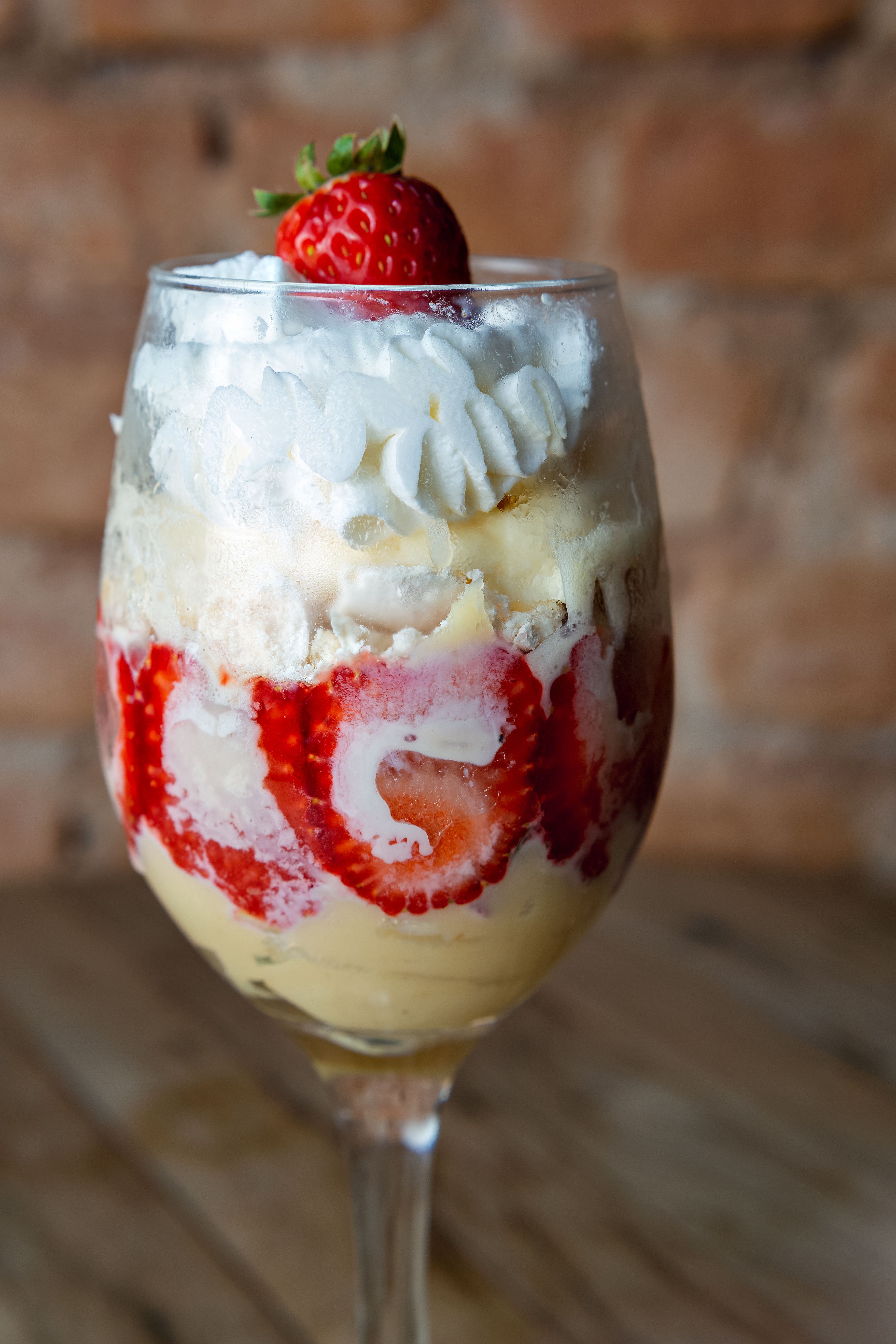
Photo: Gustavo Peres / Pexels
The diets react (see scores below)
Common Ingredients
- meringue
- heavy cream
- strawberries
- sugar
- egg whites
- vanilla
Specific recipes may vary.
Incompatible with 11 of 11 diets
Diet Ratings
Eton Mess is fundamentally incompatible with a ketogenic diet. The dish is built around meringue (egg whites and large amounts of sugar), additional sugar, and strawberries — all of which are high-carb or contain significant sugars. A standard serving would deliver an enormous sugar load from the meringue alone (which is essentially crystallized sugar), compounding further with added sugar and the natural fructose in strawberries. While heavy cream is keto-friendly, it cannot offset the carbohydrate and sugar content of the other ingredients. This dish would almost certainly knock someone out of ketosis in a single serving and has no realistic keto adaptation without fundamentally replacing its core components.
Eton Mess contains multiple animal-derived ingredients that make it clearly incompatible with a vegan diet. Meringue is made from egg whites (an animal product), and heavy cream is a dairy product derived from cow's milk. Both are core, non-incidental ingredients that cannot be overlooked. While strawberries, sugar, and vanilla are plant-based, the dish as traditionally prepared is fundamentally built on eggs and dairy. There is no version of classic Eton Mess that qualifies as vegan without complete substitution of these core components (e.g., aquafaba meringue and coconut cream).
Eton Mess is fundamentally incompatible with the paleo diet. Meringue is made from egg whites and refined sugar — the latter being explicitly excluded from paleo. Heavy cream is a dairy product, which is prohibited. The added sugar used to sweeten the dish is a direct violation. While egg whites and strawberries and vanilla are individually paleo-approved, the overall dish is built around two core non-paleo ingredients (refined sugar and dairy cream), making it an avoid. The strawberries are the only genuinely paleo-compliant component here.
Eton Mess is a British dessert that strongly contradicts Mediterranean diet principles. Meringue is made from egg whites and large amounts of added sugar, heavy cream is a high-saturated-fat dairy product consumed in significant quantity, and additional sugar is added on top. While strawberries are a Mediterranean-friendly fruit, they are a minor component overwhelmed by the problematic ingredients. The dish is essentially a sugar-and-saturated-fat delivery vehicle with negligible nutritional value aligned with Mediterranean principles. It represents exactly the kind of refined sugar and high-fat processed-style dessert the Mediterranean diet minimizes.
Eton Mess is fundamentally incompatible with the carnivore diet. While it contains egg whites and heavy cream (animal-derived), the dish is dominated by plant-based and processed ingredients that are strictly excluded: strawberries (fruit), sugar (processed sweetener), vanilla (plant-derived flavoring), and meringue (which combines egg whites with sugar). There is no meaningful animal protein or fat as a primary component. The heavy cream is the only ingredient that could be considered marginally acceptable in some carnivore frameworks, but it is a minor component in an otherwise entirely disqualifying dish. No carnivore authority or camp would endorse this dessert.
Eton Mess contains multiple excluded ingredients. Sugar is explicitly banned on Whole30 as an added sugar, and it is a core structural component of meringue. Heavy cream is a dairy product, which is excluded (only ghee and clarified butter are allowed as dairy exceptions). The meringue itself is made from egg whites and sugar — while egg whites alone are compliant, the sugar used to make meringue disqualifies it entirely. Strawberries and vanilla are compliant, but they cannot redeem a dish built on two fundamentally excluded ingredients (added sugar and dairy).
Eton Mess is a British dessert made from crushed meringue, whipped heavy cream, and strawberries. Individually, most components are low-FODMAP: meringue (egg whites and sugar) is low-FODMAP, heavy cream is low-FODMAP (fat-based, minimal lactose), vanilla extract is low-FODMAP, and strawberries are low-FODMAP at up to 10 medium berries (140g) per Monash. Sugar (sucrose) is low-FODMAP. However, the combined serving size of a typical Eton Mess dessert portion creates practical concern. Strawberries are safe individually at a standard serving, but a generous Eton Mess portion may easily push strawberry content above the 140g threshold. Additionally, meringue is high in sugar, and while sucrose itself is low-FODMAP, very high sugar loads can cause symptoms in IBS sufferers through osmotic effects. The main risk factor is portion size — a modest, carefully measured serving is likely tolerable during elimination, but a standard restaurant or home portion may exceed safe thresholds for strawberries. The dish contains no high-FODMAP red flags like wheat, garlic, onion, or high-lactose dairy, making it more manageable than many desserts.
Monash University rates strawberries as low-FODMAP up to 140g per serving, but a typical generous Eton Mess portion can easily contain more fruit than this. Some clinical FODMAP practitioners advise caution with high-sugar desserts during elimination phase due to osmotic effects, even when individual ingredients technically clear FODMAP thresholds.
Eton Mess is fundamentally incompatible with the DASH diet. The dish is built around meringue (egg whites plus large amounts of sugar), heavy cream (high in saturated fat), and added sugar — three elements that DASH explicitly limits. Heavy cream is a full-fat dairy product, directly contradicting DASH's emphasis on fat-free or low-fat dairy. The high added sugar content from both the meringue and additional sugar conflicts with DASH's restriction on sweets. The only DASH-friendly component is the strawberries, which provide potassium, fiber, and vitamin C, but they are a minor redemptive factor in an otherwise poor nutritional profile. This dessert is high in saturated fat, high in added sugars, and low in the nutrients DASH prioritizes (fiber, potassium, magnesium, calcium from appropriate sources). It is essentially a confection with no meaningful protein, whole grains, or vegetable servings.
Eton Mess is fundamentally incompatible with Zone Diet principles. The dish is built around three high-glycemic, high-sugar components: meringue (essentially pure sugar and egg whites baked into a high-GI confection), added sugar, and whipped heavy cream. While strawberries are a Zone-favorable fruit, they are a minor player in a dish dominated by sugar and saturated fat. The macro profile is wildly skewed: extremely high in simple carbohydrates (pure sugar from meringue and added sugar), high in saturated fat (heavy cream), and essentially devoid of lean protein. There is no realistic way to portion-adjust Eton Mess into a Zone-compliant ratio — the meringue itself cannot be reduced without eliminating the dish entirely, and the sugar content makes balancing the 40/30/30 ratio impossible within any reasonable serving size. This is not a caution-worthy food that requires careful portioning; it is structurally a dessert built on the exact macronutrient profile Zone seeks to avoid: high-glycemic carbs with saturated fat and no lean protein anchor.
Eton Mess is a high-sugar, high-saturated-fat dessert with very little anti-inflammatory value. The primary components — meringue (egg whites + substantial added sugar), heavy cream (high in saturated fat), and additional sugar — are all on the limit-to-avoid list under anti-inflammatory principles. Heavy cream is a full-fat dairy product high in saturated fat, which promotes inflammatory signaling (NF-κB pathway) and raises pro-inflammatory markers when consumed regularly. Added sugar is a well-established driver of systemic inflammation, raising CRP, IL-6, and TNF-α in research. The meringue base is essentially pure refined sugar and egg white — offering no fiber, no polyphenols, and no omega-3s. The one redemptive ingredient is strawberries, which contain vitamin C, anthocyanins, and quercetin — all with meaningful anti-inflammatory properties — but they are present in a supporting role and their benefits are overwhelmed by the sugar load of the dish as a whole. Vanilla adds trace antioxidants but has no meaningful impact at culinary doses. Overall, this dish represents the type of high-sugar, high-saturated-fat treat that anti-inflammatory frameworks consistently flag as pro-inflammatory and discourage even for occasional consumption.
Eton Mess is a poor fit for GLP-1 patients across nearly every dietary criterion. It is a dessert-style dish composed almost entirely of sugar (meringue, added sugar), heavy cream (high saturated fat), and whipped egg whites — delivering very high sugar load, high fat, negligible protein, and negligible fiber. The heavy cream significantly increases the risk of nausea, bloating, and reflux, which are already heightened with GLP-1 medications due to slowed gastric emptying. The meringue and sugar contribute empty calories with no nutritional payoff. The only redeeming element is the strawberries, which provide minimal fiber and some vitamin C, but they are a minor component and insufficient to offset the overall nutritional profile. This dish fails on protein density, fat content, sugar load, and GLP-1 side effect risk simultaneously.
*See how scores were generated at our methodology page.
Nutritional profile
Six traits that cut across every diet.
Fiber & Plants
How much whole-plant food and fiber it delivers.
Healthy Fats
The quality of its fats (unsaturated, omega-3).
Whole / Unprocessed
How close it is to its natural, unprocessed form.
Gut Gentle
How easy it is on digestion (low FODMAP, few irritants).
Low Glycemic
How little it spikes your blood sugar.
Protein Density
How much protein it packs per calorie.
Controversy Index
Higher controversy = more disagreement between diets.