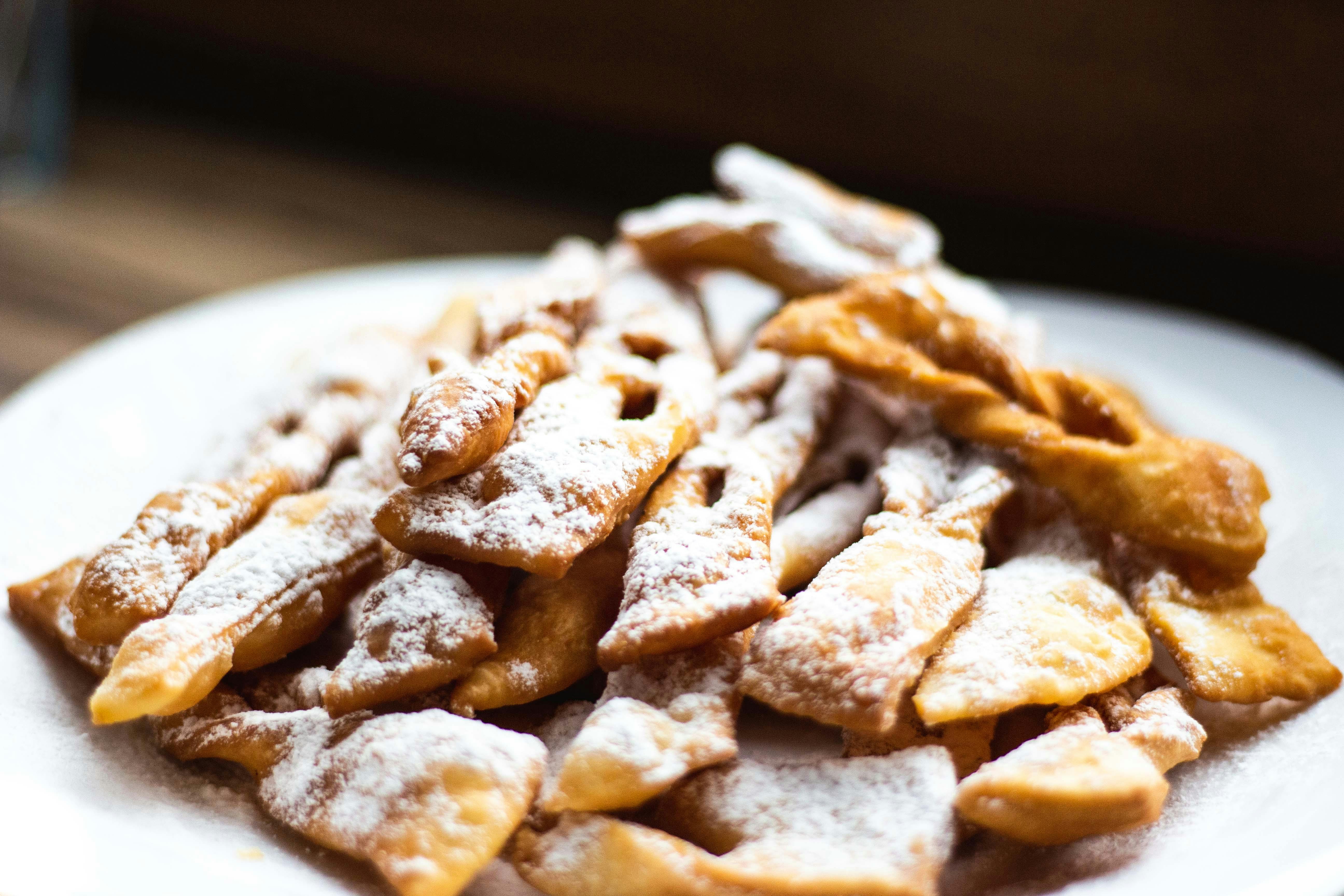
Photo: Kuba Karoń / Pexels
The diets react (see scores below)
Common Ingredients
- flour
- eggs
- butter
- sour cream
- sugar
- salt
- vanilla
- powdered sugar
Specific recipes may vary.
Incompatible with 11 of 11 diets
Diet Ratings
Faworki (angel wings) are deep-fried Polish pastries that are fundamentally incompatible with a ketogenic diet. The primary ingredient is wheat flour, a high-carb grain that alone makes this dish off-limits. Additionally, the recipe includes both granulated sugar in the dough and powdered sugar dusted on top, compounding the carbohydrate load. A single serving of faworki can easily contain 30-50g of net carbs, far exceeding safe keto thresholds. There is no meaningful fat-to-carb ratio benefit here — the fat comes from deep-frying in oil combined with a high-carb flour base, making this a high-carb, high-fat food in the worst possible combination for ketosis.
Faworki (Polish angel wings) are a traditional fried pastry that contains multiple animal-derived ingredients: eggs, butter, and sour cream. All three are animal products excluded under vegan dietary rules. There is no ambiguity here — this dish is fundamentally incompatible with a vegan diet as formulated. A vegan version could theoretically be made by substituting plant-based butter, a flax or chia egg, and plant-based sour cream, but the traditional recipe as listed is not vegan.
Faworki (Polish angel wings) are deep-fried pastries made almost entirely from non-paleo ingredients. Flour is a grain product, strictly excluded from the paleo diet. Sour cream is dairy, also excluded. Sugar and powdered sugar are refined sugars, excluded. Salt is excluded as an added ingredient. Butter and vanilla are debated or borderline, but they cannot redeem a dish that is fundamentally built on wheat flour and refined sugar. The only paleo-compliant ingredient is eggs. This dish has no viable paleo adaptation without completely rebuilding it from scratch.
Faworki (Polish angel wings) are deep-fried pastries made from refined white flour, butter, sour cream, eggs, and sugar, then dusted with powdered sugar. This dish contradicts nearly every Mediterranean diet principle: it uses refined grains instead of whole grains, butter instead of olive oil as the fat source, added sugars, and deep-frying as the cooking method. It is a highly processed sweet snack with no plant-forward nutritional value, no fiber-rich ingredients, and a high saturated fat and sugar content. There is essentially no overlap with Mediterranean dietary staples.
Faworki (Polish angel wings) are a deep-fried pastry made almost entirely from plant-based ingredients. Flour is a grain product, sugar and vanilla are plant-derived, and powdered sugar is a processed sweetener — all strictly prohibited on the carnivore diet. While eggs, butter, and sour cream are animal-derived, they play only a minor supporting role in what is fundamentally a grain-and-sugar-based snack. The dish violates core carnivore principles at nearly every ingredient level.
Faworki (Polish angel wings) contains multiple excluded ingredients and falls squarely into the excluded food category. Flour (wheat grain) is excluded. Butter (dairy) is excluded — only ghee/clarified butter is allowed. Sour cream (dairy) is excluded. Sugar (added sugar) is excluded. Powdered sugar (added sugar) is excluded. Beyond the individual ingredients, faworki are a deep-fried pastry/sweet treat, which falls directly into the 'no recreating baked goods/junk food' rule — they are essentially the Polish equivalent of fried dough or cookies, explicitly the type of food Whole30 asks participants to avoid for 30 days regardless of ingredient compliance.
Faworki (Polish angel wings) are made primarily from wheat flour, which is the dominant ingredient and a significant source of fructans — one of the most problematic FODMAPs. Even a small serving of these fried pastries would deliver a meaningful dose of wheat-based fructans. The other ingredients (eggs, butter, sugar, salt, vanilla, powdered sugar) are individually low-FODMAP, and sour cream is low-FODMAP at small servings. However, the wheat flour base makes this dish high-FODMAP at any realistic serving size. There is no fermentation process (unlike sourdough) that would reduce the fructan content. Faworki cannot be made low-FODMAP without substituting the wheat flour with a gluten-free alternative such as rice flour or a certified low-FODMAP flour blend.
Faworki (Polish angel wings) are deep-fried sweet pastries made from refined white flour, butter, eggs, sour cream, and sugar, then dusted with powdered sugar. This combination is fundamentally incompatible with DASH diet principles. They are deep-fried in oil (adding significant saturated and trans fat depending on frying medium), made with full-fat dairy (sour cream, butter) contributing saturated fat, refined white flour offering minimal fiber, and multiple forms of added sugar. They provide virtually none of the nutrients DASH emphasizes — potassium, magnesium, calcium, or fiber — and instead deliver high levels of the components DASH explicitly limits: saturated fat, added sugars, and refined carbohydrates. These are categorically a treat food with no meaningful nutritional redeeming value in the context of a DASH eating plan.
Faworki (Angel Wings) are deep-fried Polish pastries made from refined wheat flour, eggs, butter, sour cream, and sugar, finished with a generous dusting of powdered sugar. This dish is essentially pure high-glycemic carbohydrate and saturated fat with virtually no lean protein or low-glycemic vegetables. The macro profile is the antithesis of Zone's 40/30/30 target: it is overwhelmingly carbohydrate-dominant (refined flour + sugar + powdered sugar), fat-heavy from butter and deep-frying, and nearly protein-free. There is no meaningful lean protein block to anchor a Zone meal, and the carbohydrates are exclusively high-glycemic. Even with aggressive portion control, it would be nearly impossible to incorporate Faworki into a balanced Zone block structure without eating such a trivially small amount that it ceases to function as a snack. It lacks polyphenols, omega-3s, and any of the anti-inflammatory components Sears emphasizes. This is one of the clearer 'avoid' cases in the Zone framework.
Faworki (angel wings) are Polish deep-fried pastries made from refined wheat flour, butter, sour cream, eggs, sugar, and finished with powdered sugar. This dish is essentially a concentrated combination of pro-inflammatory ingredients: refined white flour (high glycemic, stripped of fiber and nutrients), added sugars (both in the dough and as a powdered sugar coating), butter and sour cream (saturated fat sources flagged for moderation-to-avoidance in anti-inflammatory frameworks), and deep frying (which typically uses high-omega-6 seed oils and generates advanced glycation end products, or AGEs, both of which promote inflammation). There are virtually no anti-inflammatory components — no omega-3s, no antioxidant-rich vegetables or fruits, no polyphenols, no fiber. The combination of refined carbohydrates and saturated fat is consistently associated with elevated inflammatory markers (CRP, IL-6) in research. This is an occasional cultural treat, not a food compatible with anti-inflammatory eating principles.
Faworki (Angel Wings) are deep-fried Polish pastries made from refined flour, butter, sour cream, and sugar, then dusted with powdered sugar. They are a textbook example of a food that conflicts with nearly every GLP-1 dietary guideline simultaneously. The deep-frying process loads them with fat, which is a primary driver of GLP-1 side effects including nausea, bloating, and reflux — all worsened by the slowed gastric emptying these medications cause. They carry virtually no protein, no meaningful fiber, and are built almost entirely from refined carbohydrates and saturated fat. Sugar appears twice (granulated in the dough, powdered as topping), making them a high-sugar, high-glycemic food with empty calories. There is no redemptive nutritional density here — every calorie is from fat, refined starch, or sugar. Even a small serving provides little satiety value while delivering significant GI risk for GLP-1 patients.
*See how scores were generated at our methodology page.
Nutritional profile
Six traits that cut across every diet.
Fiber & Plants
How much whole-plant food and fiber it delivers.
Healthy Fats
The quality of its fats (unsaturated, omega-3).
Whole / Unprocessed
How close it is to its natural, unprocessed form.
Gut Gentle
How easy it is on digestion (low FODMAP, few irritants).
Low Glycemic
How little it spikes your blood sugar.
Protein Density
How much protein it packs per calorie.
Controversy Index
Higher controversy = more disagreement between diets.