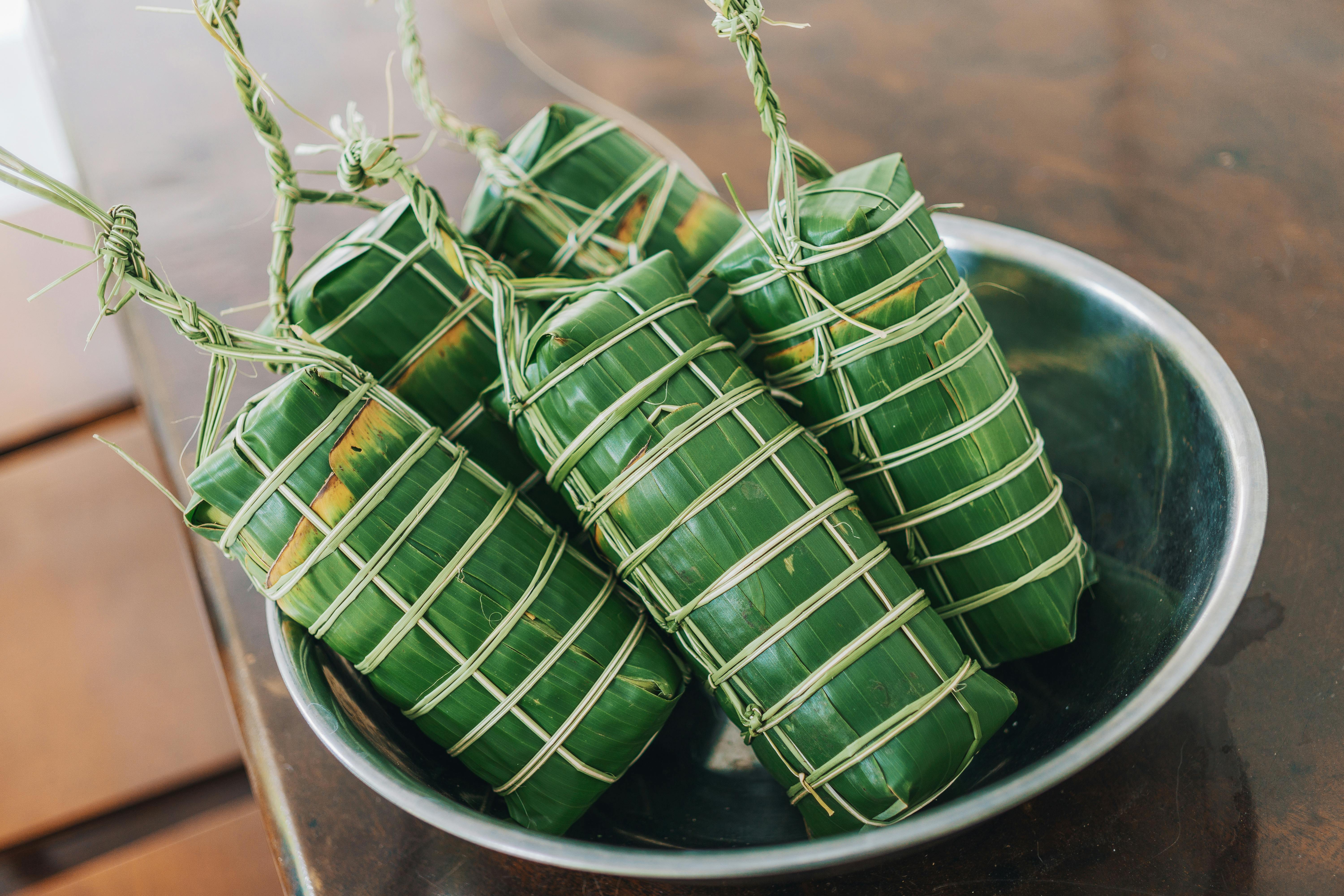
Photo: FOX ^.ᆽ.^= ∫ / Pexels
The diets react (see scores below)
Common Ingredients
- pork
- chicken
- fish
- cassava
- taro
- sweet potato
- banana leaves
- coconut cream
Specific recipes may vary.
Incompatible with 5 of 11 diets
Diet Ratings
Lovo is a traditional Fijian earth-oven feast that combines keto-friendly proteins (pork, chicken, fish) with extremely high-carb root vegetables and fruit. Cassava, taro, and sweet potato are among the most carb-dense foods possible — cassava alone contains roughly 35-38g net carbs per 100g, taro ~33g, and sweet potato ~17-20g. These staple ingredients collectively push a single serving far beyond the entire daily keto carb budget of 20-50g. The banana leaves are used as wrapping and contribute negligible carbs, and coconut cream is keto-friendly, but these positives are completely overwhelmed by the starchy components. The dish cannot be made keto-compatible without fundamentally restructuring it by omitting its core carbohydrate ingredients, which would make it a different dish entirely.
Lovo is a traditional Fijian earth-oven feast that contains multiple animal products: pork, chicken, and fish are all direct animal flesh, making this dish entirely incompatible with a vegan diet. There is no ambiguity here — three distinct categories of animal products are present as primary ingredients. The plant-based components (cassava, taro, sweet potato, banana leaves, coconut cream) are all vegan-friendly, but they do not offset the animal proteins that are central to this dish.
Lovo is a traditional Fijian earth-oven feast featuring pork, chicken, and fish — all clearly paleo-approved proteins. Sweet potato and taro are well-accepted paleo tubers, and banana leaves used as wrapping are a non-issue. The two points of contention are cassava and coconut cream. Cassava (tapioca root) is a starchy tuber generally permitted in paleo, though some strict interpretations flag its high starch load and the need for proper preparation to neutralize its natural cyanogenic compounds. Coconut cream is widely embraced in the paleo community, but it is a processed extract rather than whole coconut flesh, placing it in mild gray-area territory for purists. No grains, legumes, dairy, refined sugar, seed oils, or artificial additives are present. The dish scores well overall but the cassava and processed coconut cream prevent a full approval.
Strict Cordain-school paleo practitioners may flag cassava's very high glycemic load and the fact that coconut cream is a commercially processed product; they would recommend whole coconut meat instead and limit or avoid cassava in favor of lower-starch vegetables. Conversely, advocates like Mark Sisson and the Primal Blueprint community broadly accept both cassava and coconut cream as nutrient-dense, ancestrally appropriate foods.
Lovo is a traditional Fijian earth-oven feast dish combining pork (red meat), chicken, and fish with root vegetables. The primary protein is pork, which is a red meat that the Mediterranean diet limits to a few times per month. The combination of red meat and poultry in one dish, plus coconut cream (a saturated fat not aligned with the olive oil-centric Mediterranean fat profile), pushes this dish away from Mediterranean principles. The root vegetables (cassava, taro, sweet potato) and fish are positive elements, but they are overshadowed by the pork and coconut cream. The dish is whole and unprocessed, which is a positive, but its fat profile and red meat content conflict with core Mediterranean guidelines.
Some Mediterranean diet interpreters might score this slightly higher (a 4) given that the dish is entirely whole and unprocessed, includes fish and plant-based root vegetables, and uses a natural fat source (coconut cream). The fish component and absence of refined grains or added sugars are genuinely Mediterranean-compatible elements, and moderate consumption of this dish a few times a month could fit within a broadly interpreted Mediterranean-style eating pattern.
Lovo is a traditional Fijian earth-oven feast that combines animal proteins (pork, chicken, fish) with substantial plant-based staples. While the pork, chicken, and fish are fully carnivore-compliant, the dish fundamentally includes cassava, taro, and sweet potato — starchy root vegetables and tubers that are entirely plant-derived and excluded on any carnivore protocol. Coconut cream is a plant-based fat from coconuts, also excluded. Banana leaves used for wrapping are incidental but still plant material. The animal protein components are entirely overshadowed by the carbohydrate-heavy plant ingredients that form the core of the dish alongside the meats. A carnivore practitioner could theoretically eat only the pork, chicken, and fish portions if served separately, but as a unified dish, Lovo cannot be considered carnivore-compatible.
Lovo is a traditional Fijian earth-oven dish consisting entirely of Whole30-compliant ingredients. Pork, chicken, and fish are all approved animal proteins. Cassava, taro, and sweet potato are starchy vegetables that are explicitly allowed on Whole30 — starchy vegetables face no restriction. Banana leaves are used as a cooking wrapper and impart no excluded ingredients. Coconut cream (unsweetened, pure coconut) is a natural fat fully compatible with Whole30. There are no grains, legumes, dairy, added sugars, or other excluded ingredients present in this dish as traditionally prepared. The cooking method — slow-roasting in an underground pit wrapped in leaves — is a whole-food preparation that aligns well with the program's spirit.
Lovo is a traditional Fijian earth-oven dish combining proteins (pork, chicken, fish — all low-FODMAP) with root vegetables and coconut cream wrapped in banana leaves. The proteins are inherently low-FODMAP. Cassava and sweet potato are low-FODMAP at moderate servings (Monash rates cassava as low-FODMAP at ~100g and sweet potato at ~70g, but higher amounts push sweet potato into moderate/high polyol territory due to mannitol). Taro is low-FODMAP at small servings (~75g per Monash). The critical concern is coconut cream: Monash rates coconut cream as low-FODMAP at 60ml but moderate-to-high at 120ml due to excess fructose. In a communal dish like Lovo, coconut cream is typically used generously in cooking and may be served as a sauce, making portion control difficult. The combination of multiple moderate-FODMAP ingredients (sweet potato, taro, coconut cream) at traditional serving sizes creates a stacking risk even if each individual ingredient might be 'safe' at a restricted portion. Banana leaves are used as wrapping only and contribute no FODMAPs. No high-FODMAP aromatics like onion or garlic are listed, which is a positive factor, though traditional recipes may include them.
Monash University rates each component individually as low-FODMAP at controlled portions, suggesting a carefully portioned serving could be tolerated during elimination. However, clinical FODMAP practitioners would flag the FODMAP stacking risk from combining sweet potato, taro, and coconut cream in typical serving quantities, and the undefined amount of coconut cream used in cooking makes this dish difficult to assess with confidence during strict elimination.
Lovo is a traditional Fijian earth-oven feast dish combining several proteins (pork, chicken, fish) with starchy root vegetables (cassava, taro, sweet potato) and coconut cream wrapped in banana leaves. The dish has a mixed DASH profile. On the positive side, fish and chicken are DASH-approved lean proteins, and root vegetables like taro, sweet potato, and cassava provide potassium, fiber, and complex carbohydrates consistent with DASH principles. However, pork — especially as traditionally prepared for lovo — is typically fatty, contributing saturated fat that DASH limits. The most significant concern is coconut cream, which is high in saturated fat from tropical oils explicitly limited by DASH guidelines. The combination of fatty pork and coconut cream tips this dish into caution territory despite its other beneficial components. The dish is also relatively low in sodium by nature (no added processed salt in traditional preparation), which is a positive factor. Portion size matters considerably — smaller portions focusing on the fish, chicken, and vegetable components are more DASH-compatible than large servings of the pork-coconut cream combination.
NIH DASH guidelines explicitly limit saturated fat and tropical oils like coconut cream, placing this dish in caution. However, some updated clinical interpretations note that whole-food coconut products in the context of a traditional diet rich in fiber from root vegetables may have a different metabolic impact than processed saturated fats, and recent research on dairy and tropical fat sources has prompted some DASH clinicians to re-evaluate blanket restrictions on all saturated fat sources.
Lovo is a traditional Fijian earth-oven feast dish with a mixed Zone profile. On the protein side, it contains excellent Zone-friendly options — fish and chicken are ideal lean proteins, while pork is acceptable in leaner cuts but can carry significant saturated fat depending on the cut used. The carbohydrate side is where Zone compliance becomes challenging: cassava, taro, and sweet potato are all starchy, higher-glycemic carbohydrates that Zone methodology classifies as 'unfavorable' carbs. Cassava in particular has a high glycemic index and very dense carb load, making block balancing difficult. Sweet potato is the most Zone-tolerable of the three (lower GI, some fiber), and taro is moderate. The coconut cream adds saturated fat rather than the preferred monounsaturated fats (olive oil, avocado, almonds), which conflicts with Zone's anti-inflammatory fat guidance. Banana leaves are used as a cooking wrapper and contribute negligible macronutrients. As traditionally served, a Lovo plate would be carbohydrate-heavy and fat-imbalanced relative to Zone targets. However, with deliberate portioning — emphasizing fish and chicken, minimizing cassava, taking small portions of sweet potato and taro, and accounting for the coconut cream fat block — a Zone-compliant plate can be assembled. This is a caution rather than avoid because the dish contains genuinely good Zone proteins and the starchy carbs, while unfavorable, are not nutritionally empty.
Some Zone practitioners following Sears' later anti-inflammatory framework (Toxic Fat, The Mediterranean Zone) may be somewhat more tolerant of coconut cream given evolving perspectives on medium-chain saturated fats, and may view taro and sweet potato as acceptable lower-glycemic starches when portioned carefully. Additionally, a practitioner focused on polyphenol content might note that the variety of whole-food ingredients, despite the starch load, is preferable to processed Western carbohydrates of equivalent glycemic impact.
Lovo is a traditional Fijian earth-oven dish with a mixed anti-inflammatory profile. On the positive side, fish (particularly if reef or ocean fish) contributes omega-3 fatty acids, and the root vegetables — taro, cassava, and sweet potato — provide fiber, complex carbohydrates, resistant starch, and micronutrients including antioxidants like beta-carotene in sweet potato. Banana leaf wrapping is a clean, additive-free cooking method that avoids inflammatory oils or coatings. Chicken, as lean poultry, is classified as a 'moderate' food in anti-inflammatory frameworks. However, pork is red meat and falls in the 'limit' category due to its saturated fat content and association with elevated inflammatory markers when consumed regularly. The coconut cream is a significant concern: it is high in saturated fat (primarily lauric acid), which most anti-inflammatory authorities including Dr. Weil flag as pro-inflammatory when consumed in quantity, though this is somewhat debated. The dish is also starchy-heavy with three high-glycemic root vegetables, which in combination may contribute to glycemic load. Overall, Lovo is a whole-food, minimally processed traditional dish with no artificial additives, trans fats, or refined sugars — which counts strongly in its favor — but the pork and coconut cream content tempers the anti-inflammatory score meaningfully.
Some anti-inflammatory researchers and proponents of traditional/ancestral diets argue that saturated fats from whole-food tropical sources like coconut are metabolically distinct from processed saturated fats and may not drive systemic inflammation in the same way. Dr. Weil's framework limits but does not prohibit saturated fat from whole foods, and a number of integrative nutrition practitioners view traditional dishes like Lovo as broadly acceptable given the absence of processed ingredients.
Lovo is a traditional Fijian earth-oven feast dish that presents multiple significant challenges for GLP-1 patients. The primary protein source is pork, which is typically high in saturated fat (belly cuts, shoulder, and skin-on portions are traditional). Coconut cream adds substantial saturated fat per serving, worsening the high-fat load and increasing the risk of nausea, bloating, and reflux — all major GLP-1 side effects. The starchy base of cassava, taro, and sweet potato provides fiber and micronutrients but contributes a large volume of dense carbohydrates with minimal protein relative to calorie load. Banana leaves used as wrapping do not contribute nutritionally. While the dish does include chicken and fish (positive protein contributors), in the traditional preparation they are cooked alongside fatty pork and bathed in coconut cream, making it difficult to isolate leaner portions. The overall dish is high in saturated fat, calorie-dense, heavy, and slow to digest — a combination that is particularly problematic given that GLP-1 medications already slow gastric emptying significantly. The large, communal, feast-style serving format also conflicts with the small-portion guidance for GLP-1 patients.
Some GLP-1-aware dietitians may argue that a carefully portioned serving focused on the fish and chicken components, with minimal coconut cream, could yield a moderate rating — the root vegetables do offer fiber and the lean proteins are genuinely valuable. However, in practice the high-fat coconut cream and fatty pork are integral to the dish as typically prepared and cannot easily be removed, making a caution or approve rating difficult to justify for the dish as a whole.
*See how scores were generated at our methodology page.
Nutritional profile
Six traits that cut across every diet.
Fiber & Plants
How much whole-plant food and fiber it delivers.
Healthy Fats
The quality of its fats (unsaturated, omega-3).
Whole / Unprocessed
How close it is to its natural, unprocessed form.
Gut Gentle
How easy it is on digestion (low FODMAP, few irritants).
Low Glycemic
How little it spikes your blood sugar.
Protein Density
How much protein it packs per calorie.
Controversy Index
Higher controversy = more disagreement between diets.
Diet-Specific Tips
 Paleo — 6/10
View tips
- Pork, chicken, and fish are fully paleo-approved proteins
- Sweet potato and taro are accepted paleo tubers
- Cassava is a paleo-permitted tuber but its high glycemic index and required detoxification processing draw some criticism
- Coconut cream is widely used in paleo cooking but is a processed derivative of whole coconut
- Banana leaves used for wrapping are inert and non-problematic
- No grains, legumes, dairy, refined sugars, seed oils, or additives present
- Traditional earth-oven preparation method aligns well with ancestral cooking philosophy
 Whole30 — 8/10
View tips
- Pork, chicken, and fish are all Whole30-approved proteins
- Cassava, taro, and sweet potato are compliant starchy vegetables
- Coconut cream is a natural fat allowed on Whole30 (verify no additives on packaged versions)
- Banana leaves are a natural cooking medium with no excluded ingredients
- Traditional preparation contains no grains, legumes, dairy, or added sugars
- Earth-oven cooking method aligns with whole-food, minimally processed Whole30 principles
 Low-FODMAP — 5/10
View tips
- Pork, chicken, and fish are all low-FODMAP proteins — no concern
- Coconut cream is low-FODMAP at ≤60ml but becomes high-FODMAP at larger amounts (excess fructose) — quantity in dish is unknown
- Sweet potato contains mannitol and becomes high-FODMAP above ~70g — a typical Lovo serving likely exceeds this
- Taro is low-FODMAP at ~75g but mannitol content warrants portion control
- Cassava is low-FODMAP at ~100g serving
- FODMAP stacking risk: multiple moderate-FODMAP ingredients consumed together
- Banana leaves are safe wrapping — no FODMAP contribution
- No garlic or onion listed, but traditional recipes may include these high-FODMAP aromatics
 DASH — 4/10
View tips
- Coconut cream is high in saturated fat from a tropical oil explicitly limited by DASH
- Pork contributes additional saturated fat, a DASH-limited nutrient
- Fish is a DASH-approved lean protein and beneficial component
- Chicken is a DASH-compatible lean protein
- Sweet potato, taro, and cassava provide potassium, fiber, and complex carbohydrates aligned with DASH
- Traditional preparation involves no added processed sodium, a significant DASH advantage
- Portion control critical — fish and vegetable-focused servings are more DASH-compatible
- Multi-protein dish allows selective eating to improve DASH compatibility
 Zone — 4/10
View tips
- Fish and chicken are excellent lean Zone proteins (favorable)
- Pork is usable but may add saturated fat depending on cut (unfavorable if fatty)
- Cassava is high-glycemic and carbohydrate-dense — a challenging Zone carb (unfavorable)
- Taro is moderately high-glycemic starchy carb (unfavorable but manageable in small blocks)
- Sweet potato is the most Zone-tolerable starch present (borderline favorable/unfavorable)
- Coconut cream provides saturated fat rather than Zone-preferred monounsaturated fat (unfavorable)
- Banana leaves are a cooking vessel only — no macronutrient contribution
- As traditionally served, the carb-to-protein ratio would be too high for Zone balance
- Careful portioning can rescue Zone compliance by maximizing protein and minimizing starch servings
 Anti-Inflammatory — 5/10
View tips
- Fish provides anti-inflammatory omega-3 fatty acids
- Sweet potato contributes beta-carotene and fiber
- Taro and cassava add fiber and resistant starch but raise glycemic load in combination
- Pork (red meat) is in the 'limit' category — associated with elevated inflammatory markers
- Coconut cream is high in saturated fat, flagged as pro-inflammatory by most anti-inflammatory authorities
- No processed ingredients, artificial additives, refined sugars, or trans fats
- Banana leaf cooking method is clean and adds no inflammatory inputs
- Chicken is an acceptable lean protein in anti-inflammatory frameworks