Filipino
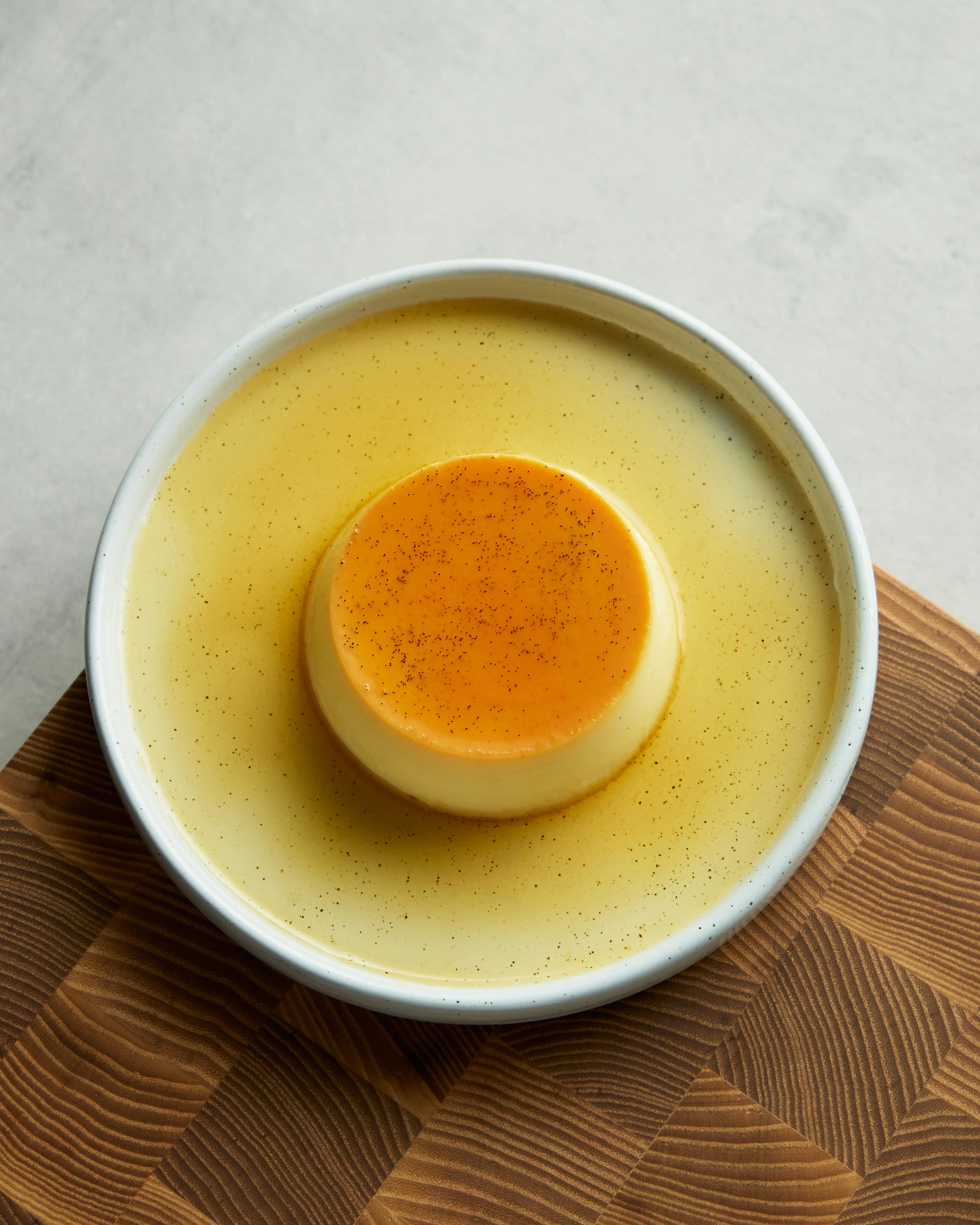
Leche Flan
The diets react (see scores below)
Common Ingredients
- egg yolks
- condensed milk
- evaporated milk
- sugar
- vanilla
- lime zest
Specific recipes may vary.
Incompatible with 11 of 11 diets
Diet Ratings
Leche Flan is fundamentally incompatible with a ketogenic diet. Its core ingredients — condensed milk and added sugar — are extreme sources of carbohydrates. Condensed milk is approximately 55% sugar by weight, and additional granulated sugar is used both in the custard and in making the caramel topping. A single standard serving (approximately 100g) can contain 30–50g of net carbs, easily exceeding the entire daily keto carb budget in one snack. While egg yolks are keto-friendly, they are overwhelmed by the carb load of the other ingredients. There is no meaningful portion that makes this dish compatible with ketosis.
Leche Flan is fundamentally incompatible with a vegan diet. The dish is built entirely around animal-derived ingredients: egg yolks (animal product), condensed milk (dairy), and evaporated milk (dairy). These are not incidental or trace ingredients — they are the structural and defining components of the dish. Sugar, vanilla, and lime zest are the only plant-based elements present. There is no ambiguity here; this dish cannot be made vegan without completely replacing its core ingredients, at which point it would be a different recipe entirely.
Leche Flan is fundamentally incompatible with the Paleo diet. The dish is built almost entirely on non-paleo ingredients: condensed milk and evaporated milk are processed dairy products, refined sugar is a core component, and the overall product is a heavily processed, industrially-produced dessert. While egg yolks, vanilla, and lime zest are paleo-approved, they are minor supporting ingredients that cannot redeem the dish. The three primary ingredients — condensed milk, evaporated milk, and sugar — are all explicitly excluded under paleo rules. This is not a gray-area case; the violations are foundational to the recipe's identity.
Leche Flan is a heavily sweetened custard dessert that directly contradicts core Mediterranean diet principles. It is built almost entirely on ingredients the diet discourages: large quantities of added sugar, condensed milk (a highly processed, sugar-saturated dairy product), and evaporated milk, with egg yolks adding significant saturated fat. While eggs and dairy are accepted in moderation in the Mediterranean diet, they appear here as vehicles for concentrated sugar and saturated fat rather than as nutritious whole foods. There are no plant-forward components, no olive oil, no whole grains, legumes, or vegetables. The sugar load alone — from both added sugar and sweetened condensed milk — firmly places this in the 'avoid' category as a treat that is antithetical to the diet's minimal added sugar principle.
Leche Flan is fundamentally incompatible with the carnivore diet. While it contains animal-derived ingredients (egg yolks, condensed milk, evaporated milk), the dish is built around sugar as a core structural component — the caramel topping and sweetened base are central to what Leche Flan is. Beyond the sugar, vanilla is a plant-derived flavoring and lime zest is a plant food. Condensed milk is also heavily sweetened, compounding the sugar load. Even if one were to debate the dairy components (condensed and evaporated milk) under a lenient animal-based framework, the added sugar and plant ingredients make this dish a clear avoid. No meaningful carnivore framework — not Baker's, not Saladino's animal-based, not the Lion Diet — permits added sugar or plant foods like lime zest and vanilla extract.
Leche Flan contains multiple Whole30-excluded ingredients. Condensed milk and evaporated milk are dairy products, both explicitly excluded from the Whole30 program. Sugar is an added sugar, also explicitly excluded. Even setting aside the spirit-of-the-program concerns, this dish fails on foundational Whole30 rules with at least three distinct excluded ingredients. There is no compliant workaround that would still produce a recognizable Leche Flan.
Leche Flan is a high-FODMAP dish primarily due to condensed milk and evaporated milk. Condensed milk is very high in lactose (and also concentrated sugars), making it a significant FODMAP trigger. Evaporated milk is also high in lactose. Together, these two dairy ingredients make a standard serving of Leche Flan unsuitable during the elimination phase. Egg yolks are low-FODMAP, sugar (sucrose) is low-FODMAP in typical amounts, vanilla extract is low-FODMAP, and lime zest is low-FODMAP — but the dairy components dominate and disqualify this dish. A standard serving of Leche Flan would contain multiple high-FODMAP lactose sources in quantities far exceeding Monash thresholds.
Leche Flan is fundamentally incompatible with DASH diet principles. It is composed almost entirely of ingredients that DASH explicitly limits or discourages: egg yolks (high in cholesterol and saturated fat), condensed milk (full-fat dairy with very high added sugar), evaporated milk (full-fat dairy), and substantial added sugar (both from condensed milk and the caramel sugar base). The dish is a concentrated source of saturated fat, added sugars, and cholesterol with negligible fiber, potassium, magnesium, or other DASH-emphasized nutrients. A typical serving delivers upward of 20-30g of added sugar and significant saturated fat, directly contradicting DASH guidance to limit sweets, full-fat dairy, and saturated fat. It offers no redeeming DASH-aligned nutritional profile — no whole grains, no vegetables, no lean protein, and no meaningful micronutrient contribution relative to its caloric and sugar load.
Leche Flan is a dessert built almost entirely from high-glycemic, high-sugar ingredients that directly conflict with Zone Diet principles. The ingredient list — condensed milk (heavily sweetened), sugar, egg yolks (high saturated fat), and evaporated milk — creates a macronutrient profile that is overwhelmingly carbohydrate-heavy from refined sugars, with significant saturated fat from egg yolks and dairy, and virtually no lean protein contribution. Condensed milk and added sugar are among the highest-glycemic ingredients possible, spiking insulin sharply — the exact hormonal response the Zone Diet is designed to prevent. The fat profile is dominated by saturated fat rather than the preferred monounsaturated fats. While the Zone is ratio-based rather than exclusionary, Leche Flan provides essentially no pathway to a 40/30/30 balance: the sugar-dominant carbohydrate load cannot be offset without an impractically large portion of lean protein added alongside it. Even as a small snack component, it contributes very little nutritional value and high glycemic disruption. This is one of the clearest 'avoid' cases in Zone methodology — a pure dessert composed of the diet's least-favorable ingredients.
Leche flan is a dessert built almost entirely on pro-inflammatory or nutritionally neutral ingredients. The foundation is egg yolks, condensed milk, evaporated milk, and refined sugar — a combination that delivers high saturated fat, significant added sugar, and a high glycemic load. Condensed milk is essentially sweetened condensed whole milk with a very high sugar concentration; evaporated milk is full-fat dairy; together they create a rich, calorie-dense base that spikes blood glucose and may elevate inflammatory markers like CRP and IL-6. The large quantity of egg yolks contributes arachidonic acid (a precursor to pro-inflammatory eicosanoids), and while eggs have some anti-inflammatory nutrients, the volume used here and the surrounding pro-inflammatory context works against them. Added sugar is one of the most reliably pro-inflammatory dietary components, associated with increased oxidative stress and NF-κB activation. Vanilla and lime zest offer trace antioxidants but in quantities too small to offset the overall inflammatory profile. This dish has no meaningful omega-3 content, no vegetables, no fiber, and no polyphenols of significance. It represents the dessert category that anti-inflammatory frameworks consistently flag: high-sugar, high-saturated-fat, refined, and calorie-dense with minimal redeeming nutritional value.
Leche flan is a high-sugar, high-fat custard dessert made almost entirely from egg yolks, condensed milk, evaporated milk, and sugar — a nutritional profile that conflicts with nearly every GLP-1 dietary priority. A typical serving (80–100g) delivers 25–35g of sugar, 8–12g of fat (predominantly saturated from dairy and yolks), and only 4–6g of protein despite the egg yolk base. The caloric density is high while nutrient density per calorie is low. The heavy sugar and saturated fat load can worsen GLP-1 side effects including nausea, reflux, and bloating, and the slow gastric emptying caused by GLP-1 medications means this rich, dense dessert will sit in the stomach uncomfortably long. Condensed milk contributes a concentrated sugar hit that spikes blood glucose — counterproductive for a medication class used to manage glycemic control. The egg yolks provide some micronutrients but the overall dish is not a meaningful protein source at practical serving sizes. This is an empty-calorie, high-sugar, high-saturated-fat food with no fiber and minimal protein — the combination most likely to cause GI distress and undermine weight loss goals on GLP-1 therapy.
*See how scores were generated at our methodology page.
Nutritional profile
Six traits that cut across every diet.
Fiber & Plants
How much whole-plant food and fiber it delivers.
Healthy Fats
The quality of its fats (unsaturated, omega-3).
Whole / Unprocessed
How close it is to its natural, unprocessed form.
Gut Gentle
How easy it is on digestion (low FODMAP, few irritants).
Low Glycemic
How little it spikes your blood sugar.
Protein Density
How much protein it packs per calorie.
Controversy Index
Higher controversy = more disagreement between diets.