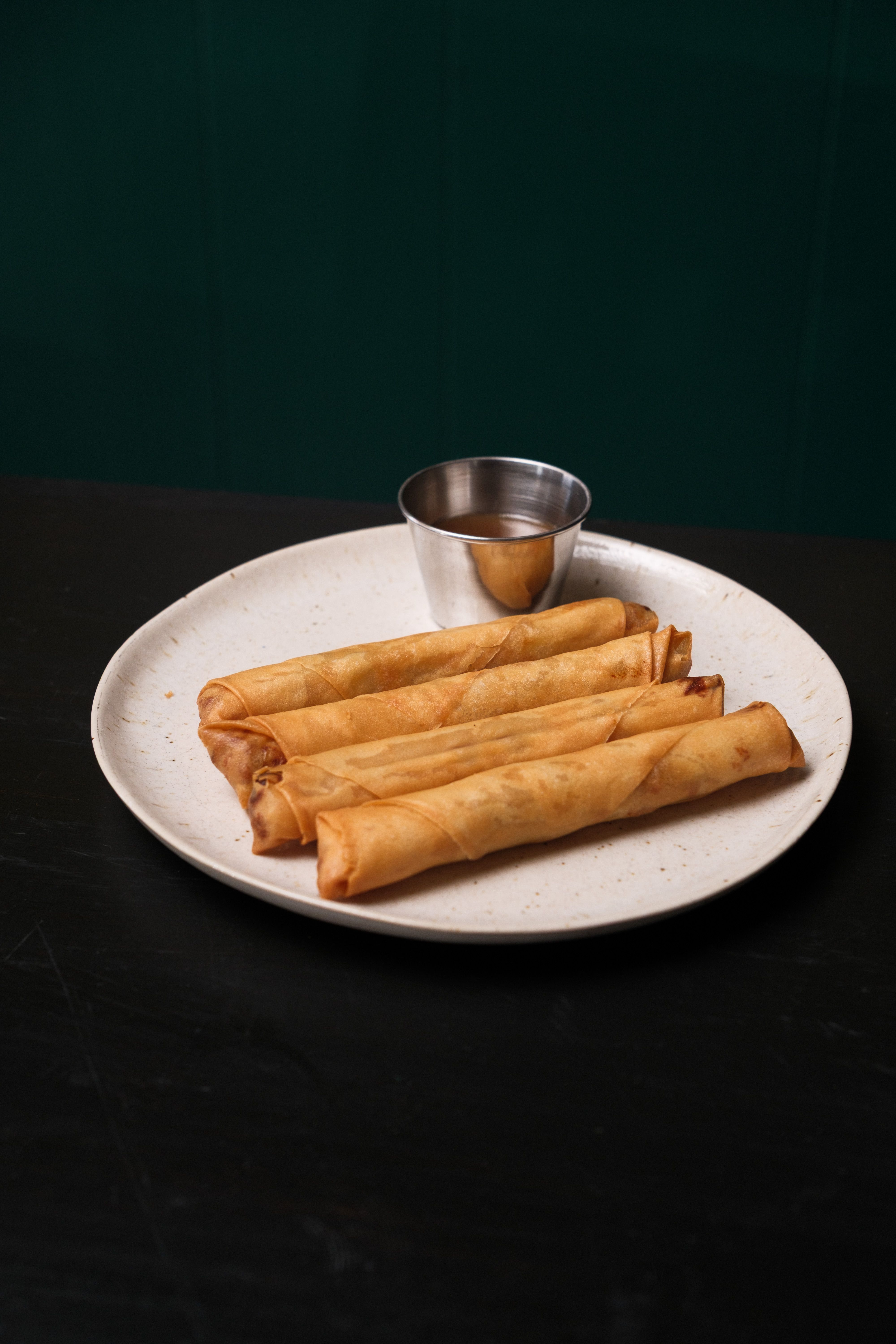
Photo: Airam Dato-on / Pexels
Filipino
Lumpia Shanghai
The diets react (see scores below)
Common Ingredients
- ground pork
- spring roll wrapper
- carrot
- onion
- garlic
- egg
- soy sauce
- scallion
Specific recipes may vary.
Incompatible with 9 of 11 diets
Diet Ratings
Lumpia Shanghai is fundamentally incompatible with ketogenic eating due to the spring roll wrapper, which is made from wheat flour or rice flour — a grain-based, high-carb ingredient. Each wrapper contributes roughly 5-8g of net carbs, and a typical serving involves multiple pieces, easily pushing 20-40g of net carbs from the wrappers alone before accounting for the carrot and onion filling. The filling ingredients (ground pork, egg, garlic, scallion, soy sauce) are largely keto-friendly, but the wrapper is the deal-breaker. This is not a borderline case — grain-based wrappers are explicitly off-limits on keto with no meaningful exception.
Lumpia Shanghai contains multiple animal-derived ingredients that are categorically incompatible with a vegan diet. Ground pork is the primary protein and a direct animal product. Egg is used as a binder and is also an animal product. These two ingredients alone make this dish firmly non-vegan. There is no ambiguity here — this is a meat-filled, egg-bound fried roll that cannot be considered vegan in its traditional form. Vegan adaptations exist using plant-based proteins (e.g., tofu, lentils, or mushrooms) and a flaxseed or cornstarch egg substitute, but the dish as described is not vegan.
Lumpia Shanghai is clearly non-paleo due to multiple disqualifying ingredients. The spring roll wrapper is made from wheat flour, a grain explicitly excluded from the paleo diet. Soy sauce contains both soy (a legume) and wheat (a grain), adding two more violations. While the filling ingredients — ground pork, carrot, onion, garlic, egg, and scallion — are largely paleo-compliant, the dish as a whole cannot be considered paleo because its defining structural and flavoring components are off-limits. There is no meaningful way to separate the compliant ingredients from the non-compliant ones in this dish as traditionally prepared.
Lumpia Shanghai contradicts Mediterranean diet principles on multiple fronts. Ground pork is a red/processed meat that should be consumed only a few times per month, and here it is the primary and dominant ingredient. The spring roll wrapper is a refined grain product with little nutritional value. The dish is deep-fried, using oils other than extra virgin olive oil and adding significant unhealthy fat. While the vegetables (carrot, onion, garlic, scallion) are Mediterranean-friendly, they appear in small quantities relative to the pork. Soy sauce adds processed sodium. This dish is the antithesis of the plant-forward, minimally processed, olive oil-based philosophy of the Mediterranean diet.
Lumpia Shanghai is fundamentally incompatible with the carnivore diet. While it contains ground pork and egg — both carnivore-approved ingredients — the dish is disqualified by multiple plant-based and processed components. The spring roll wrapper is a grain-based (wheat flour) processed food, which alone is sufficient to exclude this dish. Additionally, carrot, onion, garlic, and scallion are all plant foods explicitly excluded from the carnivore diet. Soy sauce is a fermented grain-and-legume product containing both wheat and soy, adding further plant-derived and processed ingredients. The only salvageable components are the ground pork and egg, but the overall dish as prepared is entirely off-limits for any tier of carnivore eating.
Lumpia Shanghai contains multiple Whole30-excluded ingredients. Soy sauce is a soy-based product (legume derivative) and is explicitly excluded. Spring roll wrappers are grain-based (typically wheat flour), making them excluded as well. Additionally, even if substitutions were made for those two ingredients, the dish in its traditional form falls into the 'fried snack/wrapper' category that Whole30's rule against recreating junk food and processed snack formats would flag. The combination of a grain wrapper and soy sauce makes this clearly non-compliant.
Lumpia Shanghai contains multiple high-FODMAP ingredients that make it unsuitable during the elimination phase. Onion and garlic are among the highest-FODMAP foods tested by Monash University, both rich in fructans, and there is no safe serving size for either during elimination. Spring roll wrappers are typically made from wheat flour, adding another source of fructans. Scallions (green onions) — if the white bulb portion is used — are also high in fructans, though the green tops alone are low-FODMAP. The combination of onion, garlic, and wheat-based wrappers makes this dish clearly high-FODMAP regardless of portion size.
Lumpia Shanghai is a deep-fried Filipino spring roll that conflicts with DASH diet principles on multiple fronts. Ground pork is a red meat with notable saturated fat content, which DASH explicitly limits. The spring roll wrappers are refined (not whole grain), offering little nutritional value. Soy sauce contributes significant sodium — even small amounts used in filling can add 300–600mg or more per serving — and deep frying adds substantial unhealthy fat and calories. As a fried snack food made with red meat and refined wrappers, this dish sits firmly in the 'avoid' category for DASH adherents.
Lumpia Shanghai presents several Zone Diet challenges. The spring roll wrapper is made from refined wheat flour — a high-glycemic carbohydrate that Sears classifies as 'unfavorable.' When deep-fried (the traditional preparation), the wrapper absorbs significant oil, typically omega-6-heavy seed oil, which conflicts with Zone's anti-inflammatory emphasis. Ground pork is a moderately fatty protein — not as lean as skinless chicken or fish — contributing saturated fat that skews the fat block toward the unfavorable end. On the positive side, the filling contains legitimate Zone-friendly ingredients: carrots, onion, garlic, and scallion are low-glycemic vegetables, and pork does provide usable protein blocks. The dish is theoretically workable in Zone if portioned carefully (2-3 small pieces as a snack alongside a large vegetable salad to rebalance carb quality) but the refined wrapper and frying method make this a structurally difficult fit. The 40/30/30 ratio is hard to achieve without significant dietary adjustments around this item. As a snack category food, the portions are smaller, which limits damage but doesn't resolve the macro imbalance inherent in the wrapper-to-filling ratio.
Some Zone practitioners argue that a small serving of Lumpia Shanghai (2-3 pieces) can serve as an acceptable protein-forward snack block if paired with raw vegetables, treating the wrapper as a minor carb contribution and focusing on the protein and vegetable content of the filling. Sears' later writings in 'The Zone' acknowledge that occasional unfavorable carbs in controlled portions don't break the Zone if the overall meal ratio is managed. Baked rather than fried lumpia significantly improves the fat profile and makes Zone integration more plausible.
Lumpia Shanghai presents a mixed anti-inflammatory profile. On the positive side, garlic and onion contain quercetin and allicin with documented anti-inflammatory properties, and carrots contribute beta-carotene antioxidants. Soy sauce adds minimal concern in small quantities. However, the dish's core issues are significant from an anti-inflammatory standpoint: ground pork is a red/processed-adjacent meat relatively high in saturated fat and arachidonic acid, both of which can promote inflammation when consumed regularly. The refined spring roll wrapper is essentially a refined carbohydrate with negligible fiber, which anti-inflammatory frameworks consistently flag as problematic. Crucially, Lumpia Shanghai is almost universally deep-fried, introducing large amounts of omega-6-rich seed oils (typically vegetable or canola oil) at high heat, which generates oxidation byproducts linked to inflammatory response. The dish is also typically consumed as a snack in multiples, amplifying these concerns. The aromatics (garlic, scallion, onion) provide modest mitigation but cannot offset the combined effect of red meat, refined starch, and frying oil. Occasional consumption is acceptable, but this is not a dish to eat regularly on an anti-inflammatory diet.
Lumpia Shanghai is a deep-fried spring roll filled primarily with ground pork — a fatty red meat — wrapped in a refined flour wrapper and cooked in oil. The combination of deep frying, high saturated fat from pork, and a refined-carb wrapper makes this a poor fit for GLP-1 patients on multiple fronts. Deep frying significantly increases total fat content and adds trans/oxidized fats, directly worsening GLP-1 side effects such as nausea, bloating, and reflux. The refined spring roll wrapper contributes empty calories with negligible fiber. While the filling does contain vegetables (carrot, onion, scallion, garlic) and some protein from pork, the fat-to-protein ratio is unfavorable — ground pork is typically 20–30% fat by weight, and frying compounds this. Portion control is difficult because these are served as finger-food snacks, making overeating easy. Nutrient density per calorie is low. The soy sauce adds sodium, which is a minor concern but not a primary driver of the rating. Overall, this dish hits three major 'avoid' criteria simultaneously: fried, high saturated fat, and low fiber.
*See how scores were generated at our methodology page.
Nutritional profile
Six traits that cut across every diet.
Fiber & Plants
How much whole-plant food and fiber it delivers.
Healthy Fats
The quality of its fats (unsaturated, omega-3).
Whole / Unprocessed
How close it is to its natural, unprocessed form.
Gut Gentle
How easy it is on digestion (low FODMAP, few irritants).
Low Glycemic
How little it spikes your blood sugar.
Protein Density
How much protein it packs per calorie.
Controversy Index
Higher controversy = more disagreement between diets.
Diet-Specific Tips
 Zone — 4/10
View tips
- Spring roll wrapper is refined, high-glycemic carbohydrate — classified 'unfavorable' in Zone terminology
- Traditional deep-frying adds omega-6-heavy oils, conflicting with Zone's anti-inflammatory focus
- Ground pork is moderately fatty protein, not the lean protein ideal Sears recommends
- Filling vegetables (carrot, onion, garlic, scallion) are Zone-favorable low-glycemic carbs
- Wrapper-to-filling ratio skews the carb block toward unfavorable refined starch
- Small snack portions reduce macro damage but don't resolve structural imbalance
- Baking instead of frying and increasing vegetable-based accompaniments improves Zone compatibility
 Anti-Inflammatory — 4/10
View tips
- Ground pork is a red meat with saturated fat and arachidonic acid — both pro-inflammatory in excess
- Refined spring roll wrapper is a low-fiber refined carbohydrate, flagged across anti-inflammatory frameworks
- Deep frying in seed oils introduces high-heat oxidized omega-6 fatty acids, a significant inflammatory concern
- Garlic and onion contribute quercetin and allicin with anti-inflammatory properties
- Carrots add beta-carotene antioxidants — a modest positive
- Typically consumed in multiples as a snack, amplifying pro-inflammatory components