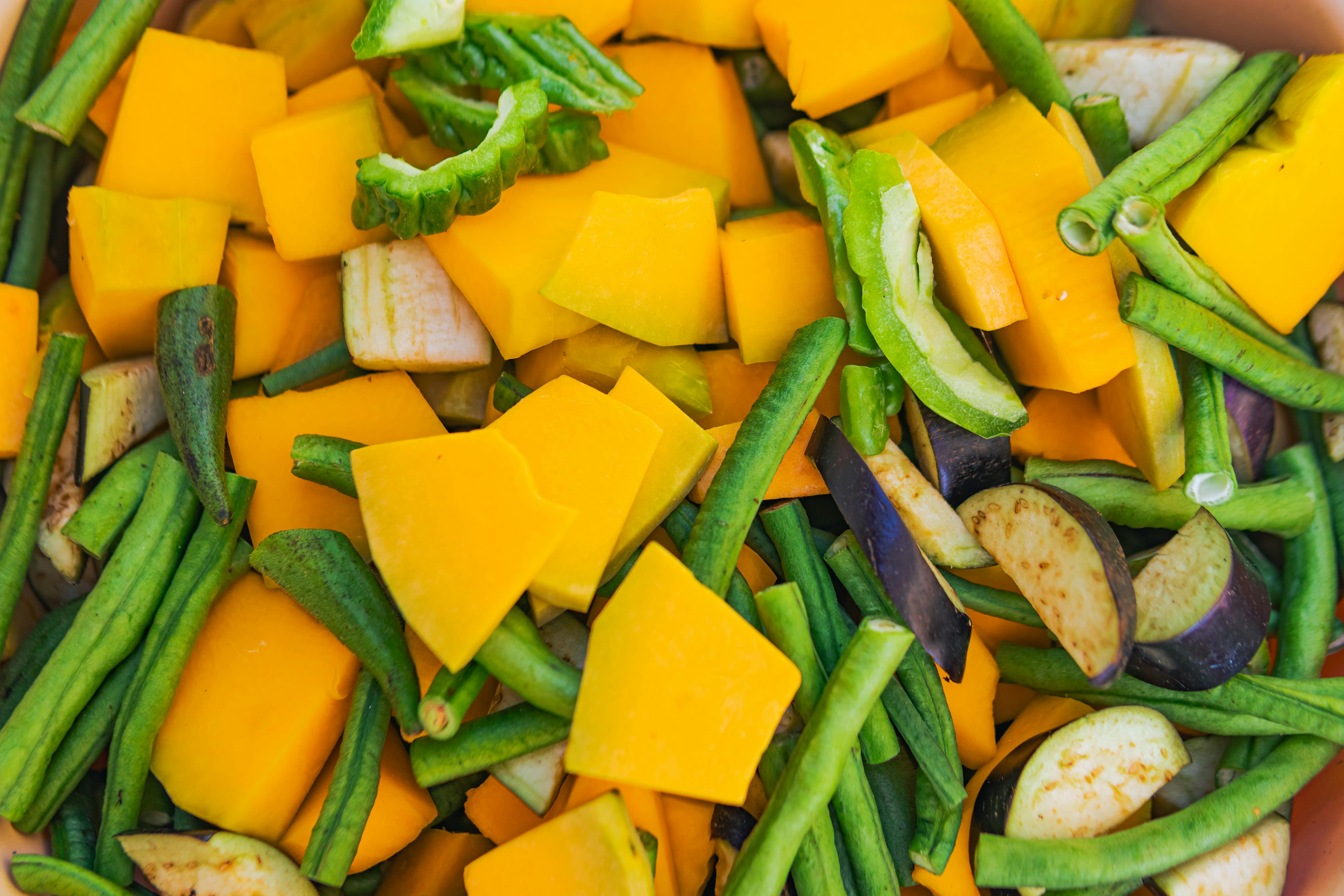
Photo: Nothing Ahead / Pexels
The diets react (see scores below)
Common Ingredients
- bitter melon
- eggplant
- okra
- squash
- string beans
- bagoong
- tomato
- pork
- garlic
Specific recipes may vary.
Incompatible with 4 of 11 diets
Diet Ratings
Pinakbet contains a mix of vegetables with varying carb loads. Most ingredients are moderate-keto: bitter melon (~2g net carbs/100g), eggplant (~3g), and garlic are relatively low-carb. However, squash (kabocha/butternut ~7-9g net carbs/100g) and string beans (~4-5g net carbs/100g) add meaningful carbs, while okra is borderline (~4g). Tomato adds a small amount of sugar. Bagoong (shrimp paste) is keto-friendly. The pork component is keto-positive. The cumulative carb load of a standard serving of this vegetable-heavy dish — especially with squash as a primary ingredient — can easily approach or exceed 15-20g net carbs per serving, making it risky without strict portion control. A smaller portion with reduced squash and string beans, focusing on the pork and lower-carb vegetables, can be worked into a daily keto budget.
Some lazy keto or moderate keto practitioners would approve a small portion of Pinakbet, arguing that the fiber content of these vegetables offsets total carbs, the dish is nutrient-dense, and vegetable variety matters. Strict keto adherents would lean toward avoid, flagging squash and string beans as too carb-dense even in moderate portions.
Pinakbet as listed contains two clear animal-derived ingredients: pork (meat) and bagoong (fermented shrimp or fish paste), both of which are strictly excluded under vegan dietary rules. The vegetable base — bitter melon, eggplant, okra, squash, string beans, tomato, and garlic — is entirely plant-based, but the presence of pork and bagoong makes this dish unequivocally non-vegan. There is no ambiguity here.
Pinakbet is a Filipino vegetable stew that contains mostly paleo-friendly vegetables (bitter melon, eggplant, okra, squash, tomato, garlic) and pork, but is disqualified primarily by two critical non-paleo ingredients. First, string beans (also called green beans) are legumes and are excluded from the paleo diet. Second, and more significantly, bagoong — a fermented shrimp or fish paste — is a heavily processed, salt-laden condiment that is central to this dish's flavor profile. Bagoong contains added salt and is a processed food by definition, making it incompatible with paleo guidelines. The combination of legumes (string beans) and a processed, high-sodium fermented paste (bagoong) as a core ingredient — not an optional garnish — pushes this dish firmly into the avoid category despite its otherwise vegetable-forward and pork-inclusive base.
Pinakbet is a vegetable-forward dish with an excellent array of Mediterranean-compatible vegetables — bitter melon, eggplant, okra, squash, string beans, tomato, and garlic are all firmly in line with Mediterranean principles. However, two ingredients complicate the assessment: pork and bagoong (fermented shrimp/fish paste). Pork is a red/processed meat that the Mediterranean diet limits to a few times per month, and its presence here as a flavoring/protein component pushes the dish away from ideal. Bagoong is a highly salted, fermented condiment — while fermented foods have some acceptance, its high sodium content and processed nature are concerns. The dish is not a core Mediterranean staple but can be adapted or enjoyed occasionally given its overwhelmingly plant-based vegetable content.
Some Mediterranean diet interpreters would view the vegetable base as so dominant that the small amount of pork used as flavoring (common in many traditional Mediterranean cuisines, e.g., Southern Italian use of cured pork for seasoning) is acceptable in moderation. Similarly, bagoong could be loosely compared to fermented anchovy pastes used in traditional Mediterranean cooking.
Pinakbet is a Filipino vegetable stew that is fundamentally incompatible with the carnivore diet. The dish is dominated by plant foods — bitter melon, eggplant, okra, squash, string beans, tomato, and garlic — which are all strictly excluded on a carnivore diet. While pork is a carnivore-approved ingredient and bagoong (fermented shrimp paste) is an animal-derived condiment, they are minor components in a dish that is defined by its vegetables. The overwhelming majority of ingredients are plant-derived, making this dish an 'avoid' regardless of the presence of pork or bagoong. There is no meaningful way to adapt Pinakbet to carnivore — its entire identity is the vegetable medley.
Pinakbet is a traditional Filipino vegetable stew with mostly Whole30-compliant ingredients: bitter melon, eggplant, okra, squash, string beans, tomato, pork, and garlic are all allowed. However, the critical ingredient is bagoong (fermented shrimp or fish paste), which is the primary seasoning. Traditional bagoong almost universally contains added sugar and sometimes other non-compliant additives, making the common version of this dish non-compliant. A bagoong-free or compliant-bagoong version (using only fermented shrimp/fish with salt) could make this dish Whole30-approved, but careful label-reading or homemade preparation is essential. String beans are fully compliant as a Whole30-allowed legume exception.
Some Whole30 practitioners argue that certain traditional fermented condiments like fish paste (without added sugar) honor the program's whole-food philosophy, and pure fermented shrimp paste (alamang) with only shrimp and salt would be technically compliant. However, the official Whole30 guidelines are strict about added sugar in any form, and commercially available bagoong almost always contains sugar, making this a label-reading necessity rather than a blanket approval.
Pinakbet contains multiple high-FODMAP ingredients that make it unsuitable during the elimination phase. Garlic is a major fructan source and is high-FODMAP at any culinary amount — it is a core flavoring in this dish. String beans (green beans) are low-FODMAP at small servings (~15 beans per Monash) but in a shared vegetable dish the cumulative load is hard to control. Okra is high-FODMAP due to fructans and polyols at standard serving sizes (Monash rates >6 pods as high-FODMAP). Bagoong (fermented shrimp paste) is a fermented condiment with uncertain FODMAP status and may contain added ingredients that complicate assessment. Bitter melon, eggplant, squash (kabocha-type), and tomato are individually low-to-moderate FODMAP at controlled portions, and plain pork is low-FODMAP. However, the combination of garlic (unambiguously high-FODMAP) and okra (high-FODMAP at standard serves) alone makes this dish a clear avoid during elimination, regardless of portion size adjustments to other ingredients.
Monash University clearly rates garlic as high-FODMAP at any culinary dose, but some clinical FODMAP practitioners suggest that if garlic is used only to infuse oil (removed before eating), the dish could theoretically be modified — however, traditional Pinakbet uses whole or minced garlic that remains in the dish, so this substitution would not apply to a standard preparation. Okra's FODMAP threshold (≤6 pods low-FODMAP) adds further dose-dependent complexity that makes this dish difficult to safely portion in a mixed-vegetable context.
Pinakbet is a nutrient-rich Filipino vegetable stew with an impressive DASH-friendly vegetable base — bitter melon, eggplant, okra, squash, string beans, and tomato are all excellent sources of potassium, magnesium, fiber, and antioxidants, perfectly aligned with DASH principles. However, two ingredients significantly undermine its DASH compatibility: bagoong (fermented shrimp or fish paste) is extremely high in sodium, often contributing 500–1,000mg+ per tablespoon, making it the primary concern; and pork (often fatty cuts like pork belly in traditional preparation) adds saturated fat, which DASH limits. The dish is genuinely nutritious and vegetable-forward, but the traditional preparation method places it firmly in 'caution' territory rather than 'avoid' because the problematic components are modifiable — lean pork loin in small amounts is acceptable in DASH, and reduced bagoong or low-sodium fish sauce can dramatically improve the sodium profile.
NIH DASH guidelines would flag bagoong as a high-sodium condiment to avoid and pork belly as a high-saturated-fat red meat to limit; however, updated clinical interpretations of DASH in culturally diverse populations acknowledge that traditional dishes like pinakbet, when modified with lean pork and reduced-sodium fermented paste, can fit within DASH targets — some DASH-aligned dietitians recommend preserving culturally meaningful dishes through ingredient modification rather than elimination.
Pinakbet is a Filipino vegetable stew that aligns well with Zone principles in several respects but has notable caveats. The vegetable base — bitter melon, eggplant, okra, string beans, and tomato — is largely Zone-favorable: these are low-glycemic, polyphenol-rich vegetables that Dr. Sears would classify as 'favorable' carbohydrate sources. Bitter melon in particular has documented blood sugar-regulating properties consistent with Zone's anti-inflammatory goals. The squash raises the glycemic load slightly depending on variety and portion size, but remains manageable. The primary concern is bagoong (fermented shrimp paste), which is extremely high in sodium and often contains additives — while not disqualifying, it complicates the dish from an anti-inflammatory standpoint. Pork, depending on the cut used, is the other variable: if lean pork (e.g., tenderloin) is used in modest portions (~25g protein), it fits within Zone parameters, but fatty pork belly — common in traditional pinakbet — adds significant saturated fat that pushes the fat profile away from Zone's monounsaturated ideal. As a side dish without a primary protein designation, the dish lacks sufficient protein blocks on its own to constitute a Zone-balanced meal component, meaning it needs pairing with a lean protein source. Overall, the vegetable density is excellent for Zone, but the fatty pork and high-sodium bagoong require adjustment for optimal Zone compliance.
Some Zone practitioners would score this higher (7) if lean pork is used, noting that the exceptional vegetable variety and polyphenol density — especially bitter melon — make pinakbet one of the more Zone-compatible traditional dishes in Southeast Asian cuisine. Sears' later work in 'The Zone Diet' and 'Toxic Fat' emphasizes polyphenols as central to Zone success, and the colorful vegetable profile here is exemplary. Others would caution that the squash and bagoong together push the dish toward 'unfavorable' territory requiring stricter portion control.
Pinakbet is a traditional Filipino vegetable stew with a genuinely mixed anti-inflammatory profile. On the positive side, the dish is dominated by an impressive array of anti-inflammatory vegetables: bitter melon (charantin, polyphenols, blood sugar-regulating compounds), eggplant (nasunin, chlorogenic acid — a notable antioxidant), okra (quercetin, fiber, mucilaginous compounds that may reduce gut inflammation), squash (beta-carotene, vitamin C), string beans (fiber, flavonoids), tomato (lycopene, especially when cooked), and garlic (allicin, organosulfur compounds). These are collectively powerful sources of antioxidants, carotenoids, and polyphenols that align well with anti-inflammatory principles. The concerns come from two ingredients: bagoong (fermented shrimp paste) contributes very high sodium, which in excess can promote systemic inflammation and cardiovascular stress, though its fermented nature provides some probiotic benefit; and pork, particularly if fatty cuts are used, introduces saturated fat that should be limited on an anti-inflammatory diet. The dish is categorized as a side (suggesting smaller portions of the pork component), and it is overall vegetable-forward, which mitigates these concerns somewhat. A version made with lean pork or reduced pork quantity and used sparingly with bagoong would trend toward a higher score. As prepared traditionally, the balance of abundant anti-inflammatory vegetables against the sodium load from bagoong and saturated fat from pork places this firmly in the 'caution' range.
Some anti-inflammatory practitioners, particularly those following AIP or nightshade-sensitive protocols, would flag eggplant and tomato as potentially problematic due to solanine and lectin content, pushing this dish toward a lower score for autoimmune-sensitive individuals. Conversely, whole-diet researchers like Dr. Walter Willett would likely view the vegetable density and fiber content as strongly net-positive, potentially approving the dish even with its sodium and pork content in the context of an otherwise balanced diet.
Pinakbet is a Filipino vegetable stew with a genuinely mixed nutritional profile for GLP-1 patients. On the positive side, it is exceptionally rich in high-fiber, nutrient-dense vegetables — bitter melon, okra, eggplant, squash, and string beans collectively provide strong fiber content (supporting the #2 priority and helping with GLP-1-related constipation), meaningful micronutrients, and high water content that aids hydration. Bitter melon also has evidence for modest blood sugar regulation, which is a bonus for many GLP-1 patients managing insulin resistance. However, several factors limit the score. First, pork is a standard ingredient and is typically a fattier cut (belly or shoulder) in traditional pinakbet, contributing saturated fat that can worsen GLP-1 side effects like nausea, bloating, and reflux. Second, bagoong (fermented shrimp paste) is extremely high in sodium — a meaningful concern as GLP-1 patients eating smaller portions are at risk of inadvertently consuming disproportionate sodium loads per calorie. Third, protein contribution from a typical side-dish serving is low, and the dish is categorized as a side with no primary protein listed, meaning it does not meaningfully advance the #1 priority. As a side dish accompanying a lean protein main, pinakbet fits well. As a standalone dish, it underdelivers on protein and carries fat and sodium concerns.
Some GLP-1-focused dietitians view traditional vegetable-forward Filipino dishes like pinakbet favorably because the vegetable volume and fiber content support satiety and GI health even in small servings — the fat concern depends heavily on how much pork and what cut is used, and some versions use minimal pork or substitute with tofu. Others flag the high sodium from bagoong as a more serious concern than the fat, particularly for patients with hypertension or cardiovascular comorbidities common in GLP-1 patient populations.
*See how scores were generated at our methodology page.
Nutritional profile
Six traits that cut across every diet.
Fiber & Plants
How much whole-plant food and fiber it delivers.
Healthy Fats
The quality of its fats (unsaturated, omega-3).
Whole / Unprocessed
How close it is to its natural, unprocessed form.
Gut Gentle
How easy it is on digestion (low FODMAP, few irritants).
Low Glycemic
How little it spikes your blood sugar.
Protein Density
How much protein it packs per calorie.
Controversy Index
Higher controversy = more disagreement between diets.
Diet-Specific Tips
 Keto — 4/10
View tips
- Squash is the primary concern — relatively high net carbs and commonly used in generous amounts
- String beans and okra add cumulative carbs that quickly stack up
- Bitter melon and eggplant are relatively low net-carb and keto-friendlier
- Pork and bagoong are keto-positive components
- Tomato adds minor sugar but is not a dealbreaker in small quantities
- Total dish net carbs per serving likely 10-20g depending on vegetable ratios and portion size
 Mediterranean — 5/10
View tips
- Rich variety of whole vegetables (eggplant, bitter melon, okra, squash, string beans, tomato, garlic) strongly aligns with Mediterranean principles
- Pork is a red meat limited to a few times per month in the Mediterranean diet
- Bagoong (fermented shrimp paste) is high in sodium and considered a processed condiment, not Mediterranean-traditional
- No olive oil as primary fat — dish relies on bagoong and pork fat for flavor
- Plant-forward composition is a significant positive factor
- Could be modified (omit pork, reduce bagoong, add olive oil) to better fit Mediterranean guidelines
 Whole30 — 5/10
View tips
- Bagoong (fermented shrimp/fish paste) is the key concern — most commercial versions contain added sugar
- All vegetables (bitter melon, eggplant, okra, squash, tomato) are fully Whole30 compliant
- String beans are explicitly allowed on Whole30 despite being a legume
- Pork and garlic are fully compliant
- Dish is compliant only if bagoong with no added sugar or non-compliant ingredients is used
- Label-reading or homemade bagoong substitution required for compliance
 DASH — 4/10
View tips
- Bagoong (fermented shrimp/fish paste) is very high in sodium — a primary DASH concern
- Pork, especially fatty cuts like belly, adds saturated fat beyond DASH limits
- Vegetable base (bitter melon, eggplant, okra, squash, string beans, tomato) is outstanding for DASH
- Rich in potassium, magnesium, and fiber from vegetables
- Can be made more DASH-compatible with lean pork loin and reduced or low-sodium bagoong
- Garlic and tomato support cardiovascular health consistent with DASH goals
 Zone — 6/10
View tips
- Strong low-glycemic vegetable base (bitter melon, eggplant, okra, string beans, tomato) aligns well with Zone carbohydrate guidelines
- Bitter melon has blood sugar-regulating properties consistent with Zone anti-inflammatory goals
- Squash adds moderate glycemic load — portion size matters
- Bagoong (fermented shrimp paste) is very high in sodium and may contain additives — not anti-inflammatory-friendly
- Pork protein quality is highly cut-dependent: lean pork = Zone-acceptable; fatty pork belly = Zone-unfavorable due to saturated fat
- As a side dish, lacks sufficient standalone protein blocks — must be paired with additional lean protein for a Zone-balanced meal
- Excellent polyphenol density from diverse colorful vegetables supports Zone's anti-inflammatory framework
- No Zone-ideal monounsaturated fat source present — would benefit from a small amount of olive oil
 Anti-Inflammatory — 5/10
View tips
- Rich array of anti-inflammatory vegetables (bitter melon, okra, squash, eggplant, string beans, tomato, garlic)
- Bitter melon has documented anti-inflammatory and blood sugar-regulating properties
- Garlic provides allicin and organosulfur anti-inflammatory compounds
- Tomato and squash are high in lycopene and beta-carotene (carotenoids); bioavailability enhanced by cooking
- Bagoong (fermented shrimp paste) contributes very high sodium, a concern for systemic inflammation
- Pork adds saturated fat, which is limited on anti-inflammatory protocols
- Eggplant and tomato are nightshades — beneficial for most, but flagged by AIP/autoimmune protocols
- Dish is vegetable-forward; pork plays a minor supporting role as a side dish
 GLP-1 Friendly — 5/10
View tips
- High fiber from diverse vegetables (bitter melon, okra, string beans, squash, eggplant) supports GLP-1 digestion priority
- High water content in vegetables supports hydration
- Pork (often fatty cut) raises saturated fat concern — worsens nausea and bloating on GLP-1 medications
- Bagoong is very high in sodium — disproportionate sodium load in small serving sizes
- Low protein per serving as a side dish — does not support the primary GLP-1 protein priority
- Bitter melon has modest evidence for blood sugar regulation — modest bonus for metabolic patients
- Works well as a side to lean protein; not recommended as a standalone meal on GLP-1 therapy
- Traditional recipe varies — leaner pork cuts or tofu substitution improves the rating meaningfully