Photo: Valeria Boltneva / Pexels
The diets react (see scores below)
Common Ingredients
- rye flour
- vendace
- pork belly
- salt
- butter
- water
Specific recipes may vary.
Incompatible with 8 of 11 diets
Diet Ratings
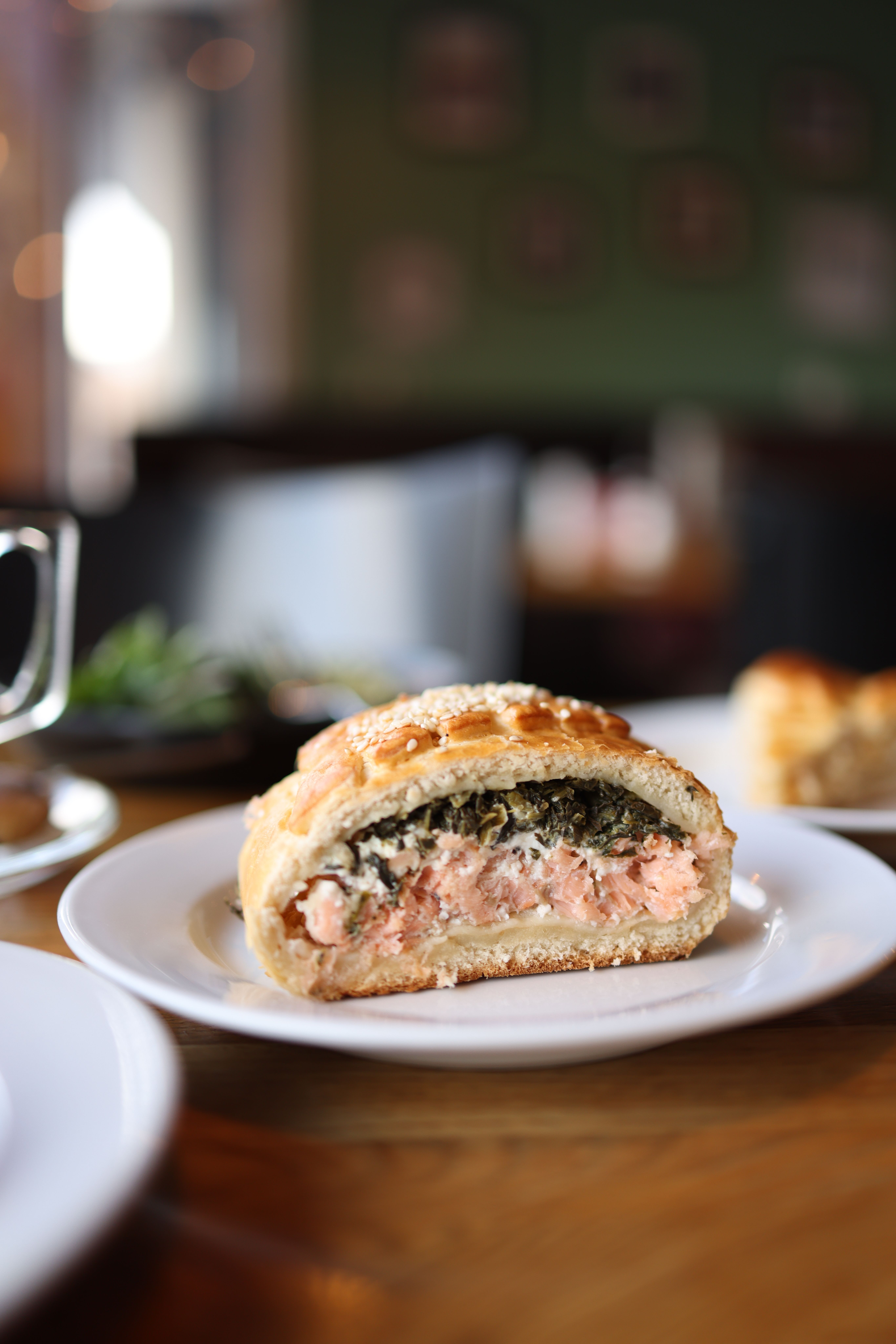
Kalakukko is a traditional Finnish fish pie baked inside a rye bread crust. The dominant ingredient by volume and caloric structure is rye flour, which is a whole grain with extremely high net carbohydrates (approximately 60-65g net carbs per 100g). A single serving of Kalakukko would deliver far more carbohydrates than the entire daily keto allowance of 20-50g net carbs. While the filling — vendace (a small freshwater fish), pork belly, butter, and salt — is inherently keto-friendly with excellent fat and protein profiles, the rye crust is inseparable from the dish as traditionally prepared and is the primary vessel and component. The grain-based crust alone disqualifies this dish from ketogenic compatibility regardless of the favorable filling ingredients.
Kalakukko is a traditional Finnish rye bread pie containing multiple animal products. Vendace (a freshwater fish) and pork belly are both animal flesh, making this dish entirely incompatible with a vegan diet. Butter is a dairy product, also excluded. The only plant-based ingredients are rye flour, salt, and water. With three distinct animal-derived ingredients (fish, pork, and dairy butter), this dish is unambiguously non-vegan.
Kalakukko is a traditional Finnish fish pie baked inside a rye bread crust. Rye flour is a grain and a clear paleo exclusion — it forms the structural foundation of this dish, making it impossible to evaluate without it. Beyond the crust, salt is an added ingredient excluded under strict paleo rules, and pork belly in processed or cured forms raises concerns, though plain pork belly itself is paleo-compliant. The vendace (a small freshwater fish) is fully paleo-approved, and butter is debated but widely used. However, none of these compliant or near-compliant ingredients can redeem a dish whose entire form depends on a grain-based crust. Rye flour alone disqualifies Kalakukko from any paleo rating above 'avoid'.
Kalakukko is a traditional Finnish rye bread loaf stuffed with vendace (small freshwater fish) and pork belly. It has both positive and problematic elements from a Mediterranean diet perspective. The rye flour is a whole grain, which aligns well with Mediterranean principles, and vendace is a nutritious fish providing omega-3 fatty acids, which is encouraged. However, pork belly is a fatty red/processed meat that contradicts Mediterranean guidelines, which limit red meat to a few times per month. Butter is used rather than olive oil, which is a less preferred fat in the Mediterranean framework. The combination of pork belly fat and butter significantly increases saturated fat content. The dish is not inherently highly processed or sugar-laden, and the fish and rye components redeem it partially, but the pork belly is a meaningful detractor.
Some Mediterranean diet interpreters might view this more harshly, arguing that pork belly effectively makes this an 'avoid' dish since red/fatty meat is a core food to minimize; others in a broader whole-foods lens might note the whole grain rye and fish components partially offset concerns, placing it firmly in caution territory rather than avoidance.
Kalakukko is a traditional Finnish fish pie baked inside a rye bread crust. While the filling — vendace (a small freshwater fish), pork belly, and salt — is entirely carnivore-compatible, the dish is fundamentally defined by its rye flour crust, which is a grain-based plant food explicitly excluded from the carnivore diet. The crust is not incidental; it is structural to the dish and inseparable from it as traditionally prepared. Butter and water are acceptable, but rye flour is a hard disqualifier. The dish as a whole cannot be approved.
Kalakukko is a traditional Finnish fish pie baked inside a rye bread crust. Rye flour is a grain and is explicitly excluded on the Whole30. Furthermore, even if compliant ingredients were substituted, this dish is fundamentally a bread/baked good (a loaf of bread encasing the filling), which violates Whole30 Rule 4 prohibiting recreating baked goods and bread. The other ingredients — vendace (a freshwater fish), pork belly, salt, and butter — are mostly compliant or near-compliant (butter is excluded; ghee would be the allowed substitute), but the rye flour crust is a disqualifying grain, and the bread format is itself disallowed.
Kalakukko is a traditional Finnish baked fish pie with a thick rye crust encasing vendace (small freshwater fish), pork belly, and salt. The critical problem is the rye flour crust, which is high in fructans — the same FODMAP category as wheat fructans. Rye is one of the highest-fructan grains tested by Monash University and is not safe during the elimination phase at any standard serving. The rye crust in Kalakukko is substantial and load-bearing, making portion reduction to a FODMAP-safe level impractical. The filling ingredients themselves (vendace fish, pork belly, salt, butter, water) are all low-FODMAP and would be fine individually. However, the rye flour is so dominant and integral to this dish that it cannot be separated out or reduced to a safe serving without fundamentally changing the dish. A standard serving of Kalakukko would deliver a significant fructan load from the rye crust alone.
Monash University has tested rye bread and rye-based products with clear high-FODMAP ratings due to fructan content, but some FODMAP practitioners note that fermentation or long baking processes may marginally reduce fructan levels in certain rye products — though not to safe levels for elimination phase. There is no Monash-specific testing of Kalakukko itself, leaving slight uncertainty about the exact fructan load per serving, though clinical consensus strongly supports avoidance.
Kalakukko is a traditional Finnish baked rye bread loaf filled with vendace (a small freshwater fish) and pork belly. While rye flour and vendace individually align with DASH principles — whole grain rye is high in fiber and vendace is a lean fish — the pork belly is a major red flag. Pork belly is a fatty, processed-style red meat that is high in saturated fat and typically very high in sodium when salted for preservation, both of which DASH explicitly limits. The combination of pork belly, added salt during preparation, and butter creates a dish that is high in saturated fat, sodium, and total fat. The baking process and traditional preparation result in a calorie-dense, sodium-heavy dish that conflicts with core DASH guidelines on multiple fronts. The vendace and rye flour are positive components but are outweighed by the problematic ingredients.
Kalakukko is a traditional Finnish fish pie baked inside a rye crust, containing vendace (a small whitefish), pork belly, butter, and rye flour. From a Zone perspective, this dish presents a mixed macronutrient profile with several challenges. The rye flour crust is the dominant carbohydrate source — rye is better than white flour (lower GI, more fiber) and is technically 'less unfavorable' in Zone terms, but a thick bread crust still delivers a heavy carbohydrate load that pushes well past Zone block ratios for a typical serving. Vendace is an excellent lean protein and omega-3 source, which is highly Zone-favorable. However, pork belly is a significant source of saturated fat, and combined with butter in the crust, the fat profile skews away from the preferred monounsaturated fats toward saturated fat. The overall dish is likely carbohydrate-heavy and saturated-fat-heavy relative to Zone targets, making the 40/30/30 ratio very difficult to achieve in a typical serving portion. A small, carefully portioned slice could theoretically be worked into a Zone meal plan with adjustments elsewhere, but as a standalone main course, it falls short of Zone ideals.
Some Zone practitioners, particularly those following Sears' later anti-inflammatory writings, might note that rye flour has a meaningful fiber content that reduces net carbs versus refined wheat flour, and that the vendace provides beneficial omega-3 fatty acids. In that framing, a small portion of Kalakukko could serve as a manageable 'unfavorable' carb block paired with a favorable protein, rather than an outright problematic food. The dish's traditional, minimally processed nature (no added sugars, no seed oils) aligns with Sears' broader anti-inflammatory dietary philosophy even if the macro ratios are off.
Kalakukko is a traditional Finnish rye-crusted bread filled with vendace (a small freshwater fish similar to whitefish) and pork belly. The dish presents a genuinely mixed anti-inflammatory profile. On the positive side, rye flour is a whole grain with notable fiber content and a lower glycemic index than wheat, associated with reduced inflammatory markers in Nordic diet research. Vendace is a small fatty freshwater fish that provides omega-3 fatty acids (EPA and DHA), placing it in a broadly favorable category alongside other small oily fish. On the negative side, pork belly is a high-fat, high-saturated-fat meat that falls squarely in the 'limit' category of anti-inflammatory frameworks — its arachidonic acid and saturated fat content can promote inflammatory signaling. Butter in the crust adds additional saturated fat. The traditional long baking method (6–10 hours) at low temperature renders much of the pork fat through the fish, meaning the final dish is quite rich in saturated fat. Salt content is typically high. The fish component is genuinely beneficial, but the pork belly and butter substantially offset those gains. The overall profile lands in 'caution' territory — meaningful benefits from rye and vendace, but meaningful drawbacks from pork belly and saturated fats.
Some Nordic diet researchers (e.g., work associated with the New Nordic Diet framework) argue that traditional preparations like kalakukko, consumed in culturally appropriate portions, fit within a broadly anti-inflammatory dietary pattern because the fish-to-pork ratio is often high and the rye crust dominates by volume. However, mainstream anti-inflammatory frameworks (Weil, IF Rating) consistently place high-fat pork belly in the 'limit' category, and the saturated fat load here is not trivial.
Kalakukko is a traditional Finnish baked rye bread loaf stuffed with vendace (small freshwater fish) and pork belly. While it contains genuinely beneficial components — rye flour provides fiber, and vendace offers lean protein and omega-3s — the dish as a whole is poorly suited for GLP-1 patients. Pork belly is a high-saturated-fat, calorie-dense ingredient that directly conflicts with the low-fat priority and is likely to worsen GLP-1 side effects including nausea, bloating, and reflux due to slowed gastric emptying. The butter adds further saturated fat load. The rye crust, while fiber-rich, is dense and heavy, making the overall dish difficult to digest and not portion-friendly in typical serving sizes. The combination of fatty meat encased in dense bread is precisely the type of heavy, slow-digesting meal that GLP-1 medications make problematic. The protein contribution from vendace is partially offset by the pork belly fat load. This dish would require significant reformulation (removing pork belly, reducing butter, serving in very small portions) to be appropriate for GLP-1 patients.
Some GLP-1-focused dietitians may note that rye-based foods have a low glycemic index and that vendace is an excellent lean protein and omega-3 source, arguing a very small portion could be acceptable; however, the pork belly component creates a near-unavoidable high-fat problem that most GLP-1 clinicians would flag as a meaningful GI risk regardless of portion size.
*See how scores were generated at our methodology page.
Nutritional profile
Six traits that cut across every diet.
Fiber & Plants
How much whole-plant food and fiber it delivers.
Healthy Fats
The quality of its fats (unsaturated, omega-3).
Whole / Unprocessed
How close it is to its natural, unprocessed form.
Gut Gentle
How easy it is on digestion (low FODMAP, few irritants).
Low Glycemic
How little it spikes your blood sugar.
Protein Density
How much protein it packs per calorie.
Controversy Index
Higher controversy = more disagreement between diets.
Diet-Specific Tips
 Mediterranean — 4/10
View tips
- Vendace (fish) is a positive Mediterranean-aligned protein
- Rye flour is a whole grain, supporting Mediterranean grain principles
- Pork belly is a fatty meat limited to rare consumption under Mediterranean guidelines
- Butter is used as the primary fat instead of extra virgin olive oil
- No added sugars or highly refined ingredients
- High saturated fat content from combined pork belly and butter
 Zone — 4/10
View tips
- Rye crust delivers a substantial carbohydrate load, making Zone block balancing difficult in a standard serving
- Vendace is a lean, omega-3-rich fish — highly Zone-favorable protein component
- Pork belly is high in saturated fat, conflicting with Zone's preference for lean proteins and monounsaturated fats
- Butter in the crust adds saturated fat, further skewing the fat profile away from monounsaturated sources
- Rye flour is preferable to white flour (higher fiber, lower GI) but still an 'unfavorable' Zone carbohydrate in quantity
- No added sugars or processed ingredients — aligns with Zone's anti-inflammatory and whole-food principles
- As a traditional baked pie, the carb-to-protein-to-fat ratio in a normal serving is unlikely to hit 40/30/30 without very small portion sizes
 Anti-Inflammatory — 4/10
View tips
- Vendace provides beneficial omega-3 fatty acids (EPA/DHA), a key anti-inflammatory nutrient
- Rye flour is a whole grain with high fiber, associated with reduced CRP in Nordic diet studies
- Pork belly is high in saturated fat and arachidonic acid, which are pro-inflammatory
- Butter in the crust adds additional saturated fat load
- Long slow baking renders pork fat throughout the filling, increasing overall saturated fat content
- High sodium content is a secondary concern for inflammatory conditions
- No herbs, spices, or antioxidant-rich vegetables to offset pro-inflammatory components